
Job search strategy. A plan you can run every week.
If you've been applying to whatever shows up and feel busy but no closer, you don't need more hours. You need a job search strategy: what to aim for, where to look, what to do each week, and how to tell if it's working. Here it is, with a plan to copy.

The short answer
- A job search strategy is four choices and one habit. Choose the jobs you're aiming for, two or three places to look, and weekly goals you control. Then check every two weeks.
- Set numbers you control, not replies. For example (our numbers, not a rule): 8 to 10 applications to jobs you fit, and 5 conversations with people, each week.
- Every two weeks, see where things stop, such as no replies or no second calls. Change that one thing before you send more.
On this page
Need work in the next few weeks? Start with the two-week plan for getting a job fast. This page is for a search that may take months, and for keeping it on track.
Why a job search strategy beats applying to everything, and what to do instead.
Four reasons a search stalls, and the change that fixes each one.
“I'm busy every night, but no closer.”
Without a clear target, every opening looks worth a try. So the hours go to scrolling, and each application fits its job a little less.
What helps: A clear target. Two or three job titles, a level and a short list of companies.
“I've sent dozens and heard nothing.”
Sending more of the same rarely fixes it. If the jobs don't fit, or your resume doesn't show the fit, a hundred more get the same silence.
What helps: Fewer applications, each one a fit. Quality over quantity. Apply where you meet most of the must-haves, and show it at the top of your resume.
“I can't tell if any of it is working.”
Replies are slow and out of your hands. A week judged by replies will almost always feel like a failure.
What helps: Count what you control. Applications and conversations each week. Then, every two weeks, check where things stop.
“I keep changing everything at once.”
New resume, new titles and new job boards, all in one week. If replies pick up, you won't know why.
What helps: One change at a time. Change the stage where things stop, then count again.
What's the best way to find a job? What the 2025 numbers say.
Most people use more than one method. In 2025, people in the US who were out of work and looking used 1.8 search methods on average, according to the Bureau of Labor Statistics (BLS). The most common was sending resumes or filling out applications (56.1%). Next came contacting an employer directly (50.8%), then friends or relatives (23.7%).
Fewer used agencies or ads. 13.8% used a public employment agency, 12.3% placed or answered ads, and 8.4% used a private employment agency. The shares add up to more than 100% because many people use more than one method. The 2025 figures cover 11 months, with October left out.
These numbers show what people tried, not what got them hired. The table counts search methods, not which one led to the job. That's our reading, and a reason to doubt anyone who says one channel is the answer.
About the famous 70%. You'll read that 70% of jobs are never advertised, or 80%, or 85%, but we found no study behind any of them. Sam Young traced the 85% and 75% versions to 1976 and 1979 career books, neither with data. The 70% came from a 2016 article citing a report he couldn't find. No one knows what share of jobs are filled without a posting.
What the research does show. In a study of nine large firms, referred applicants were more likely to be hired, and to accept an offer, than others (Burks and others, 2015). In data from Huntr, a job tracker, 6.0% of its users' applications on employer career sites led to an interview, against 3.4% on job boards. Users logged these themselves. Huntr says the figures are most reliable for US tech and professional roles.
So the best way to find a job is a mix, aimed at one list. In our reading, no single channel wins. Apply on employer sites, use one or two job boards, and reach people at the same short list of companies. The steps below set that up.
How to build a job search strategy, in six steps.
Set it up once, in an evening or two. Then the weekly plan below keeps it running.
Set your target: the jobs you'd really get
Start with your skills and strengths: what you've done that an employer would pay for, and the results you can show. Then pick two or three job titles you're qualified for today. Add the level, where you'll work (a city, or remote), the lowest salary you'll take, and any must-haves, such as hours or a visa. In our view, a narrow target makes every later step faster: the search, the resume and every note.
Example: "Customer Success Manager or Account Manager, mid-level, remote or Chicago, $75K and up." Not "anything in sales."List 20 to 30 companies you'd like to work for
Start with companies in your industry that hire your title, rivals of past employers, and companies where people you know work now. Consider different industries that need the same skills. For each one, save its careers page and one person you know or could reach there, and spend a few minutes researching what it sells. This list is the center of the plan, so you apply, watch and network at the same companies. Steve Dalton's book The 2-Hour Job Search builds a similar list, as Columbia University's School of Professional Studies describes it.
Example row: Northwind Health, careers page saved, Priya (a former colleague) works there, "they sell to the clinics I've supported." The names are made up.Choose where to find jobs: two or three channels
Use the career sites of every company on your list, and check them once a week. Add one or two job boards with saved alerts for your titles; the best job search apps are compared in our guide. Then add people: your personal network, LinkedIn connections, and the hiring manager for each position you really want. Use recruiters too if your field relies on them, and industry events if it has them.
You don't need ten sites. The same job often sits on several. In Blynk's searches for product roles, mostly senior, about 1 in 4 jobs turned up in two or more places; one turned up in nine.Set weekly goals you control
You can't control who replies, but you can control what you send and who you talk to. So set inputs, write them down, and keep them for months, because consistent weeks beat one big week. Our example is 8 to 10 applications to jobs you fit, each made for its job. Add 5 conversations, such as a note to a hiring manager, a referral ask or a coffee chat. These are our numbers, not a rule from a study, so set ones you can keep.
Why write them down: in a review of 47 job search programs, the more effective ones included goal setting and support from others (Liu and others, 2014). That was about programs, not people searching alone, but it's a good reason to put your numbers on paper.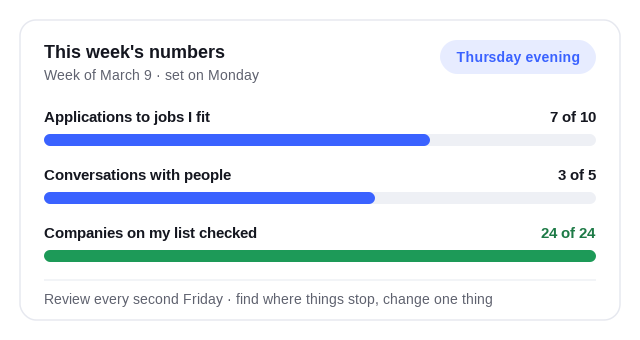
An illustration of one week's numbers, set on Monday and filled in as the week goes. The numbers are our example. Organize your job search in one tracker
Stay organized with one entry per application: the date, the company, the role, the resume version, who you wrote to and the next step. Save the job description too, since postings get taken down. Log each contact you talk to, with a date to follow up. Then when a recruiter calls, you'll know exactly what they read. Our free job application tracker template is ready to copy.
Every two weeks, check where it stops and change one thing
Every second week, look at your tracker and identify where things stop in the hiring process: no replies, no second calls, or no offers. Change that stage, and only that one, then give it two more weeks. You'll know it's working when more applications get a reply from a person, or more first calls lead to a second. Our guide to counting your own applications walks through each stage and what to fix.

A job search plan template, ready to copy.
Fill in the [square brackets]. The numbers are our examples, so change them to ones you can keep. For the two-week count, copy the funnel check too.
Your target and company list
Fill it in once. Look at it again each month.
My target
Job titles [2 or 3 you'd get today]
Level [for example, mid-level or senior]
Where [a city, or remote]
Lowest pay I'll take [amount]
Must-haves [such as hours, visa or travel]

My company list (20 to 30)
1. [Company] | careers page [link] | person I know or could reach [name] | why them [a few words]
2. [Company] | careers page [link] | person [name] | why them [a few words]
3. [Company] | careers page [link] | person [name] | why them [a few words]

Where I'll look
Career sites of every company on my list, once a week
Job boards [1 or 2], with alerts for my titles
People [former colleagues, friends in my field, alumni, hiring managers]
Events [industry events or meetups, if my field has them]
Recruiters [only if my field uses them]
Your weekly plan
Copy it each Monday. Fill in the last lines on Friday.
Week of [date]

This week's numbers
Applications to jobs I fit [8 to 10]
Conversations with people [5]
Hours I'll spend [for example, 10]

Monday
Check the career sites on my list and my job alerts
Pick this week's jobs, only ones where I meet most of the must-haves

Tuesday
Send [3] applications, each one made for its job
Write to the hiring manager for each

Wednesday
Have [2] conversations, such as a referral ask or a coffee chat

Thursday
Send [3] applications
Follow up once on anything sent more than a week ago

Friday
Send [2 to 4] applications
Update my tracker
Prepare for any calls next week

What I did
Applications sent [number]
Conversations [number]
Replies from a person [number]
Job search tips that actually help.
Eleven habits that make each week count. Most link to a guide that goes deeper.
Apply in the first days a job is up
It's our advice, not a measured rule: you usually can't tell how long a posting will stay open. Saved alerts for your job titles make it easy to be early.
Put your best match at the top of your resume
Read 10 to 15 job descriptions for your title and note the skills and keywords that come up most. That's the advice of CareerOneStop, a free resource from the US Department of Labor. Then tailor your resume to each job, using the posting's words only where they're true for you.
Make your LinkedIn profile match your target
A recruiter who looks you up should see the same job title in your headline and summary, and the same strongest results as your resume. If your work can be shown, a short portfolio helps too. That's our advice, from how recruiters work, not a study.
Apply on the employer's own form when you can
For the jobs you want most, the company site usually gives room for a resume made for the job and the employer's own questions. We compare Easy Apply and the company site.
Write to a person for every job you really want
A short note puts your name in front of someone, not just a queue. Here's how to find the hiring manager.
Ask for advice, not a job
That's the approach in Dalton's method, as Columbia describes it, and a referral can follow. Keep each message short: what you're looking for in one line, and one specific question. Start with an informational interview or these networking email templates.
Write a short cover letter when one is asked for
Most cover letters can be short. A few paragraphs about this job, highlighting one relevant result, is enough in our view. Here's when you need a cover letter.
Follow up once
In our view, one short note about a week after you apply, with something new to say, is enough. Here's how to write the follow-up email.
Prepare for interviews as replies come in
Write four or five short stories from your experience: the problem, what you did and the result. In our view, one of them will fit most interview questions, so practice them out loud. Line up two or three references early, so you're not chasing them when an offer is close.
Skip jobs that look stale
The Congressional Research Service says there are no official statistics on ghost jobs, but postings for roles no one is filling now do exist. Here's how to spot a ghost job.
Plan rest, not just work
In a daily study of unemployed people, days with little progress went with lower mood and confidence (Wanberg and others, 2010). Our guide to job search burnout shows how to pace a long search.
What makes a job search plan work, and what quietly breaks it.
The habits that keep a long search on track.
Do
- Write down your target: titles, level, place and lowest pay.
- Aim your applications and your people at the same companies.
- Set weekly numbers you control, and keep them for months.
- Keep one record of every application and conversation.
- Check where things stop every two weeks.
- Change one thing at a time.
Don't
- Apply to every job with the right title.
- Judge a week by how many people replied.
- Change your resume, titles and job boards all at once.
- Rely on one channel, such as a single job board.
- Spend whole evenings scrolling with no shortlist.
- Trust a statistic that names no source.
Questions about job search strategy, answered.
I've applied for months with almost nothing. What should I change?
Find the stage where it stops before you change anything, so you know what will improve your chances. If almost no one replies, the problem comes before any interview: the jobs may not fit, your resume may not show the fit, or no person has seen it. Fix that one stage, then give it two weeks. Our guide to why you're not getting interviews covers each cause.
What is the best job search strategy?
There's no single best channel. In 2025, out-of-work jobseekers in the US used 1.8 methods on average, most often applications (56.1%) and contacting employers directly (50.8%), according to the BLS. In our view, the best strategy is built around your target. Work a short list of companies through their own sites and the people there, with weekly goals and a check every two weeks.
What is the best way to find a job?
Use two or three channels aimed at the same companies: their career sites, one or two job boards with alerts, and people you know. In a study of nine large firms, referred applicants were more likely to be hired (Burks and others, 2015). For where to look online, see our guide to job search apps.
Is it true that 70% of jobs are never advertised?
No one knows. We found no study behind the 70% figure, or the 80% and 85% versions. One trace follows the 85% and 75% versions to career books from 1976 and 1979, neither with data, and the 70% to a 2016 article citing a report that couldn't be found. What is true: referrals help, and 23.7% of out-of-work jobseekers turned to friends or relatives in 2025 (BLS).
Is networking or applying better?
Do both, and aim them at the same list. Most jobseekers apply (56.1% in 2025, BLS), and in one large study referred applicants were more likely to be hired (Burks and others, 2015). When you reach out, ask for advice, not a job. That's the approach in Steve Dalton's The 2-Hour Job Search, as Columbia University describes it.
How many jobs should I apply to each week?
No study sets a number. Our example is 8 to 10 a week, only to jobs where you meet most of the must-haves, each one made for the job. Pick a number you can keep for months. For the totals people really reach, read how many job applications it takes to get a job.
How many hours a day should I spend job searching?
No study sets a right number. Unemployed 20- to 65-year-olds in the US averaged 41 minutes a day (American Time Use Survey, 2013 to 2018, from Brookings). In a daily study of people on unemployment benefits, it was 3.56 hours (Wanberg and others, 2010). Our advice: plan fixed blocks you can keep, and stop when they end.
How do I organize my job search?
Keep three things: a target and company list, one tracker entry per application, and a review day every two weeks. The plan template above covers the first. For the tracker, copy our job application tracker template. Or let Blynk's tracker do it. Blynk reads your inbox and updates every application on its own.
How do I job search while employed?
Send fewer, better applications, in short fixed blocks. Researchers found that the employed are "about four times more efficient than the unemployed in job search," and get better offers (Faberman and others). Our advice: set smaller weekly numbers, and keep your search off work hours and work devices.
How long does a job search take?
In October 2026, half of unemployed people in the US had been out of work 11.9 weeks or less, according to the BLS. The average was 27.1 weeks, because the longest searches pull it up: 27.6% had been out of work 27 weeks or more. Plan for months. If you need work sooner, start with how to get a job fast.
Sources, and where to go next.
Checked on November 12, 2026. The advice and the example numbers are ours. The job market numbers come from the US Bureau of Labor Statistics, and the research from the studies listed. Huntr is a job tracker, and its figures are its users' own logged applications. Blynk's count is its own: 1,477 job postings (1,270 jobs once the same company and title are grouped) from Blynk's searches for product roles, mostly senior, first seen between October 31 and November 11, 2026. A job counts as copied when it appeared in two or more of the places Blynk searches.
- How to get a job fast: the two-week plan
- How many job applications it takes to get a job
- Why you're not getting interviews
- The best job search engines
- An executive job search, step by step
- How to find jobs that match your resume
- Is LinkedIn Premium worth it?
- What a recruiter does for you
- Hiring freezes and when to apply
- Why it's so hard to get a job now
- What to do after a layoff
- Four-day work week jobs
- BLS: unemployed jobseekers by job search methods used, 2025 averages (table 34)
- BLS: unemployed persons by duration of unemployment (October 2026)
- Sam Young: how big is the hidden job market? (2021)
- Burks and others, The Value of Hiring through Employee Referrals (Quarterly Journal of Economics, 2015)
- Huntr: job search trends, Q3 2026
- Columbia University School of Professional Studies: The 2-Hour Job Search with Steve Dalton (2015)
- Liu, Huang and Wang, Effectiveness of job search interventions: a meta-analytic review (Psychological Bulletin, 2014)
- Wanberg, Zhu and van Hooft, The job search grind (Academy of Management Journal, 2010)
- Brookings: the time use of prime-age adults (2020)
- Faberman, Mueller, Şahin and Topa, Job Search Behavior among the Employed and Non-Employed (NBER)
- CareerOneStop: write your resume for current hiring
- Congressional Research Service: ghost jobs
- Blynk Find Jobs
- Blynk pricing
- Blynk job tracker
