
How to find the hiring manager. And reach the person who decides.
If you've applied through portal after portal and heard nothing, reaching a real person can change that. Most job postings don't name who's hiring, but the clues are usually there if you know where to look. Here's where, step by step, and what to say once you've found them.

The short answer
- The hiring manager is usually the manager of the team the job sits in, often one level above the role. The recruiter runs the process; the hiring manager usually makes the call.
- Look in four places: the job posting itself, LinkedIn's "Meet the hiring team" section, a LinkedIn search by team and title, and the company's own team page.
- Pick one or two people, check their email, and send a short note about the role and one result that fits it. Never ten people, and never a guessed address.
On this page
Why your application isn't reaching the hiring manager, and what a person changes.
Four things that keep job seekers from reaching the person who decides, and what to do about each.
“I apply and never hear back.”
A careers portal puts your application in a queue. Job posts can ask screening questions, and the employer can set them to filter out applicants automatically before anyone reads the rest.
What to do: Reach a person as well. A short note to the hiring manager is more likely to reach a person than a portal submission alone.
“I don't know who's hiring.”
Most job postings don't name the hiring manager, and the email confirming your application often comes from a no-reply address.
What to do: Work it out from the clues. The posting, LinkedIn and the company's own site usually give it away.
“I'll write to the wrong person.”
The most senior name at a company is rarely the one hiring for your role. The manager of the team you'd join is.
What to do: Aim one level above the role. In the team the job sits in, not the top of the company.
“I don't want to bother anyone.”
Hiring managers are trying to fill the role, so a short, specific note about it is useful to them. What bothers people is a long message, a pitch for some other job, or five follow-ups.
What to do: Keep it short and about their role. Two notes to copy are below.
How to find the hiring manager, in seven steps.
Do them in order, and stop as soon as you have a name you're confident in.
Read the job posting for clues
Look for who the role reports to, the team or department, and the location. Sometimes the job description says it outright. In 1,204 job postings Blynk read from its searches for product roles in November 2026, about 1 in 5 said who the role reports to, and fewer than 1 in 200 gave a person's own email. Note the exact team, such as Growth, Payments or Platform. You'll search for it in step 3.
"Reports to the Head of Growth Marketing" gives you the exact title to search for.Check for a "Meet the hiring team" section
On LinkedIn, some job posts list the people behind them under "Meet the hiring team", including the person who posted the job. LinkedIn says you can connect with or message anyone listed there. If only a recruiter is listed, they're still a good contact, but keep going to find the hiring manager too.
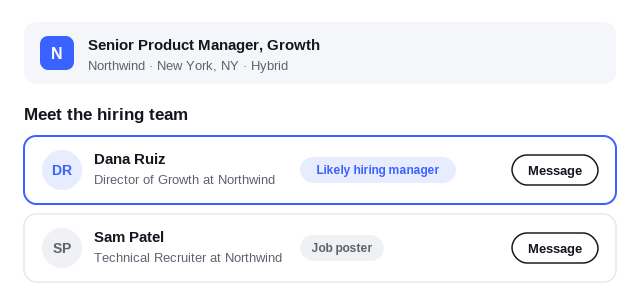
An illustration of a "Meet the hiring team" section. The names are made up. Search LinkedIn by team and title, one level up
Search the company's people on LinkedIn for the team or department name plus a manager title one level above the role. Filter to people who work there now and, if it matters, the job's location. A manager whose profile names the same team is usually your person.
Senior Product Manager, Growth? Look for a Director or Head of Product for Growth. Account Executive? Look for the Sales Manager for that region.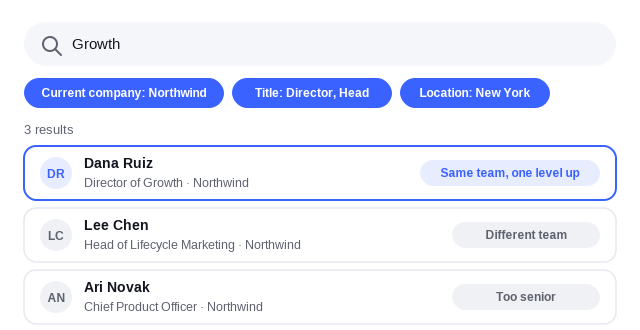
An illustration of a people search filtered to the company, the team and a title one level up. The names are made up. Check the company's own team page
Smaller companies often list their people on their website, under About, Team or Leadership. Some teams also have a blog with names on the posts. A recent post or talk by the team's manager confirms the name, and gives you something real to mention.
Tell the recruiter from the hiring manager
A recruiter's title usually says Recruiter, Talent or HR, and they run hiring for many roles at once. The hiring manager runs the team you'd join and usually makes the final decision. At a startup of a few dozen people that's often a founder; at a large company it's a manager a few levels down. Write to the hiring manager first. The recruiter for the role is a good second, and at large companies often the easier one to reach.
Find the hiring manager's email, then check it
Many companies use one pattern for work email, such as first.last@company.com or first@company.com. Find any address the company has published with a person's name in it, on its website or in a press release, and follow the same pattern. Before you send, run it through an email checker (Hunter's is free), though some company servers accept every address and can't be checked. If you can't check it, use LinkedIn instead of guessing. Or paste the job link below, and Blynk finds the address and checks it for you.
Published: jordan.lee@northwind.com. So try: dana.ruiz@northwind.com. Checked? Then send it.Pick one or two people, not ten
Write to the hiring manager, and perhaps the recruiter for the role. Writing to everyone on the team looks like a mass mailing, and they may compare notes. One person who reads it is all you need.


Still no name? Five more ways to find the hiring manager.
Search LinkedIn posts, not just people. Managers often post about the roles on their team. Search LinkedIn for the job title and the word hiring, such as "Head of Growth" hiring, switch to Posts and sort by latest. Whoever wrote the post is often the hiring manager, or knows who is. Some managers post about open roles on X or in industry communities too.
Search Google for their profile. Type site:linkedin.com/in followed by the company and the title, such as site:linkedin.com/in "Northwind" "Director of Growth". It finds public LinkedIn profiles when LinkedIn's own search shows too many people, or too few.
Ask someone you know there. The company's LinkedIn page shows which of your connections work there, and your school's LinkedIn page has an Alumni tab you can filter by where people work. Ask one of them who leads the team the role sits in; they may also be able to refer you.
Ask. Reply to the recruiter, or call the company's main number, and ask who leads the team the role sits in. Some will tell you and some won't, but it costs one short, polite question.
If an agency posted it, write to the agency's recruiter. When a staffing or recruiting firm posts the job, the company is often left unnamed, and their recruiter is the way in.
What to say to the hiring manager.
Swap the [square brackets] for your details. Keep your result true, and name the role so they don't have to look it up.
A short email to the hiring manager
Once you've found and checked their address. Subject line: [Job title] role on your team
Hi [First name],

I've applied for the [Job title] role on your team and wanted to reach you directly. The posting mentions [one thing the role needs]. At [Company], I [one true result, with a number if you have one].

Would a 15 minute call be worthwhile, or is there anything I can send that would help?

Thanks,
[Your name]
[Link to your LinkedIn profile]
A LinkedIn message, with your connection request
With a connection request. Free accounts allow 200 characters, so keep the result to a few words.
Hi [First name], I applied for the [Job title] role on your team. At [Company] I [one short, true result]. I'd love to help with [team goal].
Do this, not that.
Do
- Start from the posting: its team, title and location.
- Aim one level above the role, in the same team.
- Check every email address before you send.
- Mention one true result that fits the posting.
- Write to one or two people.
- Follow up once or twice, then stop.
Don't
- Guess an address and hope it lands.
- Write to the CEO, or to everyone on the team.
- Send the same message to ten people.
- Message personal accounts or phone numbers.
- Run extensions that pull contact details through your LinkedIn account. Several of these tools' own help pages warn that LinkedIn may flag or restrict accounts.
- Get in touch at all if the posting asks you not to.
Questions about finding the hiring manager.
Is it OK to contact the hiring manager directly?
Yes, in most cases. A short, polite note about a role they're hiring for is a normal part of a job search. The exception is a posting that asks you not to contact anyone: respect it and apply through the portal.
How can I directly contact a hiring manager?
Email them at a work address you've checked, or send a LinkedIn connection request with a short note. Name the role, give one true result that fits it, and ask one easy question. If the job posting asks you not to contact anyone, apply through the portal instead.
How do I find out who the hiring manager is?
Read the posting for the team and who the role reports to, and check LinkedIn's "Meet the hiring team" section. Then search LinkedIn for a manager title one level above the role in that team. The company's own team page can confirm it.
How do I find a hiring manager's email address?
Many company websites don't list their team's email addresses, so work out the company's email pattern from an address it has published, apply it to the person's name, and check it with an email checker before you send. Hunter's guide for job seekers starts with the job posting, which sometimes lists a contact email, and uses LinkedIn to confirm the name. Its email checker is free. Never send to a guess you couldn't check.
Should I address my cover letter to the hiring manager?
Yes, by name once you've found it, such as "Dear Dana Ruiz". If you can't find a name, address the team, such as "Dear Growth team", rather than "To whom it may concern". It shows you looked.
How do I message a hiring manager on LinkedIn?
Send a connection request with a short note: the role, one true result and a friendly close. On a free account LinkedIn lets you add a note to only a few requests a month, up to 200 characters each, so use the note above. InMail, LinkedIn's way to message people you're not connected to, is a Premium feature.
What if I can't find the hiring manager?
Write to the recruiter for the role, or the most senior person you can find in that team. If there's no one you're confident in, a strong application through the portal is still worth sending.
What is the 70/30 rule in hiring?
It's an informal rule of thumb, not a formal standard, and people use it two ways. Some mean hiring someone who meets about 70% of a job's requirements and training the rest; others mean judging a candidate about 70% on skills and experience and 30% on fit. The useful part for you is the first: if you meet most of the must-haves, apply, and lead your note to the hiring manager with the result that covers the biggest one.
What is the hardest month to get hired?
Usually December. By the government's count of hires, December had the fewest US hires in 8 of the 9 years from 2017 to 2025, and February was lower in 2021 (BLS, not seasonally adjusted). Hiring slows but doesn't stop. There were still about 3.9 million hires in December 2025. Keep applying anyway, and use the quiet weeks to find the hiring managers for the roles you want in January.
Is there a tool that finds the hiring manager for me?
Contact finders such as Hunter, Apollo and Lusha find details for people you search for by name, company or title, so you still decide who's hiring. Blynk starts from the job link: it finds the people hiring for that role, picks two with checked work emails, and writes the note.
Where the facts come from.
Checked in November 2026. The advice is ours; facts about LinkedIn, the contact finders and Blynk come from each company's own pages. The posting counts are Blynk's own: 1,204 job postings from Blynk's searches for product roles, most of them senior, from company career sites and job boards, first seen between October 31 and November 11, 2026, each read for a reporting line and for email addresses.
- Follow-up email after applying
- Blynk vs Hunter
- Blynk vs Apollo
- Blynk vs LinkedIn Sales Navigator
- How to write a cold email for a job
- Reaching a recruiter instead
- Is LinkedIn Premium worth it?
- How to find someone's email address
- What a hiring manager does
- LinkedIn Help: add screening questions to your job post
- Villanova career center: the LinkedIn Alumni tool
- LinkedIn Help: Meet the hiring team on job posts
- LinkedIn Help: personalize invitations to connect
- LinkedIn Help: InMail and personalized invitations
- Hunter blog: how to find a hiring manager's email
- Hunter Email Verifier
- Hunter Email Finder
- Apollo help: search filters
- Lusha sales prospecting
- Kaspr help: LinkedIn profile visit guidelines
- Snov.io LinkedIn automation
- ContactOut help: can LinkedIn detect the extension
- Blynk Find the Hiring Manager
- Blynk pricing
- TestGorilla: skills-based hiring and the 70/30 rule
- Homebase: hiring process steps (the 70/30 rule)
- Yahoo, reporting Enhancv's study of 25 years of hiring data by month
- US Bureau of Labor Statistics: Job Openings and Labor Turnover Survey
