
Do I need a cover letter? And when it's worth your time.
You're on your twentieth application, the form says “Cover letter (optional)”, and you've heard both “always send one” and “nobody reads them”. Neither is quite true. Here's a one-minute check for whether this job needs a cover letter, and what to write when it does.

The short answer
- Required? Write one. If the job posting or the application form asks for a cover letter, send it. The posting rarely says, so look at the form itself.
- Optional? Write a short one only when it explains something your resume can't: a career change, a gap, a move, a referral, or a job you really want. In one survey, about 1 in 4 hiring managers and recruiters marked people down for skipping it.
- No box? Skip the cover letter. If the form asks “Why do you want to work here?”, that's where the effort goes now: two or three specific sentences.
On this page
Why “do I need a cover letter?” gets two opposite answers, and what's really going on.
Five things people say about cover letters, and what the evidence shows.
“Optional is a test. Skip it and you've ruined your chances.”
Not usually. When ResumeGo, a resume-writing company, surveyed 236 hiring managers and recruiters, 26% said they marked candidates down for a missing cover letter when the job didn't require one. That's about 1 in 4. And on the Greenhouse forms we read, optional is simply the usual setting: 70 of 81 had an optional cover letter box.
What to do: Treat optional as optional. Write a cover letter when you have something to say that your resume doesn't.
“Nobody reads cover letters anyway.”
Some people do and some don't. In surveys, 27% of recruiters say they consider cover letters (Jobvite, 2020). 87% of hiring managers and recruiters say they read them (ResumeGo, 2020). The Muse's review of the surveys puts it simply: recruiters sorting a big pile skip more, and hiring managers choosing finalists read more.
What to do: Write for the hiring manager. Keep it short enough that a busy recruiter can skim it in seconds.
“Every article says always send one.”
Look at who wrote it. In our reading of the top pages, most that say “always” come from resume and cover letter companies, and so do most of the surveys they quote. That doesn't make the numbers false. But those companies have a reason to find a yes.
What to do: Check who ran the survey. This page names the company behind every number it uses.
“I'm sending 50 applications. I can't spend 30 minutes on each.”
You don't have to, especially in a long job search. Of 168 application forms we read, only 2 required a cover letter, and the job posting itself almost never asks for one. Our advice: spend the time on the few jobs where a letter can change the answer, and send the rest without one.
What to do: Save the effort for the jobs that need it. The one-minute check below sorts them.
“I got jobs without one, and sent cover letters that got nothing.”
Both are normal. In Jobvite's 2018 survey of job seekers, 45% had sent a cover letter for their current or most recent job, so more than half hadn't. Our reading: a good letter can help at the edges, but fit matters more.
What to do: Don't judge by one result. Judge by what the job and the form ask for.
Are cover letters necessary? What 168 real application forms ask for.
We looked at the forms, not just the postings. On November 11, 2026, we read the live application forms for 168 jobs in Blynk's searches, at 156 companies. We read them through the public job-board data of two hiring systems, Greenhouse and Ashby. Nothing was submitted. Most are senior product roles at tech companies.
2 of the 168 forms required a cover letter. That's about 1 in 100. 87 offered an optional cover letter box (52%), and 79 had no place for one at all (47%).
The hiring system makes a big difference. On Greenhouse, 70 of 81 forms had an optional cover letter upload, 1 required one and 10 had none. On Ashby it was the other way round: 69 of 87 had no cover letter field, 17 had an optional one and 1 required it.
Each employer sets up its own form. Greenhouse lets it choose which questions show and which are required. Indeed Apply lets it require a cover letter, make it optional or hide it.
The job posting almost never tells you. Of 1,272 job postings with full text in Blynk's searches, mostly for product roles, 3 mention a cover letter and only 1 asks for one. So the answer to “do I need a cover letter?” is usually on the form.
The new cover letter is a question. 14 of the 87 Ashby forms ask a short “why this company” or “why this role” question, and 13 of them require an answer. 10 are on forms with no cover letter box, like one that asks: “Why should we hire you? (in under 50 words)”. 3 Greenhouse forms ask one too.
What this doesn't tell you. It covers two hiring systems, for jobs first seen over 12 days. Workday, LinkedIn Easy Apply and others weren't checked. And a box on a form says nothing about whether anyone reads what you put in it.
Should you write a cover letter for this job? A one-minute check.
Five quick steps, in the order you'll do them. They end in one of three answers: a full cover letter, two sentences, or nothing.
Search the job posting for “cover letter”
Press Ctrl+F (Cmd+F on a Mac) and type “cover letter”. If the posting asks for one, treat it as required, and follow its instructions exactly. If it says not to send one, don't: Indeed lists that as a time to skip it. Most of the time you'll find nothing, and that's normal.
What an ask looks like: “Please include a cover letter with your application.” What a no looks like: “No cover letter is needed.”Check the form: is a cover letter required, optional or missing?
Open the job application form and scroll to the end before you start filling it in. Look next to the resume upload for a box called “Cover letter”. An asterisk (*) or the word “required” means you can't submit without one, and “optional” means it's your call. Some forms tuck it inside a box for “additional documents”.
On Indeed Apply, a required cover letter shows as “Cover letter is required”. You can type one of up to 4,000 characters or upload a file, and you can't edit it after you apply.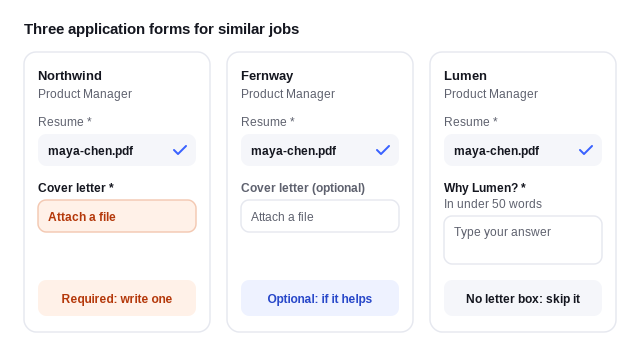
An illustration of the three kinds of form. The companies and names are made up. Look for the “Why do you want to work here?” question
Some forms have no cover letter box but ask one short question instead, and it's usually required. Treat it as a mini cover letter: one reason about them and one thing you've done that fits, in two or three sentences. Stay under the word limit.
Instead of “I've always admired your company.” try “Your move into small-business payroll is the problem I spent three years on at my last job.”Ask what your resume can't explain
A cover letter earns its place when it answers a question your resume raises: a career change, a gap, or a move to a new city. It also helps when someone at the company referred you. Most career guides give the same list. Our advice is to add one more case: a small company, or a job where you know who the hiring manager is. If none of these apply, your resume can do the talking.
Decide: a full cover letter, two sentences, or nothing
Our rule of thumb. If it's required, or your resume leaves a question open, write the short cover letter below. If the box is optional and you really want the job, write the two-sentence version. If there's no box, or you'd only paste a generic letter, skip it and answer the form's own questions well.

When a cover letter is worth writing, and when it's wasted time.
The cases where a letter can change what the reader thinks, and the ones where it can't.
Write one when
- The posting or the form asks for a cover letter.
- You're changing careers and need to connect the dots.
- You have a gap in your work history you'd rather explain yourself.
- You're moving, or applying from another city.
- Someone at the company referred you, or you have a connection there. Name them in the first line.
- The company is small, or you know who the hiring manager is.
- It's your dream job, and you'd regret not making the case.
- The job leans on communication skills. Jobscan, a resume tool, says fields like HR, operations and creative work value letters more than the tech industry does.
Skip it when
- The posting says not to send one.
- There's no cover letter box anywhere on the form.
- It's a quick, one-click application with no place to add one.
- You can't customize it for this job, and you'd only paste the letter you sent last time.
- The form asks “Why do you want to work here?” instead. Put the effort there.
- It would only repeat your resume, line by line.
Do recruiters and employers read cover letters? It depends who opens it.
Recruiters and hiring managers read differently. A recruiter screening hundreds of applications is more likely to skip the cover letter and go straight to the resume. A hiring manager choosing between a few finalists is more likely to read it. That's how The Muse sums up the surveys, and the numbers below fit it.
Jobvite, a hiring software company, asked about 800 recruiters in 2020. 27% said they consider cover letters when they evaluate candidates, up from 8% in 2017 (as reported by The Muse).
ResumeGo, a resume-writing company, asked 236 hiring managers and recruiters in 2020. 87% said they read cover letters.
Resume Genius, a resume builder, asked 625 US hiring managers through the survey panel Pollfish. 83% said they always or frequently read cover letters, and 45% said they read the cover letter before the resume.
Schullery, Ickes and Schullery, academic researchers, in a survey of employers published in 2009. 56% preferred applicants to include a cover letter. It's the only academic survey we found, and it's old.
Our reading: the closer the person is to the final decision, the more they say they read. Most of these surveys come from companies that sell cover letter help, and all of them record what people say, not what they do. So write for the hiring manager, and keep it short enough for the recruiter.
Do cover letters matter? What two experiments found.
A cover letter written for the job helped more than a generic one. ResumeGo, a resume-writing company, sent 7,287 made-up applications to real job openings on ZipRecruiter, Glassdoor and Indeed between July 2019 and January 2020. Applications with a tailored cover letter got a callback rate 53% higher than those with no letter. Generic cover letters did 17% better than none, as The Muse reports.
AI made letters better, but not more successful. Abbas Nejad, Musillo, Wicker and Zaccaria ran two field experiments, accepted by the Journal of Labor Economics in 2026. AI help raised the quality of cover letters, mostly for weaker applicants. It didn't lead to more interview invitations. And when recruiters were told AI had been used, they valued well-written human letters more.
Our reading: a short cover letter written for this job can help a little, and a generic one barely does. Neither makes up for applying to a job you don't fit. That's why the one-minute check asks what the letter would add, not whether to send one out of habit.
How to write a short cover letter, in three paragraphs.
At the short end of the advice. Advice on length varies: Novoresume suggests 250 to 400 words, and Resume.io 200 to 350. Our advice, when the cover letter is optional: about 250 to 300 words, so every line has a job.
Paragraph 1: why this job. Name the role and one specific thing from the job description that made you apply. Skip “I'm writing to express my interest”. The reader already knows.
Paragraph 2: one or two proofs. Pick the most important of the posting's requirements and show one thing you've really done that meets it, with a number if you have one. Don't retell your resume. Highlight the relevant experience and add the context a bullet point can't hold.
Paragraph 3: what your resume can't say, then close. The career change, the gap, the move or the referral, in one or two plain sentences. Then one line to close. Put your contact information at the top, so the letter still makes sense if it gets separated from your resume, as Indeed suggests.
Address a person, and proofread. Use the hiring manager's name if you can find it, and “Dear hiring team” if you can't. Our guide on how to find the hiring manager shows where to look. Before submitting, check the company name and the job title, and save it as a PDF unless the form asks for a different format.
Three short cover letters, ready to copy.
Swap the [square brackets] for your details. Keep every claim in each template true and specific: for example, one real result beats three adjectives.
A short cover letter for a box or a PDF
For a required box, or an optional one when your resume leaves a question open. Paste it into the box, or save it as a PDF.
[Your name]
[Email] · [Phone] · [LinkedIn profile link]

Dear [Hiring manager's name, or "hiring team"],

I'm applying for the [Job title] position at [Company]. [One specific thing from the job description] is the kind of problem I've worked on for [time], and it's why this role stood out.

At [Current or last company], I [one true result that matches the posting's main need, with a number if you have one]. I also [a second, shorter proof, if you have one].

[One or two sentences on what your resume can't explain, like the career change, the gap, the move, or who referred you.] I'd welcome the opportunity to talk about how I could help with [a goal from the posting].

Best,
[Your name]
The two-sentence version
For an optional box when you want the job but have nothing extra to explain, or as the body of an email with your resume attached.
Hi [First name],

I'm applying for the [Job title] role because [one specific reason about the company or the team]. In my last role I [one true result that fits the posting], and I'd be glad to bring the same to [Company].

[Your name]
The answer to “Why do you want to work here?”
For the short question some forms ask instead of a cover letter. Under 50 words.
[Company]'s work on [a specific product, customer or problem] is why I applied. I've spent [time] doing [the closest thing you've done], most recently [one true result], and I want to do that next for a team like yours.
Questions about cover letters, answered.
Is it unprofessional to not have a cover letter?
No, not when it's optional or the form has no place for one. In ResumeGo's survey of 236 hiring managers and recruiters, 26% said they marked candidates down for a missing cover letter when the job didn't require one. It is a problem when the posting or the form asks for one, so check both. Of 168 application forms we read, 2 required a cover letter.
Is a cover letter necessary anymore?
Rarely required, still sometimes read. Of 168 application forms for jobs in Blynk's searches, 2 required a cover letter and 79 had no box for one. In surveys, hiring managers say they read them more often than recruiters do. And in ResumeGo's field experiment, tailored cover letters got 53% more callbacks than no letter. So write one when it's asked for, or when it explains something your resume can't.
Is it okay to apply for jobs without a cover letter?
Yes, unless the posting or the form requires one. In Jobvite's 2018 survey of job seekers, 45% had sent a cover letter for their current or most recent job, so more than half hadn't. If the form asks “Why do you want to work here?”, answer that well instead.
Do most jobs prefer a cover letter?
Most don't require one, and the surveys disagree on “prefer”. An academic survey (Schullery, Ickes and Schullery, 2009) found 56% of employers preferred one. Resume Genius, a resume builder, says 60% of the companies in its survey require one. On the forms we read, far fewer did: 2 of 168 required a cover letter, and about half offered an optional box.
Do recruiters read cover letters?
Some do, and many skim. In Jobvite's 2020 survey of about 800 recruiters, 27% said they consider cover letters when they evaluate candidates. Hiring managers report reading them far more: 83% in Resume Genius's survey, and 87% of the hiring managers and recruiters in ResumeGo's, both resume companies. So make the first two lines count on their own.
Is a generic cover letter better than none?
A little, in the one big test. In ResumeGo's experiment, generic cover letters got 17% more callbacks than none, and tailored ones 53% more. Our advice: if you're going to spend the time, spend it on two specific sentences rather than a long generic letter.
How long should a cover letter be?
Advice varies: 250 to 400 words (Novoresume) or 200 to 350 (Resume.io). Our advice for an optional box is the same letter, about 250 to 300 words in three short paragraphs, and two or three sentences for a “why us” question. If the form gives a limit, stay under it.
Do I need a cover letter for an internship or a part-time job?
Use the same check: the form decides. If it asks for a cover letter, write one. If it's optional and you have little work experience to show, as is common for an internship, our advice is to write the short version. It's your chance to say why you want the role. For a quick part-time application with no box, skip it.
Can I use AI to write a cover letter?
Yes, for a draft, but make the reasons yours. In field experiments accepted by the Journal of Labor Economics in 2026, AI help made cover letters better written but didn't lead to more interview invitations. In a TopResume survey of 600 US hiring managers (May 2025), 19.6% said they'd reject a candidate for an AI-generated resume or cover letter. Our guide to the best AI cover letter generators compares the tools, or Blynk can write one for each job and show you every change.
Where the facts come from.
Checked in November 2026. The advice is ours. Facts about Indeed Apply and Greenhouse come from their own help and developer pages, and survey and study figures from their publishers, or from The Muse where it reports them. Blynk's two counts are its own. Postings: 1,272 job postings with full text from Blynk's searches, mostly for product roles, first seen between October 31 and November 11, 2026, each searched for “cover letter”. Forms: on November 11, 2026, the application forms of 168 open jobs from the same searches (81 on Greenhouse at 72 companies, 87 on Ashby at 84), read through each system's public job-board data. Nothing was submitted.
- The best AI cover letter generators
- How to tailor your resume to a job description
- Follow-up email after applying
- How to write a letter of interest
- How long a cover letter should be
- How to start a cover letter
- What to include in a cover letter
- Indeed Help: adding or uploading cover letters
- Greenhouse: Job Board API documentation
- The Muse: do you really need a cover letter? (ResumeGo and Jobvite figures)
- ResumeGo: cover letter field experiment and survey
- Resume Genius: cover letter statistics
- Schullery, Ickes and Schullery (2009): employer preferences for résumés and cover letters
- Abbas Nejad, Musillo, Wicker and Zaccaria: Labor market signals, the role of large language models (Tilburg University)
- TopResume: AI in hiring survey, 2025
- Jobscan: should you include a cover letter?
- Indeed: do employers care about cover letters?
- Indeed: is a cover letter necessary?
- Novoresume: do I need a cover letter?
- Resume.io: do I still need a cover letter?
- Blynk Auto-Apply
- Blynk Find Jobs
