
Job search burnout. How to keep going when the replies don't come.
If you've been applying for months, hearing mostly silence, and each rejection makes it harder to start again, you're far from alone. Here's why a long search wears people down, a pace you can hold, and how to read each rejection so it tells you something.

The short answer
- It's common. In a 2025 survey by Employ, which makes hiring software, 66% of US workers and job seekers said they felt burned out from searching for a new job. Long effort with little feedback is hard on anyone.
- Score your days by what you control, not by replies: give the search set hours and a stop time, aim at a few applications that fit, and give silence a date so it stops living in your head.
- Read each job rejection by the stage it came at. One no is noise. The same no at the same stage, again and again, tells you which part to change.
On this page
What job search burnout is, and why a long search wears you down.
It's an everyday phrase, not a diagnosis. The World Health Organization says burnout is “not classified as a medical condition” and is a term for work, not other parts of life. So “job search burnout” borrows the word. The feeling is real, though, and researchers study it. In one study of 56 long-term job seekers in Italy, the authors describe the search itself as work, and work that can wear people out.
Your mood follows each day's sense of progress. In a US study, 233 unemployed people answered a short survey every weekday for three weeks. On days they felt they'd made less progress, their mood was worse and they felt less sure they'd find a job. For people under money pressure, those days hit mood harder. Our reading: that's why a quiet week can feel like a bad week, even when you did the work.
Silence is normal, and it rarely comes with a reason. In a December 2024 survey by Greenhouse, which makes hiring software, of 2,500 workers in the US, UK and Germany, 61% of job seekers said they'd been ghosted after a job interview. In a 2025 survey by Textio, an HR software company, 84% said they'd never had interview feedback when they didn't get the offer. So the reason you fill in is usually a guess.
Being out of work is hard on people. A 2009 review of hundreds of studies found that, on average, 34% of unemployed people had psychological problems, against 16% of people in work. Our reading: if being out of work is weighing on you, that's a common response to a hard situation, not a flaw in you.
And often there's no money for a break. In the job site Indeed's 2026 survey of 1,501 US job seekers, run by YouGov, 68% of active seekers said they'd like to take a break but can't afford one. The plan below is built for keeping going, not for stopping.
Signs of job search burnout, in plain words.
Burnout at work has three parts, in the World Health Organization's words: exhaustion, feeling distant or cynical about the job, and feeling less effective. The long-term job seekers in the study above described the same kinds of feelings. In a search, they tend to look like this. It's our wording, not a checklist.
Tired in a way a weekend doesn't fix. You dread opening the laptop. Or you open LinkedIn, scroll, and apply to nothing.
Cynical about every posting. Each new job looks like one more that won't answer, so you put off applications and follow-ups.
Feeling like nothing you do works. One rejection knocks you out for days, and you start to read every no as a verdict on your worth.
The search spills into everything. Late nights, weekends, checking your inbox in bed.
What about the “5 C's of burnout”? You may see lists by that name. We found no standard one behind them. The three parts above are the definition with a source.
None of this is a diagnosis. If it feels like more than tired, see the note further down.
How to deal with job search burnout, starting with your week.
Three changes to how the week runs. They're about what you control, because the replies aren't.
Give your job search office hours
Pick the hours you'll search, a time you stop, and at least one day fully off. Our advice: a few focused hours on weekdays, in blocks of an hour or two, and fewer if you're working. No study sets the right number: in the daily study above, people searched 3.56 hours a day on average, from under half an hour to over eight. That's what people did, not a target. When the stop time comes, close the laptop.
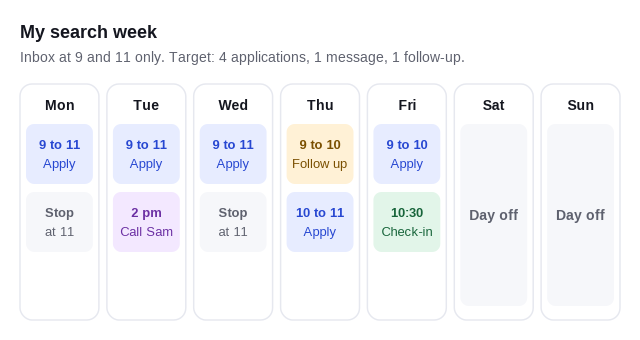
An illustration of a search week with set hours, a stop time and two days off. It's an example, not a rule. Set goals in actions, not replies
You decide how many applications you send, but not who answers. So set the week's target in things you can do: applications to jobs you fit, one message to someone you know, one follow-up. A 2014 review of 47 job search programmes found that the more effective ones included goal setting and social support, among other parts. They only worked when they built both skills and motivation. Those were structured programmes, but in our view the idea carries over.
Example: “This week: 4 applications to jobs I fit, 1 message to a former colleague, 1 follow-up.” Not “Get 3 interviews.”Send fewer applications, to jobs you fit
Our reading: mass-applying when you're tired tends to bring more silence, and silence is what wears you down. Apply where you meet most of the must-haves, and make each application fit the job. Our guide on how many job applications it takes has the numbers. The slow part is finding those jobs across many sites and sorting what fits.

How to deal with job rejection, the day it lands and the week after.
What to do when a no arrives, whether it's an email after one application or a call after the final round.
Give it a day
It's allowed to hurt. In a well-known lab study, being left out of a simple online ball-tossing game lit up a brain area that's also active in studies of physical pain. The more upset people felt, the more it lit up. A job rejection isn't a game, but it's no surprise that it stings. Our advice: let yourself feel it for a day, then come back to your plan.
Reply once, and ask to be kept in mind
A short thank-you is enough. The University of Florida's career center suggests thanking them and asking to be kept in mind for future roles. Our follow-up email guide has a reply to a rejection you can copy. Our advice: don't argue the decision.
Ask for feedback once, and expect nothing
In that same reply, you can ask for one thing you could do better. Just don't wait on it. In Textio's survey, 84% of people said they'd never had interview feedback after not getting the offer. If an answer comes, it's a bonus.
Stop taking job rejection personally: the reason is a guess
Most rejections arrive without a reason, so any story you tell yourself about why is a guess. Our advice: swap it for one fact you do know, the stage it came at. Write it down next to the job. The stages below show what each one can mean.
Then go back to your hours
Keep other applications moving, and don't wait on any one company. A no from one employer doesn't change the others on your list.
Give silence a date, so it stops living in your head.
Write down the day you applied. If 30 days pass with no word, mark it “No reply” and stop checking. It's the same rule as in our free job application tracker. It comes from a study of more than 83,000 applications to entry-level jobs at 108 Fortune 500 firms, where 24% were contacted within 30 days, most of them within 14. The 30-day line is our reading of that.
Check your inbox at set times. Our advice: once or twice a day, inside your search hours. Not first thing in the morning, and not last thing at night. A rejection read at 11 pm sits with you all night.
Let the record do the remembering. A sheet with the job, the date, the stage and the next step means you don't carry it all in your head. If you'd rather not keep the dates yourself, Blynk's tracker reads your inbox and updates each application on its own.
Job rejection: what it means at each stage.
Where a no came from tells you more than the no itself. Here's our reading of each stage, and what to change if it keeps happening there.
“No reply at all.”
It tells you the least. The job may not fit well enough, your resume may not show the fit, or the posting may not have been really open.
What to change: Where you apply, and how your resume reads. Apply where you meet most of the must-haves, and use the posting's words for things you've really done.
“Rejected within hours or days.”
A very fast no can come from the form itself. Hiring systems can sort applications by rules. Greenhouse, which makes hiring software, lets employers reject applications automatically based on the answers to screening questions. It also helps to know the “70/30 rule” in hiring. Workable describes a 70% rule for employers: hire people who meet about 70% of what a role needs, and train the rest.
What to change: The must-haves and the questions. Read the requirements and the form's questions before you apply. If you meet most of them, apply. If a hard one rules you out, such as a license, skip it.
“Rejected after a recruiter screen.”
You got past the resume. Our reading: a no here is often about practical fit, like pay, location, start date or a must-have. Or it's about how you summed yourself up in the first few minutes.
What to change: The basics, and your opening. Say your pay range and location early. Practise a 30-second answer to “Tell me about yourself.”
“Rejected after the final round.”
You were close. Our reading: at this stage it's a comparison with other finalists you can't see, and the reason rarely comes. Some interviews ask for a 30-60-90 day plan, your goals for your first three months. Indeed says employers ask for it to see how you'd move into the new role. Our reading: if you got that far, your work was taken seriously.
What to change: Very little. Reply kindly, ask to be kept in mind, and keep going. If final rounds keep ending this way, a practice interview with someone you trust is worth it.
When to change your approach, and when to keep going.
One rejection is noise. A pattern is information. Our rule of thumb: if the same stage keeps failing across a run of applications, change that one stage before you send more.
Where to look. If you get no replies at all, look at where you apply and how your resume reads. If screens go nowhere, work on your opening. If final rounds end in a no, change very little.
Change one thing at a time, and give it a couple of weeks before you judge it. If you change everything at once, you won't know what helped. Our guide to counting your applications shows where to look.
Don't change your worth. The stage is the part to fix. You aren't.
Rest is part of the job search, not a break from it.
A long search needs the person doing it to last too.
Talk to people, not only portals
Tell a friend or a former colleague when you apply and how it went. A career center, an alumni group or a group of other job seekers helps too. Social support was one of the parts of the more effective programmes in the 2014 review above. The careers charity 80,000 Hours suggests telling friends about your applications, so a rejection feels less like a secret.
Plan rest the way you plan applications
Our advice: keep one day a week fully off, and take a short break after a hard rejection, like a final-round no. You may have heard of the “42% rule” for burnout. It says to rest about 42% of the day, roughly 10 of every 24 hours, most of it sleep. It comes from Emily and Amelia Nagoski's book Burnout. Amelia Nagoski says the number was distilled from research on rest and sleep, not measured, so treat it as a rule of thumb.
Plan for setbacks before they come
The authors of the daily study above suggest that people under money pressure plan for setbacks in advance. Decide now what you'll do on the day a rejection lands: who you'll tell, what you'll do that evening, and when you'll pick up again.
Finish one thing a day that isn't the search
A search rarely gives you something finished. Our advice: one small thing a day that ends with something done, like a meal, a walk or a fixed shelf.
If it's more than tired. If you're feeling hopeless, or thinking about harming yourself, call or text 988 in the US, or chat at 988lifeline.org. The 988 Suicide & Crisis Lifeline is free, confidential and open 24/7, and it's for anyone who needs someone to talk to. A doctor or counselor can help with what rest doesn't fix.
A week plan and a Friday check-in, ready to copy.
Fill in the [square brackets]. Keep the targets small enough to hit in a hard week.
A one-week search plan
Fill it in on Sunday evening or Monday morning, then keep it where you'll see it.
My search hours this week
Monday [start] to [stop]
Tuesday [start] to [stop]
Wednesday [start] to [stop]
Thursday [start] to [stop]
Friday [start] to [stop], then my check-in
Days fully off [days]

This week I will
Send [number] applications to jobs I fit
Send [number] message to someone I know
Send [number] follow-up

I check my inbox at [time] and [time]
One thing each day that isn't the search [activity]
A Friday check-in
Five questions, about ten minutes, at the end of your last search block of the week.
1. What did I send this week?
2. What came back, and at what stage?
3. Is the same stage failing again?
4. What one thing will I change next week?
5. What will I do this weekend that isn't the search?
What helps with job search burnout, and what makes it worse.
Small habits, either way.
Do
- Set search hours and a stop time.
- Score your day by what you did, not who answered.
- Apply where you meet most of the must-haves.
- Give silence a date: 30 days, then No reply.
- Write down the stage of every no.
- Change one thing at a time.
- Tell someone how the week went.
Don't
- Apply all day, every day.
- Refresh your inbox between tasks.
- Read one rejection as a verdict on you.
- Mass-apply when you're tired.
- Change everything after one bad week.
- Do it all alone.
Questions about job search burnout and job rejection, answered.
Is it normal to get rejected from a job?
Yes. In Greenhouse's 2024 survey, 61% of job seekers said they'd been ghosted after a job interview. In Employ's 2025 survey, nearly a third said they'd been ghosted, and nearly half of those more than three times. Our reading: a no, or no answer, is part of almost every search. Read each one by its stage, not as a verdict.
Why is job searching so exhausting?
It's effort with little feedback. Researchers describe the search itself as work. In a daily study of unemployed people, mood and confidence rose and fell with each day's sense of progress. And most nos come with no reason: in Textio's 2025 survey, 84% never had interview feedback after not getting the offer. That's why scoring your days by actions you control helps, in our view.
Is it possible to get a job after being rejected?
Yes. A rejection is about one role at one moment. The University of Florida's career center suggests thanking the employer and asking to be kept in mind for future roles. No one publishes how often a rejected candidate is hired later, so treat it as a door left open, not a plan.
What is the 3 month rule for jobs?
It usually means a probation period once you're hired. ADP describes an introductory period of 30 to 90 days, sometimes longer, and says they commonly last three to six months. It isn't a deadline for your search. In October 2026, half of unemployed people in the US had been out of work for 11.9 weeks or less, according to the Bureau of Labor Statistics. The average was 27.1 weeks.
Why is Gen Z having a hard time finding jobs?
Starting out is harder in the numbers. Recent college graduates aged 22 to 27 had 5.2% unemployment in the third quarter of 2026, and 42.5% were underemployed, according to the New York Fed. When a search may run longer, a pace you can hold matters more, in our view.
At what age is it harder to find a job?
Time out of work tends to rise with age, then levels off. In 2025 the median unemployed 16- to 19-year-old had been out of work 6.8 weeks, according to the Bureau of Labor Statistics. At 45 to 54 it was 11.8 weeks, and at 55 to 64, 11.3 weeks. A longer search is a reason to plan rest into it from the start.
What is the hardest month to get hired?
Usually December. By the government's count of hires, December had the fewest US hires in 8 of the 9 years from 2017 to 2025, and February was lower in 2021 (BLS, not seasonally adjusted). Hiring slows but doesn't stop. There were still about 3.9 million hires in December 2025. So a quiet stretch over the holidays says more about the calendar than about you. January is crowded too. Job searches on Indeed ran up to 31% above early December in January 2026, while postings stayed about level.
What career has the highest burnout?
There's no official ranking of burnout by career. For burnout from the job search itself, Employ's 2025 survey has a breakdown by field. People in communications, marketing and advertising (100%), government (91%), clinical healthcare (81%) and restaurant and food service (80%) were the most likely to say they felt it. That's one survey's answers, so read it loosely.
Is it okay to quit a job due to burnout?
That's your call, and it's a common reason to look: in Employ's 2025 survey, 31% named burnout in their current role as a reason to start searching. The World Health Organization's definition of burnout is about exactly this: chronic stress at work that hasn't been managed. Our advice: if you can, start the search before you leave, with set hours, so the search doesn't wear you down too. If it's affecting your health, talk to a doctor.
What are five signs that it's time to quit your job?
Indeed's career guide lists 15 signs. Five of them are that you're underusing your skills, the work environment is unhealthy, there's no room to grow, the company's future is in question, and you dread going to work. Lists of 7 or 10 signs cover the same ground. Even then, Indeed says it's best to have another job lined up when you resign.
Sources, and where to go next.
Checked on November 11, 2026. The advice is ours, and marked as ours. Each fact comes from the study or survey named beside it, and we say when a survey was run by a company that sells hiring software or services. Nothing here is medical advice.
- A free job application tracker template
- How many job applications it takes to get a job
- How to write a follow-up email after applying
- How to get a job fast
- Find the reason you're not hearing back
- Follow-up emails after an interview
- Why it's so hard to get a job now
- World Health Organization: burn-out an “occupational phenomenon” (2019)
- Employ: 2025 Job Seeker Nation Report (survey by Zogby Analytics)
- Greenhouse: 2024 State of Job Hunting report
- Textio: Interview Feedback in 2025
- Indeed: State of the Job Seeker report (2026, survey by YouGov)
- Wanberg, Zhu and van Hooft: The job search grind (Academy of Management Journal, 2010)
- Nonnis and others: burnout among long-term unemployed job seekers (2023)
- Paul and Moser: Unemployment impairs mental health, meta-analyses (Journal of Vocational Behavior, 2009)
- Liu, Huang and Wang: effectiveness of job search interventions (Psychological Bulletin, 2014)
- Eisenberger, Lieberman and Williams: Does rejection hurt? (Science, 2003)
- Emily Nagoski: how much should you rest (the 42% rule)
- 988 Suicide & Crisis Lifeline
- University of Florida Career Connections Center: dealing with rejection after a great interview
- 80,000 Hours: career rejection (2023)
- Greenhouse help: application rules overview
- Workable: the 70% rule of hiring
- Indeed career guide: the 30-60-90 day plan interview question
- Kline, Rose and Walters: systemic discrimination among large US employers (NBER)
- ADP: what is a probationary period
- BLS: unemployed persons by duration of unemployment (October 2026)
- BLS: duration of unemployment by age, 2025 averages
- New York Fed: the labor market for recent college graduates
- Indeed Hiring Lab: February 2026 labor market update
- HR Dive, reporting Indeed Hiring Lab data on December 2024 job searches
- Indeed career guide: 15 signs it's time to quit your job
- Blynk Find Jobs
- Blynk pricing
- US Bureau of Labor Statistics, JOLTS data (hires by month, not seasonally adjusted)
