
Your executive job search. Posted roles, and the people who fill the rest.
If you're used to being recruited, applying online can feel pointless, and most advice is "network" plus a list of paid boards. Executive roles fill two ways: some are posted, and the rest move through recruiters and people you know. Here's how to work both, and a count of what's really posted.

The short answer
- Run two tracks at once. Apply to the posted VP, Head of and C-level roles that fit, on the employer's own site. Give as much time to people: the hiring executive, recruiters in your field, investors and former colleagues.
- Executive recruiters work for the company, not for you. Get known by a few in your field, through referrals, instead of sending your resume to every firm.
- Paid executive boards are optional. Check what one lists and what it costs before you pay. Senior roles are posted on company career sites and LinkedIn too.
On this page
Why the job search for executives feels different, and what works.
Four things senior people say about looking for their next role, what's really going on, and what to do instead.
“The good roles are never posted.”
You'll often read that 70 to 80% of executive jobs are never posted. No one publishes a source for it, and Jobgether says it isn't backed by verifiable research. One product VP's guess, in Aakash Gupta's newsletter, is that 10 to 30% of Director and above product roles go unposted, and 70 to 100% at the C-suite. Meanwhile, over a thousand senior roles were posted in one 12-day count (below).
What works: Work both tracks. Apply to the posted roles that fit, and spend as much time on people.
“Applying online is pointless at my level.”
Executive job search strategist Meg Guiseppi, quoted by Jobscan, estimates that 10% or fewer of executive jobs are landed through job boards. That's her estimate, not a study, and fewer isn't none. The software doesn't go away either: Jobscan counted a detectable hiring system at 97.8% of Fortune 500 companies in 2025, as Jobgether reports.
What works: Apply to the few that fit. Then reach a person for each one, so your name isn't only in a queue.
“A headhunter will find me something.”
Stanford's business school tells its alumni that recruiters work for hiring organizations, and are "not employment agents that work on behalf of candidates." The company is the client. You are one of the people they consider.
What works: Be findable and relevant. Get known by the few recruiters who fill roles like yours.
“Do I have to pay for an executive board?”
Of the executive boards we checked, only Ladders shows its price on its own site. The others don't show one on the pages we read. Posted senior roles also sit on company career sites and LinkedIn.
What works: Check before you pay. Look at what a board lists for your title and field, then decide.
How many executive jobs are posted? What one 12-day count shows.
More than the advice suggests. Blynk counted the VP, Head of and C-level job postings that its searches found between October 31 and November 11, 2026. Those searches were mostly for senior product roles, so this isn't every executive job. Counting each company and title once, there were 1,064 senior postings: 690 VP, 336 Head of and 38 C-level. That's a sample from 12 days, not a year.
About a third showed pay. 343 of the 1,064 postings (32%) gave a pay range. The 86 Head of roles that showed pay had a median range of $200,000 to $275,000. Only 8 C-level postings showed pay, too few to give a figure.
"VP" means two different levels. At investment banks, vice president is a middle rank: analyst, associate, vice president, then director and managing director, as the Corporate Finance Institute describes it.
The count shows the pay gap. VP postings at banks and other financial firms (235 postings at 58 firms, 78 with pay) had a median range of $133,000 to $215,000. VP postings everywhere else (455 postings at 378 companies, 171 with pay) had $232,000 to $292,004. In our reading, many financial firms use the title at that middle level too, and the pay gap fits. Both are real jobs; the title just means a different level.
Few name the person. Of the 832 senior postings with a full description, 67 (about 1 in 12) named the executive the role reports to, such as "reporting to the CEO." A handful were posted by a recruiter for an unnamed client ("Our client is..."). And 475 of the 1,064 (45%) said remote in the location.
Your executive job search, step by step.
The best job search strategy for executives, in our view, is two tracks worked on purpose: the posted roles and the people behind the rest. Here's the order we'd do it in.
Write your target in one line
Name the title, the scope, the kind of company and your pay floor. Then read every posting for its level, not its title: who it reports to, how big the team is, and what it pays. A VP at a bank and a VP at a software company can be two steps apart.
Example: "VP or Head of Product, 30+ people, Series C to public software, remote or New York, $250K base and up." Not "a senior product role."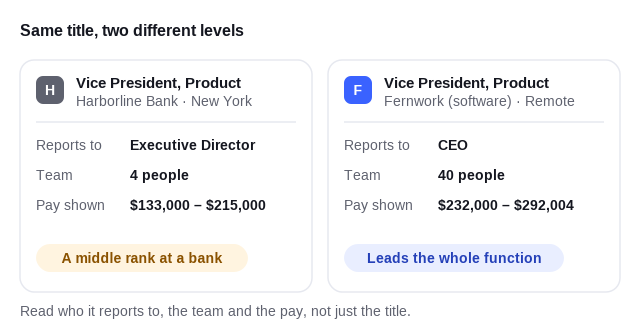
An illustration of two postings with the same title. The companies and details are made up; each pay range is the median range for its group in the count above. Get your story ready before you need it
Have three things ready: a resume, a one-page bio, and a LinkedIn profile that says the same thing. Stanford's alumni advice is to keep your LinkedIn titles descriptive and searchable. Lead with the scope and results that match your target. For product leaders, our product manager resume guide shows how to write the bullets.
Find posted executive jobs every week
Make a list of 20 to 40 companies you'd join, and check their career pages each week. Add LinkedIn job alerts for your titles (and Built In, if you work in tech), set to the last week so you see roles while they're new. Want remote only? Filter the location for remote, then read the posting: in the count above, 45% of senior postings said remote. If a posting starts "Our client is...", a recruiter holds the search, so reply to that recruiter.
Get on executive recruiters' radar
Pick the three to five search firms that fill roles like yours, and get introduced to the right person at each, ideally through someone they know. Keep them up to date when something changes. The section on executive recruiters below explains who pays them and what that means for you.
Find the roles that aren't posted publicly
These come through people. Tell 15 to 20 former bosses, peers and board members what you're looking for, in one clear line. In one Blind thread about senior tech roles, a reply says such roles are often created for someone by a former boss or colleague. That's one person's experience, not a study. Investors are worth a note too: the product leader guide in Aakash Gupta's newsletter advises building ties with venture firms' talent teams.
Reach the people behind each posted role
For every posted role you really want, write to two people, the executive it reports to and the recruiter running it, and look for someone who can introduce you. Only about 1 in 12 senior postings with a full description named that executive in the count above, so you'll usually need to work it out. Our guide to finding the hiring manager has every step, and our cold email guide shows what to write. Keep the note short, and make it about their problem.
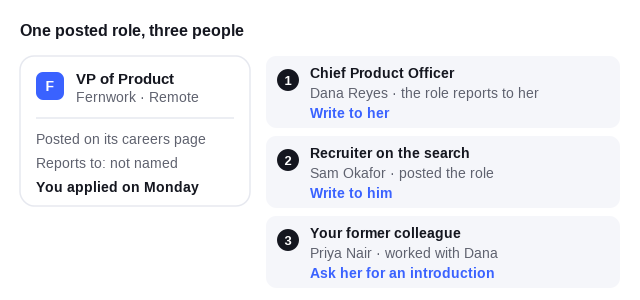
An illustration of the people behind one posted role. The names and the company are made up.


Executive recruiters: who they work for, and how to get on their list.
The company pays them. Executive recruiters (also called headhunters or search firms) are hired and paid by the employer. Stanford's business school puts it plainly: they work for hiring organizations, not for candidates.
Retained and contingency firms work differently. A retained firm is paid whether or not it fills the role, usually about a third of the role's yearly salary and bonuses, and it's usually the only firm on that search, according to SHRM. A contingency firm is paid only when someone is hired, usually 20 to 25% of first-year cash pay. Several contingency firms may work the same job.
What that means for you, in our reading: a retained recruiter is running a few searches for a few clients. They call people who fit those searches. So the useful move is to be easy to find and clearly relevant to the roles they fill, not to send your resume to every firm.
Find the right ones. Stanford suggests keeping relationships with three to five recruiters in your field. The five big global firms (Heidrick & Struggles, Korn Ferry, Spencer Stuart, Russell Reynolds and Egon Zehnder) mainly handle C-level, board and VP searches. Smaller boutique firms usually start at director level.
Get introduced. Ask peers who placed them, and look at who recruited your former colleagues. Stanford advises a referral over a cold email, and notes recruiters may not be the best route if you're switching careers.
Don't pay to be "marketed" to recruiters. Search firms are paid by the employer, not by you. Services that charge you to market you or apply for you are a separate thing you'd be hiring. For the message itself, see how to reach out to a recruiter.
Executive job sites and boards: what each lists and what it costs.
We checked each site's own pages in November 2026, and say so where a site shows no price.
Ladders lists roles paying $100K and up. Premium costs $49.97 a month, or $24.97 a month billed yearly ($299.64). It also offers Apply4Me, where its experts can apply for you. Its strength: the only executive board we checked that shows its prices up front.
ExecuNet is a paid network that offers Premium members "first access" to $200K+ roles, plus a strategy session and an advisor. Its Premium page doesn't show a price. Its strength: a high pay bar, and people to talk to.
BlueSteps is part of AESC, the association of executive search firms, and says it's the only career service with access to AESC's resources. No price is shown on its homepage. Its strength: a direct line to the search firms' own association.
ExecThread calls itself a selective network of executives who discreetly share jobs, including confidential, recruiter-led searches. It offers "free weekly updates" and shows no prices on its homepage. Its strength: discretion.
Experteer calls itself the career service for executives, with jobs from $100K and discreet access to its headhunter network. No price is shown on its homepage. Its strength: it's free to sign up.
LinkedIn Premium Career is $39.99 a month and includes 5 InMail credits a month. Its strength: InMail lets you write to people outside your network.
General boards carry senior roles too. In the count above, LinkedIn and Built In were two of the biggest sources, next to companies' own hiring systems such as Workday.
Are paid boards worth it? In our view, only after you've checked what one lists for your title, field and city. Whichever you use, the slow part is reading each posting against what you've done. Blynk's Find Jobs gives every job a match score against your resume, so the strongest ones sit at the top.
Looking while you're still employed? How to keep an executive search quiet.
Tell recruiters, not everyone. LinkedIn's Open to Work setting has a "Recruiters only" option, shown only to people using LinkedIn Recruiter. LinkedIn takes steps to hide it from recruiters at your own company, but says it "can't guarantee complete privacy."
Search firms keep secrets for a living. Retained searches are often confidential, Stanford notes. AESC's code for its member firms says they always respect confidential information from clients and candidates. Tell a recruiter what must stay private, and ask before your name goes to any company.
Pick your few with care. Write to a small number of people you trust, by name, rather than posting about it. ExecThread and Experteer both describe their service as discreet. Read their terms on who sees your profile.
What works in an executive job search, and what wastes months.
The biggest mistake, in our view, is betting on one track: waiting for a recruiter to call, or only applying online. That's as true for remote roles as for any other.
Do
- Apply to the posted roles that fit your target, every week.
- Write to the executive behind each role you really want, with something specific.
- Keep three to five recruiters in your field up to date.
- Tell former bosses, peers and investors what you want, in one line.
- Read each posting for its level: who it reports to, the team and the pay.
- Keep a record of every conversation, not just applications. A tracker that reads your inbox can update each application on its own.
Don't
- Pay for a board or a "reverse recruiter" before you've checked what it offers.
- Send your resume to every search firm you can find.
- Rely on one recruiter, or one channel.
- Judge a role by its title alone.
- Tell your whole network at once if your search must stay quiet.
- Treat "70 to 80% are never posted" as a fact.
Questions about the executive job search, answered.
Is the hidden job market real for executive roles?
Partly, but we found no measurement of it. The often-quoted figure that 70 to 80% of executive jobs are never posted has no published source, and Jobgether says it isn't backed by verifiable research. Meg Guiseppi, quoted by Jobscan, estimates that 10% or fewer of executive jobs are landed through job boards. And plenty is posted: in Blynk's 12-day count, 1,064 VP, Head of and C-level postings turned up, mostly from searches for product roles. Work both tracks.
How do executives find jobs?
On two tracks, since some roles are posted and the rest move through recruiters and people they know. Meg Guiseppi, an executive job search strategist quoted by Jobscan, estimates that 10% or fewer of executive jobs are landed through job boards. That's her estimate, not a study, and posted roles are real, so apply to the ones that fit and write to the executive behind each. Spend as much time on people, such as three to five recruiters in your field (Stanford's advice) and former bosses and peers. The six steps above show the order.
What is the best executive job site?
There isn't one best site. For posted roles, start with the career pages of companies you'd join, plus LinkedIn and Built In if you work in tech. Of the paid executive boards, Ladders is the only one we checked that shows its price up front ($49.97 a month, or $24.97 a month billed yearly). ExecuNet, BlueSteps, ExecThread and Experteer don't show a price before you sign up.
Are executive job boards worth paying for?
Only if one lists roles you can't find elsewhere, and you can check that. ExecuNet says Premium members get "first access" to $200K+ roles, and ExecThread says it shares confidential, recruiter-led searches. Those are their claims. Search a board for your title and city first, and compare with what's on company career pages and LinkedIn.
Should executives use LinkedIn Premium?
It can help if you'll use the messages. LinkedIn Premium Career is $39.99 a month and includes 5 InMail credits a month. To be found, you can also show LinkedIn's Open to Work setting to recruiters only.
Is it worth it to hire a headhunter to find a job?
You can't really hire one. Retained and contingency search firms work for the employer, which pays them, according to SHRM and Stanford's business school. So it costs you nothing to get known by three to five recruiters in your field, as Stanford suggests. Services that charge you to market you or apply for you are a different thing, where you're the client, so check what you'd get before you pay.
Do executive recruiters charge job seekers?
No. Retained and contingency search firms are paid by the hiring company, according to SHRM and Stanford's business school. SHRM says retained fees are usually about a third of the role's yearly salary and bonuses, and contingency fees 20 to 25% of first-year cash pay.
What are the top 5 executive search firms?
No source we found ranks them. Stanford's business school names five big global firms, Heidrick & Struggles, Korn Ferry, Spencer Stuart, Russell Reynolds and Egon Zehnder, and says they mainly handle C-level, board and VP searches. Smaller boutique firms usually start at director level. The right firm for you is the one that fills roles like yours, so ask peers who placed them.
How long does an executive job search usually take?
No named survey measures it, and estimates vary. A product leader guide in Aakash Gupta's newsletter says 2 to 7 months. Jobscan mentions an old rule of thumb of one month per $10,000 of salary, with no source. In one Blind thread, a former VP said their search took nearly 10 months. Plan for months, not weeks.
What are C-level jobs?
C-level, or C-suite, roles are the "chief" jobs: chief executive officer (CEO), chief financial officer (CFO), chief product officer (CPO) and so on. Stanford notes the five big global search firms mainly handle C-level, board and VP searches. In Blynk's 12-day count, mostly from searches for product roles, 38 of 1,064 senior postings were C-level, and only 8 showed pay.
Sources, and where to go next.
Checked on November 12, 2026. The advice is ours; facts about other companies come from their own pages, and the executive board prices from each board's own site that day. Blynk's counts are its own: 1,477 job postings from Blynk's searches, first seen between October 31 and November 11, 2026, mostly for senior product roles. Each company and title was counted once (1,266 postings), and titles were grouped as VP (including SVP and EVP, not assistant VP), Head of, or C-level (Chief ... Officer and CPO), leaving out executive assistants, chiefs of staff and similar titles: 1,064 senior postings. Banks and other financial firms were picked out by company name and job-site address, from a list we wrote, so a few may be missed. Pay is the range a posting shows, read as US dollars a year; the median low and the median high are given separately. "Reports to" was counted in the 832 senior postings with a description over 300 characters.
- How to find the hiring manager
- How to write a product manager resume
- How to reach out to a recruiter
- Blynk vs LinkedIn Jobs
- A job search strategy that works
- What a recruiter does for you
- How to write an executive resume
- What fractional jobs are
- SHRM: how to work effectively with an executive search firm (2016)
- Stanford GSB alumni career resources: executive recruiters
- AESC Code of Professional Practice
- Corporate Finance Institute: the typical hierarchy at investment banks
- Jobscan: how executives find jobs (2024)
- Jobgether: the best job search strategy for executives (2026)
- Aakash Gupta and Colin Lernell: the product leadership job search (2024)
- Blind: is the market really this bad for exec and middle management roles in tech? (2024)
- LinkedIn Help: Open to Work privacy
- Ladders: homepage and Premium prices
- ExecuNet: Premium membership
- BlueSteps (AESC)
- ExecThread
- Experteer (US)
- LinkedIn Premium Career
- Blynk Find Jobs
- Blynk Find the Hiring Manager
- Blynk pricing
