
What to do after a layoff, and how severance negotiation works. Your first two weeks, in order.
Just laid off, with an agreement to sign and a lot of questions? Here's what has a deadline, what you can ask for in a severance negotiation, and how to restart your search. Every rule comes from an official page, listed at the end. It's information, not legal advice.

The short answer
- Don't sign on the spot. Read the agreement, note the deadline, and ask your questions in writing. If you're 40 or older and it waives age claims, federal rules give you at least 21 days to decide (45 in a group layoff).
- Severance is negotiable because it isn't required. Federal law doesn't make private employers pay it, so it's an agreement. Ask politely, in writing, for the two or three things that matter most, and have a lawyer read anything that signs away your rights.
- Start the clocks that won't wait. File for unemployment with your state this week, and choose health coverage within 60 days. Then start your job search, with a short list of jobs you really fit.
On this page
What to do after being laid off, in the first two weeks.
A layoff is a business decision, and it happens to a lot of people. In September 2026 alone, US employers recorded 1.6 million layoffs and discharges, by the government's count. Here's what to do first, starting with the things that run on a clock.
Save your papers and write down every date
Gather your offer letter, any contract, the employee handbook, your last pay stub, the severance agreement and the benefits letter. Facet, a financial planning firm, suggests emailing copies of your own employment papers to a personal address. Then write down your last day, the day your health coverage ends and the deadline to sign. The picture below shows the clocks that usually matter after a layoff.
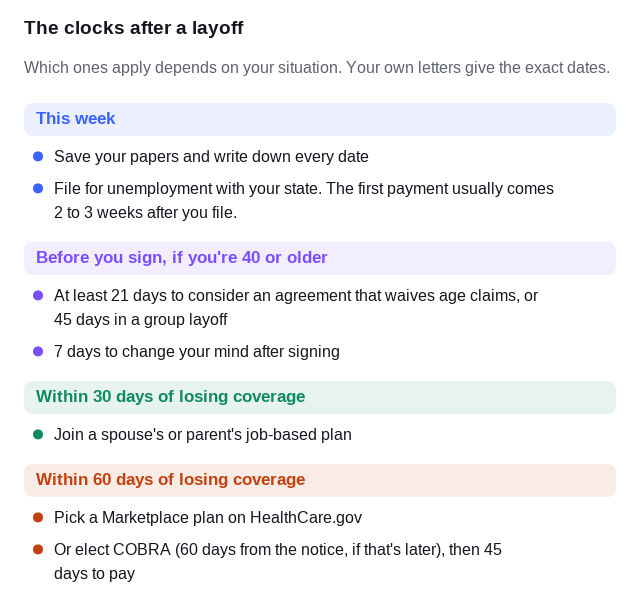
The usual clocks after a layoff, from the Department of Labor, the EEOC and HealthCare.gov. Which ones apply depends on your situation. File for unemployment this week
Unemployment insurance is for workers who lose a job “through no fault of their own,” says the Department of Labor (DOL), and each state runs its own program. The DOL says to contact your state's program “as soon as possible after becoming unemployed,” in the state where you worked. The first check generally comes 2 to 3 weeks after you file. Prudential's severance guide says to make sure severance won't interfere with unemployment, so ask your state how it counts. The IRS counts unemployment as income, too.
Choose health coverage within 60 days
If your job came with health insurance, three routes usually remain. COBRA keeps your current plan for up to 18 months after a layoff, at employers with 20 or more employees. You usually pay the whole premium plus 2%, and you have 60 days to elect it, then 45 days to pay. A Marketplace plan on HealthCare.gov must be picked within 60 days of losing job-based coverage, and its savings depend on your household's income for the year. A spouse's or parent's plan at work usually has to be joined within 30 days.
Check your final pay and unused vacation
Federal law doesn't require your final paycheck right away, the DOL says, though some states do. It doesn't require pay for unused vacation either, which the DOL calls a matter of agreement between you and your employer, so your handbook and your state's rules decide. Facet notes that if your contract or handbook offers pay for unused vacation, that pay often can't be withheld just because you haven't signed a severance agreement. If something is missing, your state's labor office is the place to ask.
Check whether the layoff needed notice
Under the federal WARN Act, employers with 100 or more employees must give at least 60 calendar days of written notice before a plant closing or a mass layoff, per the DOL. A mass layoff here means 50 or more people at one site, and there are some exceptions. Some states, such as California, have their own notice rules. If you think the rule applies to your layoff, raise it with an employment lawyer before you sign anything.

How to negotiate severance, step by step.
Severance negotiation is a polite, written request to improve an agreement before you sign it. Federal law doesn't require private employers to pay severance; the DOL calls it “a matter of agreement between an employer and an employee.” That's why there's room to ask. Here's how it usually goes, from the sources we read. It isn't legal advice, and only a lawyer can tell you what your own agreement means.
Read what you'd be giving up
Prudential notes that employers may ask you to give up the right to sue the company in exchange for severance. The Muse calls “unknowingly waiving critical rights” one of the biggest legal risks when negotiating severance. So find the release, any non-compete or confidentiality terms, the payment schedule and the deadline. The EEOC says you can still file a discrimination charge with it even after signing.
If you're 40 or older, you get extra time
Federal age rules add protections when a severance agreement waives age discrimination claims. Per the EEOC, the waiver must give you at least 21 days to consider it, or 45 days in a group layoff, and 7 days to revoke after you sign. It must also advise you in writing to consult an attorney. In a group layoff, the employer must give you the job titles and ages of the people who were eligible or selected for the program.
Know what's typical for your level
There's no official average severance. In The Muse's words, “higher-level employees may get more” than the common formula of one to two weeks of pay per year of service. Challenger, Gray & Christmas, an outplacement firm, reports an average of 19.3 weeks across industries in its 2024 data, and less than 10 weeks for individual contributors. Its post doesn't say how the packages were gathered, so treat it as a rough guide. Your handbook or a written severance plan may already set a formula, so check it first.
Pick the two or three things that matter most
Money is only one part. Prudential and The Muse list what people commonly ask for. The list includes more weeks of pay, paid health coverage for a few months, payout of unused PTO, faster vesting or a longer window for stock options, and outplacement help. Prudential also lists a recommendation letter, and Facet a letter that says why you were let go. Choose the few that would make the next months easier for you, and ask for those.
Ask in writing, with your reasons
Thank them, then make one clear request with a reason. The Muse points to reasons such as your years at the company, your results, and help you can offer with the handover. It also suggests asking for specific things rather than vaguely for more money. Keep it polite and in writing, so there's a record. The two emails below are short versions you can adapt.
Bring in a lawyer when the stakes are high
The EEOC suggests that you consider having an attorney review a severance agreement. In our reading, that matters most when it releases claims you might have, includes a non-compete, involves equity, or you suspect the layoff was discriminatory, which Facet also flags. Prudential notes that you'll most likely pay for the lawyer yourself, by the hour or as a share of what's negotiated. Ask about the fee before you start.
Get the final version in writing before you sign
Whatever you agree on a call, ask for it in the agreement itself, which The Muse lists as the last step. Read the final version as carefully as the first, since terms can change between drafts. If you're 40 or older, your 7 days to change your mind start after you sign.
Two severance negotiation emails, ready to copy.
Swap the [square brackets] for your details. Keep each one short, and send it to the person who gave you the agreement.
Asking for time and the details
Soon after you get the agreement, while you still have time to ask questions.
Hi [Name],

Thank you for sending the separation agreement and for walking me through it.

I'd like to review it properly before I sign. Could you confirm the deadline to sign, and send me the benefits details, including when my health coverage ends and how unused PTO will be paid?

I'll come back to you with any questions by [date].

Thanks,
[Your name]
Asking for a better package
After you've read it, and after a lawyer has looked if you're using one. One or two asks, not ten.
Hi [Name],

Thank you for the offer and for the time to review it. I've been glad to be part of [team or company] for [number] years, including [one result, such as leading the launch of a product].

Given my time here, I'd like to ask whether there's room on two points. The first is [one ask, such as two more months of base pay]. The second is [another ask, such as the company paying my health premiums for three more months].

I'm also happy to help with the handover until [date] if that's useful.

Thank you for considering it. I look forward to hearing from you.

Best,
[Your name]
Your job search after a layoff, starting with a short list.
There's no prize for applying the day after a layoff. The clocks above come first. Then the search goes better with a plan than with a flood of applications.
Take a few days before you apply
Our advice: sort the paperwork and rest for a few days before you send a single application. In our view, a rushed first week tends to mean one generic resume sent to jobs that don't fit. If the weeks start to wear you down, our guide to job search burnout may help.
Say plainly that you were laid off
Being laid off is common, and you can say so in one line, without apology. How to put it on a resume, a form and in an interview is covered in our guides to explaining a career gap and your reason for leaving a job.
Know your number before the first call
If a recruiter asks what you're looking for, it helps to know the going rate. Of 1,535 job postings in Blynk's searches between October 31 and November 12, 2026, mostly for product roles, 565 showed pay, and 532 of those gave a range. Our advice: look at postings for your role before the first call, and base your number on the market, not on your last salary or your severance. Our guide on how to negotiate salary covers the conversation itself.
Ten jobs that fit beat a hundred that don't
Start with a short list of roles you'd really be good at, and tell former colleagues you're looking, since they know your work. Employers still hire every month, with 5.4 million hires in September 2026, by the BLS count. For the full plan, see our job search strategy, and for the market now, why it's so hard to get a job.
Severance and layoff mistakes, and what to do instead.
Do
- Read the whole agreement before you sign, and note the deadline.
- File for unemployment with your state as soon as you can.
- Put every date in your calendar, from the signing deadline to day 60 for health coverage.
- Ask in writing for the two or three things that matter most to you.
- Ask a lawyer about any release, non-compete or equity terms you don't understand.
Don't
- Don't sign on the spot because you're told the package is standard.
- Don't let the 60 days for health coverage slip while you wait on severance.
- Don't assume severance is required. Under federal law, it's an agreement.
- Don't apply everywhere in week one. A short list of jobs that fit goes further.
- Don't share the details before you've read any confidentiality terms.
Severance and layoff questions, answered.
Can negotiating severance backfire?
It can, in the sense that nothing makes an employer improve an offer, and an unsigned offer isn't final. None of the guides we read describes a polite, written ask commonly leading to an offer being pulled, but none rules it out. Prudential notes that you don't have to accept the package you're offered, and The Muse names a different risk as one of the biggest, which is signing away rights without knowing it. If you're worried, have a lawyer read the agreement or make the request with you.
Is negotiating severance worth it?
Only you can weigh that for your own agreement, and a lawyer can help. Severance isn't required by federal law, so the first offer is the employer's opening, not a fixed rule. Prudential and The Muse both say you can try to negotiate, and a short email costs little. It matters most when the agreement releases claims or includes a non-compete, which is also when a lawyer's review matters most.
How much severance can you negotiate?
There's no set limit or legal formula. What you can get depends on your level, your years there, your employer's policy and what you'd be giving up. The Muse calls one to two weeks of pay per year of service a common formula. Challenger, Gray & Christmas reports that individual contributors averaged under 10 weeks in its 2024 data, and VPs and directors 15 to 25. In our reading, a specific ask with reasons is easier to say yes to than a large round number.
What's an average severance pay package?
Challenger, Gray & Christmas, an outplacement firm, reports an average of 19.3 weeks of severance across industries in its 2024 data, up from 15.6 weeks a year earlier. It puts C-suite leaders at 30 to 50 or more weeks and individual contributors under 10. It doesn't describe how it gathered the packages, and there's no official government average. Beyond pay, packages often include help with health coverage, PTO payout and outplacement, per Prudential and The Muse.
What is the 70 rule for severance?
It isn't a law, and it means different things at different employers. One use is an eligibility test for buyouts, where your age plus your years of service must add up to 70 or more. Microsoft used that test for its first voluntary buyout in 2026, as UC Today reported. Check your own severance plan or handbook to see whether your employer has a rule like it, and what it gives.
Can I negotiate a severance package if I quit?
The DOL describes severance as often granted when employment ends, and federal law doesn't require it either way. In our reading, you have little to bargain with once you've resigned, so any ask comes before you hand in notice. The DOL says unemployment is for people who lose a job “through no fault of their own,” so quitting can affect it too. If you're thinking of leaving, talk to an employment lawyer before you resign.
What are you entitled to if you are laid off?
Under federal law, less than many people expect. You're owed your final pay, though when it arrives depends on your state. You may qualify for unemployment from your state, COBRA if your employer has 20 or more employees, and a Marketplace plan. Severance and unused vacation pay depend on your agreement, your employer's policy and your state. Employers with 100 or more employees may also owe 60 days of written notice for a mass layoff under the WARN Act.
Do I get paid if I am laid off?
You get your final paycheck for the time you worked. Federal law doesn't require it right away, but some states do, according to the DOL. After that, money comes from severance, if your employer offers it, and unemployment benefits, if your state finds you eligible. The first unemployment check generally comes 2 to 3 weeks after you file, so file early.
Is getting laid off scary?
It often feels that way, and that's a normal reaction. It's also common. US employers recorded 1.6 million layoffs and discharges in September 2026 alone, by the BLS count. A layoff is a decision about a role, not a verdict on you. Our advice: take the steps on this page one clock at a time, so the first weeks can feel more manageable.
What are the tax implications of severance pay?
The IRS says you must include severance pay in your income, and the same goes for unemployment benefits. You can choose to have federal income tax withheld from unemployment using Form W-4V. What you owe depends on your whole year, so for your own case, check IRS Publication 525 or ask a tax professional.
Where the facts come from.
Checked on November 12, 2026. Rules come from the Department of Labor, the EEOC, the IRS and HealthCare.gov, quoted or paraphrased from their own pages. Your state can add its own rules, and nothing here is legal, tax or financial advice. Severance amounts are Challenger, Gray & Christmas's figures and The Muse's description, labeled as theirs. Blynk's count covers 1,535 job postings first seen in Blynk's searches from October 31 to November 12, 2026, from 909 companies, mostly product roles; 565 had pay in the posting, 532 of them as a range. It covers only those searches, not the whole market.
- How to explain a career gap
- A job search strategy that works
- Why it's so hard to get a job right now
- Your reason for leaving a job
- How to negotiate salary
- Job search burnout
- U.S. Department of Labor, Severance Pay
- U.S. Department of Labor, Last Paycheck
- U.S. Department of Labor, Vacation Leave
- U.S. Department of Labor, Unemployment Insurance
- U.S. Department of Labor, Plant Closings and Layoffs (WARN)
- U.S. Department of Labor, COBRA Continuation Coverage
- U.S. Department of Labor (EBSA), FAQs on COBRA Continuation Health Coverage for Workers
- HealthCare.gov, If you lose job-based coverage
- EEOC, Q&A: Understanding Waivers of Discrimination Claims in Employee Severance Agreements
- IRS, Publication 525, Taxable and Nontaxable Income
- IRS, Topic 418, Unemployment compensation
- U.S. Bureau of Labor Statistics, Job Openings and Labor Turnover, September 2026 (released November 3, 2026)
- Challenger, Gray & Christmas, Benchmarking Severance in 2025
- The Muse, How to Negotiate a Severance Package (republished by the University of Miami's Toppel Career Center, March 27, 2025)
- Prudential, How to negotiate severance
- Facet, What are the first 10 things to do if I get laid off? (updated November 3, 2026)
- UC Today, Rule of 70: Microsoft's employee exit plan (May 5, 2026)
