
Ghost jobs. How to spot them, and stop applying to them.
If you've applied to dozens of jobs and heard nothing back, you've probably wondered if some of them were even real. Some weren't. Here's what ghost jobs are, how common they are, where the law stands, and a quick check to run before you spend an evening on an application.

The short answer
- A ghost job is a posting for a job that doesn't exist, or that the employer isn't planning to fill soon. It usually comes from a real company, which is what makes it different from a scam.
- You can't always tell, but a two-minute check catches the obvious ones. Find the job on the company's own careers page, check the date, look for a named team or manager, and ask a person if it's still open.
- No single sign proves it. Reposts and missing salaries are common in real jobs too. Several signs together are worth acting on.
On this page
What ghost job postings are, and what they aren't.
A ghost job is a posting for a job that doesn't exist, or that the employer isn't planning to fill right away. That's close to how the Congressional Research Service (CRS), which writes reports for the US Congress, describes them. Greenhouse, which makes hiring software, calls them positions advertised with no intent to hire.
The word covers a range. At one end, there's no job at all. Then there's the role with a candidate already chosen, and the posting kept up in case the right person comes along. At the other end are listings nobody meant to leave up: plans changed, or a job board's copy outlived the original. So people argue about what counts, and the numbers below disagree.
A ghost job isn't a scam. Ghost postings usually come from real employers. Scams, CRS says, come from scammers posting fake jobs at fake companies or pretending to be real employers. They're after your money or your personal details, and the signs are different (see fake job postings below).
Why companies post jobs they won't fill, and repost the same ones.
Five things job seekers say about ghost jobs, what's really going on behind each one, and what to do about it.
“The same job keeps coming back.”
Often that's routine, not a trick. On LinkedIn, a free job post stays active for up to 14 days, then pauses. It closes on its own after 30 days unless the employer pays to promote it. So an employer who's still hiring may simply post it again. On Indeed, a filled job stays up until the employer closes it: Indeed says it doesn't remove filled jobs automatically.
What helps: A repost is a reason to check, not proof. Run the two-minute check below before you skip it or apply.
“They had someone in mind all along.”
Sometimes that's true. CRS lists posting a job to show a wide pool of applicants when an internal candidate has already been chosen. Some postings are also required by law, such as the recruitment step in the Labor Department's PERM process for employers hiring foreign workers permanently.
What helps: Ask whether it's open to outside candidates. One short question to the recruiter can save you an evening.
“They're just collecting resumes.”
Some are. In a 2024 survey commissioned by Resume Builder and run online through Pollfish, 1,641 hiring managers were asked about fake job listings. 40% said their company had posted one in the past year. Of those, 59% said one goal was to collect resumes to keep on file, and 67% said it was to look open to new talent.
What helps: Apply where there's a person to write to. A short note to the hiring manager puts you in front of someone, not just a database.
“They want to look busy, or keep staff on edge.”
In the same survey, managers whose companies had posted a fake listing gave other goals too. They wanted to look like the company was growing (66%), make staff think help was coming (63%) and make staff feel replaceable (62%). It's a self-reported online survey, not a count of postings. But managers do admit to these reasons.
What helps: It isn't about you. When a posting looks off, move on quickly and spend the time on the next good one.
“The job was real, then it wasn't.”
Not every ghost job is on purpose. CRS notes that a company's plans can change after a job is posted. It also notes that job boards can copy a posting that then stays up after the original is taken down.
What helps: Find the original. If the job isn't on the company's own careers page, the copy you found may be out of date.
Are ghost jobs real? How common they are, and what each number measures.
Yes, but nobody has an official count. CRS says there are no official statistics on ghost jobs, and the studies that exist don't define them the same way. Here's what each number you'll see actually measures.
Greenhouse: 18-22% of jobs on its own platform. Greenhouse says that in any given quarter, 18-22% of the jobs posted on the Greenhouse platform are classified as ghost jobs. That's one hiring platform's jobs, not all postings, and the report doesn't say how they're classified. Many "1 in 5 job postings are fake" headlines cite this number.
A research paper: up to 21% of Glassdoor ads. A 2024 working paper by Ng, posted on arXiv, estimates that up to 21% of job ads on Glassdoor may be ghost jobs. It uses a language model to sort the ads, and it hasn't been peer-reviewed.
Resume Builder: 40% of companies, by their managers' own account. In its 2024 survey of 1,641 hiring managers, 40% said their company had posted a fake listing in the past year. 3 in 10 said one was up at the time. It counts companies that admit to it, not postings.
Clarify Capital: 68% had postings up 30+ days. In a survey of 1,045 managers involved in hiring, run August 31 to September 1, 2022, 68% had postings that had been up for more than 30 days. Clarify's project manager added that 43% weren't actively trying to fill some positions, to keep staff motivated or to look like the company was growing.
Why ghost jobs feel more common than any study finds.
One number to ignore: that 1 in 3 job openings never leads to a hire. It comes from dividing openings by hires in the government's JOLTS survey, such as 7.5 million openings against 5.4 million hires in September 2026.
What the Bureau of Labor Statistics actually counts. It counts an opening on the last business day of the month. It counts it only if a specific job exists, work could start within 30 days, and the employer is actively recruiting from outside. Hires are everyone added to the payroll during the whole month. So, in our reading, one can't be divided by the other to find ghost jobs.
Why it feels like more. The same job gets copied from site to site. In Blynk's searches for product roles, mostly senior, about 1 in 4 jobs (302 of 1,270) turned up in two or more places; one turned up in nine. So one opening can look like several, and each copy that never answers feels like another ghost. The count shows copies, not intent.
How to spot ghost jobs, and tell if a job posting is real.
Run this on any posting before you spend an evening on it. It takes about two minutes. No single sign proves anything, so look at them together.
Find the job on the company's own careers page
Search the company's careers page for the job title. If it's there, the employer still lists it, and that's where your application lands. If it's only on job boards, you may be looking at a copy left behind after the job closed.
A careers page isn't proof, though. In Resume Builder's survey, managers whose companies posted fake listings used the company website (72%) about as often as LinkedIn (70%). It tells you the job is listed, not that someone will hire.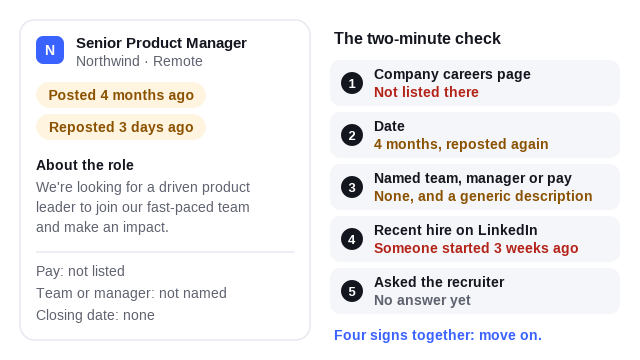
An illustration of one posting run through the check. The company and its details are made up. Check the date, and how long job postings stay up
There's no US rule on how long a posting stays up. A free LinkedIn post closes after 30 days unless it's promoted, and Indeed leaves a filled job up until the employer closes it. Pages that give a cut-off, such as 30 days or two months, don't cite a study for it. In Resume Builder's survey, about 2 in 3 of the fake listings were up for a month or less, so age alone can't separate them.
What counts more: a job posted months ago and reposted again and again. Few postings say when they close: about 2 in 100 did in Blynk's searches.Look for a named team, manager or pay range
Look for details only that team would know: the product, the problem the role solves, who you'd report to. A description that could fit any company is a warning sign, in our view. A named manager or a pay range is a good sign. But their absence is common, so don't skip a job for that alone.
In the same Blynk searches, about 1 in 6 of the 1,204 postings with a full description named who the role reports to, and about 4 in 10 stated a pay range in their text. So plenty of postings leave out one or both.Search LinkedIn for someone who just started in the role
Search LinkedIn for the company and the job title. If someone joined in that exact role in the last few weeks, the job may already be filled and the posting simply left up. It's not proof either: a big team can hire for the same title more than once.
Ask a person whether the role is open
Write one line to the recruiter or the hiring manager. Ask if the role is still open, and when they're hoping to have someone start. A straight answer beats any sign above, and the note puts your name in front of a person. Our guide to finding the hiring manager shows where to look. If you don't know who to ask, paste the job link and Blynk finds the people hiring for the role.
Treat a ghost job checker as a second opinion
Free ghost job checkers and browser extensions exist. The ones we found look at things like a posting's age, its reposts, or whether the role is live on the company's own site: the same checks as above. We didn't find one that publishes how accurate it is. LinkedIn's verified badge isn't a checker either. It confirms the company page and the person posting, and LinkedIn says applying to a verified job doesn't make you more likely to be hired.

Which signs matter, and which are noise.
Our reading of the sources above. None of these proves anything alone, but the first list is worth acting on, especially when two or three show up together.
Worth acting on
- The job isn't on the company's own careers page, only on boards.
- It was posted months ago and has been reposted again and again.
- The description could fit any company: no product, team or manager.
- Someone started in that exact role at the company in the last few weeks.
- The recruiter can't say whether it's open, or when someone would start.
Weak on their own
- No pay range: only about 4 in 10 postings in Blynk's searches stated one.
- No manager named: only about 1 in 6 did.
- No closing date: about 2 in 100 gave one.
- A repost on LinkedIn: free posts close after 30 days unless promoted.
- Older than 30 days: the cut-offs you'll see online don't cite a study.
Ghost jobs vs fake job postings, and how to spot scam listings.
A ghost job wastes your time. A scam is after your money or your details. Scam postings come from fake companies or from people pretending to be real employers, CRS says. And they're growing: the Federal Trade Commission (FTC) says reports of job and employment agency scams tripled from 2020 to 2024. Reported losses rose from $90 million to $501 million.
The FTC's warning signs. Honest employers will never ask you to pay to get a job, the FTC says. Never deposit a check from an employer and send part of the money back. Be wary of jobs reshipping packages, requests to pay with gift cards, and fees up front for a placement.
Applying for government jobs is free. Federal jobs are on USAJobs.gov, and Postal Service jobs are at usps.com/employment, the FTC notes. If a posting looks like a scam, report it at ReportFraud.ftc.gov.
Are ghost jobs illegal? Where the law stands in November 2026.
No federal law bans them. As of April 2025, CRS found no federal bill that explicitly addressed ghost job postings. It noted that the federal ban on deceptive business practices could apply in theory, though intent is hard to prove. A November 2025 article in the Columbia Law Review argues that ghost jobs do break that law, section 5 of the FTC Act.
New York's bill has passed both houses, with no signature on record. Bill S8877 passed the State Senate on April 28, 2026 and the Assembly on June 2, 2026. As of November 11, 2026, the Senate's page for the bill shows no delivery to the governor and no signature.
What New York's bill would do, if signed. It covers employers with 100 or more employees, and the sites that post their jobs. A posting would have to give the date the job will be filled, or say it isn't a current vacancy. The posting would have to come down within two weeks of the job being filled, and fines would start at $2,500 per platform. The Society for Human Resource Management (SHRM) notes the bill gives job seekers no right to sue.
Other places. SHRM reported in July 2026 that bills were pending in Pennsylvania and New Jersey. California's had passed the Assembly and had sat in a Senate committee since August 2025. In Ontario, since January 1, 2026, employers with 25 or more employees must say in public job postings whether the job is an existing vacancy. They must also tell applicants they interviewed about a decision within 45 days.
What it means for you today. In most of the US, the check above is still your best tool. In Blynk's searches, only 2 of the 1,204 postings with a full description said outright that they might be used for future openings. In our reading, that's the gap New York's bill and Ontario's rule are trying to close.
Questions about ghost jobs, answered.
What is considered a ghost job?
A job posting for a role that doesn't exist, or that the employer isn't planning to fill right away. That's close to how the Congressional Research Service describes it. The term also covers listings left up by mistake and copies that stay on job boards after the job has closed. A ghost job usually comes from a real employer, so it isn't the same as a scam, which is after your money or personal details.
Are ghost jobs illegal?
No federal law bans them, and CRS found no federal bill aimed at them as of April 2025. New York's bill S8877 passed both houses in 2026, but as of November 11, 2026, the State Senate's page shows no signature by the governor. If signed, it would make employers with 100 or more employees say when a job will be filled, and take postings down within two weeks of filling them. In Ontario, postings have had to say whether a job is an existing vacancy since January 1, 2026.
Why are there so many ghost jobs right now?
Posting a job costs little, and an open posting keeps applicants coming, as the Ng paper notes. Managers in Resume Builder's 2024 survey also said they posted fake listings to look like they were growing and to collect resumes. Some are accidents: plans change, and job boards copy postings that outlive the original. And copies make it feel worse: in Blynk's searches, about 1 in 4 jobs turned up in two or more places, so one opening can look like several.
How to tell if a job is ghosting you?
Ghosting is when an employer stops replying without explaining why, which is different from a ghost job. In Greenhouse's survey of 2,500 workers in the US, UK and Germany, 61% said they'd been ghosted after an interview. US employers generally have no duty to reply, CRS notes, though Ontario now requires an answer to interviewed applicants within 45 days. Our advice: send one polite follow-up after about a week, then keep applying, because silence alone doesn't prove the job was fake. Here's how to write the follow-up.
Which companies post ghost jobs?
No official source names companies, and lists built from anonymous reports can't be checked, so we don't name any. Research points to patterns instead. The Ng paper found ghost jobs more common at larger firms and in specialized industries. In Resume Builder's survey, managers said their companies had posted fake listings for entry-level, mid-level, senior and executive roles alike.
How common are ghost job postings?
There's no official count. Greenhouse says 18-22% of the jobs posted on its own platform are classified as ghost jobs in any given quarter. A 2024 working paper estimates up to 21% of Glassdoor ads. In Resume Builder's 2024 survey, 40% of hiring managers said their company had posted a fake listing in the past year. So it's roughly 1 in 5 on the platforms that measured it, but each number counts something different.
How long do job postings stay up?
There's no rule in the US. A free LinkedIn job post stays active for up to 14 days, then pauses, and closes on its own after 30 days unless it's promoted. On Indeed, a job stays up until the employer pauses or closes it, even after it's filled. New York's bill, if signed, would require postings to come down within two weeks of the job being filled.
Is there a ghost job checker?
Yes, several free ones, many of them browser extensions. The ones we found check things like a posting's age, how often it's been reposted, or whether it's still live on the company's own careers page. We didn't find one that publishes how accurate it is. The two-minute check above covers the same ground, plus the most useful step of all: asking a person.
Where the facts come from.
Checked on November 11, 2026. The advice and our reading of each source are ours; facts about other organizations come from their own pages, and survey numbers from the companies that ran them. Blynk's counts are its own: 1,477 job postings (1,270 jobs once the same company and title are grouped) from Blynk's searches for product roles, mostly senior, first seen between October 31 and November 11, 2026. A job counts as copied when it appeared in two or more of the places Blynk searches. Pay ranges, reporting lines, closing dates and future-opening wording were counted in the 1,204 postings with a full description. The counts show copies and wording, not whether a job was real.
- How to find the hiring manager
- How to write a follow-up email after applying
- LinkedIn Easy Apply vs the company site
- The best job search apps, compared
- Blynk vs Indeed
- Blynk vs LinkedIn Jobs
- How to spot a job scam
- Congressional Research Service: "Ghost" Job Postings (IF12977, April 2025)
- Greenhouse: 2024 State of Job Hunting report
- Ng, Why is it so hard to find a job now? Enter Ghost Jobs (arXiv working paper, 2024)
- Resume Builder: survey of 1,641 hiring managers on fake job listings (2024)
- Clarify Capital: ghost jobs survey of 1,045 managers (2022)
- BLS: JOLTS definitions
- BLS: Job Openings and Labor Turnover, September 2026
- New York State Senate: bill S8877
- SHRM: New York moves to crack down on ghost job postings (July 2026)
- Ontario: requirements for publicly advertised job postings
- Grimm, Ghost Jobs (Columbia Law Review Forum, November 2025)
- LinkedIn Help: how long a job post stays active
- LinkedIn Help: verifications on job posts
- Indeed for employers: how to close or pause jobs
- US Department of Labor: PERM labor certification
- FTC: job scams
- FTC: new data on reported fraud losses in 2024
- Blynk Find Jobs
- Blynk Find the Hiring Manager
