
Why am I not getting interviews? Find the leak before you send more.
If you've sent dozens of applications and heard almost nothing, you're not imagining it, and it isn't all you. But the silence usually has a cause you can find. Here's an honest look at the market, and a short check that shows which part of your search is leaking.

The short answer
- Most silence has a few causes: a missed must-have, one screening answer, a resume without the job's top asks in its words, or no person ever seeing it.
- Check before you send more. Go through your last 20 applications with the checklist below, and fix the earliest weak spot first. Sending more the same way rarely changes the result.
- Getting interviews but no offers is a different problem. Your resume is doing its job, so look at the round where you stop.
On this page
Is it you or the market? Why interviews are harder to get right now.
Both are real, and it helps to know which part is which. Hiring in the US is slow, but it hasn't stopped. In September 2026, employers had 7.5 million job openings and made 5.4 million hires, according to the Bureau of Labor Statistics. In October, 7.1 million people were unemployed, and 27.6% of them had been looking for 27 weeks or more.
Some jobs close without hiring anyone. Greenhouse, a hiring software company, reports how many jobs on its platform closed with a hire: 69.76 for 2025. It doesn't state the unit. Our reading: about 7 in 10 jobs closed with a hire, so about 3 in 10 didn't. Greenhouse's 2024 job seeker report also said 18% to 22% of jobs on its platform in a quarter were classified as ghost jobs, advertised with no intent to hire.
More people apply for each job. Greenhouse counted more than twice as many applications per job in 2025 as in 2022. So a quiet inbox can happen to a strong candidate.
The part you control is still big. It's which jobs you pick, how you answer the form's questions and how your resume reads for this job. It's also whether a person sees it, and when you apply. The checklist below looks at each one, using your own applications. If the search has worn you down, that's normal too, and our guide to job search burnout is about that part.
Not getting interviews? Check these six leaks, in order.
Open your last 20 applications, or all of them if you've sent fewer. Each step below is one question to ask of every application. Write down how many of the 20 pass each one.
Count your last 20 applications first
For each one, note two things: did a person reply, and did it lead to an interview? Automatic “we received your application” emails don't count. If almost none got a reply from a person, the leak is early, in the steps below. For what's typical, see how many job applications it takes to get a job.
For example: 20 applied, 1 reply from a person, no interviews yet. Run the six checks below on all 20 and note how many pass each one.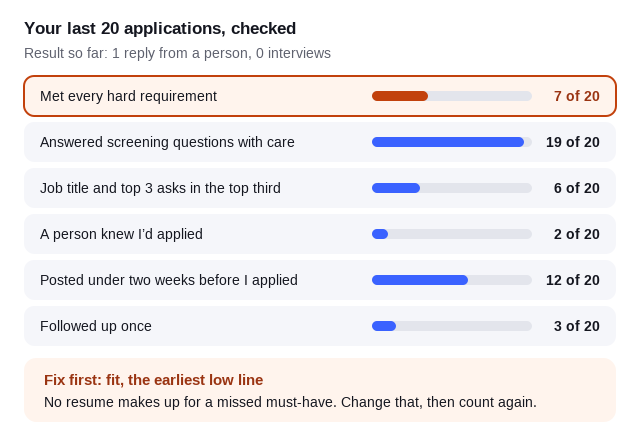
An illustration of the six checks on 20 applications, using made-up numbers. Fit: do you meet the must-haves?
Many job postings mix hard requirements with nice-to-haves, and some say which is which. Lines marked “preferred” or “a plus” are the nice-to-haves. In our reading, the hardest lines are years of experience, a license, a degree with no “or equivalent”, and work authorization. If you miss one of those, that's the first thing to look at. What 1,204 job postings really ask for is further down.
Check: Of your 20, how many met every hard requirement? Our rule of thumb: if it's under half, start here.Screening questions: did one answer end it?
Many application forms ask questions before anyone opens your resume, such as years of experience, location, a license or whether you need sponsorship. In Greenhouse, a common hiring system, employers can set rules that reject an application automatically based on those answers. The rule can send the rejection email too. That can explain a rejection that arrives within minutes. A careless click, such as picking “3-5 years” when you have 6, can end an application on its own.
Check: How many of your 20 had screening questions you answered carefully and truthfully? Reread any that were rejected within a day.Resume: does it show this job's title and top asks?
Recruiters can search the applications in their hiring system by keyword; Greenhouse's help pages, for one, describe exactly that. Then a person reads what comes up, often briefly: in Ladders' 2018 eye-tracking study, recruiters spent 7.4 seconds on average on a first screen of a resume. So, in our reading, the top third matters most. It should name the kind of role you're applying for and show the posting's top three asks, in its words, with real results. Keep the layout one the system can read, with one column, standard headings and your newest job first; our guide to an ATS-friendly resume has the details.
Check: Put each posting next to your resume. Are its title and its top three asks in your top third, in its words? Our advice: also follow every instruction the posting gives, such as a question to answer or a file to attach, and proofread the top before you send. Our guide to tailoring your resume shows how, without making anything up. Our cover letter guide says when a letter is worth writing.Route: did a person ever see it?
Applying works: in Ashby's data on nearly 250,000 hires, people who applied made up 43% to 52% of hires. Referrals were a real but smaller share, about 17% to 18%, and Ashby says referred candidates convert better, though it gives no numbers. Our advice: for the jobs you want most, add a person. That can be a short note to the hiring manager, or a referral from someone you know there. Whoever gets it may look you up, so make your LinkedIn headline match the roles you're applying for.
Check: For how many of your 20 did a person at the company know you'd applied? Our guide on how to find the hiring manager shows where to look.Timing: how old was the posting?
We don't know of a measured rule here, so treat this as our advice. A posting that's been up for weeks may already have a shortlist, or may never be filled, since some jobs close without a hire. Fresh postings are a better use of your evenings. Applying soon after a job goes up is the habit our guide to getting a job fast is built on.
Check: How many of your 20 had been up for more than two weeks when you applied? If you can't tell, sort by date next time.Follow-up: did you follow up once?
Our advice: one short, polite note a week or two after applying. It puts your name in front of a person again, and it's an easy step to add if you've never done it. Our follow-up email guide has notes you can copy.
Check: How many of your 20 got one follow-up? If none did, add one for every application you still care about.Fix the earliest weak line, then count again
Look at your six counts. Start with the earliest one that's low, because it affects everything after it: no resume can make up for a missing must-have. Change that one thing, send your next 15 to 20 applications, and count again. If you change five things at once, you won't know which one helped.
In the example, only 7 of 20 met every hard requirement, so fit comes first. Applying only where you do also makes the resume step easier, because your real experience already matches.

Do you need every requirement? What 1,204 job postings really ask for.
It's easy to read a job posting as a list you must complete. Real postings are looser than that in some places, and strict in others. We counted what 1,204 job postings with a full description asked for. They come from Blynk's searches for product roles, mostly senior, first seen October 31 to November 11, 2026.
Years of experience: stated in just over half. 652 of the 1,204 (54%) give a number of years, such as “8+ years of product management experience”. The first figure given was most often 10 to 14 years (247 postings) or 5 to 7 (187). These are mostly senior roles, so the years run high, and your field will differ. In our view, years you clearly don't have are a hard line.
A bachelor's degree: mentioned in about 1 in 4. 315 postings mention one. About half of those (151) also accept equivalent experience or call the degree preferred. That's a floor, since we only counted that wording in the same sentence.
An MBA: mentioned in about 1 in 12, and rarely required. 97 postings mention an MBA. About 3 in 4 of those (72) call it preferred, a plus or desirable. None of the postings we checked said an MBA was required.
What to do with this. Read each posting's hard lines first: years, a license, work authorization, and a degree with no “or equivalent”. If you meet them, a “preferred” line you lack isn't a reason to skip the job, in our reading. Show your closest real proof for it instead, and never claim what you haven't done.
Getting job interviews but no offers? Why you're still not getting hired.
If you get interviews, your resume and your choice of jobs are working. The leak is later, so sending more applications won't fix it. Find the round where you usually stop.
You stop after the first call. In our reading, a first call with a recruiter is mostly about the basics, so be ready for them: pay, level, location and why this role. Before each one, compare the posting's pay range and level with what you want. Prepare short answers to those questions, too.
You stop after later rounds. After each interview, write down every question you were asked. Prepare one story with a clear result for each of the posting's top asks. After a final-round no, ask once, politely, for feedback. Some people will share it.
Silence after an interview isn't always a verdict. In Greenhouse's 2024 survey of 2,500 workers in the US, UK and Germany, 61% said they'd been ghosted after a job interview. And about 3 in 10 jobs on Greenhouse closed without a hire, in our reading. Follow up once, then put your energy into the next one.
What doesn't get you more interviews, and what does.
A short list to keep next to your applications.
Do
- Apply where you meet the hard requirements.
- Answer every screening question carefully and truthfully.
- Put the job's title and top asks in your top third.
- Write to one person for the jobs you want most.
- Follow up once.
- Count your replies every two weeks.
Don't
- Send more of the same and hope.
- Stuff in keywords or claim skills you don't have.
- Use one resume for every job.
- Apply to postings that have been up for weeks without checking.
- Change five things at once.
- Read silence as a verdict on you.
Questions about not getting interviews, answered.
What's the hardest month to get hired in?
Usually December. By the government's count of hires, December had the fewest US hires in 8 of the 9 years from 2017 to 2025, and February was lower in 2021 (BLS, not seasonally adjusted). Hiring slows but doesn't stop. There were still about 3.9 million hires in December 2025. January is the most crowded month for applicants. Indeed's Hiring Lab found job searches were up to 31% higher in January 2026 than the early-December average, while postings stayed about level. Our advice: keep applying through December. In January, lean on fit and on reaching a person, because more people are going after the same jobs.
What are good signs you'll get the job?
We found no study on this, so this is our advice. Good signs: they talk about next steps and a timeline, or ask for references. They ask when you could start or what pay you expect, or introduce you to more of the team. None of them is a promise: in Greenhouse's 2024 survey, 61% of job seekers said they'd been ghosted after an interview. Send a short thank-you, follow up once, and keep applying until you have an offer.
Why are Gen Z not getting hired?
Starting out is hard right now, especially without a track record. The New York Fed puts unemployment for recent college graduates aged 22 to 27 at 5.2% in the third quarter of 2026. It counts 42.5% of them as underemployed, in jobs that typically don't need a degree. With little track record, fit and a person who has seen your work count for more, in our view. The checklist above still applies: start with jobs whose stated years you really meet.
Why am I getting interviews but not getting the job?
Because the leak is later in the process, not in your resume. Find the round where you usually stop: in our reading, a stop after the first call often comes down to the basics, such as pay, level or location. A stop after later rounds is more about your stories and answers. Prepare one story for each of the posting's top asks, and ask for feedback after a final round. The section on interviews without offers has more.
Why am I not getting through interviews?
If you get interviews but rarely reach the next round, the leak is in the interviews themselves, not in your applications. After each one, write down the questions you were asked and where your answers felt thin. Then prepare one story with a clear result for each of the posting's top asks, and practice saying it out loud. The section on interviews without offers goes through it round by round.
Is it my resume or the market?
Usually some of both. The market is slow: in October 2026, 27.6% of unemployed people in the US had been looking for 27 weeks or more, and some jobs close without a hire. But you can test your part. If few of your last 20 met the must-haves, it's the jobs you pick. If they fit and still nothing came back, look at the resume, the screening questions and whether a person saw it.
Is the ATS rejecting my resume?
Not the way the famous claim says. The line that software throws out 3 in 4 resumes, often quoted as 75%, has no study behind it; HiringThing, which makes hiring software, traced it to Preptel, a job-services company that closed in 2013. In Enhancv's 2025 interviews with 25 US recruiters, a resume company's small sample, 23 said their system doesn't auto-reject for formatting, content or design. The two who described automatic rejection tied it to knockout questions or match and experience thresholds; in Greenhouse, for example, rules can reject on your answers to the application's questions. You can see how hiring software reads your resume against a job, including the keywords you're missing.
Could I be overqualified for the jobs I'm applying to?
It's possible, and level cuts both ways. We found no solid study to cite, so this is our advice. If your title or years are well above the posting's, an employer may wonder about pay or how long you'd stay. Apply at the level you want next, and say in one line of your note or cover letter why this role fits. If you're under the stated years instead, that's the fit check above.
Could an employment gap be why I'm not getting interviews?
It can play a part, and explaining it seems to help. ResumeGo, a resume company, ran a field experiment in 2019 with fictitious applicants. Those with a gap got callbacks 6.8% of the time when the resume gave a reason, against 4.3% with none. Gaps filled with training or education did better, at 8.5%. So give the gap one honest line, such as caregiving, study or a layoff.
How many applications should it take to get an interview?
There's no set number, and the figures you'll see vary a lot by field and by who counted. Our guide to how many job applications it takes goes through the sourced ones. More useful than any average: count the replies from your last 20 applications, fix the earliest leak, and count again.
Where the facts come from, checked one by one.
Checked in November 2026. The advice is ours, and where a line is our reading rather than a measured fact, it says so. Blynk's counts come from 1,204 job postings with a full description, from Blynk's searches for product roles (mostly senior), first seen October 31 to November 11, 2026, at 734 companies. We counted postings that state a number of years followed by a work word such as “of” or “experience”, and postings that mention a bachelor's degree or an MBA, with “or equivalent” or “preferred” wording in the same sentence.
- How many job applications it takes to get a job
- How to get a job fast
- How to tailor your resume to a job description
- How to find the hiring manager
- A job search strategy that works
- Why it's so hard to get a job now
- Applying when you're overqualified
- US Bureau of Labor Statistics: Job Openings and Labor Turnover, September 2026
- US Bureau of Labor Statistics: The Employment Situation, October 2026
- Greenhouse: recruiting benchmarks (The Hire Standard, 2026)
- Greenhouse: 2024 State of Job Hunting report
- Greenhouse Support: application rules overview
- Greenhouse Support: search resumes for keywords
- HR Dive: eye-tracking study shows recruiters look at resumes for 7 seconds (Ladders, 2018)
- Ashby: talent trends report, inbound applications (2025)
- HiringThing: applicant tracking system myths (2022)
- Enhancv: do ATS reject resumes (25 recruiters, 2025)
- ResumeGo: employment gaps field experiment (2019)
- Federal Reserve Bank of New York: the labor market for recent college graduates
- Indeed Hiring Lab: February 2026 labor market update
- Blynk Find Jobs
- Blynk ATS Check
- Blynk pricing
- US Bureau of Labor Statistics, JOLTS data (hires by month, not seasonally adjusted)
