
How to write a follow-up email after applying. And get a reply without being annoying.
If you applied a week or two ago and heard nothing, checking in isn't needy. Employers are fine with it: when Accountemps asked more than 300 HR managers how long to wait before following up, not one said you shouldn't. Here's when to send it, who to send it to, and seven templates to copy.

The short answer
- Wait 1 to 2 weeks to ask the recruiter for an update, or 3 to 5 working days to write to the hiring manager. Email a person, not the careers inbox.
- Say one useful thing. Name the role, add one true result that fits it, and ask one easy question about next steps. Keep it under 100 words.
- No reply? Send one shorter note a week later, then stop. Two follow-ups is the limit. After that, your time is better spent on the next job you fit.
On this page
Why a follow-up email feels awkward, and what's really going on.
Five worries that stop people sending it, and what to do about each.
“I don't want to be annoying.”
One polite email, a week or two after you apply, is normal. When Accountemps asked HR managers how long to wait, none said candidates shouldn't follow up. What the same survey warns against is a stream of emails or calls. And skip anything that asks them to do work for you.
What to do: Send one, and keep it short. Three or four sentences they can answer in a few seconds.
“If they wanted me, they'd have reached out by now.”
Partly true, but on a clock. In a study of 83,000+ applications to large US employers, most of the contact that came arrived within two weeks. And a no isn't always sent: some hiring systems don't even tell you when your status changes.
What to do: Give it two weeks, then ask once. If a second, shorter note gets no response either, move on to the next job you fit.
“Is it too soon?”
It depends on who you're writing to. A short note to the hiring manager can go after 3 to 5 working days. A check-in with the recruiter is better after 1 to 2 weeks, once the first review has happened.
What to do: Pick the clock for the person. If the posting gives a closing date, wait about a week after it.
“I don't know who to send it to.”
The email confirming your application often comes from a no-reply address. The person who decides is the hiring manager, and the recruiter for the role runs the process.
What to do: Write to a person, by name. Step 2 below shows where to look.
“I don't know what to say.”
Most follow-ups only ask for an update, which gives the reader nothing new to go on.
What to do: Give them one reason to look. The role, one result that fits it, and one easy question.
How to follow up after applying, in six steps.
The whole follow-up, in the order you'll do it.
Pick the right wait for who you're writing to
3 to 5 working days for a short note to the hiring manager. 1 to 2 weeks for a status check with the recruiter. If a recruiter gave you a timeline, wait until just after it; if the job posting gives a closing date, wait about a week after it. If you have another offer with a deadline, write now and say so.
Applied on a Monday? Write to the hiring manager on Thursday or Friday. Check in with the recruiter the Monday after next.Find the hiring manager to send it to
Skip the no-reply address on your confirmation email. The best person is the hiring manager, usually the manager of the team the role sits in, and the recruiter for the role is a good second. Start with the posting itself, then LinkedIn's "Meet the hiring team" section if the job has one, then the company's team page. Our guide on how to find the hiring manager goes step by step. Never send to a guessed address: it may bounce, or land in an inbox nobody owns.
Say one useful thing
Name the exact role and roughly when you applied. Add one result from your real experience that matches what the posting asks for. End with one question that's easy to answer. Keep the whole thing under 100 words, so it reads well on a phone.
Instead of "Just checking in on my application." try "The posting mentions faster onboarding. At my last job I cut onboarding from 9 days to 2."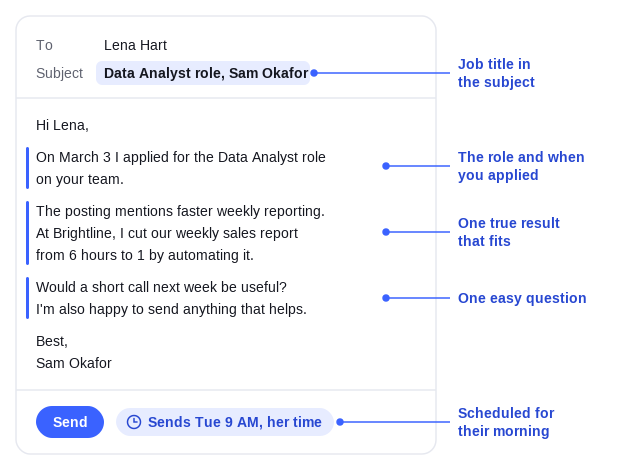
An illustration of a finished follow-up email. The names are made up. Write a subject line they'll recognize
Plain beats clever. Put the job title in it, and your name if it's the first time you write. When you follow up again, reply in the same thread so they see the whole conversation. If the posting shows a job ID or reference number, put it in too.
Try "Following up on my Data Analyst application" or "Senior Product Manager role, Maya Chen".Send it on a weekday morning, their time
An email that lands at the start of their day sits near the top of the inbox, not under a night of other mail. If they're in another time zone, write it now and schedule it. Gmail and Outlook both let you choose when it goes out.
Follow up once more, then stop
If a week passes with no reply, send one different, shorter note in the same thread. If that gets nothing too, stop writing and move on. If they reply with a no, thank them: it costs one minute and keeps the door open for the next role.

How long to wait after applying, and why the advice disagrees.
Two emails, two clocks. Most advice mixes up two different emails. A status check with the recruiter needs the first review to have happened, so it waits 1 to 2 weeks. A short note straight to the hiring manager can go after 3 to 5 working days, while the pile is still fresh.
Employers split, too. When Accountemps asked more than 300 US HR managers how long to wait after sending a resume, 29% said under a week, 36% one to two weeks, 25% two to three weeks and 10% longer. None said don't follow up.
Two weeks is the useful line. In a huge US hiring experiment (83,000+ applications to entry-level jobs at 108 Fortune 500 companies), about 1 in 4 applications heard anything from the employer within 30 days, and most of that contact came within 14 days. After two weeks of silence the odds have dropped, and it's time for your check-in.
The job posting rarely tells you. Advice says to wait for the posting's own hiring timeline, but fewer than 1 in 100 of the 1,204 job postings Blynk read from its searches for product roles in November 2026 say when you'll hear back (4 of them). So you'll usually need the default.
Wait longer, or go sooner. Give it about 2 to 3 weeks for senior or executive roles, and about a week after a stated closing date. Go sooner if you have another offer.
Emailing the hiring manager after applying, and how it differs from a check-in.
It's a different email. A check-in asks where your application stands in the hiring process. A note to the hiring manager gives them a reason to look: why this team, and one result that fits. That's why it can go sooner.
Is it OK? Yes, once, unless the posting asks you not to. To be honest, not every hiring manager welcomes it, and nobody has measured that a note changes your odds. Employers say candidates should follow up, so keep yours short enough that it costs them nothing to read.
If someone referred you, name them in the first line. Toptal suggests writing about 3 to 5 days after a referral. The referral template below does it for you.
If you applied internally, our advice is to tell your own manager first and follow your company's rules for internal moves. After that, a short note to the hiring manager is normal.
The template "Emailing the hiring manager" below has the words, and step 2 above shows how to find them.
Status, resume or phone call? Three follow-up questions, settled.
"Submitted" or "Under review" doesn't mean what it says. Each employer sets its own labels. At one Workday employer (UW-Madison), you see "Submitted" for the whole review stage and "In Progress" for every later active stage, a phone screen doesn't change it, and a status change sends you no notice. Greenhouse shows candidates only "active" or "inactive", and only if the employer turns it on; you go inactive after a rejection is sent. So a status that hasn't moved isn't a no: follow your clock, not the portal.
Attach your resume, or not? Sources disagree: Indeed and Toptal say attach it, DearHiringManager says offer it instead, and no survey settles it. Our advice: the recruiter already has it in their hiring system, so don't send it again unless they ask. A hiring manager may never have seen it, so a link, or one small PDF, is fine.
Email or call? Email first: in the Accountemps survey, 64% of US HR managers preferred email, 21% a phone call and 14% in person (in Canada, 46% email and 39% phone). Indeed suggests a call as an option once a week has passed with no response to your email. Our advice is to call once, in a professional, friendly tone, and keep it to one line, such as "Hi, this is [name]. I applied for the [Job title] role on [date] and wanted to ask if there's an update on next steps."
Seven follow-up emails, ready to copy.
Swap the [square brackets] for your details. Keep your result true and specific; one real number beats three adjectives.
Checking in with the recruiter, 1 to 2 weeks after you apply
To the recruiter or whoever posted the job. Subject line: Following up on my [Job title] application
Hi [First name],

I applied for the [Job title] role (job ID [number]) on [date] and wanted to check in. I'm still very interested, and my experience with [something the posting stresses] lines up closely with what the team needs.

Is there an update on next steps, or anything else I can send you?

Thanks,
[Your name]
Emailing the hiring manager, 3 to 5 working days after you apply
To the person who runs the team. Subject line: [Job title] role on your team, [Your name]
Hi [First name],

I recently applied for the [Job title] role on your team. The posting talks about [one thing the team needs]. In my last role I [one true result, with a number if you have one].

Would a short call next week be useful? I'm also happy to send anything that helps.

Best,
[Your name]
[Link to your LinkedIn profile]
[Link to your resume]
When someone at the company referred you
To the hiring manager, 3 to 5 working days after you apply. Subject line: [Referrer's name] suggested I reach out about the [Job title] role
Hi [First name],

[Referrer's name] on the [team] team suggested I get in touch. I applied for the [Job title] role on [date], and [Referrer's first name] thought my work on [one relevant project] would be useful to your team.

In my last role I [one true result, with a number if you have one]. Would a short call next week be helpful?

Best,
[Your name]
When you have something new to share
Any time before they decide, if it's real news. Reply in the same thread as your last email.
Hi [First name],

A quick update on my application for the [Job title] role. Since I applied, I [finished the certification, shipped the project or published the piece], which ties directly to [something the posting asks for].

Here's the link in case it's useful. [Link]

Is there anything else I can send you?

Thanks,
[Your name]
The last follow-up, when there's no reply
A week after your first one. Reply in the same thread, so the subject stays the same.
Hi [First name],

I wanted to follow up once more on the [Job title] role. If the timing isn't right or the role has moved on, no problem at all. I'd still be glad to hear about anything similar on your team.

Thanks again,
[Your name]
After an interview, when the date they gave has passed
A day or two after the decision date they mentioned. Reply to your last email with them.
Hi [First name],

Thanks again for talking with me about the [Job title] role on [day]. You mentioned hoping to decide by [date], so I wanted to check in.

I'm still excited about the role, especially after hearing about [one thing from the interview]. Is there an update on your decision, or anything else I can share?

Best,
[Your name]
After a rejection, to stay in touch
Within a day or two of hearing no. Reply to their email.
Hi [First name],

Thank you for letting me know, and for considering me for the [Job title] role. I'm disappointed, but I enjoyed learning about [the team or the company].

If a similar role opens up, I'd love to be considered. And if you have a minute to share any feedback, I'd find it really helpful.

All the best,
[Your name]
A follow-up email that gets ignored, and what's wrong with it.
Hi,
I applied for a position at your company a few days ago and haven't heard anything back. I'm just checking in to see if you've looked at my application yet. I've attached my resume and cover letter again in case you missed them. Please let me know as soon as possible.
Thanks
No name. "Hi," usually means a shared inbox, which nobody owns.
"A position." They may be hiring for several, so now they have to look you up.
"A few days ago." Too soon for a status check. Give it 1 to 2 weeks.
Nothing new. No result, so no reason to open your application.
"Again in case you missed them." The recruiter already has your files, and the line reads as a complaint.
"As soon as possible." A deadline for a stranger. The tone turns pushy.
The fix is the second template above: the role, one result, one easy question.
Following up, do this, not that.
Do
- Write to a named person, not the careers inbox.
- Name the exact role, so they don't have to look it up.
- Add one true result that matches the posting.
- Keep it under 100 words.
- Reply in the same thread when you follow up again.
- Thank them, even when the answer is no.
- Check the address before you send.
Don't
- Follow up the day after you apply.
- Send more than two follow-ups.
- Ask "Did I get the job?" Ask about next steps instead.
- Send your resume again to a recruiter who already has it.
- Write to everyone on the team at once.
- Guilt-trip them or set a deadline.
- Get in touch at all if the posting asks you not to.
Questions about follow-up emails, answered.
Is it appropriate to email a hiring manager after applying?
Yes, once, unless the posting asks you not to. In Accountemps' 2017 survey of more than 300 US HR managers, none said candidates shouldn't follow up. Keep it to a few sentences and send it 3 to 5 working days after you apply.
How long should I wait to send a follow-up email after applying for a job?
1 to 2 weeks for a status check with the recruiter, which is the most common answer from employers. 3 to 5 working days for a short note to the hiring manager. Don't leave it much past two weeks: in a study of 83,000+ applications, most of the contact employers made came within 14 days.
How do I professionally say I'm following up?
Open with the role and the date, then give one reason to look. Three openings to copy: "I applied for the [Job title] role on [date] and wanted to follow up." "I'm writing to follow up on my application for [Job title]." "A quick update on my [Job title] application." Avoid "just checking in" on its own, since it gives them nothing to answer.
How do I write a follow-up email after submitting my job application?
Five parts, under 100 words: a subject line with the job title, the role and when you applied, one true result that fits the job posting, one easy question about next steps, and your name. A real result shows continued interest better than saying so. The templates above are ready to copy.
How do I politely ask for an update on an application?
Ask about the timeline or next steps, not about yourself: "Is there an update on the timeline for the [Job title] role?" Ask once, after 1 to 2 weeks, and offer to send anything that helps. If there's no response, send one shorter note a week later, then stop.
How do I politely ask if I've been hired?
Don't ask "Did I get it?" Ask about the decision, once, just after the date they gave you: "You mentioned hoping to decide by [date]. Is there an update, or anything else I can share?" If they gave no date, our advice is to ask the same way about a week after the interview. The after-interview template above has the full email.
How do I message a hiring manager after applying?
By email, if you can find and check their work address. On LinkedIn, if the job lists them under "Meet the hiring team". On a free account, LinkedIn lets you add a note to only a few connection requests a month, up to 200 characters each, so keep it to the role and one result. Our guide on how to find the hiring manager shows where to look.
Should I send a thank-you email after an interview?
Yes, within 24 hours. In a 2017 Accountemps survey, 80% of HR managers said thank-you messages are considered in hiring, yet they said only 24% of candidates send one. Mention one thing from the conversation.
What is the 70/30 rule in hiring?
It's an informal rule of thumb with two meanings, and neither is a standard. TestGorilla describes hiring someone who meets about 70% of the requirements and developing the other 30% on the job; Homebase describes basing 70% of the decision on skills and experience and 30% on team fit. For your follow-up: if you meet most of the must-haves, apply, and open with the result that covers the biggest one.
Can a tool write and send my follow-ups?
Gmail and Outlook can schedule an email you've written to go out later. Blynk also writes it: paste the job link, and it finds the people hiring, writes the note and two polite follow-ups from your resume, and sends nothing until you approve each one.
Where the facts come from.
Checked in November 2026. The advice is ours; facts about LinkedIn, Gmail, Outlook, Greenhouse and Blynk come from each company's own pages, Workday statuses from UW-Madison's HR guide, and the survey and study figures from their publishers. The posting count is Blynk's own: 1,204 job postings from Blynk's searches for product roles, most of them senior, from company career sites and job boards, first seen between October 31 and November 11, 2026, each read for a stated time to hear back.
- How to find the hiring manager
- The best AI job application tools
- What “under review” really means
- How to reach out to a recruiter
- Following up after the interview
- LinkedIn Help: Meet the hiring team on job posts
- LinkedIn Help: personalize invitations to connect
- Gmail Help: schedule emails to send later
- Microsoft Support: delay or schedule sending email in Outlook
- Blynk Find the Hiring Manager
- Blynk pricing
- Accountemps (Robert Half): The Art of Following Up, 2017
- Accountemps Canada: The Art of Following Up, 2017
- Accountemps (Robert Half): thank-you notes survey, 2017
- Kline, Rose and Walters: Systemic Discrimination Among Large U.S. Employers (NBER)
- UW-Madison HR: candidate view by Workday application status
- Greenhouse Support: MyGreenhouse application tracking
- Indeed: how to write a follow-up email after a job application
- Toptal: follow-up email after applying
- DearHiringManager: emailing the hiring manager after applying
- TestGorilla: skills-based hiring and the 70/30 rule
- Homebase: hiring process steps and the 70/30 rule
