
How to do an informational interview. Ask for 20 minutes. Bring five questions.
If you've been told to network, and asking a stranger for their time feels awkward, this makes it simple. Who to ask, what to write, the informational interview questions worth bringing, and what to send after.

The short answer
- It's a short chat, not a job interview: 15 to 30 minutes with someone who does the work you want. You ask, they talk.
- Ask for 20 minutes, with a reason: who you are, why them, and that you want their advice, not a job.
- Bring five questions, end on time, and thank them the same day. Before you go, ask who else you should talk to.
On this page
Why informational interviews work, and why people say yes.
The worries are normal, and each one has a simple fix.
“Why would a busy stranger say yes?”
Wikipedia's entry puts it plainly: the person you ask "is doing a favor". So make the favor small. In our reading, a clear request for 20 minutes is far easier to accept than "Can I pick your brain?"
What to do: Ask for little, and say why them. One reason you chose this person, one time limit, one topic.
“I don't know anyone in that field.”
You may not need to. In a LinkedIn experiment with about 20 million members, published in Science in 2022, moderately weak ties were the most useful for job moves. Usefulness peaked at about 10 mutual connections. The study measured job moves, not informational interviews.
What to do: Start with people you half-know. Old colleagues, alumni from your school, friends of friends.
“How do I ask without sounding like I want a job?”
Say it plainly. UC Berkeley's career center advises: "Emphasize that you are looking for information, not a job."
What to do: Ask for advice, not a role. If a real role is open on their team, don't hide it. What to do then is further down.
“What if I don't know what to ask?”
You need fewer questions than the long lists suggest. A Berkeley career webinar says to "aim to cover 4–6 questions", and Stanford's alumni guide suggests five to seven.
What to do: Bring five. Put the one you most need answered first.
How to ask for an informational interview, step by step.
Most of the work happens before you write a word: picking the right person.
Pick one person who does the work you want
Look for someone one or two levels above the role you'd like, in the team you'd like to join. That's our advice: they remember the step you're trying to take, and they know how their team hires. Coursera suggests people with "several years of experience". Job postings can point you to them. In 1,204 job postings Blynk read from its searches for product roles in November 2026, about 1 in 5 said who the role reports to, and fewer than 1 in 200 gave a person's own email.
Moving into UX research? A senior researcher or research lead is a better first ask than the head of design. Our guide to finding the hiring manager shows how to work out who leads a team.Look for a warm path first, then go cold
Try people you share something with first: your school's alumni directory, old colleagues, or a friend who can introduce you. Indeed also suggests LinkedIn and professional organizations. If there's no link at all, a cold message is fine. Just keep it even shorter.
Write a short ask: who you are, why them, 20 minutes
UPenn's career services says a request is "just 2-3 short paragraphs". Put in how you found them, a clear ask, a little about you, flexible times, and the kinds of questions you'd ask. It also suggests leaving formal terms like "informational interview" out of the message. Ask for 20 minutes by video, phone or in person, and let them pick the time. Here's a finished one, with its parts labelled.
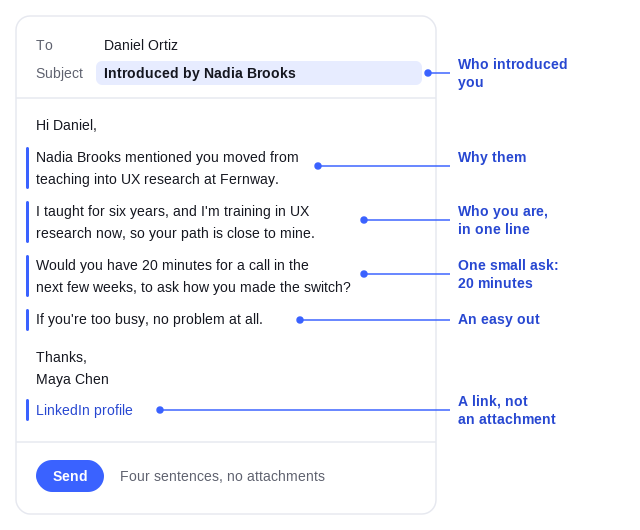
An illustration of a finished request. The names are made up. No reply? Follow up once, after about a week
The advice varies. Mac's List suggests three emails in all, four or five business days apart, then stop. Coursera says to follow up in a week or two. Our advice: one polite nudge after about a week, in the same thread. Then let it go, and ask someone else.
Once they say yes, confirm and keep it light
Send a short confirmation with the time, the format and a link if it's a video call. Yale's career office suggests a confirmation, and arriving 10 to 15 minutes early if you meet in person. In our advice, don't send a long list of questions or your resume ahead. One line on what you'd like to ask is enough.

Informational interview requests, three to copy.
Swap the [square brackets] for your details, and keep each one this short. On LinkedIn, the connection note is the ask itself. LinkedIn's help page, checked on November 12, 2026, says "Each message can be up to 200 characters". Without Premium, you can add a personalized message to up to three connection requests per month. For a referral ask, see our networking email templates.
When someone introduced you
Email. Subject line: Introduced by [Mutual contact's name]
Hi [First name],

[Mutual contact's name] suggested I write to you. I'm [one line on who you are], and I'm exploring [field or role]. Your work on [something specific they've done] is close to what I'd like to do next.

Would you have 20 minutes for a call in the next few weeks? I'd like to ask how you got into [field] and what you'd focus on in my place. Any time that suits you works for me.

If now's a busy time, no problem at all.

Thanks,
[Your name]
[Link to your LinkedIn profile]
A cold LinkedIn connection note
165 characters with the brackets in. Short details keep it under the limit; count before you send.
Hi [First name], I'm moving into [field] and your path from [their earlier role] stood out. Would you have 20 minutes in the next few weeks for 3 questions about it?
A cold email
No mutual contact. Subject line: [Your school or field]: a question about [their team or role]
Hi [First name],

I found you through [where: your school's alumni directory, a talk, a post]. I'm [one line on who you are], and I'm trying to learn how people get into [role or field].

Would you have 20 minutes for a call in the next few weeks? I'd like to ask three questions about your path and your team.
[Only if a role is posted on their team: I also saw the [Job title] opening on your team, and I'd value your view of the work before I apply.]

If you're too busy, I completely understand.

Thanks,
[Your name]
[Link to your LinkedIn profile]
Informational interview questions to ask, in four groups.
Pick five, put the one you most need answered first, and let their answers lead you to the next. The groups run in the order we'd ask them.
Their path into the work
Start here. Anyone can answer it, and it warms the call up.
How did you get into this work?
What did you do before this role that helps you most now?
If you were starting today, what would you do differently?The work, day to day
This is what no job description tells you.
What does a normal week look like for you?
What's the hardest part of the job, and the part you enjoy most?
Which skills or tools do you use most?
What's changed most in this work since you started?The team, and how it hires
Ask about the team in general, not about a job for you.
How is your team set up, and who does it work with most?
What do people who do well here have in common?
When your team hires, what matters that a posting doesn't say?Advice for you, and who to talk to next
End here, and always with the last question. One name leads to the next conversation.
If you were in my shoes, what would you focus on first?
Is there a gap in my background I should close before I apply for roles like yours?
Who else do you think I should talk to?
What not to ask in an informational interview.
Their salary. Yale's career office is plain: "Do not ask for their salary." Berkeley's suggests a softer route: name a range you've read, and ask whether it matches what they've seen.
Asking them for a job. Berkeley's Sue Harbour, quoted in a Ladders piece that Georgetown Law reprints, says: "Don't ask for a job or internship." In our reading, it turns their favor into a decision they never agreed to make.
Anything a quick search answers. Coursera's advice is to ask only what your research can't answer. "What does your company do?" tells them you didn't look.
Anything personal. In the same Ladders piece, Amanda Nachman notes that even salary "can be perceived as a personal question". Our advice: skip family, age and health, and anything you wouldn't ask a new colleague.
During the informational interview, let them talk and watch the clock.
Start with a few lines on you, then your first question. You asked for the call, so you lead it. Stanford's alumni guide says you keep the conversation going and watch the time.
Let them talk. Yale's career office suggests asking for stories, asking why, and allowing silence. Take short notes, so your thank-you can name something they said.
End on time, even if it's going well. Berkeley's advice: "Limit the meeting to the agreed-upon timeframe." Ours: at 20 minutes, offer to stop. If they want to keep going, they'll say so.
If a role is open on their team, say so once. Don't ask them to get it for you. Our advice is one honest line, then a question they can easily answer: "I noticed the Senior Product Manager role on your team. Who would you suggest I talk to about it?"
End with the next name. Ask who else you should talk to, and how they'd like to stay in touch. Stanford's guide offers a line for when nothing is open: "How do you recommend I stay in touch to learn about future openings?" Then thank them, and stop.
After the informational interview, the two notes to send.
Send the thank-you the same day, while the call is fresh. Indeed says within 24 hours and Berkeley within one to two days; same-day is our advice, inside both. Weeks later, close the loop: Berkeley's webinar and Stanford's guide both suggest telling them how things turned out. For thank-yous after a job interview, see our follow-up email after an interview guide.
The thank-you, the same day
Email, or a LinkedIn message if that's where you talked. Subject line: Thank you, [First name]
Hi [First name],

Thank you for your time today. Your point about [one specific thing they said] was the most useful thing I've heard about [field] so far, and I'm going to [what you'll do with it].

I'll get in touch with [the person they suggested], as you recommended.

Thanks again,
[Your name]
Closing the loop, a few weeks later
Same thread. Tell them what you did with their advice.
Hi [First name],

A quick update since we spoke in [month]. I took your advice and [what you did: a course, a project, a talk with the person you suggested]. [One line on how it went.]

Thank you again for pointing me there. If I can ever return the favor, I'd be glad to.

Best,
[Your name]
Informational interview vs job interview: eight questions people mix up.
In a job interview, they're deciding about you. In an informational interview, you ask, and nobody decides anything. Google shows these job-interview questions with this search, so here's what each means here.
What is the 30-60-90 rule in an interview? It usually means a 30-60-90 day plan: a short outline of what you'd do in your first three months. Career sites such as the Corporate Finance Institute describe it. Here, ask what their own first 90 days involved.
What is the 80/20 rule in interviewing? A rule of thumb, described by Mind Tools for interviewers, that the candidate talks about 80% of the time. We found no study behind it. Here it flips, in our advice: they talk most.
What is the biggest red flag to hear when being interviewed? Lists vary, and we found no study. Here, in our advice, the red flag is yours to avoid: asking for a job.
What are signs you didn't get the job? There's no job to get here. In our reading, the call didn't land if you leave with no names and no offer to stay in touch.
What are the signs that you are hired? In our reading, the reliable signs in a job interview are things they do, like checking references. Here, a good sign is a name to talk to next.
How do you know you blew an interview? Here, you ran over, had no questions, or asked for the job. Send a specific thank-you anyway, in our advice.
What are five interview killers? There's no single list. Ours for this kind of call: arriving late, no questions ready, talking about yourself, running over, and no thank-you.
What is the biggest failure interview question? It's "Tell me about your biggest failure". Here, turn it around and ask them: "What's a mistake you made early on that you'd warn me about?"
Informational interviews: do this, not that.
Do
- Ask one person for 20 minutes, and say why them.
- Read up on them before the call.
- Bring five questions, the most important first.
- Name an open role honestly, if there is one.
- End on time.
- Thank them the same day, and close the loop later.
Don't
- Open with "Can I pick your brain?"
- Ask for a job or a referral in your first message.
- Ask about their salary.
- Ask what a quick search would answer.
- Send a long list of questions or your resume ahead.
- Chase more than once if they don't reply.
Questions about informational interviews.
What is an informational interview?
A short, informal conversation with someone who does work you're curious about, to learn what it's really like. You ask the questions, they talk, and nobody is hiring anyone. Wikipedia credits the term to Richard Nelson Bolles, author of What Color Is Your Parachute?
Does informational interview mean I got the job?
No. It isn't a job interview, and there's no job on the table. Yale's career office says one may lead to a job offer, but that isn't the main goal. Wikipedia notes it can turn formal if the person is a potential employer weighing you up. So prepare as if it matters, in our advice.
How do you politely ask for an interview?
Keep it short and specific. Say how you found them, why you picked them, and what you'd like: 20 minutes, at a time that suits them. Add an easy out, such as "If now's a busy time, no problem." The three request templates above are ready to copy.
How to prepare for an informational interview?
Read up on the person and their company, pick five questions from the list above, and practise a short introduction. Berkeley's career webinar suggests a 30-second one. Say who you are, what you're exploring, and why you picked them. On a video call, test your link first.
What do I ask in an informational interview?
Ask what only they can answer: how they got into the work, what a normal week looks like, how their team hires, and what they'd do in your place. Open questions get stories; yes-or-no questions get yes or no. Always end with "Who else do you think I should talk to?"
What are the top 10 questions typically asked in an informational interview?
There's no official list. These ten cover most calls: how they got into the work, a normal week, and the hardest and best parts of the job. Then the skills that matter, how the team is set up, what people who do well there share, and what's changed since they started. End with what they'd focus on in your place, and who else you should talk to.
What should you not ask during an informational interview?
Their salary, whether they can get you a job, anything a quick search would answer, and anything personal. What career offices say about each is in the section above.
How long should an informational interview be?
Ask for 20 minutes, plan for 15, and end on time. That's our advice, and it sits inside what others suggest. Wikipedia says they're often 15 to 20 minutes, Indeed and Coursera say most last 20 to 30, and Mac's List says no more than 30. One Indeed page says to ask for about an hour, then says they may only have 15 or 30 minutes.
How do I ask for an informational interview on LinkedIn?
Send a connection request with a note, and make the note the ask itself: who you are, why them, and 20 minutes. The LinkedIn template above fits the limit. If you've used your personalized notes for the month, connect without one and send your ask once they accept. Or email them instead.
Do I need a resume, and what should I wear?
Bring a resume, but don't hand it over straight away, as Berkeley's career center advises. The call is about their work, not a review of yours. For what to wear, our advice: dress the way people in that job do on a normal day, or one step smarter.
Where the facts come from.
Checked in November 2026. The advice is ours, and marked as ours. What career offices and other guides recommend comes from their own pages, LinkedIn's limits from LinkedIn's help center, the weak-ties study from MIT's report of the paper in Science, and facts about Blynk from its own pages. The posting count is Blynk's own: 1,204 job postings from Blynk's searches for product roles, most of them senior, from company career sites and job boards, first seen between October 31 and November 11, 2026, each read for a reporting line and for email addresses.
- How to find the hiring manager
- Cold email for a job
- How to reach out to a recruiter
- Follow-up email after an interview
- How to ask for a coffee chat
- How to change careers
- How to write a 30-60-90 day plan
- UC Berkeley Career Engagement: informational interviews
- UC Berkeley Career Engagement: informational interview questions
- Berkeley Voices: informational interviewing webinar (2019)
- Yale Office of Career Strategy: informational interviewing
- Stanford Alumni: acing the career conversation
- Penn Career Services: requesting to connect for an informational interview
- Mac's List: 5-step checklist for scheduling informational interviews
- Coursera: how an informational interview works
- Indeed: informational interview questions
- Indeed: how to prepare for an informational interview
- Wikipedia: informational interview
- Georgetown Law: informational interview questions (reprint from Ladders, 2020)
- LinkedIn Help: personalize invitations to connect
- MIT News: the strength of weak ties on LinkedIn (2022)
- Rajkumar et al.: a causal test of the strength of weak ties (Science, 2022)
- Mind Tools: the 80/20 rule in interviews
- Corporate Finance Institute: 30-60-90 day plan
- Blynk Find the Hiring Manager
