
How to tailor your resume to a job description. Without an hour a job, and without making anything up.
If you're sending the same resume everywhere, you probably know you should tailor it, and that it takes ages. Tailoring isn't rewriting your story for every job. It's choosing, ordering and rewording what you've really done around what the job description asks for. Here's how, step by step.

The short answer
- Tailoring is choosing and rewording, not inventing. Put the experience the job asks for first, in its own words, and cut what it doesn't care about.
- Start from the job description: mark its must-haves, match each one to a real result, then rewrite your summary, the top bullet of each role and your skills list.
- Short on time? Do the quick version for every job (summary, top bullets, skills, the cover letter's first line) and all nine steps for the jobs you really want.
On this page
Why one resume stops working, and why tailoring fixes it.
Four common frustrations with sending one resume everywhere, and what tailoring does about each.
“I apply and never hear back.”
A general resume leaves the reader to work out whether you fit, and they're reading a lot of them. In a 2018 Ladders study, recruiters' initial screen of a resume averaged 7.4 seconds, and they looked at job titles more than at anything else.
Fix: Put the proof this job asks for at the top. The first lines of each role should answer what the job asks for.
“The software screens me out.”
More than 90% of employers in a Harvard Business School and Accenture survey use their hiring software to filter or rank applicants first. Recruiters also search it by the job description's own words. If your resume says the same thing differently, you may never come up.
Fix: Use the job's words for work you've really done. Same experience, their vocabulary.
“It takes an hour a job.”
Rewriting from scratch for every job is slow, so it's the first thing to slip when you're tired.
Fix: Keep a master list and choose from it. Tailoring then becomes picking and rewording, not writing.
“I'm not sure how far I can stretch it.”
There's a line between presenting your experience well and claiming experience you don't have.
Fix: Reword and reorder; never add. If you couldn't talk about a line for two minutes in an interview, it doesn't go on. The line, shown on one bullet, is below.
How to tailor your resume to a job description, in nine steps.
Work through them in order, with the job description open beside your resume. The first one is the slowest; after a few, you're mostly choosing, not writing.
Read the job description twice
First for the story: what problem is this team hiring someone to solve? Then for the detail, in the order West Virginia University's career center suggests: the qualifications first (read them as requirements), then the responsibilities, then the overview. Note the skills, tools, results and phrases it repeats. Skip the parts about culture and benefits for now.
Mark the must-haves and the nice-to-haves
Split what it asks for into the two. If it doesn't say which is which, treat the requirements section, and anything it says more than once, as must-haves; words like "preferred", "a plus" or "bonus" mark a nice-to-have. CareerOneStop is a career site sponsored by the US Department of Labor. If you're applying for several similar roles, it suggests reading 10 to 15 postings and listing the requirements that come up most.
A requirements line (an example): "Experience running A/B tests and pricing experiments; comfortable with SQL."
Must-haves: A/B testing, pricing experiments, SQL.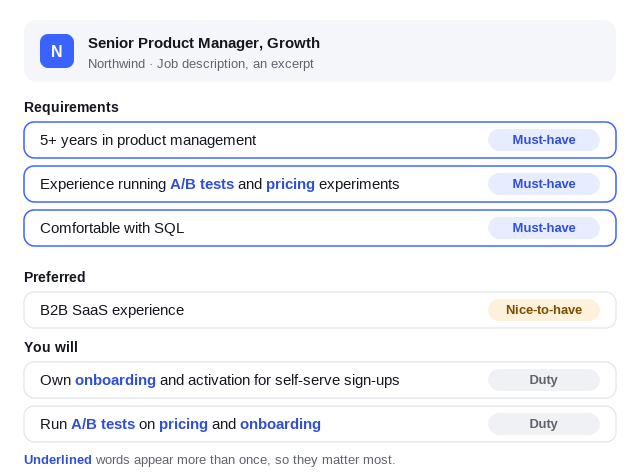
An illustration of a job description with its must-haves marked. The company is made up. Match each one to something you've really done
Next to each must-have, write the result from your own work that proves it. If you have nothing for one, leave it blank. That's a gap to be honest about in an interview or cover letter, not a bullet to invent. It isn't automatically a reason to skip the job, either (see missing a must-have).
Rewrite your summary for this job
Two or three lines: the kind of role you're going for, your strongest proof for it, and one thing that sets you apart. Drop anything in your summary that was written for a different job.
Move the most relevant bullet to the top of each role
Reorder before you rewrite. Whoever reads your resume sees the first lines of each role first, so lead with the result that matches this job's must-haves.
Use the job description's words for your work
Where it names something you've done, use its exact term: CareerOneStop warns that a different wording "may fail to be recognized" as the same qualification. Use each term once to three times, and only where it's true, as the University of Arizona advises. Keep your real job titles and numbers exactly as they are; our guide to which keywords to use goes further.
Trim what doesn't matter, and move education up if it's asked for
Cut or shorten bullets that don't speak to this job, especially in older roles. If the job requires specific credentials, Tulane's career advice is to move your education section higher. A tighter resume puts more of the right proof where it will be read.
Check the skills section
List the tools and skills it asks for that you really have, spelled the way it spells them ("Salesforce", not "CRM software", if that's what it says). Take out ones this job doesn't need. Leave off anything you couldn't answer questions about.
Write the cover letter's first line
Open with the role and your strongest match for it, not "I am writing to apply". The rest of the letter follows from the must-haves you matched in step 3.
An example: "You're hiring a product lead to grow self-serve revenue. For the last three years, I've run the pricing and onboarding experiments that did that at my current company."

The habit that makes it fast: keep a master resume with every role and every bullet you've ever written, real numbers included. Tailoring a new job then starts from choosing, not writing.
A tailoring worksheet, for any job description.
Copy it, paste it next to the posting, and fill in the blanks. When it's done, your edits are already decided.
Tailoring worksheet
One per job. Fill it in before you touch your resume.
Job: [Title] at [Company]
What this team needs solved: [One sentence]

Must-have 1: [What the job asks for]
My proof: [A real result, with the real number]

Must-have 2: [What the job asks for]
My proof: [A real result]

Must-have 3: [What the job asks for]
My proof: [A real result, or leave it blank: that's a gap]

Their words I'll use: [Terms from the posting]
New first line of my summary: [The role + my strongest proof]
Top bullet for each role: [Which result goes first]
Cut for this job: [Bullets that don't speak to it]
Cover letter's first line: [The role + my strongest match]
One job description, tailored: the before and after.
A made-up job and a made-up resume, so you can see every move. The numbers are examples; yours must be your own.
The job description (an excerpt)
A Senior Product Manager, Growth role at Northwind, a made-up company: the one marked up in the illustration above.
Requirements: 5+ years in product management; experience running A/B tests and pricing experiments; comfortable with SQL.
Preferred: B2B SaaS experience.
You will: own onboarding and activation for self-serve sign-ups, and run A/B tests on pricing and onboarding.The worksheet, filled in
Each must-have gets a real result next to it, or stays blank.
A/B tests and pricing experiments: 60 experiments in a year; paid conversion from 4% to 7%.
5+ years in product management: 6 years as a product manager.
SQL: blank. Pulls numbers from Looker dashboards others built.
Nice-to-have, B2B SaaS: none, so leave it.The summary, before and after
The role and the strongest proof for this job come first; the general line goes.
Before: Product manager with experience across many industries and a passion for great products.
After: Product manager for 6 years. Ran 60 pricing and onboarding A/B tests in a year that lifted paid conversion from 4% to 7%.Three bullets, before and after
Reorder first, then reword. The numbers mark which old bullet became which. What changed: the order, and the job's own words. The facts and numbers are the same, and nothing was added.
Before:
1. Managed the new-user onboarding roadmap, including activation, for customers who sign up on their own, with design and engineering.
2. Ran 60 tests on the pricing and onboarding pages over a year, which took paid conversion from 4% to 7%.
3. Used Looker dashboards to track how many new sign-ups became active users.
After, in the new order:
2. Ran 60 pricing and onboarding A/B tests in a year, lifting paid conversion from 4% to 7%.
1. Managed the onboarding and activation roadmap for self-serve sign-ups, with design and engineering.
3. Tracked activation of self-serve sign-ups in Looker dashboards.The skills line, before and after
SQL stays off. What to do about that gap is below.
Before: Product strategy, Agile, analytics, CRM software
After: A/B testing, pricing experiments, onboarding and activation, Looker
How long tailoring takes, and when the quick version is enough.
No study has timed it. Indeed estimates that once you have a primary resume, tailoring "typically takes 10 to 20 minutes". On Reddit, job seekers describe spending 20 to 45 minutes tailoring each application, and 5 to 10 minutes once they work from a base resume. In our reading, the master resume is what makes the difference.
The quick version, for every job: rewrite the summary, move the right bullet to the top of each role, update the skills line and write the cover letter's first line.
The full version, for the jobs you really want: all nine steps and the worksheet.
Ten applications that fit, each done properly, beat a hundred that don't.
Tailoring or lying? Where the line is, on one bullet.
The worry behind most tailoring questions is simple: can I just copy the job description in? No. It tells you which of your real experience to put first, and which words to use for it. It doesn't tell you what to claim.
Take the SQL must-have from the example above. The candidate has never written SQL, but does track activation in Looker dashboards. Three versions of the same line:
Tailored (true): "Tracked activation of self-serve sign-ups in Looker dashboards." The job's words, where they're true.
Stretched: "Used SQL and Looker to analyze activation." It sounds close, but the candidate didn't write the SQL, and one interview question shows it.
Invented: SQL added to the skills list.
The test: could you talk about the line for two minutes in an interview? CareerOneStop says to use a posting's exact terms only for skills you have, and the Ladders study lists keyword stuffing among the traits of the worst-performing resumes.
Missing a must-have? What job descriptions really ask for.
It's easy to read a job description as a checklist you have to complete. Many aren't written that way. Here's what we found in 190 job postings Blynk read line by line in November 2026, mostly for senior product roles.
About half (96 of 190) mark anything as required in so many words. 7 in 10 mark at least one ask as only preferred or a plus. About 1 in 13 (15 of 190) say outright to apply even if you don't match every requirement. And a typical one asks for 9 things.
Degrees work the same way. Of the 345 postings that ask for a degree, out of 1,070 Blynk checked, about 1 in 4 accept equivalent experience instead.
What to do about a gap: don't write it in. Show your nearest true proof, as the example's Looker line does. If the posting says "or equivalent experience", your experience is the answer. If you have real proof for most of the must-haves, the gap alone isn't a reason to skip the job; speak to it in the cover letter or the interview.
Format your tailored resume so the hiring software can read it.
An applicant tracking system (ATS) is the employer's hiring software: it holds every application, and recruiters search and filter it. Wording matters there. In the Harvard Business School and Accenture survey, 88% of employers agreed that qualified high-skills candidates get filtered out because they don't match the job description's exact criteria.
Formatting matters too, because the software has to read your file before anyone can search it. Keep to one column, and leave out tables, text boxes and graphics. Put your contact details in the body, not in a header or footer. Use standard section names, and spell titles out ("Senior Account Executive", not "Sr. Account Exec").
Upload a .docx or PDF under 2.5MB; Indeed says .docx may be the safer choice. Name the file with your name, the job title and "resume". The full list is in our ATS-friendly resume guide.
To see how yours reads against one specific job, a free ATS check reads it the way hiring software does and checks it for the job's keywords.
Tailoring your resume with ChatGPT or Claude, without made-up lines.
Using AI for this is fine, says CareerOneStop, as long as you edit the draft and "only include true information about you". It warns that AI "can generate great-sounding descriptions that exaggerate your experience or completely falsify your information". Employers sometimes get near-identical AI resumes from different candidates, it adds, and reject them.
Before you paste: take out your phone number and address. In ChatGPT, turn off "Improve the model for everyone" in Settings, under Data controls, or use a Temporary chat. In Claude, whether your chats are used for training is your choice in Privacy Settings, and Incognito chats are never used.
Use the prompt below. It follows Anthropic's own advice for reducing made-up answers: use only what you give it, and quote the line behind each change. It also has the AI ask about your experience first, as CareerOneStop suggests.
Then check every line against your resume, especially dates, titles and numbers. OpenAI says ChatGPT "can produce incorrect or misleading outputs" and to use it "as a first draft, not a final source". Don't ask it whether your resume is good; it can sound confident even when it's wrong.
If you'd rather use a tailoring tool, check what it adds: Careerflow's help center, for one, says its AI may add commonly expected responsibilities or metrics. Look for one that rewrites the whole resume for the job, uses only your real experience and shows every change. We compared nine AI tailoring tools on exactly that.
A prompt to copy, that keeps the AI to your facts.
Written for ChatGPT or Claude. It lists what's missing instead of making it up.
Tailoring prompt for ChatGPT or Claude
Paste it, then add the job description and your resume where it says.
I'm applying for the job below. Tailor my resume to it.

Follow these rules.
- Use only facts from my resume and my answers to your questions. Don't add skills, tools, titles, dates or numbers.
- Keep my job titles, employers, dates and numbers exactly as they are.
- If the job asks for something my resume doesn't show, don't write it in. List it under Gaps instead.
- For every bullet you change, quote the line of my resume or my answer it comes from.
- Before you start, ask me up to 5 questions about my experience.

Then give me these five things.
1. The job's must-haves, most important first
2. A new summary of 2 or 3 lines
3. My bullets, reordered and reworded for this job
4. A skills line, using the job's exact terms where I really have them
5. Gaps

The job description
[Paste it here]

My resume
[Paste it here, without your phone number or address]
Tailor it, don't stretch it: do this, not that.
The line between tailoring and stretching the truth, in one list.
Do
- Use the job's words for work you've really done.
- Use a term once to three times, where it's true.
- Lead each role with the result that fits this job.
- Keep your real numbers exactly as they are.
- Rewrite the summary for every job.
- Save the version you sent with the job it went to.
- Read it once more for typos, and for words left over from the last job, before you send it.
Don't
- Add a skill, tool or title you don't have.
- Round a number up, or invent one, to sound stronger.
- Hide the job's keywords in white text.
- Copy the posting's sentences word for word.
- Send a tool's output without reading every line.
Questions about tailoring your resume, answered.
Can you help me tailor my resume to a job description?
Yes. This page walks you through it: the worksheet and the nine steps above, or ChatGPT or Claude with the prompt above and a line-by-line check. If you'd rather not do it for every job, Blynk rewrites your resume and cover letter for each job only from what you've really done, and shows every change.
What is the 7 second rule in resume?
It isn't a fixed rule. It comes from a 2018 Ladders study, which found that recruiters' initial screen of a resume averaged 7.4 seconds, up from 6 seconds in its earlier study. The study doesn't say how many recruiters took part, which an ERE article pointed out in 2020. What it means for tailoring: keep your real job title at the top of each role, and put the result that fits this job right under it, where the eye lands first.
How should you tailor your resume for a specific job application?
Read the job description twice and mark its must-haves. Match each one to a real result. Then rewrite your summary and move the most relevant bullet to the top of each role. Use the job's words for your work, trim what doesn't matter and check your skills list. Save the version you sent with the job it went to, and name the file with your name, the job title and "resume".
How can I tailor my resume to a job description for free?
By hand, with the worksheet above, it costs only time. ChatGPT has a free plan, and Claude's free plan has usage limits that reset every 5 hours and weekly. If you use either, paste the prompt above, and turn off training on your chats first.
Is tailoring your resume lying?
No. Tailoring is choosing, ordering and rewording what you've really done for the job in front of you. It becomes lying when you add a skill, title, result or number you don't have. A good test: could you talk about every line for two minutes in an interview? There's an example of the line on one bullet above.
What if I don't meet every requirement?
Don't write the gap in, and don't rule yourself out too fast. In 190 job postings Blynk read line by line, only about half marked anything as required, and about 1 in 13 said outright to apply without matching everything. Among the postings Blynk checked that ask for a degree, about 1 in 4 accept equivalent experience instead. Put your nearest true proof first and speak to the gap in the cover letter or interview.
How long should tailoring a resume take?
No study has timed it. Indeed estimates 10 to 20 minutes once you have a primary resume, and job seekers on Reddit describe 5 to 10 minutes once they work from a base resume. Keep a master resume, do the quick version (summary, top bullets, skills, the cover letter's first line) for every job, and all nine steps for the ones you really want.
Should I tailor my resume for every job?
Yes, at least the quick version. Most employers' hiring software filters or ranks applicants first, and recruiters search it by the job's own words. It's also a good reason to apply to fewer jobs that fit, and do each one properly.
What should I change, and what should stay the same?
Change the summary, the order of your bullets, the wording and the skills list. Keep your job titles, employers, dates and numbers exactly as they are. If the job uses a newer name for the same role, there's a simple fix. Dawn Rasmussen, quoted in Andrew Seaman's LinkedIn article, suggests keeping your real title and adding the newer one in parentheses.
Do I need a new cover letter for every job too?
Yes, and it should tell the same story as the tailored resume. Open with the role and your strongest match for it, then back it up with one or two of the results you matched to the job.
Where these facts come from.
Checked in November 2026. The advice is ours; facts about other companies come from their own pages. The job-posting counts are Blynk's own: 190 job postings, mostly senior product roles, read line by line between November 2 and 11, 2026, each line labelled required, preferred or neither by the posting's own words; and 1,070 distinct postings from Blynk's searches for product roles, first seen October 31 to November 11, 2026, checked for a degree requirement and an "or equivalent experience" clause.
- The best AI resume tailoring tools, compared
- ATS-friendly resume: what it means, with a free check
- Resume keywords: how to find the right ones
- ChatGPT resume prompts that don't make things up
- Do you need a cover letter?
- Ladders: eye-tracking study, 2018 (archived copy)
- ERE: is the 6-second resume scan a myth?
- Harvard Business School and Accenture: Hidden Workers, Untapped Talent
- Greenhouse Support: search resumes for keywords
- Greenhouse Support: unsuccessful resume parse
- CareerOneStop: write your resume for current hiring practices
- West Virginia University Career Center: how to tailor your resume
- University of Arizona: tailoring your resume
- Tulane SoPA: 3 tips for tailoring your resume
- Indeed: how to tailor your resume to a job description
- Reddit r/jobsearchhacks: the "tailor your resume for every job" advice is exhausting
- Reddit r/jobsearchhacks: how much resume tailoring is actually enough?
- Andrew Seaman on LinkedIn: how to use job descriptions to tailor your resume
- Anthropic: reduce hallucinations
- OpenAI Help: does ChatGPT tell the truth
- OpenAI Help: data controls in ChatGPT
- Claude Privacy: is my data used for model training
- ChatGPT pricing
- Claude pricing
- Careerflow Help: create a resume with an AI prompt
- Blynk: tailoring (homepage)
- Blynk: free ATS check
- Blynk pricing
