
What a hiring freeze means for your application. And when companies hire the most.
If a recruiter just said the role is on hold, or you're wondering whether to wait until January, this page is for you. Here's what a hiring freeze usually means, what to send, and what the government's own monthly count says about the best time to look.

The short answer
- A hiring freeze is a pause or limit on new hires, often to save money. Many are partial, so some roles still get filled, and a paused role can come back.
- If a role you applied for is frozen, ask one question. Is it paused or closed? Keep the recruiter's name, set a date to check back, and keep applying elsewhere.
- Hiring slows, but it never stops. By the government's count, December had the fewest US hires in 8 of the last 9 years. Yet there were still about 3.9 million in December 2025.
On this page
What a hiring freeze means for your application, and what to do this week.
When a role you applied for is frozen, it can feel worse than a no. Here's what a freeze means for candidates already in the process, and what to do in the first week, in order.
Read the words they used
The wording usually tells you how much of a chance is left. In our reading, on hold or paused means the job may come back. Cancelled or closed means it's off for now. Filled means someone else got it. If your portal says something else, our guide to what “not retained” means covers that label.
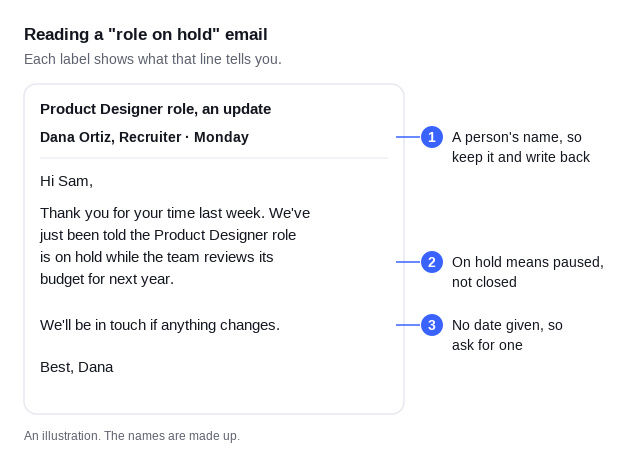
An illustration of a typical on-hold email. The names are made up. Ask one question, paused or closed?
Reply within a day or two, and keep it short. Ask whether the role is paused or closed, and whether you can check back in about a month. In our view, a recruiter can answer that even without an end date for the freeze. The first email below does it in a few lines.
If you had an offer, get the next step in writing
An offer put on hold is the hardest case. 4 Corner Resources advises talking to the hiring manager and HR about how long the freeze may last and whether they'll honor the offer. It notes that some firms bring people on as contractors first, and that an offer is often rescinded when a freeze is announced after it but before the start date. Our advice. Don't give notice at your current job until you have the offer and a start date in writing.
Keep the recruiter's name and a date
The Muse suggests staying in touch with recruiters and asking for timeline updates. Write down who you spoke to, whether a recruiter or someone else on the talent acquisition team, what they said and the date you'll check back. Our guide on how long to hear back after applying has the normal wait at each stage.
Keep applying, to teams still hiring
Many freezes are partial. SHRM notes that some freezes still let mission-critical or revenue-generating roles be filled. So the same company may still be filling critical roles, or hiring in another team, and US employers still make millions of hires every month (BLS). Our advice. Give the frozen role a check-back date, and give your evenings to jobs that are open now.

Two short emails for a hiring freeze, ready to copy.
Swap the [square brackets] for your details, and send each one as a reply in the same thread.
When the role goes on hold
Within a day or two of hearing, to the person who told you.
Hi [First name],

Thanks for letting me know about the [Job title] role. I understand these things change.

Could you tell me whether the role is paused or closed for now? And would it be all right if I checked back around [date, about a month from now]?

I'm still very interested, and I'd be glad to pick up where we left off.

Thanks,
[Your name]
A check-in about a month later
On the date you set, in the same thread. Shorter than the first.
Hi [First name],

When we spoke on [date], the [Job title] role was on hold, and I said I'd check back around now.

Has anything changed? If the team is hiring for something close to it, I'd be glad to hear about that too.

Best,
[Your name]
What is a hiring freeze? A pause on new hires, often partial.
A hiring freeze is a temporary pause or limit on hiring new employees. It can cover the whole company, specific departments, or only new positions, while existing employees stay. Here are the types, why companies implement them, what they mean for the team inside and how long they last.
Full, partial and department freezes
In a hiring freeze, writes SHRM, the Society for Human Resource Management, all open requisitions for hire are put on hold. No new positions are created, and roles left by people who quit stay empty, which Factorial calls a full freeze. Some companies add exceptions, so only revenue-generating or mission-critical roles can be filled, which Factorial calls a partial freeze, since essential roles are still filled. Factorial also lists a department freeze, where only specific departments stop hiring. SHRM describes a headcount freeze, where a company keeps its current number of full-time staff, and Recrew a backfill-only one, where only people who leave are replaced.
Why companies freeze hiring
HR guides give the same few reasons. A company wants to reduce costs during a downturn or financial trouble, waits out economic uncertainty, or is going through restructuring, a merger or an acquisition. Sometimes a freeze is a way to avoid layoffs, by holding the budget steady while keeping the current workforce. In a crisis, freezes spread fast. In March 2020, as the COVID pandemic began, a Willis Towers Watson survey found that 42% of 812 mostly large North American employers had frozen or reduced hiring, as Recrew reports it.
What a freeze means for the team inside
HR pages note that a freeze often increases the workload for existing employees, since the work of open roles gets shared out, and that it can hurt morale. Our advice. If you interview with a team that has just come out of a freeze, ask how the work has been shared and what the new person would take on first. It's a fair question, and the answer tells you a lot.
How long a hiring freeze lasts
There's no official average. Some pages say 3 to 6 months but give no source, and we found no study. The best-documented freeze, the US federal one, ran by that name from January 20 to October 15, 2025, about nine months. Then it turned into a committee approval process rather than ending, as the next section shows. Our advice is to ask, and to plan as if it could be months.
A hiring freeze isn't a layoff
A freeze stops new hires. A layoff cuts current jobs. HR glossaries agree they're different things. Some pages say a freeze can sometimes signal cuts to come, but we found no data showing that one predicts the other.
Is there a hiring freeze in federal agencies? Not by that name, but most vacancies need approval.
Here's the US federal government's freeze as it stands on November 12, 2026, from the White House's and OPM's own pages, in date order. It covers federal civilian jobs, not private employers.
January to October 2025, a named hiring freeze
A presidential memorandum on January 20, 2025 froze hiring of federal civilian employees across the executive branch. Positions vacant that day couldn't be filled, and no new ones could be created. The military, immigration enforcement, national security and public safety were exempt. On April 17 it was extended to July 15. A July 7 memo kept a similar rule in place until October 15, 2025, though a hire approved in writing by a department head could go ahead after notice to OPM.
Since October 15, 2025, Executive Order 14356
Executive Order 14356, “Ensuring Continued Accountability in Federal Hiring,” replaced the freeze. No vacant civilian position may be filled or created except as the order allows or the law requires. Each agency sets up a Strategic Hiring Committee that approves each vacancy, and agencies write yearly staffing plans. The same groups are exempt, plus a few more, such as the Executive Office of the President.
Staffing plans, and a one-for-four rule until they're in
Guidance from OPM and OMB on November 5, 2025 told agencies to keep the July rules until they submit their staffing plans. That includes Executive Order 14210's limit of no more than one hire for every four employees who leave. On July 30, 2026, OPM set September 30, 2026 as the due date for plans for fiscal year 2027, and said hiring that year follows the plan.
Where it stands now, in our reading
As of November 12, 2026, no order called a hiring freeze is in force. But under Executive Order 14356, federal agencies still need a committee's approval to fill most vacancies. OPM's list of 2026 memos, through November 10, shows no new freeze memo, and we found no White House page that ends the order.
When do companies hire the most? Hiring season, by the government's monthly count.
Every month, the Bureau of Labor Statistics (BLS) counts US hires in its job openings and labor turnover survey (JOLTS). A hire is anyone added to a payroll that month, including seasonal and part-time workers. These figures aren't seasonally adjusted, so the real ups and downs show. Blynk has no data of its own on when jobs are posted, so every number here is the government's or a named company's.
The busiest hiring season runs from May to August
On average from 2023 to 2025, US employers made about 6.3 million hires a month in May and June, and about 6 million in July and August. June was the top month in 7 of the 9 years from 2017 to 2025, and May in the other two. April is about as busy as July.
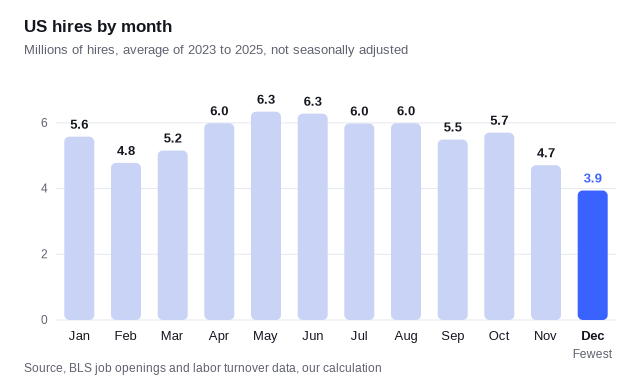
Hires by month, all US employers outside farms, not seasonally adjusted (BLS series JTU000000000000000HIL). Our calculation, the average of 2023, 2024 and 2025. December is the slowest month, almost every year
December had the fewest hires in 8 of the 9 years from 2017 to 2025. The one exception was 2021, when February was lower. December's hires usually run at 68% to 78% of that year's monthly average. Slow isn't stopped, though. There were 3.88 million hires in December 2025.
Openings and hires aren't the same thing
Job openings are roles still unfilled at the end of a month that employers are recruiting for. On the 2023 to 2025 average, January had the most openings of any month, 8.87 million, just ahead of April. But January is crowded. Indeed's Hiring Lab found job searches on Indeed in January 2026 ran up to 31% above early December, while postings stayed about level. In our reading, January brings more postings and more people chasing them, and more of the hires land later.
Summer includes seasonal work, and office fields peak in April
Because JOLTS counts seasonal and part-time hires, summer jobs lift the totals. By industry, the peaks differ. On the 2022 to 2025 average, professional and business services hired the most in April and the least in December, and finance and insurance also peaked in April. In our reading, those two are closest to office jobs. Health care peaked in July, leisure and hospitality in May, and government in August, with the school year.

Do companies hire in December? Yes, and here's how to job search during the holidays.
Hiring in December is slower, not closed. Here's what the numbers show, and what to do with the weeks around the holidays.
Hiring in December, by the numbers
In December 2025, hires were 2.4% of all US jobs, against 3.8% in June 2025 and 3.4% in January 2026 (BLS, not seasonally adjusted). Government and the information sector had their fewest hires in December in each of the four years from 2022 to 2025. Still, US employers make millions of hires every December.
Fewer applicants, in one tracker's data
Huntr, a job tracker app, studied about 2 million applications from its own users. Saving jobs hit its low point in December, 12% below trend in 2025. And applications sent in December led to an interview a little more often than the year's average, 3.6% against 3.5%. That's Huntr's users, not the whole market. In our reading, a quieter December can mean a smaller pile.
How to job search during the holidays
Our advice. Keep going, at a pace you can keep. Apply to the few new jobs that fit, and send them before the last week of the year. Expect replies to take longer while people are away, and set your check-back dates for January. By the BLS count, the “holiday hiring freeze” is a slowdown, not a freeze.
The best month to look for a job, and why it's usually this one.
Career sites often say January and February are the best months, then September and October. Here's how that holds up against the counts.
Do companies hire in January?
Yes. January sits in the middle of the year for hires, about 5.6 million on the 2023 to 2025 average, and it has the most openings. January's hires have run 25% to 36% above the December before. It's also the most crowded month, as the Indeed searches above show.
February and the fall
February is among the slowest months for hires, about 4.8 million on average, third-lowest after December and November. The fall looks better for people applying. In Huntr's data, its users saved the most jobs in September and October, and October's applications led to an interview most often, 5.1%. January's did least often, 2.7%. That's applicant data, not employer hiring.
So when is the best time to look for a job?
In our reading, there's no month when hiring stops, and no month that rescues a search. The most hires land from May to August, December is the slowest, and January is busy on both sides. So the best month to look for a job is usually the one you're in, spent on jobs you fit. Our job search strategy guide covers how to plan the weeks. If a long stretch has worn you down, see our guide to job search burnout.
Questions about hiring freezes, and the best time to look.
Why do companies go on a hiring freeze?
Mostly to save money or to wait out an uncertain stretch. HR guides also list restructuring, a merger, or a way to avoid layoffs. In a shock, freezes spread fast. In March 2020, 42% of 812 mostly large North American employers in a Willis Towers Watson survey had frozen or reduced hiring, as Recrew reports it.
Why is it so hard to get a job right now in 2026?
In our reading, mostly because employers are hiring slowly. In September 2026, hires were 3.4% of all US jobs, and in 2026 they've averaged about 3.32% a month, seasonally adjusted, close to 2012 and 2013 (our calculation from BLS data). Our guide on whether the job market is bad right now has this month's numbers in one place.
Is there a hiring freeze in federal agencies?
Not by that name, as of November 12, 2026. The named freeze ran from January 20 to October 15, 2025. Since then, Executive Order 14356 says no vacant civilian position may be filled or created except as the order allows, and each agency's Strategic Hiring Committee approves each vacancy. The federal section above has every date and source.
What is the hardest month to get hired?
By the government's count of hires, December. It had the fewest US hires in 8 of the 9 years from 2017 to 2025, and February had the fewest in 2021. There were still about 3.9 million hires in December 2025 (BLS, not seasonally adjusted).
At what age is it harder to get hired?
In BLS figures, searches tend to run longer from the early 20s to the mid-50s. In 2025, the median unemployed person aged 20 to 24 had been looking for 9.5 weeks, against 11.8 weeks at ages 45 to 54. US law forbids age discrimination against people 40 or older, including in hiring. Whatever your age, the steps above for a frozen role are the same.
How long do hiring freezes last?
We found no study that measures it. Some pages say 3 to 6 months without a source. The US federal freeze ran by that name for about nine months in 2025, then became a committee approval process. Ask the recruiter, and plan as if it could be months.
Is a hiring freeze a sign of layoffs?
Not necessarily. A freeze stops new hires, and a layoff cuts current jobs. Some pages say a freeze can sometimes signal cuts, but we found no data showing that one leads to the other. HR guides also list a freeze as one way companies try to avoid layoffs.
Can you still get hired during a hiring freeze?
Often, yes. Many freezes are partial. SHRM notes some freezes still fill mission-critical or revenue-generating roles, and the federal freeze exempted whole groups, such as public safety. Ask whether your role is paused or closed, and keep applying to teams that are still hiring.
Should I wait for a hiring freeze to end, or keep looking?
Keep looking, in our view. Nothing is certain until you have a written offer, and we found no data on how often a frozen role comes back. Set a check-back date for the frozen role, about a month out, and spend the time between on jobs that are open now.
What is hiring season?
It usually means the months when employers hire the most. By the BLS count, that's May to August, with June the top month in most years. Openings run highest earlier, in January and April, and December is the slowest month for hires.
Where the facts come from.
Checked on November 12, 2026. Federal facts come from the White House's and OPM's own pages, with their dates. Monthly hires and openings are our calculations from the BLS's job openings and labor turnover data, not seasonally adjusted, for 2017 to 2025, and BLS may revise recent months. Indeed and Huntr figures are those companies' own data, labeled as such. Blynk has no data of its own on when jobs are posted or which companies are frozen, so none of its numbers appear here.
- Is the job market bad right now?
- How long to hear back after applying
- What “not retained” means
- Ghost jobs
- Job search burnout
- What to do after a layoff
- The tech job market now
- The White House, Hiring Freeze (presidential memorandum, January 20, 2025)
- The White House, Extension of Hiring Freeze (April 17, 2025)
- The White House, Ensuring Accountability and Prioritizing Public Safety in Federal Hiring (July 7, 2025)
- The White House, Executive Order 14356, Ensuring Continued Accountability in Federal Hiring (October 15, 2025)
- OPM, OPM and OMB issue agency guidance on federal hiring (November 5, 2025)
- OPM, Guidance on Annual Staffing Plans (July 30, 2026)
- OPM, CHCO Council published memos (checked November 12, 2026)
- US Bureau of Labor Statistics, Job Openings and Labor Turnover, September 2026
- US Bureau of Labor Statistics, JOLTS definitions
- US Bureau of Labor Statistics, JOLTS data (hires and openings, not seasonally adjusted)
- US Bureau of Labor Statistics, unemployed persons by age and duration of unemployment (2025)
- EEOC, age discrimination
- SHRM, Companies Look to Cut Costs with Hiring Freezes (April 2, 2020)
- Recrew, hiring freeze glossary (reports the Willis Towers Watson 2020 survey)
- Factorial, what is a hiring freeze (May 2024)
- Indeed Hiring Lab, February 2026 labor market update (February 19, 2026)
- Huntr, the best time of year to look for a job (August 2026)
- Vault, which month is the best to look for a new job
- TopResume, holiday hiring freeze, fact or fiction (updated November 2024)
- 4 Corner Resources, what is a hiring freeze (updated February 2025)
- The Muse, hiring freeze (updated September 2024)
- Blynk Find Jobs
