
How many applications does it take to get a job? And how to need fewer of them.
If you're at application 80 and still waiting, it's natural to wonder whether you need 200. The sourced numbers are mostly smaller, and messier, than the famous ones.

The short answer
- There's no single number, but the sourced ones are in the dozens. In United Way NCA's 2026 survey of 1,000 recent and current US job seekers, the average was 62.6 applications and 4.76 interviews. Of Huntr users who logged a first offer after 11 or more applications, about two-thirds got it within 50.
- Per interview, it's roughly 1 in 6 to 1 in 13 from the job seeker's side. The US Bureau of Labor Statistics found about 1 interview per 6 applications among unemployed jobseekers (2018 data). Employers count differently: small businesses invited 3 of every 100 applicants to interview (CareerPlug, 2024 data).
- Your own numbers matter more than any average. Count how many you applied to, heard back from, interviewed for and got offers from. Fix the stage where yours drop before you send more.
On this page
How many job applications it takes, according to sources that show their work.
These four sources say who they counted and when. Each bold line says what it counts.
About 1 interview per 6 applications (US Bureau of Labor Statistics). In 2018 surveys, unemployed people looking for work reported 13.67 applications and 1.93 interviews, on average, over the previous two months. The BLS calls that an “approximate ratio of 1 interview per 6 applications.” It gives no figure per offer.
62.6 applications and 4.76 interviews, on average (United Way NCA, 2026). That's a survey of 1,000 recent and current US job seekers, taken in February and March 2026, and it reports averages only. Dividing one by the other gives about 1 interview per 13 applications. That's our arithmetic, a ratio of two averages.
About two-thirds of first offers within 50 applications (Huntr, 2026). Huntr, a job tracker, looked at 927 users who logged a first offer after at least 11 applications, from October 2025 to September 2026. 65% got it within 50, and the largest group, 29.3%, after 11 to 20. Huntr says its findings are most reliable for tech and professional roles in the US.
3 interviews per 100 applicants, from the employer's side (CareerPlug, 2024 data). Across 60,000+ small businesses and 10M+ applications, 3 in 100 applicants were invited to interview and 27% of interviews ended in a hire. That's counted per job posting, not per job seeker.
Our reading of all four: from your side, think about 6 to 13 applications per interview. For a whole search, the two large job seeker samples point to dozens of applications, more in tech. Your own count is the only one that's yours.
Where the famous application numbers really come from.
The claim: 100 to 200 applications per offer. The trail runs through a 2021 editorial in The Brown and White, Lehigh University's student newspaper, to a 2020 post on Lehigh's career-center blog, Hire Lehigh. That post credits LiveCareer by linking to an article on informational interviews. The link now redirects, but a 2019 archived copy says one in every 200 resumes results in a job offer, and names no study.
The claim: each job gets 250 applicants, 4 to 6 interviews and 1 hire. It's from a 2015 Glassdoor blog post introducing an eBook, with no data or method shown. A newer, sourced figure: Greenhouse counted 244 applications per job in 2025. Both count applicants per posting, not how many applications one person needs.
The claim: only 2% to 3% of applications get an interview. The pages we checked that repeat it, such as LoopCV, name no source. The closest real one is CareerPlug's 3 interviews per 100 applicants, counted by small businesses. From the job seeker's side the figures are higher: about 1 in 6 (BLS) and 1 in 13 (United Way NCA).
The claim: the BLS says six applications get you a job. Google's snippet of the BLS article reads that way. The article says about six applications per interview, and gives no figure per offer.
The claim: 100 untargeted applications get interviews 2.4% of the time, focused ones 8%. Huntr's report compares people by how many they sent in a quarter, not by how targeted they were. Its full result, below, cuts both ways.
Two more without a source: an 8.3% chance of an interview per application, and matching 70% to 80% of a posting's keywords. The 8.3% comes from the same Lehigh post. The archived LiveCareer article says one out of every 12 informational interviews results in a job offer, and 1 in 12 is 8.3%. Our reading: it was about offers from informational interviews, never interviews per application. For the keyword figure we couldn't find a primary source, and we use neither figure.
Why your number of applications won't match anyone's average.
Your field and situation move it. In United Way NCA's survey, tech job seekers averaged 103.7 applications, healthcare 41.6 and education 35.7. People who had been laid off averaged 95.3.
Where you apply seems to matter. In Huntr's 2026 data, 6.0% of applications sent on employers' own career sites led to an interview, against 3.4% on job boards. Huntr notes that its rates show what happened, not what caused it.
More applications buy more chances, at worse odds each. Huntr grouped users by how many applications they sent in a quarter. At 11 to 20, 8.0% of applications led to an interview; at 100 or more, 2.4% did. Yet 72.0% of the 100+ group got at least one interview, against 47.8%. Pages that quote this usually give only the first half.
And offers don't keep rising with volume. In the BLS data, about 27% to 31% of jobseekers who had sent 1 to 80 applications had an offer. Of those who had sent 81 or more, about 20% did. Our reading: volume can buy you a first call, but it doesn't replace fit.
An average hides the thing that matters most. Fifty applications to jobs you barely fit and fifty to jobs you clearly fit both count as fifty. They don't behave the same. Ten applications that fit beat a hundred that don't, and your own numbers show where you stand.
Why sending more applications rarely fixes a stalled search.
Five things people say around application 80, what's usually going on, and the question worth asking instead.
“I've sent 80 and heard nothing.”
You're not alone. In United Way NCA's survey, job seekers heard nothing back from 67% of their applications, on average. But silence after 80 can point to an early step: the jobs you pick, or how your resume reads for them. Sending 80 more the same way doesn't change that step.
Ask: Am I applying to jobs I really fit? Meeting most of the must-haves matters more than a matching title.
“The software screens me out.”
Recruiters search their hiring system by the posting's own words and filter by screening questions. If your resume says the same thing differently, you may never come up.
Ask: Does my resume use this posting's words, truthfully? Same experience, their vocabulary, most relevant result first.
“I get replies, but no interviews.”
When a first call goes nowhere, the gap is often in that call. It may be how you answered, or a mismatch on pay, location or level that a closer read of the posting would have shown.
Ask: What did they ask, and what did I say? Write it down after every call, so you can spot the pattern.
“I keep reaching the final round and losing.”
That's hard, and it's also a sign you're being chosen to interview. Sending more applications won't fix it. The work now is in the interviews.
Ask: What did my final rounds have in common? Request feedback once, politely. Some people will share it.
“I don't even know my numbers.”
When replies are scattered across an inbox and a half-kept spreadsheet, it's hard to see which step is the problem, so the only lever left seems to be sending more.
Ask: Can I count my last 40 applications? If not, start the tracker below today.
Count your own applications, then fix the stage that leaks.
Four numbers tell you more than any average. Here's how to get them, and what to change at each stage.
Count four numbers
Go back over your last 40 or so applications, or all of them if you've sent fewer. For each one, note whether a person replied, whether it led to an interview, and whether it led to an offer. Automatic “we received your application” emails don't count as replies.
For example: 40 applied, 3 replies from a person, 2 interviews, no offer yet.Find where it drops
Compare each stage with the one before it. The biggest drop is your leak. Work on one stage at a time, starting with the earliest one that's leaking.
In the example, 40 applications became 3 replies. That first step is where to work. The interviews, 2 out of 3 replies, are going fine.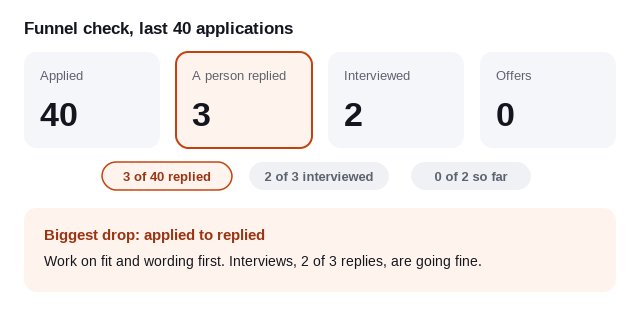
An illustration of a two-week funnel check, using the example's numbers. Few replies? Fix the fit, the wording, and who sees it
This is the leak that sending more makes worse. Apply only where you meet most of the must-haves (Blynk ranks new jobs by how well you fit, if that helps). Then use the posting's words: CareerOneStop's resume guide suggests reading 10 to 15 postings for your role and using the requirements that come up most in your summary, experience and skills. In Huntr's self-reported data, applications with a resume tailored in its tool led to an interview 4.23% of the time, against 2.07% for untailored ones. Then write a short note to the person hiring, three or four sentences with one concrete result, and (our advice) if you know someone at the company, ask them to pass your application on.
Before: “Kept the sales, finance and support teams aligned on the launch of a new billing flow.” After, for a posting that asks for stakeholder management: “Managed stakeholders in sales, finance and support for the launch of a new billing flow.” Same facts, in the posting's words.Replies but no interviews? Fix the first call
Before you apply, check the posting's location, level, work authorization and pay range against your situation. Pay isn't always there: in 1,204 job postings from Blynk's searches for product roles, about half (599) stated pay. Before each first call, prepare short answers to the questions these calls tend to start with: tell me about yourself, why this role, and what you're looking for in pay.
Interviews but no offers? Fix the interviews
After every interview, write down each question you were asked. Prepare one story with a clear result for each of the posting's top requirements. After a final-round no, ask once for feedback.
Change one thing, then count again
Make one change, send your next 15 to 20 applications, and compare the stage you were fixing. If it improved, keep the change. If you change five things at once, you won't know which one helped.

A simple application tracker, ready to copy.
Paste these into a note or a spreadsheet. The first is one entry per application; the second is your check every two weeks.
One entry per application
Fill it in the day you apply, and update it when anything comes back.
Date applied [date]
Company [company]
Role [job title]
Link to the posting [link]
Do I meet most of the must-haves? [yes / mostly / no]
Resume version sent [file name]
Wrote to a person [name, role, date, or no]
Followed up [date, or no]
Person replied [date, or no]
Interview [dates and rounds, or no]
Offer [yes / no / waiting]
What they asked [notes]
Your two-week funnel check
Every two weeks, add up your entries and fill this in.
Funnel check, [date]

Applied [number]
A person replied [number] (that's [replies] out of [applied])
Interviewed [number] (that's [interviews] out of [replies])
Offers [number]

Biggest drop [applied to replied / replied to interviewed / interviewed to offer]
One thing I'll change [for example, only apply where I meet most of the must-haves]
Count again after [the next 15 to 20 applications]
What helps, and what just adds to the count.
A short list to keep beside the tracker.
Do
- Apply where you meet most of the must-haves.
- Use the posting's words for what you've really done.
- Write a short note to the person hiring.
- Follow up once, about two weeks after applying.
- Count your numbers every two weeks.
- Keep the resume version you sent to each job.
Don't
- Chase a number of applications.
- Send the same resume everywhere.
- Claim a skill you haven't used to get past a filter.
- Count automatic confirmations as replies.
- Change five things at once.
- Follow up more than twice.
Questions about job applications, answered.
Is 2 job applications a day enough?
It can be, if each one fits. We found no study that gives a daily number, and Indeed's suggestion of two to three a day comes without a source. Our advice: 2 a day is about 40 a month, plenty to learn from. Count your replies before you add more.
How many applications do most jobs get?
A lot. Greenhouse, a hiring software company, counted 244 applications per job in 2025 across 6,000+ companies, up from 116 in 2022. Greenhouse doesn't say whether that's an average or a typical job; if it's an average, a few very popular postings can pull it up. CareerPlug's small-business data shows 180 applicants per hire.
Is it worth applying to jobs with over 100 applicants?
Yes, if you meet the must-haves. For LinkedIn jobs that send you to the employer's site, LinkedIn's help says it “doesn't keep a record of who applied.” So for those jobs, the count can't be finished applications. Where you can, apply on the employer's own career site, which did better than job boards in Huntr's data.
What is the 70/30 rule in hiring?
It's an informal rule of thumb, not a standard. Workable describes a “70% rule” for employers: hire people who meet about 70% of what a role needs and train the rest. For you, the useful version is to apply when you meet most of the requirements. In 1,204 job postings from Blynk's searches for product roles, about half (588) marked some requirements as preferred or nice to have. Hard requirements, such as a license or work authorization, don't bend.
How many job applications does it take to get a job?
There's no single number. In a 2026 United Way NCA survey, job seekers averaged 62.6 applications and 4.76 interviews, and tech job seekers averaged 103.7 applications. Among Huntr users who logged a first offer after at least 11 applications, 65% got it within 50.
Am I doing something wrong if I've applied to 100 jobs and have no offer?
Not necessarily. In Huntr's data, about 1 in 7 people who logged a first offer after 11 or more applications got it after more than 100. But 100 applications is enough to learn from. Count how many got a reply from a person and how many led to interviews. The step where the numbers drop tells you what to change.
What's a good response rate for job applications?
Hearing nothing is common. In United Way NCA's 2026 survey, job seekers got no response to 67% of their applications, on average. More useful than any benchmark: note your own reply rate, make one change, and check it again after your next 15 to 20 applications.
How long does it take to get a job?
Months, in both large samples we found. United Way NCA's 2026 survey found an average search of 28.5 weeks, about 6.6 months. In Huntr's data, the median time from starting a search to a first offer was 102 days, across 667 job seekers.
Should I follow up if I don't hear back?
Yes, once is normal: a short, polite note to the recruiter or the hiring manager. Indeed's career guide suggests about two weeks after applying. Our advice is to stop after two follow-ups. Our follow-up email guide has notes you can copy.
Will an auto-apply tool get me a job faster?
It raises the count, which isn't the same thing. Sending more of the same doesn't fix a low reply rate. If you use one, pick one that tailors each application and shows it to you before it's sent. Blynk does both, and applies on the employer's own site. Our comparison of AI job application tools covers the rest.
Where these numbers come from, checked one by one.
Checked in November 2026. Every figure names who was counted and when. Blynk's counts come from 1,204 job postings from Blynk's searches for product roles, first seen October 31 to November 11, 2026, at 740 companies: mostly senior, mostly US, and several US states require pay ranges in postings. We counted postings that use words such as “preferred” or “nice to have” for some requirements (588), and postings that state pay (599).
- The best AI job application tools
- A free job application tracker template
- Why you're not getting interviews
- How to keep going without burning out
- Why it's so hard to get a job now
- US Bureau of Labor Statistics: How do jobseekers search for jobs? (Beyond the Numbers, 2020)
- United Way NCA: how long does it take to find a job, 2026 survey
- Huntr: job search trends, Q3 2026
- Huntr: job search trends, Q1 2026
- CareerPlug: recruiting metrics report (2024 data)
- Greenhouse: recruiting benchmarks (The Hire Standard, 2026)
- Glassdoor blog: 50 HR and recruiting stats (2015)
- The Brown and White: an offer of encouragement (2021 editorial)
- Hire Lehigh, Lehigh University career center: how many applications does it take to get a job? (2020)
- LinkedIn Help: application flow for jobs on external sites
- Indeed: how many applications to get a job
- Workable: the 70% rule of hiring
- CareerOneStop: write your resume for current hiring practices
- Blynk Find Jobs
- Blynk tailoring
- Blynk Find the Hiring Manager
- Blynk Job Tracker
- Blynk pricing
- LiveCareer: What are informational interviews, and why should I do them? (archived 2019 copy)
