
What is a recruiter? Who they work for, and how to answer one.
A recruiter just messaged you, or the job posting says the recruiter will be in touch, and you're not sure whose side they're on. Here's who recruiters work for, who pays them, the three kinds you'll meet, and what to say back, with replies to copy.

The short answer
- A recruiter finds, screens and hires people for an employer. They post the job, look for people, run the first call and often make the offer. The hiring manager usually makes the final call.
- The employer pays the recruiter. You shouldn't pay anything. In-house recruiters are on one company's staff. Agency recruiters and headhunters work outside the company, and the employer pays them, often only when someone is hired.
- Answer every real recruiter in a few lines, even to say no. With an agency, ask which company before your resume goes anywhere. Follow up once, one business day after the date they gave, or about a week later.
On this page
What is a recruiter, and what does one actually do?
A recruiter fills jobs for an employer. The US Bureau of Labor Statistics (BLS) counts recruiters, also called talent acquisition specialists, as a kind of human resources specialist. BLS lists their main duties. They find, screen and interview applicants for open positions, post job listings, and go to job fairs and campuses. Some take on other responsibilities, such as testing applicants, contacting references and making job offers.
They run the hiring process, step by step. Greenhouse, which makes one of the applicant tracking systems employers use for hiring, describes recruiters guiding it from the job description to the offer. That covers posting the job, sourcing people, scheduling interviews and interviewing. Greenhouse says the final decision is “usually left up to” the hiring manager, and that the two “work closely together.”
The parts you'll see. In our reading, the recruiter is usually your initial phone screen, your contact for dates, pay and feedback, and the person who calls with the offer. The hiring manager runs the team you'd join and asks about your skills and the work itself. Our guide on recruiter vs hiring manager covers which one to contact. And how to find the hiring manager shows where to look for them.
How recruiters may find you. LinkedIn sells recruiters a paid hiring tool called LinkedIn Recruiter. If you turn on Open to Work and choose Recruiters only, LinkedIn shows it only to people using that tool. It tries to hide it from Recruiter users at your own company, but says it “can't guarantee complete privacy.”
A military recruiter is a different job. BLS says they recruit people into the military and explain its pay, benefits and way of life.
Who pays a recruiter, and why it shouldn't be you.
The employer pays, not you. The US Federal Trade Commission (FTC) says honest placement firms “do not typically charge a fee to job candidates.” The hiring company pays them. If someone asks you for a fee, especially up front, the FTC says to walk away. Honest employers, it adds, “will never ask you to pay to get a job.”
So the recruiter works for the employer. Stanford's business school says recruiters work for hiring organizations. They are “not employment agents that work on behalf of candidates.”
That's good news when you fit. In our reading, a recruiter only gets what they want when the job is filled. So if you fit the job, they want you to get it. If you don't, they move on, and it isn't personal.
Check they're real before you share anything. The FTC suggests searching the company or person's name with words like “scam”, “review” or “complaint”. Services that charge you to market you or apply for you are a different thing, since you're their client. Check what you'd get before you pay.
Types of recruiters, and how to answer each one.
Most recruiters you'll meet are one of three kinds. Knowing which one wrote to you tells you who pays them, what they can do for you, and how to answer.
In-house recruiter, on the company's own staff
An in-house recruiter, also called an internal or corporate recruiter, works for one company and hires for its own open jobs. The company employs them, so you pay nothing. They can tell you the steps, the timeline and the pay range, and pass you to the hiring manager. They can't put you forward for jobs at other companies.
How to answer one. Talk about this job. Ask what the interview process is and what the role pays. Their title and email should name the company itself.Agency recruiter, paid when someone is hired
An agency or staffing recruiter is an external recruiter. They work for a recruiting firm that fills jobs for several employers. SHRM, the HR professionals' association, said in 2016 that a contingency firm is paid only if it fills the job, usually 20 to 25% of first-year cash compensation. A company may use several contingency firms on one job.
How to answer one. Before you say yes, ask which company and which job. In our reading, an agency can only send you where the employer takes its candidates. Of 1,204 job postings from Blynk's searches for product roles, 25 said they don't take resumes from agencies or don't use them. A few take them only from agencies they have an agreement with.Retained search recruiter, sometimes called a headhunter
A retained or executive search firm is hired for a senior search, and it's usually the only firm on it. SHRM said a retained firm is paid about a third of the role's yearly salary and bonuses, whether or not it fills the job. Stanford's business school says these searches are often confidential. In our reading, that's why some won't name the company on the first call.
How to answer one. They're filling one role, so say yes or no to that role. If it's a no, ask to stay in touch for the next one. Our executive job search guide covers working with them.
Recruiter vs headhunter, and why the words overlap.
The words overlap. Exec's career guide calls agency recruiters headhunters. Randstad Canada, a staffing firm, draws a line between them. It says a headhunter is usually a self-employed consultant hired to fill one specific role, often senior or hard to fill. Agency recruiters fill many roles at once.
What matters is who pays, and how. A contingency recruiter is paid only if someone they sent is hired. A retained firm is paid for the search itself, as SHRM describes. In our reading, that's why a contingency recruiter may pitch you several jobs, while a retained one calls about one.
A headhunter's call out of the blue is normal. By Randstad's definition, they're filling one role for one client. You don't have to be looking to take the call, and you don't have to say yes.
How to respond to a recruiter on LinkedIn, and what to reply to any recruiter message.
Read the message first, then pick the reply that fits. Keep it short. That's our advice, and in LinkedIn's study of recruiters' own messages to candidates, ones under 400 characters got 22% more responses than average.
Work out who they work for, and that they're real
Open their profile. Does it name the employer, or a recruiting firm? Does the message name the company and the job? Check that their email is on their firm's own domain. If anything feels off, search their name with “scam” or “review”, as the FTC suggests.
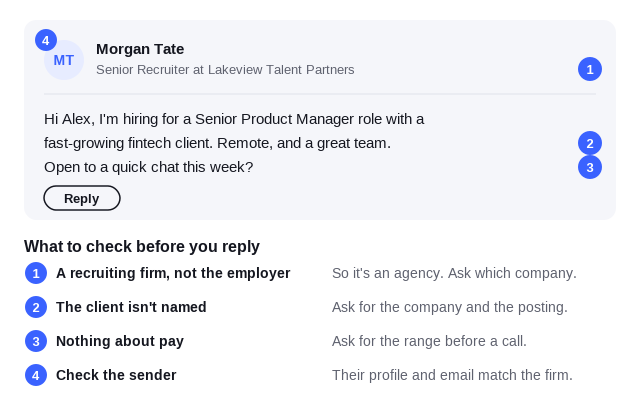
An illustration of a recruiter's message, with what to check before you reply. The names are made up. Interested? Say so, and ask what happens next
Thank them, say how your qualifications fit the role, and offer two times to talk. Ask about the steps, the timeline and the team's culture. Send your resume once you know which company it's for.
Interested, but you need the pay range first
It's a fair question before a call, and it saves you both time. Ask for the range, and say what you're looking for if you know. Our guide to picking a desired salary helps with the number.
Not now, but maybe later
Say no to this role, and say what would interest you, such as a title, a team or a pay level. In our reading, a recruiter who knows that is more likely to come back with a better fit.
Not interested at all
Thank them in one line. You don't owe a reason. It takes a minute, and in our reading it keeps the door open if their next role fits better.
An agency recruiter? Ask which company first
Ask which company and which job they'd send you to. Then ask them to check with you before your resume goes to any employer. Greenhouse, which makes hiring software, says its system records the agency as the source of a candidate it submits. So in our reading, it matters who sends you first.

Replies to a recruiter, ready to copy.
Swap the [square brackets] for your details. Each works as a LinkedIn message or an email.
Yes, I'm interested
When the role fits and you'd like the call.
Hi [First name],

Thanks for reaching out. The [Job title] role sounds like a good fit, and I'd like to hear more. Could you share the next steps and the pay range?

I'm free [day and time] or [day and time].

Thanks,
[Your name]
Interested, but first the pay range
When the pay decides whether a call is worth it.
Hi [First name],

Thanks for thinking of me. Before we set up a call, could you share the pay range for the [Job title] role? I'm looking for around [your range], so I want to be sure it's worth your time too.

Thanks,
[Your name]
Not now, but keep me in mind
When this role isn't right, but the recruiter's field is.
Hi [First name],

Thanks for reaching out. I'm not looking to move for this role, but I'd be glad to hear about [kind of role, team or level] in the future.

Best,
[Your name]
No, thank you
When you're not interested. One line is enough.
Hi [First name], thanks for thinking of me. I'm not interested in this one, but I appreciate you reaching out. All the best, [Your name]
To an agency recruiter, before anything is sent
When the message doesn't name the company.
Hi [First name],

Thanks for reaching out. Before we go further, which company is the role with, and could you send me the job posting? Please check with me before you send my resume to any employer.

Thanks,
[Your name]
How to follow up with a recruiter, once, and after their date.
Advice varies a lot. Coursera says to wait 5 to 7 business days after silence, and to check in every two weeks. The Forage says to send a thank-you within 24 hours, then check in every few months. Our rule is simpler, and it's the same across our guides.
After a call with a recruiter, send a short thank-you within 24 hours, and ask when you'll hear back. Check in once, one business day after that date. No date? Wait about a week.
If you wrote first and heard nothing, follow up once, about a week later, then stop. Our guide on when to follow up with a recruiter has the full timing.
With an agency or retained recruiter, follow up with the recruiter, not the employer, since they're the one talking to the employer. If you apply to one of their clients yourself, tell them. That's our advice.
Need the words? Our guide to the follow-up email after an interview has nine to copy, including the last note when a recruiter goes quiet.
Working with recruiters, do this, not that.
The advice is ours, unless a source is named.
Do
- Reply to every real recruiter, even to say no.
- Ask an agency which company and job before you say yes.
- Keep a list of which recruiter sent you to which job.
- Give a researched pay range, not your current pay.
- Follow up once, one business day after the date they gave you.
- Tell a recruiter you're working with if you get another offer.
Don't
- Pay anyone to get you a job. Honest employers never ask, the FTC says.
- Let an agency send your resume without naming the job.
- Apply to a job yourself after an agency sent you, without telling them.
- Message every recruiter at one company. Our guide to reaching out explains why.
- Go quiet on a recruiter in the middle of a process.
Questions about recruiters, answered.
Do you need a degree to be a recruiter?
Usually, though it isn't a legal rule. BLS says recruiters and other HR specialists typically need a bachelor's degree, in human resources, business, communications or a related field. Some jobs also want experience, such as work as an HR assistant or in customer service.
What is the minimum salary of a recruiter?
BLS doesn't give a minimum. For HR specialists, the group that includes recruiters, the lowest-paid 10% earned under $47,180 a year in May 2025, and the median was $75,940. In employment services, the industry that includes staffing agencies, the median was $60,550.
What does "hiring manager review" mean in the context of the hiring process?
It usually means the recruiter has passed your application to the hiring manager, who reads it before deciding on an interview. That's our reading. Each employer names its own steps, so the label can differ. Our guide to what “under review” means covers the common statuses.
What is the definition of a job recruiter?
A job recruiter finds, screens and helps hire people for an employer. BLS counts them as human resources specialists, also called recruitment or talent acquisition specialists. They can work for the employer itself, or for a recruiting firm the employer pays.
Do recruiters get paid if you get hired?
Yes, by the employer, not by you. An in-house recruiter is on the company's staff. An agency recruiter on contingency is paid only if someone it put forward is hired, usually 20 to 25% of first-year cash pay, SHRM said in 2016. A retained firm is paid for the search either way. The FTC says honest placement firms don't typically charge job candidates.
What not to tell a recruiter?
Your current pay, unless you choose to. Some states bar employers from asking about your pay history, including California, New York, Washington and Massachusetts. Give a researched range for the role instead, and our guide to desired salary helps you pick it. And don't let an agency send your resume before you know which company it's for. That part is our advice.
Do recruiters work for me or the company?
The company. Stanford's business school says recruiters work for hiring organizations and are “not employment agents that work on behalf of candidates.” In our reading, that still helps you when you fit the job, since they only succeed when it's filled.
Can two agencies submit me for the same job?
They can both try. SHRM says a company may use several contingency recruiters on one job. Greenhouse, which makes hiring software, records the agency as the source of a candidate it submits. So our advice is to let only one agency send you to each job, and keep a list of who sent you where.
Is it worth working with a recruiting agency?
Often, if it recruits in your field and names the company. It costs you nothing, and a good recruiter can tell you about the process and the pay. But in our reading, an agency only reaches employers that take its candidates. Of 1,204 job postings from Blynk's searches for product roles, 25 said they don't take resumes from agencies or don't use them. So our advice is to keep applying yourself too.
Why did a recruiter ghost me?
Often the job moved on without you, or they're busy with other searches. That's our reading, not a rule. Follow up once, then move on, and our guide to being ghosted after an interview has the next steps.
Where the facts come from.
Checked on November 12, 2026. The advice is ours, and where a line is our reading we say so. Facts about pay, fees, hiring software and LinkedIn come from each publisher's own page, linked below. Blynk's count covers 1,204 job postings from Blynk's searches for product roles, mostly senior, first seen October 31 to November 11, 2026, each with more than 300 characters of text. We searched them for words about agencies and search firms, read every match by eye, and dropped 4 that weren't about agencies.
- How to reach out to a recruiter
- How to find the hiring manager
- Follow-up email after an interview
- Executive job search
- Blynk vs LinkedIn Sales Navigator
- Blynk vs Apollo
- Contract-to-hire jobs explained
- What a hiring manager does
- US Bureau of Labor Statistics, human resources specialists (pay for May 2025)
- US Bureau of Labor Statistics, military careers
- US Federal Trade Commission, job scams
- SHRM, how to work effectively with an executive search firm (2016)
- Stanford GSB alumni careers, executive recruiters
- Exec, what is a recruiter's role
- Randstad Canada, recruiters versus headhunters
- Greenhouse glossary, what is a recruiter
- Greenhouse Support, invite an agency recruiter
- LinkedIn Help, who can see that you're open to work
- LinkedIn Talent Blog, the InMails that get the best response rates
- Coursera, how to follow up with a recruiter
- The Forage, what is a recruiter and how to talk to one
- California Labor Code 432.3 (salary history)
- New York Labor Law 194-a (salary history)
- Washington RCW 49.58.100 (salary history)
- Massachusetts General Laws c.149 §105A (salary history)
- Blynk Find the Hiring Manager
