
How to get a job fast. Without sending a hundred applications.
If you've been applying for weeks with little back, sending more of the same won't speed things up. Focus will: fresh roles you fit, an application made for each, a person to write to, and a follow-up. Here's a two-week plan, and where to look if you need paid work this week.

The short answer
- Fast comes from focus, not volume. Ten applications to fresh jobs you fit, each made for the job, beat a hundred sent the same way.
- Apply early, reach a person, use your network: write to the hiring manager the day you apply, ask people you know for referrals, and follow up once after a week.
- Need paid work this week? Temp and staffing agencies can often place you in days, not weeks, and some fast-start work pays the next day. Legitimate agencies don't charge you.
On this page
Need a job immediately? Where paid work starts fast.
First, pick the problem you're solving. Kelly Services' advice: if your savings won't cover more than two months of essentials, put cash flow first, because splitting your effort evenly slows both. Whether to take the first offer depends on whether it's a short-term or long-term role, Kelly says. So take a bridge job that meets your minimum pay and fits your schedule, and weigh a long-term role's full value first.
Call a temp or staffing agency. Employers pay the agency to fill roles. Kelly says temp, contract and temp-to-hire roles "move fastest, often in days instead of weeks." The staffing firm Protech says many of its candidates start with short-term jobs and move into permanent positions. Say yes to short-notice interviews, as Kelly advises. Make your schedule clear up front and reply to recruiters as soon as they reach out, as Protech advises.
Try work that starts fast. PeopleReady's JobStack app needs no resume, only the ID for a Form I-9, and many of its jobs are eligible for next-day pay. Its work includes construction, hospitality, retail, and manufacturing and logistics. Kelly names healthcare, logistics, retail and hospitality as the fields that consistently hire fastest.
Filter the job boards for speed. Indeed has a "Fast Hiring" search. It also has an "Urgently hiring" label, which signals an employer "is hiring on a short timeline," in Indeed's words. Employers get the label with Indeed's paid Premium Sponsored Jobs. On any board, filter by date posted.
Get local help. The US Department of Labor points job seekers to their local American Job Center to talk with a counselor, and to CareerOneStop for job search and training resources.
Watch for scams. Legitimate staffing agencies don't charge job seekers, Kelly says, and a recruiter who asks you for a fee is a red flag. Employbridge warns of imposters posing as its staff: don't open attachments or click links from people who contact you out of the blue.
Why job hunting feels slow, and what gets you hired faster.
Five things that make a job search drag, and the change that fixes each one.
“I've sent dozens and heard nothing.”
Sending more of the same spreads your time thin: in one evening, every extra application gets a little less of it, and fits its job a little less.
What helps: Fewer, better-fit applications. Apply where you meet most of the must-haves, and make each one fit.
“By the time I apply, the job is old.”
The same job gets copied from site to site. In Blynk's searches for product roles, mostly senior, about 1 in 4 jobs turned up in two or more places; one turned up in nine. So a copy can look newer than it is.
What helps: Go to the source, early. Check company career sites, and apply in the first days a job is up. That's our advice, not a measured rule: only about 2 in 100 postings in the same searches said when they close, so you usually can't tell how long you have.
“The software screens me out.”
Recruiters can search resumes in their hiring system for keywords, and Greenhouse, for one, lets them reject applications automatically based on the answers to screening questions. If your resume says the same thing differently, you may never come up.
What helps: Use the posting's words, truthfully. Reword what you've really done; never add what you haven't.
“No one even reads it.”
An application through a careers portal joins a queue.
What helps: Reach a person. A short note to the hiring manager, or a referral from someone you know, puts your name in front of a person, not just a queue.
“I'm losing track of what I sent.”
When you're moving fast, it's easy to forget which resume went where, or to miss a reply.
What helps: Keep one simple record. The job, the date, the resume version, who you wrote to and the next step.
How fast can you get a job? What the latest numbers say.
Half of unemployed people have been looking for under three months. In October 2026, half of unemployed people in the US had been out of work for 11.9 weeks or less, according to the Bureau of Labor Statistics. About 3 in 10 had been out of work for under 5 weeks.
The average is closer to six months, because the longest searches pull it up. The average was 27.1 weeks, and 27.6% had been out of work for 27 weeks or more. That's why you'll hear both "about three months" and "about six months."
Your clock depends on your field, your level and who's hiring. No one can promise you a date, and this plan doesn't.
Get a job fast with this two-week plan.
Here's how to spend each day on the things that move a search forward.
Day 1: Pick a clear target
Choose one or two job titles you're qualified for today, where you want to work (a city, or remote), and the pay you need. A narrow target is what makes the rest fast: every search, every resume edit and every note gets easier.
Example: "Senior Product Manager or Product Lead, remote or New York, $170K and up." Not "anything in product."Day 1 to 2: Build one strong base resume
Read 10 to 15 postings for your target title and note what comes up most, as CareerOneStop suggests. Then make one clean resume around it: one column, standard headings (Experience, Skills, Education), and a result in each bullet. This is the version you'll adjust for each job, so get it right once. Make your LinkedIn headline say the same target, so a recruiter who looks you up sees it.
If you rebuilt customer onboarding and it cut time to first value from 9 days to 2, don't write "Responsible for customer onboarding." Write "Rebuilt customer onboarding, cutting time to first value from 9 days to 2."Day 2: Tell your network
Message 10 to 20 people you know: former colleagues, managers, friends in your field. Say what you're looking for in one line, and ask if they know anyone hiring. In a study of nine large firms, referred applicants were more likely to be hired than others. Do it now, while your search is fresh, not after a month of silence.
Every morning: Find fresh jobs you fit
Spend about 30 minutes on new postings only. On a job board, set the date posted to the last day or two and sort by newest. Check company career sites as well: it's the employer's own posting, and where your application lands. Shortlist the ones where you meet most of the must-haves, and skip the rest without guilt.
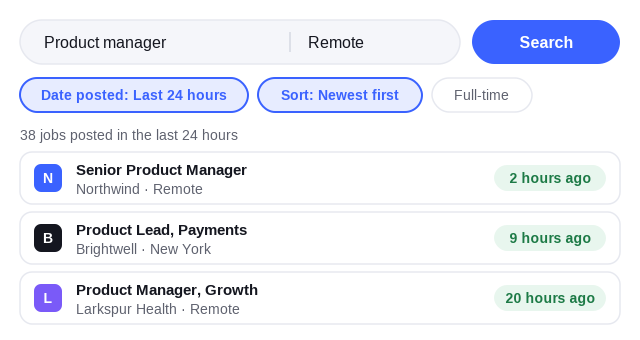
An illustration of a job search filtered to the last 24 hours and sorted by newest. The companies are made up. Every day: Send 2 or 3 good applications
For each job, move your most relevant result to the top, use the posting's words where they're true for you, and answer "Why this company?" in two honest, specific sentences. Where a cover letter is asked for, adapt a short one the same way. Two or three done well a day adds up to 20 to 30 strong applications in two weeks.
If the posting says "stakeholder management" and you've done it, say it that way, not "worked with other teams." Never claim a tool or skill you haven't used: it falls apart in the first interview.Same day: Write to the person hiring
Find the hiring manager or the recruiter for the role. Some LinkedIn jobs show the hiring team; otherwise look for the team's lead at the company. Send a short note: the role, one result that fits, and a question. Around 60 to 80 words is plenty. Our guide to finding the hiring manager has every step.
After about a week: Follow up once
If you've heard nothing, send one polite follow-up with something new: a related result, or a thought on something the team shipped. Advice on timing varies: Employbridge says 10 to 14 days after applying, and to skip it if the posting asks for no follow-ups. One is enough, in our view. Here's how to write the follow-up.
Week two: Prepare as replies come in
Keep your phone on and reply to recruiters the same day. Write four or five short stories from your resume: the problem, what you did, and the result. In our experience, one of them will fit most interview questions. Before each first call, read the job again and check your record, so you know exactly what they read; after each interview, send a short thank-you note. Indeed's guide says it shows good manners and appreciation, and lets you follow up.
End of week two: Do more of what worked
Look at where replies came from: which titles, which kinds of company, and which route (a portal, a note, a referral). Do more of that in week three, and drop what got nothing.

Three messages, ready to copy.
Fill in the [square brackets] with your own details. Keep each one short: they're meant to be read on a phone.
A note to the hiring manager
Send it the day you apply. Under 100 words. Subject line: [Role] application, [Your name]
Hi [First name],

I've just applied for the [Role] role on your team. [One result that matches what the posting asks for, with a number if you have one.]

[One sentence on why this team or product, specifically.]

Would you be open to a short call, or is there someone else I should speak with?

Thanks,
[Your name]
[LinkedIn or phone]
A follow-up after a week
Once, about a week after your first note, if you've heard nothing.
Hi [First name],

Following up on my note about the [Role] role. I'm still very interested, and [one new detail, such as a related result or a thought on something the team shipped].

Happy to share more if it helps.

[Your name]
Asking for a referral
To someone you know at the company, or who might know someone there.
Hi [Name],

I hope you're well. I'm looking for a new role as a [Title], and I saw [Company] is hiring for [Role] ([link]).

Would you be comfortable referring me, or pointing me to the right person? I can send a short summary you could forward.

Thanks either way,
[Your name]
What gets you hired faster, and what slows you down.
The habits that save days, and the ones that quietly waste them.
Do
- Apply in the first days a job is up.
- Apply where you meet most of the must-haves.
- Use the posting's words for things you've really done.
- Write to a person for every job you really want.
- Say when you can start, and reply to recruiters the same day.
- Follow up once, after about a week.
- Keep a record: the job, the date, the resume version, who you wrote to.
Don't
- Send the same resume to every job.
- Apply to every role with the right title.
- Claim a skill or tool you haven't used.
- Let a tool send applications you haven't seen.
- Chase the same person every few days.
- Quit your job before you have an offer.
- Spend whole evenings scrolling boards with no shortlist.
Questions about finding a job fast, answered.
What is the fastest way to get a job right now?
If you need a job immediately, go where hiring takes days: a temp or staffing agency, or a day-labour app. PeopleReady's JobStack, for one, needs no resume and says many jobs are eligible for next-day pay. Your local American Job Center can help too. For a professional role, start with people you know: in a study of nine large firms, referred applicants were more likely to be hired. Then apply early to fresh jobs you fit, each made for the job.
Why is it so hard to get a job right now in 2026?
Our reading of the federal numbers: hiring is slow, but the openings are there. In September 2026 US employers had 7.5 million openings and made 5.4 million hires. In October, 7.1 million people were unemployed, so roughly one opening for each (the months differ, so compare loosely). The typical unemployed person had been out of work 11.9 weeks, and 27.6% for 27 weeks or more. A slow market is a reason to focus, not to send more.
Why are Gen Z not getting hired?
The numbers show it's harder at the start. Recent college graduates aged 22 to 27 had 5.2% unemployment in the third quarter of 2026, and 42.5% were underemployed, according to the New York Fed. For all workers the rate was 4.1% in October (a different survey, so compare loosely), and for teens aged 16 to 19 it was 13.9%. With little track record to show, a referral and an early application count for more, in our view.
At what age is it harder to get hired?
Time out of work tends to rise with age, then levels off. In 2025 the median unemployed 16- to 19-year-old had been out of work 6.8 weeks, against 11.8 weeks at 45 to 54 and 11.3 weeks at 55 to 64. People 65 and over had a median of 10.6 weeks but an average of 31.4, so some searches run very long. US law forbids age discrimination against people 40 or older, including in hiring.
What is the hardest month to get hired?
Usually December. By the government's count of hires, December had the fewest US hires in 8 of the 9 years from 2017 to 2025, and February was lower in 2021 (BLS, not seasonally adjusted). Hiring slows but doesn't stop. There were still about 3.9 million hires in December 2025. January is crowded on the other side. Job searches on Indeed ran up to 31% above early December in January 2026, while postings stayed about level. Our reading: keep applying through December, when fewer people are looking.
What is a red flag on a resume?
Indeed's UK hiring guide for employers lists ten, including employment gaps, inaccuracies, a generic resume, unclear wording and an inconsistent career path. It says frequent job changes are a red flag especially when they aren't explained. So give a gap or a short stint one plain line, check every date and name, and make each bullet a result.
What is lazy apply?
LazyApply is a Chrome extension that sends job applications in bulk "with a single click." Its FAQ says there's no free trial, and plans start at $99 a year. Bulk sending is the opposite of this page's advice, because each application goes out without being made for the job. Blynk rewrites your resume and cover letter for each job and waits for your OK before anything is sent: Blynk vs LazyApply, compared.
What is the 3 month rule for jobs?
It usually means a probation period once you're hired. ADP describes an introductory period of 30 to 90 days, sometimes longer, and says they commonly last three to six months. Benefits may wait until it ends, though the Affordable Care Act bars health-plan waiting periods over 90 days. Only Montana requires a probation period by law. So a fast job is worth most if it's one you can keep.
What are five signs that it's time to quit your job?
Indeed's career guide lists 15 signs. Five of them are that you're underusing your skills, the work environment is unhealthy, there's no room to grow, the company's future is in question, and you dread going to work. Even then, Indeed says it's best to have another job lined up when you resign. The staffing firm Employbridge agrees, citing New York Fed research that people who are employed tend to get better job offers. So start the plan above while you're still being paid.
What is the best lazy girl job?
The phrase was coined on TikTok in 2023 for a low-stress job with a good salary, benefits, flexibility and work-life balance. There's no single best one. If that's what you want, make it part of your target on day 1: the pay, the hours, and remote or not. A clear target is what makes a search fast.
Sources, and where to go next.
Checked on November 11, 2026. The advice is ours; facts about other companies come from their own pages, and the job market numbers from the US Bureau of Labor Statistics, the New York Fed and Indeed Hiring Lab (with HR Dive's report of it). The origin of "lazy girl job" comes from Fortune. Blynk's counts are its own: 1,477 job postings (1,270 jobs once the same company and title are grouped) from Blynk's searches for product roles, mostly senior, first seen between October 31 and November 11, 2026. A job counts as copied when it appeared in two or more of the places Blynk searches. Closing dates were counted in the 1,204 postings with a full description.
- The best job search apps, compared
- How to write a follow-up email after applying
- How to find the hiring manager
- Applying a lot and hearing nothing back?
- When the search wears you down
- How to spot a ghost job
- Finding companies that sponsor visas
- The best job search engines
- How to find jobs that match your resume
- A job search strategy that works
- BLS: unemployed persons by duration of unemployment (October 2026)
- BLS: The Employment Situation, October 2026
- BLS: Job Openings and Labor Turnover, September 2026
- BLS: duration of unemployment by age, 2025 averages
- New York Fed: the labor market for recent college graduates
- Burks and others, The Value of Hiring through Employee Referrals (Quarterly Journal of Economics, 2015)
- Kelly Services: I need a new job ASAP
- Employbridge: 9 things to do to find a job fast
- Protech: 10 secrets to getting hired fast
- PeopleReady: find work
- Indeed: Fast Hiring jobs
- Indeed for employers: the Urgently hiring label
- Indeed career guide: how to find a job fast
- Indeed career guide: 15 signs it's time to quit your job
- US Department of Labor: resources for job seekers
- CareerOneStop: write your resume for current hiring
- LinkedIn Help: Meet the hiring team
- Greenhouse help: search resumes for keywords
- Greenhouse help: application rules overview
- Indeed Hiring Lab: February 2026 labor market update
- HR Dive, reporting Indeed Hiring Lab data on December 2024 job searches
- Indeed UK hiring guide: ten resume red flags
- EEOC: age discrimination
- ADP: what is a probationary period
- Fortune: Gen Z and lazy girl jobs
- LazyApply homepage and pricing
- LazyApply FAQ
- Blynk Find Jobs
- Blynk pricing
- US Bureau of Labor Statistics, JOLTS data (hires by month, not seasonally adjusted)
