
Networking email templates. One small ask, easy to say yes to.
If writing to someone you haven't spoken to in years feels awkward, you're not alone. A good networking email makes one small ask that's easy to say yes to. Here's who to ask first, what to say, and eight templates sorted by how well you know the person.

The short answer
- Keep it short, about 120 words: how you know them, what you're looking for in one line, one clear ask, and an easy out.
- Match the ask to how well they know your work. People who've worked with you can be asked for a referral. Everyone else, ask for 15 minutes of advice or an introduction first.
- For a referral, name one job and send the link, your resume as a link, and three lines they can paste into the referral form.
On this page
Why people you know matter in a job search, and what a referral really does.
You'll see big claims on other pages about how many jobs come through networking. We couldn't trace them to a measured study, so they're not here. This is what has been measured.
“Is it rude to ask for a referral?”
Not to someone who knows your work. In a study of nine large firms, referred applicants were "more likely to be hired and more likely to accept offers", and referred workers were less likely to quit (Burks and others, 2015). The authors add that the difference is "driven by referrals from high productivity workers".
What to do: Ask people who know your work. Our reading: a referral counts most when the person can say something true about how you work.
“Does a referral actually help?”
Often, yes. In Ashby's data on more than 38 million applications, 40% of referred candidates reached an interview, against 3% of people who applied on their own. Referrals were only about 1% of applications. But 60% of referred candidates still didn't reach an interview.
What to do: Treat it as a way in, not a promise. Ask for one named job, and keep applying to others.
“I haven't talked to them in years.”
That may matter less than you think. In a LinkedIn experiment with about 20 million members, published in Science in 2022, weaker ties led to more job moves than strong ones. Our reading: someone you've lost touch with can still be a useful contact.
What to do: Name the gap, then ask. One line that admits the time, then the ask. The templates below show how.
“Nobody I know works there.”
Then it isn't really a networking email. It's a short note to the person hiring, and it has its own method.
What to do: Write to the hiring manager. It's covered further down, after the LinkedIn section.
How to network for a job when you're already looking, starting with who knows your work.
Most networking advice treats everyone the same. Our advice: let the ask change with how well the person knows you. Start at the top of this list and work down.
People who've seen your work: ask for a referral
A former manager, teammate or client can say something true about you. They're the people to ask for a referral for one named job. Simplify, a job search tool, suggests asking one or two people per company. It suggests mid-level people on the team rather than senior leaders.
Friends at the company: ask about the team first
A friend knows you, but may never have seen you work. Ask what the team is like and who's hiring for the role. If they offer to refer you, send your resume and a few lines about your work, so they're not vouching blind.
People you've lost touch with: name the gap, then ask
Admit the time in your first line, and say what you've been doing. If they saw your work back then, you can still ask for a referral. If not, ask for 15 minutes of their advice.
A friend of a friend: ask your friend for the introduction
Don't write to the stranger first. Ask the friend you share to introduce you, and give them a short note they can forward. Then the first message they see comes from someone they trust.
Alumni and people you've met once: ask for advice, never a referral
With a loose connection, Dice, a job board, says it's better to ask for "things that don't require a commitment", such as advice. A short chat is the right ask. Our guide to informational interviews covers the call itself. Here's the whole list in one picture.
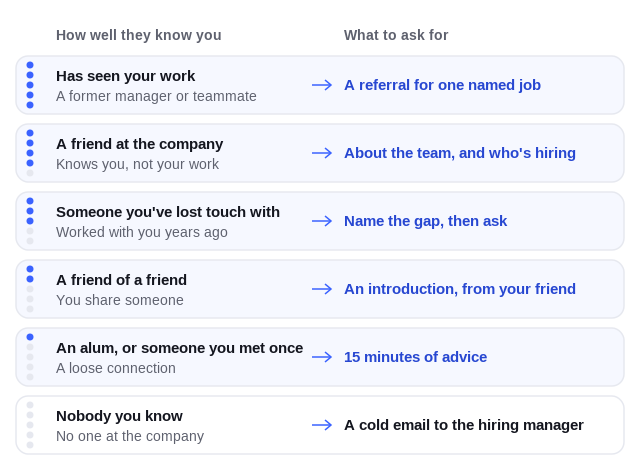
An illustration of who to ask, and what to ask each one for.

How to write a networking email, in five parts.
The guides that rank all say keep it short. career.io suggests three to four short paragraphs, and Penn's career office two to three for a request to connect. None cites a study. Our advice: about 120 words, short enough to read on a phone.
A subject line they'll recognize
Put in the subject the thing they know you by: your old company, your school, the friend who sent you, or the job title. Then they know what it's about before they open it. There are ten examples further down.
Start with how you know them
Your first line is the connection: where you worked together, who introduced you, or the school you share. If it's been years, say so here, briefly.
Say what you're looking for, in one line
The kind of role and the kind of company, in a sentence. Not your life story, and not a list of skills. If one of your results fits what they'd care about, add it.
Make one ask
Pick one: a 15-minute chat, an introduction, or a referral for a named job. One ask is easy to answer. "Let me know if you hear of any openings" sounds polite, but it hands them homework.
Instead of "Let me know if anything comes up" try "Would you be comfortable referring me for the Product Designer role (job ID 4471)?"End with an easy out, and thanks
A line like "If you'd rather not, no problem at all" takes the pressure off. Sign with your name and a link to your LinkedIn profile, not an attachment. Here's a finished one, with its parts labelled.
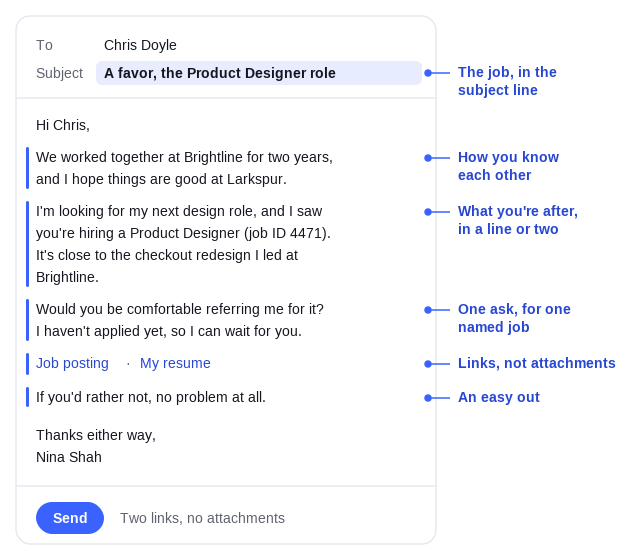
An illustration of a finished referral request. The names are made up.

Networking email templates, sorted by how well you know them.
The first five go from the closest person to the least close. The last three work for anyone. Swap the [square brackets] for your details, and keep every result true.
Referral request message, to a former colleague who knows your work
Email, before you apply. Subject line "[Job title] at [Their company], a favor to ask"
Hi [First name],

I hope things are good at [Their company]. I'm looking for my next [kind of role], and I saw you're hiring a [Job title] ([Job ID]). It's close to the work we did together on [project].

Would you be comfortable referring me for it? I haven't applied yet, so I can wait for your referral.

Here's the posting and my resume, plus three lines you can paste into the referral form.
[Link to the job posting]
[Link to your resume]

[Your name] and I worked together at [Company] on [project]. [One true result, with a number if you have one]. [One line on why you'd fit this role].

If you'd rather not, no problem at all. Thanks either way.
[Your name]
A friend who works there
They know you, but not your work. If they offer to refer you, send your resume and a few lines about your work, so they're not vouching blind. Subject line "A question about the [Team] team"
Hi [First name],

I'm looking for a new job, and I saw [Company] has a [Job title] role on the [Team] team. It's close to the [kind of work] I've been doing at [Current company].

Do you know anything about that team, or who's hiring for it?

No pressure either way.
[Your name]
Someone you've lost touch with
Name the gap in the first line. If they saw your work back then, swap the ask for the referral ask in the first template. Subject line "It's been a while, from [Shared company]"
Hi [First name],

It's been a few years since [Shared company or team], and I should have kept in touch better. I saw [one real thing, such as a new role, a launch or a post], and it looks great.

I'm now looking for [kind of role] roles, and [Their company] is high on my list. Would you have 15 minutes in the next couple of weeks to tell me what it's like there?

If now's a busy time, no problem at all.
[Your name]
[Link to your LinkedIn profile]
Asking a friend to introduce you
To the friend you share, not to the stranger. The second part is a note they can forward. Subject line "Could you introduce me to [Their contact's name]?"
Hi [Friend's name],

I saw you're connected to [Their contact's name] at [Company]. I'm interested in the [Job title] role on their team. Would you be comfortable introducing us?

To make it easy, here's a short note you can forward.

[Your name] is a [your role] who [one true result]. [Your first name] is interested in the [Job title] role on your team and would love 15 minutes of your advice.
[Link to your LinkedIn profile]

Totally fine if you don't know them well enough to ask.
Thanks,
[Your name]
A fellow alum, asking for 15 minutes
An advice ask, never a referral. If you're a student, swap [your role] for your year and subject. Subject line "[School] alum, a question about [Their team]"
Hi [First name],

I found you through the [School] alumni network. I'm a [your role] looking at [kind of role] roles, and I saw you've been on the [Team] team at [Company] for [time].

Would you have 15 minutes in the next few weeks? I'd love to hear how you got there and what the team looks for.

If you're too busy, I understand.
Thanks,
[Your name]
[Link to your LinkedIn profile]
LinkedIn connection request message, for a job at their company
For an alum or someone you've lost touch with. LinkedIn allows up to 200 characters. This one is 151 with the brackets in, so keep your details short and count before you send.
Hi [First name], fellow [School] alum here. I'm looking at [Team] roles at [Company] and would value your advice. Could I send you two quick questions?
The one follow-up, about a week later
Reply in the same thread after about five working days with no answer. Then stop.
Hi [First name],

Just bringing this back up in case it got buried. [Repeat your ask in one line].

If it's not a good time, no problem, and thanks again.
[Your name]
The thank-you, and closing the loop
Send it the day they help. When you hear back, whatever the answer, reply in the same thread with "I wanted you to know [I got an interview, I got the job, they went with someone else]. Thanks again for your help."
Hi [First name],

Thank you for [the referral, the introduction, your time]. It was generous of you, and it helped.

I'll let you know how it goes. And if I can ever return the favor, please ask.
[Your name]
Networking email subject lines, ten to copy.
Our advice: put the thing they'll recognize in the subject line, and keep it plain. A vague subject such as "Quick question" or "Touching base" is easy to skip, because it doesn't say who you are.
When you're asking for a referral. "A favor, the [Job title] role at [Company]" · "Would you refer me for [Job title]?"
When they know you well. "Your advice on the [Team] team"
When it's been a while. "It's been a while, from [Shared company]" · "[Shared team] catch-up, and a question" · "Congrats on [their news], and a question"
When someone introduced you. "[Mutual contact] suggested I write" · "Introduced by [Mutual contact]"
When you share a school. "[School] alum, a question about [their team]" · "Fellow [School] grad in [your field]"
How to ask for a job referral, and what to send with it.
A referral puts the person's name next to yours, so make it easy for them and easy to say no.
Ask before you apply, if you can
Simplify suggests asking before you apply, when you can. If you've already applied, say so, and give the date and the job ID.
Ask for one job per message
Happenstance's advice is one job per message. Give the job title, the job ID and the link, so they can find the exact posting in their own system.
Send what they need to refer you
The posting link, the job ID, your resume as a link rather than an attachment, and three lines that tie the job to your work. Happenstance suggests offering a short block they can paste into their referral form. Write it in their voice, so they don't have to rewrite it.
Three lines for Nina's email above, in Chris's voice: "Nina and I worked together at Brightline for two years. She led our checkout redesign. She'd fit your Product Designer role well."Make no easy, and thank them either way
Some people can't refer anyone, or don't know your work well enough to. Dice advises thanking them even if they won't refer you. If they say no, ask a smaller thing, such as who leads the team.
How to ask for a referral on LinkedIn, and when not to.
Find who you know first. LinkedIn's job search has an "In your network" filter. Its help page says "You can filter for jobs in your network". LinkedIn announced an "Ask for a Referral" feature in 2018, but its current help pages don't describe it, so don't count on seeing that button.
Keep the connection note for reconnecting. LinkedIn's help page says "Each message can be up to 200 characters". Without Premium, you can add a note to up to three connection requests a month. Premium members can send unlimited personalized invitations.
Make the referral ask after they accept. Our advice: use the note to reconnect or ask for advice, like the template above. Then ask for the referral in a message once they accept, or by email.
Don't ask strangers to refer you. They can't vouch for work they've never seen, so ask for advice instead and save any introduction for later. A HubSpot guide, reprinted by the University of Virginia, says not to ask for one in the first email. For messages to recruiters, see our guide on how to reach out to a recruiter.
When no one you know works there, write to the hiring manager instead.
First, check for alumni from your school, or a friend of a friend, using the list above. If there's still no one, a networking email isn't the right tool. Write a short cold email to the person who'd manage you, or to the recruiter for the role.
Portal applications often go unanswered. In a US experiment that sent more than 83,000 test applications to entry-level jobs at 108 Fortune 500 companies, 24% heard from the employer within 30 days. A note to a person gives your application a second way in.
The slow part is finding who that is. In 1,204 job postings Blynk read from its searches for product roles in November 2026, about 1 in 5 said who the role reports to, and fewer than 1 in 200 gave a person's own email. Our guides show how to find the hiring manager by hand, and what to say in a cold email for a job.
Following up on a networking email, once, then let it go.
Follow up once, about a week later, then stop. career.io says to wait "a business week" and follow up once. Happenstance says five working days, in the same thread. Simplify says follow up once after several days. Our advice is the same: one short nudge, then let it go.
Treat silence as a no, not an insult. Happenstance gives the same advice. You can still write again months later, when you have real news.
Tell them how it turned out. If someone referred you or introduced you, let them know what happened, whatever it was. The last template above is for that. For notes to an employer after you've applied, see our follow-up email guide.
Networking emails, do this, not that.
Do
- Start with people who've seen your work.
- Say how you know them in the first line.
- Make one ask, for one named job or one short chat.
- Send the job link and your resume as a link.
- Give them three lines they can paste or forward.
- Follow up once, then stop, and thank them whatever happens.
Don't
- Send your resume with no ask.
- Ask them to tell you about "any openings".
- Send the same note to everyone at a company.
- Ask someone to vouch for work they've never seen.
- Ask a stranger on LinkedIn for a referral.
- Follow up again and again.
Questions about networking emails and referrals.
Is it rude to ask someone for a job referral?
Not if they know your work and you make it easy to say no. In a study of nine large firms, referred applicants were more likely to be hired, and referred workers were less likely to quit. Ask for one named job, send what they need, and give them an easy way to say no. What can feel rude is asking a stranger to vouch for you, so with them, ask for advice instead.
How do I start a networking email?
With how you know them, in the first line: where you worked together, who introduced you, or the school you share. If it's been a while, say so briefly. Then say what you're looking for in one sentence. Skip "I hope this email finds you well" and the paragraph about yourself.
Is it OK to ask a friend for a referral?
Yes, if they can say something true about you. If they've never seen you work, ask them about the team and who's hiring first. Send your resume and a few lines about your work if they offer to refer you. If you know several people there, ask the one closest to the team. Simplify suggests people at the middle level on that team rather than senior leaders.
How do I ask for a referral from someone I don't know well?
Don't, at first. Ask for something smaller: 15 minutes of advice, or who leads the team. Dice, a job board, says that without a strong relationship it's better to ask for "things that don't require a commitment". If you get on well, they may offer to refer you. If they say they don't know your work well enough, thank them and ask who you should talk to.
Should I apply first or ask for the referral first?
Ask first, if you can. Simplify suggests asking before you apply. If you've already applied, say so in your message, with the date and the job ID, so they know where your application is.
What should I send someone who agrees to refer me?
The link to the posting, the job ID, your resume as a link, and three lines that tie the job to your work. Happenstance suggests writing those lines so they can paste them straight into the referral form. The first template above includes them.
Does a referral guarantee an interview?
No. In Ashby's data on more than 38 million applications, 40% of referred candidates reached an interview, against 3% of people who applied on their own. That's a big difference, but it means 60% of referred candidates didn't. Keep applying to other jobs while you wait.
What should I put in a networking email subject line?
The thing they'll recognize: your shared company or school, the name of the person who introduced you, or the job title. Keep it plain, such as "Introduced by [Mutual contact]" or "[School] alum, a question about [their team]". For a referral, name the job: "Would you refer me for [Job title]?" The list above has ten.
How long should a networking email be?
Short. career.io suggests three to four short paragraphs, and Penn's career office two to three. Our advice is about 120 words, short enough to read on a phone. If you don't hear back, follow up once after about a week, then stop.
How do I network for a job if I don't know anyone?
Start with people you half-know: alumni from your school, old classmates, or friends of friends. Ask them for advice, not a referral. If no one you know works at the company, write a short cold email to the hiring manager instead. Our cold email guide shows how. Or paste the job link: Blynk finds the people hiring for the role and writes them a short note built from your resume.
Where the facts come from.
Checked in November 2026. The advice is ours. The research comes from each study's own page, facts about LinkedIn and Blynk from each company's own pages, and what other guides recommend from those guides. The posting counts are Blynk's own: 1,204 job postings from Blynk's searches for product roles, most of them senior, from company career sites and job boards, first seen between October 31 and November 11, 2026, each read for a reporting line and for email addresses.
- How to write a cold email for a job
- How to do an informational interview
- How to reach out to a recruiter
- How to find the hiring manager
- Follow-up email after applying
- How to ask for a coffee chat
- How to write a letter of interest
- How to email your resume
- How to find someone's email address
- Ashby Talent Trends: referrals (2025)
- Burks, Cowgill, Hoffman and Housman: the value of hiring through employee referrals (QJE, 2015)
- Burks, Cowgill, Hoffman and Housman: working paper (IZA DP 7382)
- MIT News: the strength of weak ties on LinkedIn (2022)
- LinkedIn Help: personalize invitations to connect
- LinkedIn Help: job search filters
- LinkedIn News: introducing Ask for a Referral (2018)
- Kline, Rose and Walters: Systemic Discrimination Among Large US Employers (NBER)
- Happenstance: how to ask for a referral for a job
- Simplify: how to ask for a job referral
- Dice: how to ask for a job referral
- career.io: networking email templates
- University of Virginia Economics (HubSpot reprint): networking email advice
- Penn Career Services: requesting to connect for an informational interview
- Blynk Find the Hiring Manager
