
Is the job market bad right now? It's not just you. Here are the numbers.
If you've been applying for months while the news says unemployment is low, you're not imagining the gap. Employers are hiring slowly and laying off few people, so people looking wait longer. Here are this month's official US numbers in one place, what each means for you, and what to change.

The short answer
- For people looking, yes, it's slow. In September 2026, hires were 3.4% of all jobs, a pace Indeed's Hiring Lab calls the slowest since 2013. In October, 27.6% of unemployed people had been out of work for 27 weeks or more.
- For people with jobs, it's steadier. Layoffs were 1.0% of jobs in September, and unemployment was 4.1% in October. That's why the headlines and your inbox don't match.
- What helps is fewer applications that closely fit, sent early, plus a short note to the person hiring. Sending more the same way mostly adds to the pile.
On this page
Is the job market bad right now? Six official numbers, as of November 2026.
Each one comes from a federal release, with the month it covers. The next updates come out on December 1 (job openings and hires) and December 4 (the monthly jobs report).
Job openings, 7.5 million in September
That's about one opening for every unemployed person, by our calculation from Bureau of Labor Statistics (BLS) data. In September 2019 there were 1.24, and in March 2022 about 2. So the jobs are there. But an opening is an ad, not a hire, and it says nothing about how many people go for it.
Hires, 5.4 million in September
That's 3.4% of all jobs in one month. Across 2026 so far, hires have averaged 3.32% of jobs a month, about as slow as 2012 and 2013, and well below 2019 and 2022 (our calculation from BLS data). This is the number that matches how the search feels. Employers are filling seats, just not many, and not fast.
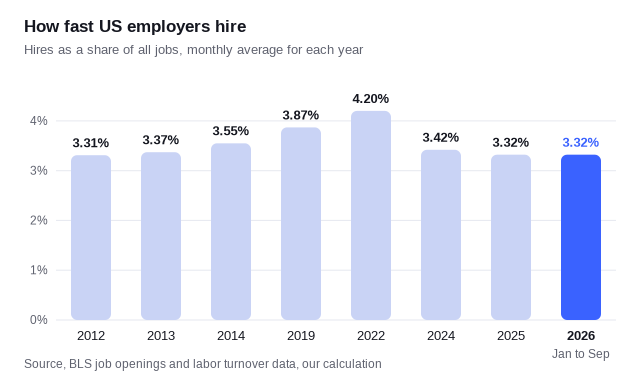
Selected years, our calculation from BLS job openings and labor turnover data (seasonally adjusted). 2026 covers January to September. Layoffs and quits, both low
Layoffs were 1.6 million in September, or 1.0% of jobs, close to 2019's levels. Quits were 3.4 million, or 2.1%, a little below 2019's average. Few people are pushed out, and few leave on their own, so few seats open up. The economist Jed Kolko put it simply in January 2026. The market is good for job holders and bad for job seekers.
Unemployment, 4.1% in October
That's 7.1 million people, and the rate has stayed between 4.1% and 4.3% since March. It counts people who are out of work and looking. It doesn't measure how quickly they get hired, which is why a low rate and a hard search can both be true.
How long people are out of work, the longest in years
In October, half of unemployed people had been looking for 11.9 weeks or less. The average was 27.1 weeks, and 27.6% had been out of work for 27 weeks or more. In October 2019 those numbers were 9.0 weeks, 22.4 weeks and 21.9%. Hiring Lab says the average is the highest since December 2021. These are searches still going, not the time it takes to get a job.
One gap to know. October 2025 was never measured, because of the federal government shutdown. So any page comparing this October with last October is guessing.Recent graduates, a harder start
Among college graduates aged 22 to 27, unemployment was 5.2% in the third quarter of 2026, according to the New York Fed. It counts 42.5% of them as underemployed, in jobs that usually don't need a degree.

Is it you or the job market? Often both, and here's how to tell.
The numbers above are real, and none of them are about you. When few people get hired each month, strong people wait longer too. If you feel like you're doing everything right and hearing nothing, the data says many people are in the same spot.
Your part is still worth checking. It's which jobs you pick, how each application reads for that job, and whether a person ever sees it.
If many of your applications were a stretch, start there. If they fit, the market is part of it, and our six-step check for why you're not getting interviews finds the rest. And if the search has worn you down, our guide to job search burnout is about that part.
Why is it so hard to get a job right now? Five reasons the numbers back up.
Why are jobs so hard to get? In short, few seats open up each month, and more people go for each one. Here's what sits behind that.
Hiring is slow, even though layoffs aren't high
Indeed's Hiring Lab calls it a “low-hire, low-fire” market. Its economist Cory Stahle wrote in November 2026 that employers are hiring at the slowest pace since 2013. In other words, companies are keeping the staff they have and adding few new people.
What it means for you. Each opening matters more, so the first days after a job goes up count.Low unemployment doesn't mean easy hiring
Jed Kolko, an economist at the Peterson Institute (PIIE), looked in January 2026 at November 2025's hires rate, 3.2%. He noted that before the pandemic, it would typically have come with unemployment of around 8%. In our reading, unemployment stays low because so few people are losing jobs. The headline number tells you about people with jobs, not people looking.
What it means for you. A long search right now isn't proof that something is wrong with you.More people apply for each job
Greenhouse, a hiring software company, counted about twice as many applications per job on its platform in 2025 as in 2022. Its time to fill a job went up too. More applications per job is part of why replies are slow. Our guide on how many job applications it takes to get a job has the details.
What it means for you. Sending more of the same adds to the pile. Fewer, closer fits stand out in it.Some fields are shrinking
From October 2025 to October 2026, the information sector lost 119,000 jobs (about 4%), financial activities lost 99,000 and government lost 58,000 (our calculation from BLS data). On Indeed, software development job postings were about 21% below their February 2020 level in October, by Indeed's own index.
What it means for you. If your field is shrinking, search by the work you do, not only by your last title. The same skills often fit other industries.Starting out is harder, for Gen Z and first jobs
In October 2026, unemployment was 13.9% for teens and 7.5% for people aged 20 to 24, against 4.1% for everyone. In October 2019 it was 11.9% and 6.3%. A Stanford study found employment of 22 to 25 year olds in jobs most exposed to AI was 19% below where it would have been. Its authors call that early, descriptive evidence, not proof that AI caused it.
What it means for you. With little track record, fit and a person who knows your work count for more, in our view.
Job market numbers that are made up, and what the real ones say.
Many pages about why it's so hard to find a job repeat a few big numbers with nothing behind them. They make the search sound hopeless, or they sell you something. Here are the common ones.
“An ATS rejects 75% of applications before anyone reads them.” No study shows this. HiringThing, which makes hiring software, traced the claim to Preptel, a job-services company that closed in 2013. In a small 2025 survey by Enhancv, a resume company, 23 of 25 US recruiters said their system doesn't reject resumes for formatting, content or design. Where a system does reject people automatically, it follows rules the employer sets, such as answers to the application's questions, as Greenhouse's help pages describe. Our guide on how an ATS really works walks through what happens after you press Submit.
“93% of companies post ghost jobs.” That comes from a vendor survey with no method on the page. Greenhouse, using its own data, found in December 2024 that 18% to 22% of jobs on its platform in a quarter were classified as ghost jobs. That's real, but it's not most jobs. More in our guide to ghost jobs.
“85% of jobs are filled through networking.” We found no study behind it. Ashby, which makes hiring software, looked at nearly 250,000 hires through June 2025. People who applied made up 43% to 52% of hires, and referrals about 18%. Applying works. A referral helps, but it's a smaller share than the myth says.
“There are no jobs.” There were 7.5 million openings in September. The problem is how few get filled each month, not that none exist.
The job market in 2026, what changed this year.
2025 ended weaker than it looked. After the BLS's yearly revision, US employers added about 116,000 jobs in all of 2025, against about 1.46 million in 2024.
2026 has added more jobs, but hiring hasn't sped up. Payrolls grew by about 861,000 from December 2025 to October 2026, including 165,000 in October. Yet the hires rate barely moved all year. It hit a low of 3.1% in February and has averaged 3.32%.
And searches got longer. The share of unemployed people out 27 weeks or more went from 23.6% in September 2025 to 27.6% in October 2026.
Most new jobs were in health care. Health care and social assistance added 519,000 jobs from October 2025 to October 2026, about 6 in 10 of all new jobs (our calculation; Hiring Lab says about 60%). Professional and business services added 269,000, and construction 124,000.
Are we in a recession? In the US, only the National Bureau of Economic Research (NBER) dates recessions, and the last one it has dated ended in April 2020. Payrolls grew by 885,000 in the 12 months to October 2026. What the numbers show is a slow hiring market, not falling employment.
A few early signs of a turn. Indeed's job postings were 2.8% higher than a year earlier in mid-October (Hiring Lab, October 22). On November 6, Hiring Lab called it the first yearly gain in more than four years (Indeed's own data). In the New York Fed's October survey, people's average sense of their chance of finding a job if they lost theirs rose to 46.5%, the highest since November 2025. That's how people feel, not how many get hired.
What to do in a slow job market, five changes that fit it.
None of these changes the market. They change how much of your time goes into applications that have a real chance.
Send fewer applications, to closer fits
When each job draws more people, a close fit stands out and a stretch rarely does. Pick jobs whose must-haves you really meet. Our guide on how many applications it takes has the numbers.
Apply early, on the employer's own site
Openings are scarce, so the first days count. If the Apply button lands on the company's careers page or hiring system, that's the employer's own route. LinkedIn tells employers that Easy Apply brings “2x as many applicants.” Its own help pages say too many applications make it “harder for recruiters to identify genuine applicants.” Here's when to use LinkedIn Easy Apply and when to apply on the company site.
Make each application fit, truthfully
Use the posting's own words for things you've really done, and put the job's top asks near the top. See how to tailor your resume to a job description.
Reach a person, not just a portal
A short note to the hiring manager gets your name in front of someone who decides. Our guide shows how to find the hiring manager and what to write.
Plan for a long search
With more than a quarter of unemployed people out for six months or more, set hours you can keep for months. Our job search burnout guide helps with the pace. If you need paid work now, see how to get a job fast.
Questions about this year's job market.
How are people actually getting jobs in 2026?
Mostly by applying, with help from people they know. In data from Ashby, a hiring software company, on nearly 250,000 hires through June 2025, people who applied were 43% to 52% of hires and referrals about 18%. Our advice for now is to apply to fewer, closer fits, apply early, and reach a person. Our guide shows how to find the hiring manager by hand, or Blynk can find the people hiring and write the note. Nothing is sent until you say so.
Why are Gen Z not getting hired?
Starting out is harder when employers add few people. In October 2026, unemployment was 7.5% for people aged 20 to 24 and 13.9% for teens, against 4.1% for everyone (BLS). A Stanford study found fewer young workers in AI-exposed jobs than expected, which its authors call early, descriptive evidence. More in the reasons above.
At what age is it harder to get hired?
It's hard at both ends, in different ways. Young people are more often unemployed, at 13.9% for teens and 7.5% for ages 20 to 24 in October 2026 (BLS). Older people tend to search longer. CNN, reporting BLS data in June 2026, said laid-off workers aged 45 to 54 had been out of work 30.7 weeks on average. US law forbids age discrimination against people 40 or older.
Is the job market going to get better in 2026?
There are signs, but not a turn yet. Employers added 165,000 jobs in October, and Indeed's job postings rose over the year for the first time in more than four years. People in the New York Fed's survey also felt a bit better about finding work, but hiring is still as slow as it was all year, and searches are the longest since 2021. Our reading is that it's better for people with jobs than for people looking. The next numbers come out in early December.
Is 2026 the hardest year to get a job?
By how fast employers hire, it's among the hardest in more than a decade. Hires have averaged 3.32% of jobs a month in 2026, about the same as 2012 and 2013 (our calculation from BLS data). Hiring Lab says long searches are at a share rarely seen outside the aftermath of a recession. But layoffs are low, at 1.0% of jobs, and the US added 885,000 jobs in the 12 months to October. So it's a hard year to be looking, not a year of mass layoffs.
What jobs and careers are in demand in 2026?
Health care, by far. Health care and social assistance added 519,000 jobs from October 2025 to October 2026, about 6 in 10 of all new US jobs (our calculation from BLS data). Professional and business services and construction came next. On Indeed, job postings in engineering and in healthcare were well above their February 2020 levels in October, by Indeed's own index.
Which jobs are doomed in 2026?
No official source calls any job doomed. What the numbers show is where jobs shrank over the past year. From October 2025 to October 2026, the information sector lost 119,000 jobs, financial activities 99,000 and government 58,000 (BLS). Indeed's software development postings were about 21% below their early 2020 level. Fewer jobs in a field isn't zero jobs, and the skills often move.
Is a cover letter still important?
Sometimes. It's often optional, but a short one written for the job can help. In a field experiment by ResumeGo, a resume company, tailored cover letters got 53% more callbacks than no letter at all. Our advice for a slow market is a few lines on why this job, not a generic page. See do you need a cover letter.
What is the 30-60-90 rule for a new job?
It usually means a 30-60-90 day plan, an outline of what you'd aim to do in your first three months in the job. Indeed's career guide says employers may ask in an interview what you plan to achieve in your first three months.
How do I explain an employment gap, and how big of a gap is too big?
Give the gap one honest line, such as caregiving, study or a layoff. In a 2019 field experiment by ResumeGo, a resume company, gaps with a reason got callbacks 6.8% of the time, against 4.3% with none. In the same study, callbacks fell slightly with each year of gap, then dropped by about half between two years and three. We found no study on other resume red flags, so our six-step check for why you're not getting interviews goes through the rest of your applications.
Where the facts come from.
Checked on November 12, 2026, against the newest releases. The job openings figures cover September 2026, and the jobs report and duration figures cover October 2026. Comparisons with earlier years and the industry totals are our calculations from the BLS's own data series. Indeed, Greenhouse, Ashby and ResumeGo figures are those companies' own data, labeled as such. We update the numbers each month. Blynk has no data on the job market, so none of its own numbers appear here.
- Why am I not getting interviews?
- Job search burnout
- How does an ATS work?
- Ghost jobs
- A job search strategy that works
- Hiring freezes and when to apply
- How to change careers
- What to do after a layoff
- The tech job market now
- US Bureau of Labor Statistics, Job Openings and Labor Turnover, September 2026
- US Bureau of Labor Statistics, The Employment Situation, October 2026
- US Bureau of Labor Statistics, unemployed persons by duration of unemployment, October 2026
- US Bureau of Labor Statistics, job openings and labor turnover data series
- US Bureau of Labor Statistics, Current Employment Statistics by industry
- Federal Reserve Bank of New York, the labor market for recent college graduates
- Federal Reserve Bank of New York, Survey of Consumer Expectations, October 2026
- Indeed Hiring Lab, US labor market snapshot, October 2026
- Indeed Hiring Lab, September 2026 JOLTS report (Cory Stahle)
- Indeed Hiring Lab, October 2026 jobs report
- PIIE, labor market measures point all directions (Jed Kolko, January 2026)
- Greenhouse, recruiting benchmarks (The Hire Standard, 2026)
- Greenhouse, 2024 State of Job Hunting report
- Greenhouse Support, application rules overview
- Stanford Digital Economy Lab, Canaries in the Coal Mine (revised August 2026)
- NBER, US business cycle dating
- HiringThing, applicant tracking system myths (2022)
- Enhancv, do ATS reject resumes (25 recruiters, 2025)
- Ashby, talent trends report, inbound applications (2025)
- ResumeGo, cover letter field experiment
- ResumeGo, employment gaps field experiment (2019)
- LinkedIn Talent Solutions, Easy Apply
- LinkedIn Help, applying to many jobs
- Indeed career guide, the 30-60-90 day plan
- CNN via ABC17 News, why it's so difficult to find work (June 2026)
- EEOC, age discrimination
- Blynk Find Jobs
