
The tech job market right now. What the numbers say, and who it's hard on.
You've seen both headlines this year. Tech hiring is back, and tech layoffs are up. Both are true, because they count different things. Here are the newest official numbers and named trackers, each dated, what each one means for you, and what helps while you look.

The short answer
- It's steadier for people in tech than for people trying to get in. Unemployment for IT workers was 2.8% in October 2026, against 4.1% for everyone, by CompTIA's reading of BLS data. Postings for IT jobs were 22% higher than a year earlier.
- It's still smaller than it was. Jobs in the information sector are 12% below their 2022 peak. Software development postings on Indeed are about 21% below early 2020. And tech employers announced 171,501 job cuts through October, more than in all of 2025, by Challenger's count.
- It's hardest at the start. New graduates in computer engineering and computer science had some of the highest unemployment of any major. What helps is aiming at the roles that are growing and applying to jobs you clearly fit.
On this page
The tech job market in numbers, seven, as of November 2026.
Each one names its source and the month it covers. The BLS figures for the latest months are preliminary. The next job openings release is on December 1, and the next jobs report on December 4.
Unemployment for IT workers, 2.8% in October
CompTIA, the IT industry group, read the BLS's October numbers and put unemployment for IT workers at 2.8%, against 4.1% for all workers. It counts about 26,000 more IT jobs across the economy than in September. CompTIA notes that monthly numbers by occupation move a lot and get revised, so one month is a hint, not a trend. In our reading, people who already work in tech mostly keep working.
IT job postings, up 22% in a year
By CompTIA's count from Lightcast job ad data, employers added 290,892 new IT postings in October. That's up 22.2% from October 2025. Active postings were 629,876, up 18.5% over the year. Software developers and engineers had the most new postings, at 51,944.
Software postings, still about 21% below 2020
Indeed's index of software development postings was about 79 in mid-October 2026, where February 2020 is 100. That's the lowest of the fields in Indeed's October snapshot. Software postings have risen almost 15% since February 2025, and Indeed's Hiring Lab found 71% of the rise from May 2025 to May 2026 came from senior roles. Hiring Lab's Guillermo Gallacher notes that the rebound “has a low starting point.”
Jobs at tech companies, still shrinking
The BLS counted 2.73 million jobs in the information sector in October 2026. That's 119,000 fewer (4.2%) than a year earlier, 381,000 fewer (12.2%) than the November 2022 peak, and below February 2020 (our calculation from BLS data). The sector covers software, publishing, telecom, film and data hosting, so it isn't only tech. Computer systems design firms, where many developers and IT consultants work, had 25,600 fewer jobs than a year earlier and 129,400 fewer than their March 2023 peak.
Openings in the information industry, the fewest in years
Employers in the information industry had about 88,000 job openings in an average month from January to September 2026. That's the lowest of any year since 2019, as far back as we checked, against 224,000 in 2022 and 141,000 in 2019 (our calculation from BLS job openings data). September rose to 116,000, but this industry's monthly numbers come from a small sample and jump around.
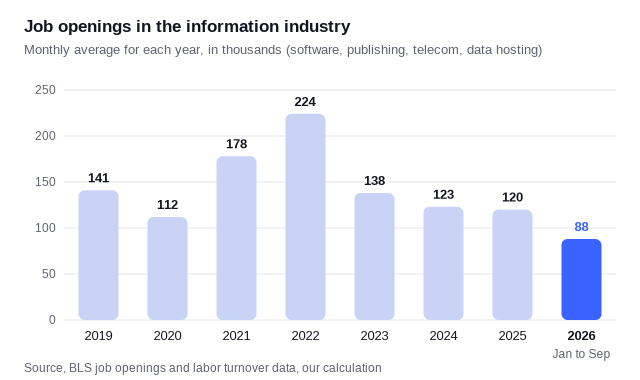
Our calculation from BLS job openings and labor turnover data, seasonally adjusted. 2026 covers January to September; September is preliminary. Tech layoffs, more announced than in all of 2025
Challenger, Gray & Christmas, an outplacement firm, counted 171,501 job cuts announced by US tech employers through October 2026. That's up 21% on the same months of 2025, more than the 154,445 for all of last year, and 28% of all cuts announced this year. October's 5,576 was tech's lowest month of the year. These are announced plans, not a count of people let go.
New graduates, a hard start
In 2024, recent computer engineering graduates aged 22 to 27 had 7.8% unemployment. That was the second highest of 73 majors in the New York Fed's table. Computer science was 7.0%, against 4.2% for all recent graduates. Those who do find work mostly land degree-level jobs, though. Only 15.8% of computer engineering and 19.1% of computer science graduates were underemployed, against 39.4% overall, and their typical early-career pay was $90,000 and $87,000.

Why tech job market headlines disagree, and how to read them.
“Tech hiring is back” and “tech jobs keep disappearing” can both run in the same week. Usually both are true, because they count different things. Four questions sort most headlines out.
Tech jobs, or tech companies? CompTIA counts people doing tech work in any industry, such as a bank's developers or a hospital's IT team. The BLS information sector counts jobs at companies in software, publishing, telecom and so on, including their staff who don't do tech work. In September, CompTIA's own headline put it this way. Tech jobs are growing across the US economy, while tech companies pull back on staff.
Postings, or hires? A posting is an ad, not a hire. Postings can climb from a low point while hiring stays slow. Lenny's Newsletter used hiring data from Live Data Technologies. It counted about 113,000 software engineers hired by US companies from May 2025 to April 2026, less than half the 2022 peak of 239,000.
Compared with when? “Up 22% on last year” and “21% below 2020” can describe the same market. Check which year a headline starts from.
Announced, or counted? Challenger counts layoffs companies announce. Trackers such as Layoffs.fyi and TrueUp count the reports they find, each in its own way, so their totals differ. The BLS asks employers about layoffs in its job openings survey. In the information industry, layoffs averaged 1.8% of jobs a month in 2026, against 1.4% in 2019 (our calculation).
Our reading: parts of the tech job market are growing again, from a low base, and the whole is still smaller than in 2022.
Who tech hiring is hardest on, and where it's growing.
Google's own summary calls the market split between entry-level and senior or specialized roles. Here's what the named sources show, side by side.
Hardest: new graduates and first tech jobs
A Stanford Digital Economy Lab study used ADP payroll data through June 2026. It found employment of 22 to 25 year olds in the jobs most exposed to AI 19% below where it would otherwise be. Experienced workers in the same jobs showed “no comparable gap.” The authors call these early, descriptive signs, not proof of what caused them. Indeed's finding that most of the rise in software postings came from senior roles points the same way.
Hard: general software and design roles
Lenny Rachitsky's late 2026 report draws on TrueUp's openings at more than 9,000 tech companies worldwide. In it, open engineering roles grew only 2.5% in the past year. Open product design roles, about 1,900, were the fewest since his tracking began and down 28% on the year.
Hard: fully remote tech work
In the same report, only 14% of open tech roles offered remote work, down from 21% in late 2022 and the lowest on record. About 15% were in the San Francisco Bay Area. If you need remote work, our guide on how to find remote jobs covers where to look.
Growing: AI roles and AI skills
On Indeed, AI-related postings made up 7.3% of all postings in October 2026, past their 2022 peak of 3.3%. In its March 2026 report, CompTIA counted dedicated AI roles up 81% over the year, though still a small share of tech hiring. In Lenny's data, “LLM” is now the skill most often named in product manager postings.
Growing: infrastructure, security and data
In CompTIA's October count, postings for DevOps engineers, infrastructure architects, cybersecurity engineers and data scientists all grew by double digits. Indeed's data center postings were 117% above their January 2024 level.
Growing: product managers
Open product manager roles were at their highest in nearly four years, by Lenny's count.
The tech job market in 2026, what changed this year.
Postings turned up. Software development postings on Indeed rose almost 15% from late February 2025, by Indeed's July 2026 count, while postings overall fell 7%. By October, IT postings were 22% above a year earlier, by CompTIA's count.
Jobs at tech companies kept falling. The information sector went from 2.84 million jobs in December 2025 to 2.73 million in October 2026 (our calculation from BLS data).
Tech layoffs went up while others went down. Announced tech cuts were up 21% through October, while cuts across all industries were down 44%, by Challenger's count. Challenger also says market and economic conditions overtook AI as the top reason given for cuts in 2026.
AI showed up in more postings. AI-related postings passed their 2022 peak on Indeed, and remote tech work kept shrinking, by the numbers above.
For the whole US job market, not just tech, our guide is the job market bad right now? has this month's official numbers. In short, employers across the economy are hiring slowly and laying off few people.
Will the tech job market recover? What the forecasts say, and whose they are.
We don't make forecasts. Here's what the people who do make them say, with their names on it.
CompTIA's projection. In March 2026, CompTIA projected that net tech employment would grow 1.9% this year, to about 9.8 million workers, after falling about 0.3% in 2025.
The BLS's 10-year projection. The BLS expects jobs for software developers, quality assurance analysts and testers to grow 10% from 2025 to 2035, much faster than average, with about 106,100 openings a year. It ties part of that demand to software for AI, robotics and automation. That's a decade-long projection, not a call on next year.
What to watch. CompTIA's monthly analysis has come out on the day of each jobs report, and the next jobs report is on December 4. The next job openings figures come out on December 1.
Our reading: for people already in tech, the market has been steady. For people trying to get in, the recovery so far is mostly in postings, and mostly for senior and AI roles.
What to do in this tech job market, five changes that fit it.
None of these changes the market. They point your time at the parts of it that are growing.
Aim at the roles that are growing
If your work is close to infrastructure, security, data or AI, look at those titles too, not only your last one. The skills often carry over. Search by the work you do, then read each posting's must-haves.
Show AI in the work you've really done
Indeed's Sneha Puri told CNBC, “Being able to use AI in your work and improve your efficiency is a great place to start.” If you've used AI tools to ship something, say what and with what result. Don't claim what you haven't done.
Apply to jobs you clearly fit
Our advice: when a posting draws a crowd, a close fit stands out more than a stretch. Our guide on how many job applications it takes to get a job has the numbers on volume and fit.
Look beyond tech companies
Tech work is growing across the economy even as tech companies cut, by CompTIA's count. CompTIA names professional and technical services, manufacturing, health care and construction among the employers looking for tech skills. Our list of the best tech job boards shows which boards fit which kind of role.
Reach a person, not just a portal
A short note to the person hiring puts your name in front of someone who decides. Here's how to find the hiring manager and what to write.
Questions about the tech job market.
Is IT hard to find a job right now in 2026?
It's harder to get in than to stay in. Unemployment for IT workers was 2.8% in October 2026, below the 4.1% for everyone (CompTIA, from BLS data). But recent computer engineering and computer science graduates had some of the highest unemployment of any major. And openings in the information industry are at their lowest of any year since 2019.
Will the tech job market recover in 2026?
Parts of it already have, from a low point. IT postings were 22% higher in October than a year earlier (CompTIA), but jobs at tech companies are still falling and tech layoff announcements are up 21% (Challenger). CompTIA projected 1.9% growth in tech employment for 2026. That's its forecast, not ours.
Are tech companies hiring in 2026?
Yes, but fewer than before. Information industry employers had about 88,000 openings in an average month this year, against 224,000 in 2022 (our calculation from BLS data). Jobs in computer systems design were 25,600 lower than a year earlier. More of the growth is in tech work at other kinds of employers.
Are IT jobs still in demand?
Yes. Employers posted 290,892 new IT postings in October 2026, 22.2% more than a year earlier (CompTIA, Lightcast data), and IT unemployment was 2.8%. The BLS projects computer and IT jobs to grow faster than average from 2025 to 2035, with about 280,000 openings a year.
What are the most in-demand IT jobs in 2026?
Software developers and engineers had the most new postings in October 2026, 51,944 by CompTIA's count. DevOps engineers, infrastructure architects, cybersecurity engineers and data scientists grew fastest, each by double digits. On Indeed, data center postings were 117% above their January 2024 level.
Which 5 jobs will survive AI?
No official source lists five. The BLS projects software developer jobs to grow 10% from 2025 to 2035, partly because of software for AI. Stanford researchers found the early pressure falls on young workers in AI-exposed jobs, not experienced ones. We don't make forecasts, so we won't name five. On Indeed, AI-related postings were 7.3% of all postings in October 2026, past their 2022 peak.
Which tech job is highly paid?
By the BLS's May 2025 medians, computer and information research scientists ($140,300) and computer network architects ($134,050) are paid best. Next come software developers, QA analysts and testers ($134,040) and information security analysts ($129,180). The median for the whole computer and IT group was $109,470, against $50,980 for all jobs.
What career makes $1,000,000 a year?
No tech job in the BLS's career guide has a typical pay anywhere near that. The highest median among computer and IT jobs is $140,300, for computer and information research scientists (May 2025). A median is the middle, so half in that job earn more and half less.
What are top 3 tech skills?
There's no official top three. CompTIA's research head names software, AI, cybersecurity, data, systems and networking as what employers across industries want. In job postings tracked for Lenny's Newsletter, Python is still the top engineering skill, and LLM has passed Java.
Which tech skill is most profitable?
We found no study that ranks skills by pay with a method we could check. Pay is easier to see by job. The BLS's highest medians in tech go to research scientists, network architects, software developers and security analysts, so the skills those jobs need are a fair guide.
Where the facts come from.
Checked from November 13 to 16, 2026, against the newest releases. BLS figures cover October 2026 (employment) and September 2026 (job openings), and the latest months are preliminary. Comparisons with past years, peaks and averages are our calculations from the BLS's own data series. CompTIA, Indeed, Challenger and Lenny's Newsletter figures are those organizations' own data, labeled as such. The New York Fed's table by major uses 2024 data. We couldn't open Layoffs.fyi or TrueUp directly, so their totals aren't used. Blynk's own job data comes from its users' searches and can't speak for the market, so none of it appears here.
- Is the job market bad right now?
- The best tech job boards
- Hiring freezes and when to apply
- AI job boards
- How to find remote jobs
- How to find the hiring manager
- CompTIA, tech employment gains momentum in October (November 6, 2026)
- CompTIA, technology occupations grow across US economy despite staffing pullback at tech companies (September 4, 2026)
- CompTIA, State of the Tech Workforce 2026 (March 27, 2026)
- US Bureau of Labor Statistics, Current Employment Statistics by industry (information, computer systems design)
- US Bureau of Labor Statistics, job openings and labor turnover data, information industry
- US Bureau of Labor Statistics, Occupational Outlook Handbook, software developers, QA analysts and testers
- US Bureau of Labor Statistics, Occupational Outlook Handbook, computer and information technology occupations
- Indeed Hiring Lab, US labor market snapshot, October 2026
- Indeed Hiring Lab, AI and job postings, from destruction to creation? (Guillermo Gallacher, July 8, 2026)
- Challenger, Gray & Christmas, October 2026 job cuts report (November 5, 2026)
- Federal Reserve Bank of New York, the labor market for recent college graduates (outcomes by major, 2024 data)
- Stanford Digital Economy Lab, Canaries in the Coal Mine (revised August 12, 2026)
- Lenny's Newsletter, state of the tech job market, late 2026 (Lenny Rachitsky, November 10, 2026)
- CNBC, AI is automating coding, so why are software developer job postings on the rise? (October 11, 2026)
- Blynk Find Jobs
