
How to change careers. Test the move before you make it.
Tired of your field and wondering if a switch is realistic? It usually is, but rarely as one leap. Here's the order of decisions, a cheap way to test a new field before you quit, and what changes at 30, 40 and 50.

The short answer
- Pick the move that keeps the most. The same work in a new field, or new work in your field, is easier than changing both at once.
- Test it before you quit. Talk to people who do the job, try a small project, and read 20 real job postings for what they ask.
- Then land it. Close only the gaps those postings require, and tell your story in one line on your resume and in interviews.
On this page
Changing careers, three things you've heard, checked.
Career change advice often repeats a few numbers that don't hold up. Here's what the sources behind them actually say.
“People change careers five to seven times.” BLS has never counted that. The US Bureau of Labor Statistics (BLS) says it has never tried to estimate how many times people change careers, because there's no agreed definition of a career change. What BLS does count is jobs. People born from 1957 to 1964 held an average of 12.9 jobs from age 18 to 58, where a job means time with one employer.
“Most people change careers at 39.” That number comes from Indeed's 2019 career change survey of 662 full-time US workers. 39 was the average age of the people it surveyed, not the age they changed careers. The same survey found that 49% had made a dramatic career shift.
“You'll have to go back to school.” Often not. In Indeed's survey, only 37% of career changers enrolled in a specific education or training program. Job postings can be looser than they look, too. In 1,204 job postings from Blynk's searches for product roles, 315 mention a bachelor's degree. About half of those (151) also accept equivalent experience or call the degree preferred.
How to change careers, in six steps.
The order matters more than the speed. Indeed's survey found career changers spent an average of 11 months thinking about the move before they made it. These steps turn that thinking into tests you can run while you're still paid.
Write down why you want out, and what you'd keep
Be specific about the problem, because a new career only fixes some problems. In Indeed's survey, career changers said they left because they were unhappy in their old job or sector (81%), wanted more flexibility (79%) or more money (79%), no longer felt challenged (78%), or wanted to advance (77%). If the trouble is one manager or one company, our advice is to try a new employer in your field first. Then list what you'd keep, such as the people you know, a skill you're known for, or your pay.
Leaving because
I'm bored by month-end close, and I can't move up here.
Keeping
Numbers, the hospital world, and the people I know there.Pick the move that keeps the most, a career pivot or a full change
There are three kinds of move. You can do the same work in a new field, new work in the field you know, or change both at once. Our reading is that each thing you keep is experience that still counts, so changing one thing at a time is usually easier. People often call the first two a career pivot. Indeed's own career guide suggests a similar sort, grouping target careers by whether your skills transfer, need some training, or need advanced skills you don't have yet.
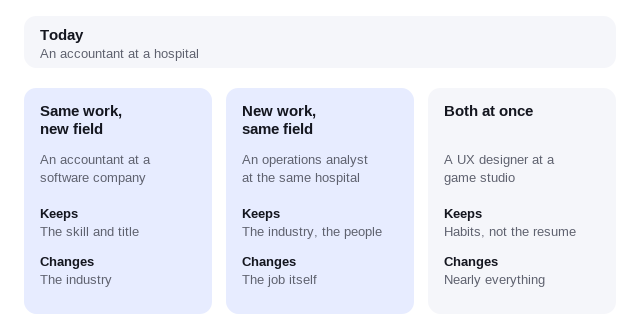
An illustration of the three kinds of career move, with a made-up example. Which keeps the most is our reading. Test the new career before you quit
In a Harvard Business Review article, researcher Herminia Ibarra argued that people change careers by “test and learn”, not by “plan and implement”. She advised trying new roles “on a limited but tangible scale, without compromising your current job”, through freelance or pro bono work, moonlighting or a sabbatical. Our advice is to run three cheap tests in about a month. Talk to two or three people who do the job (our informational interview guide has the questions), do one small project in the new work, and read 20 real job postings for it.
Week 1
Read 20 job postings, and list what most of them ask for.
Weeks 2 and 3
Talk to two people who do the job.
Week 4
Do one small project, then ask yourself if you'd want this every day.Close only the gaps the job postings require
Split your list from the postings in two. A license or certification that most postings require is a real gap. A skill only a few postings mention, or that they call preferred, usually isn't. In 1,204 job postings from Blynk's searches for product roles, about half (588) marked some requirements as preferred or nice to have. Our advice is to pay for training only when most of your 20 postings name the gap, and to apply around the rest.
Work out the money and the timing before you give notice
Plan for the chance of earning less at first. In Indeed's survey, 58% of career changers said they were willing to take a pay cut. Indeed's career guide suggests waiting until you have a job offer before you leave. Look up what the new job pays in the BLS Occupational Outlook Handbook, and check it against the pay ranges in your 20 postings. How long you can manage on less is your call, and a financial professional can help you work it out.
Land the job with a one-line story
Ibarra calls this making sense, which means telling a story about the change that others can follow. Put it in one line, linking what you did to what you want to do next, and use the same line on your resume, on LinkedIn and in interviews. Our career change resume guide shows how to rework the resume itself. Our advice is to apply first where your old field counts as a plus, such as a software company that sells to hospitals, if you come from health care.
Ten years in hospital finance taught me how care teams spend money. Now I want to build the tools they use.

Career change at 30 or 35, while it costs the least.
Moving around is normal at this age. In January 2026, the median worker aged 25 to 34 had been with their employer for 3.0 years, by BLS figures, against 9.6 years for workers aged 55 to 64.
Our reading is that a career change at 30 or 35 costs the least it ever will. You have fewer years of seniority to give up, and a few years of work that already count as experience. If you want to change both the work and the field at once, this is the easiest time to try it.
The same holds at 35. Run the tests in step 3 first, because a year in the wrong job costs time at any age.
Career change at 40, lean on what you've already done.
A worry that comes up again and again in forums at 40 is competing with people in their 20s for entry-level jobs. Our advice is to avoid that contest where you can. Pick a move that keeps one thing, your skill or your field, so that your years still count. A finance manager who moves into operations at a company in the same industry is a career changer who isn't starting over.
Expect the search to take time. CNN, reporting BLS data in June 2026, said laid-off workers aged 45 to 54 had been out of work 30.7 weeks on average. That's a reason to run your tests while you're still employed.
Many people over 40 worry about age bias, and in the US there's a law against it. The Age Discrimination in Employment Act forbids age discrimination against people aged 40 or older, including in hiring. The EEOC's age discrimination page explains who it covers and the deadline to file a charge.
Career change at 50, plan for a longer search.
By 50, many people have one long stretch at one employer. Workers aged 55 to 64 had a median of 9.6 years with their employer in January 2026, according to BLS. That makes the one-line story in step 6 matter more. It explains how decades in one place lead to the new role.
Our advice is to choose moves that use your judgment, not just your skills. That could be the same work in a new sector, advising or teaching others in your field, or the operations side of the work you know. We'd also show that you're current. Name the tools you use now, not the ones you used in 2010.
Retirement savings and benefits often shape a career change at 50. They're too personal for a general guide, so check your plan's own documents or ask a financial professional before you give notice.
Career change jobs, and how to find ones that use what you have.
Lists of the “best career change jobs” can't know what you already do. Our advice is to start from your tasks instead. Write down five things you do every week, then search for jobs that use them.
Two free US government sites help. My Next Move, sponsored by the Department of Labor, lists more than 900 careers you can search by keyword or browse by industry, and its Interest Profiler suggests careers that match your interests. The BLS Occupational Outlook Handbook shows each occupation's pay, the training it needs and its outlook.
For where the work is heading, BLS projections for 2025 to 2035 expect health care support to be the fastest-growing major group of jobs. Office and administrative support is expected to shrink fastest, partly because of automation tools, including ones built on AI. Those are projections, not promises, but they're the government's official estimate.
Changing careers, do this, not that.
The short version of everything above.
Do
- Name exactly what you're leaving, and what you'd keep.
- Change one thing at a time if you can, the work or the field.
- Test the new career while you're still paid.
- Read 20 job postings before you sign up for a course.
- Train only for gaps that most postings require.
- Tell your story in one line, the same line everywhere.
Don't
- Quit before you've tested the new work.
- Pay for a degree when the postings accept equivalent experience.
- Compete for entry-level jobs if a move can keep your experience.
- Rely on statistics like “five to seven careers” or “the average age is 39”.
- Dodge the switch in interviews. Tell your one-line story.
Questions about changing careers.
Can I do a career change?
Yes, and many people do. In Indeed's 2019 survey of 662 full-time US workers, 49% said they had made a dramatic career shift, and 88% of those said they were happier since. Those are survey answers, not a measure of every worker. What makes it work is the order. Pick the move that keeps the most, test it while you're paid, then apply.
At what age do most people make a career change?
There's no reliable number. BLS says it has never tried to estimate career changes, since there's no agreed definition. The often-quoted “39” is the average age of the people in Indeed's 2019 survey, not the age they changed careers. People change careers at every age, and the age sections above cover what's different at 30, 40 and 50.
What is a good second career?
One that keeps something from your first. Our advice is to look for work that uses the skills you already have, or that stays in a field you know, so your experience still counts. My Next Move, a free Department of Labor site, matches careers to your interests. The BLS Occupational Outlook Handbook shows each one's pay and training.
What is a career pivot?
It's an everyday name for a career change that reuses most of what you already have. That could mean the same kind of work in a new industry, or a new role in the industry you know. There's no official definition. A pivot is usually easier than changing both your work and your field at once, because more of your experience still counts.
How to career change at 40?
Keep one thing, your skill or your field, so your years still count, and avoid competing for entry-level jobs if you can. Test the new work while you're still employed, since searches can run long. CNN, reporting BLS data, said laid-off workers aged 45 to 54 were out of work 30.7 weeks on average. US law also forbids age discrimination against people 40 or older.
What is the 30-30-30 rule for career transitions?
It's a recent rule of thumb, not a research finding. As Inshorts described it in January 2026, you spend 30 minutes a day on each of three things, which are learning, building skills, and networking or visibility. No one is named as its creator. Our reading is that it pairs well with step 3. Spend the networking time on conversations with people who do the job.
Which career will AI not replace?
No one can say for certain. The best official guide is BLS's projections for 2025 to 2035. They expect health care support to be the fastest-growing major group of jobs, and office and administrative support to shrink fastest, partly because of automation tools, including AI.
Why is Gen Z not getting hired?
Young workers are out of work more often than most. In October 2026, unemployment was 7.5% for people aged 20 to 24, against 4.1% for everyone, by BLS figures. That's a different question from changing careers, so our guide on why it's so hard to get a job covers it with the latest BLS figures.
Do I need to go back to school to change careers?
Usually not first. Read 20 postings for the new job and see what most of them require. In Indeed's survey, only 37% of career changers enrolled in a specific education or training program. Some careers do require a license or degree, such as nursing or teaching in public schools. The postings and the BLS Occupational Outlook Handbook will tell you which.
Will I have to take a pay cut to change careers?
Sometimes, at least at first. In Indeed's survey, 58% of career changers said they were willing to take a pay cut to switch. Moves that keep your skill or your field are less likely to send you back to entry level. Check the pay ranges in real postings and in the Occupational Outlook Handbook first.
Where the facts come from.
Checked in November 2026. The advice is ours, and marked as ours. Figures on jobs, tenure and projections come from the US Bureau of Labor Statistics; survey figures from Indeed's 2019 Career Change Report, which surveyed 662 full-time US workers; the test-and-learn research from Herminia Ibarra's Harvard Business Review article; and the law from the EEOC. Blynk's counts come from 1,204 job postings with a full description, from Blynk's searches for product roles (mostly senior), first seen October 31 to November 11, 2026. We counted postings that mention a bachelor's degree with “or equivalent” or “preferred” wording in the same sentence, and postings that use words such as “preferred” or “nice to have” for some requirements. They are product roles, so treat them as a sign of how postings are written, not as a count for your field.
- Career change resume
- Informational interview
- Coffee chat
- Tailor your resume to a job
- Why is it so hard to get a job
- US Bureau of Labor Statistics, questions and answers on the National Longitudinal Surveys (career changes)
- US Bureau of Labor Statistics, number of jobs held by individuals from age 18 to 58 (released 2025, reissued July 2026)
- US Bureau of Labor Statistics, employee tenure in January 2026
- US Bureau of Labor Statistics, The Employment Situation, October 2026
- US Bureau of Labor Statistics, Employment Projections 2025-2035 (August 2026)
- US Bureau of Labor Statistics, Occupational Outlook Handbook
- Indeed, Career Change Report (662 US workers, October 2019)
- Indeed career guide, how to change careers
- Herminia Ibarra, How to Stay Stuck in the Wrong Career, Harvard Business Review (December 2002)
- CBS MoneyWatch, reprint of the same HBR article (2008)
- My Next Move, US Department of Labor
- EEOC, age discrimination
- CNN via ABC17 News, why it's so difficult to find work (June 2026)
- Inshorts, what is the 30-30-30 career change rule (January 2026)
- Blynk Find Jobs
