
How long to hear back from a job application. The wait at each stage, and when to move on.
It's been a week or two, the portal still says the same thing, and you're wondering if silence means no. Here's the normal wait at each stage, with a source for every number, what the famous averages leave out, and three dates to set for each application.

The short answer
- If a reply is coming, it usually comes within two weeks. In a study of 83,000+ applications to entry-level jobs at 108 Fortune 500 companies, most employer contact came within 14 days.
- Many applications never get a reply. In the same study, about 1 in 4 heard anything within 30 days. The often-quoted 6 to 7 days counts only the people who got a reply.
- So give each application three dates. Follow up with a person after 1 to 2 weeks, move on after 3 to 4 quiet weeks, and keep applying meanwhile. After interviews and in government jobs, the clocks run longer.
On this page
Still waiting to hear back, and wondering what the silence means.
Most of the worry comes down to four questions. Here's what the sources say about each one.
“It's been a week. Isn't the average 6 to 7 days?”
That number counts only the people who got a reply. It's Careery's median of 6.7 days to a first interview email, among the 1,000+ job seekers in its sample who got one. Careery sells an applying service. Scoutify, which sells auto-apply, timed 24,124 of its users' applications and found about half got no human reply within 30 days.
What to do. Count from the day you applied, not from a headline number. One quiet week is normal.“Two weeks and nothing. Is that a no?”
Not yet, but the odds have dropped. In the NBER study, most employer contact came within 14 days, and a little more came by day 30. Scoutify found about 1 in 10 of its users' replies came after a month. Alison Green of Ask a Manager says that after 4 to 6 weeks, you're probably not getting a call.
What to do. Follow up once now. Then pick the day you'll move on.“The portal still says under review.”
That label can't tell you much on its own. Each employer and each hiring system uses it differently. Our guide to what “under review” means covers every common status, and there's one on what each Workday status really means.
What to do. Check the portal, but don't wait on it. Your own dates decide, not the label.“They said I'd hear back this week, and I haven't.”
Dates slip. In Robert Half's 2021 survey, a third of US managers said hiring was taking longer. The same survey found 62% of professionals lose interest if they don't hear within 2 weeks of a first interview. In our reading, the wait costs employers too.
What to do. Give it their date plus a couple of working days. Then send one short check-in.
How long to hear back after applying, stage by stage.
Each stage gives the usual wait, who measured it, and the day to follow up. Don't expect the job posting to tell you. In 1,272 job postings from Blynk's searches, mostly senior product roles, only 6 (from 5 employers) said how long you'd wait to hear back or how long hiring takes.
After you apply, a reply usually comes within 2 weeks, if it comes
The fastest replies come in days. SmartRecruiters, which makes hiring software, says US applications on its system are reviewed in 6 days on average. Huntr, a job tracker, puts its users' median wait from application to interview at 5 days. Among the replies Scoutify's users got, the median came in about 5 days. But in the NBER study, only about 1 in 4 applications heard anything within 30 days.
Follow up after 1 to 2 weeks, to a person, not the portal. In a 2017 Accountemps survey of 300+ US HR managers, 65% said to wait less than two weeks. The week-by-week plan below has the rest.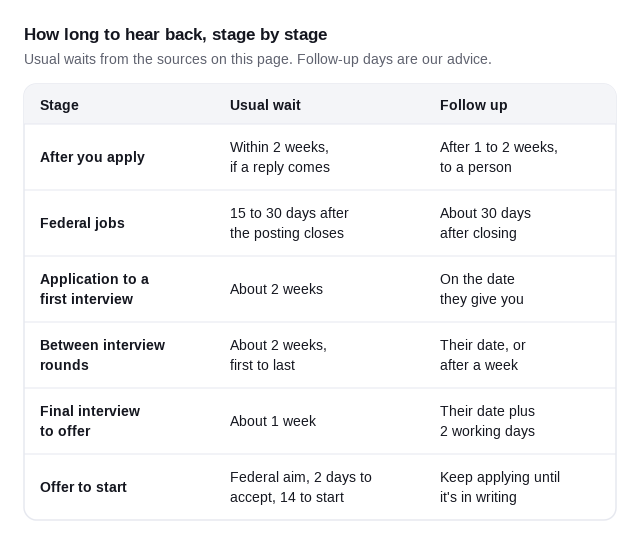
The six waits at a glance. Each step on this page names the source. Follow-up days are our advice. Federal government jobs, 15 to 30 days after the posting closes
The clock starts when the job announcement closes, not when you apply. The US Office of Personnel Management (OPM) says you'll generally hear from the agency about 15 to 30 days after that, though it varies by agency. Agencies must also update you at four points, when your application is received, assessed, referred or not, and selected or not. OPM also says to check your application history in your USAJOBS account.
Follow up about 30 days after the closing date, with the agency contact named on the announcement. That's our advice, built on OPM's timeline. For state, local and school jobs we found no national figure, so ask the contact on the posting.From application to a first interview, about 2 weeks
SmartRecruiters found that US interviews take place 14 days after applications are received. Invites can come faster. Among Scoutify's users, the median interview invite came in about 3 days, from 147 invites. Ashby, another hiring software maker, says employers on its system archive people they won't interview in a median of about 6 days. Archived doesn't always mean you're told.
Got a recruiter call booked? Before you hang up, ask when you'll hear about next steps. That date is your new follow-up day.

How long to hear back after an interview, round by round.
After the first call, the wait depends on how many rounds there are. The only figure we found for the last step comes from Huntr's users. The rest is advice, and we say whose.
Between interview rounds, about 2 weeks from first to last
For people who were hired, Ashby puts the time from first to last interview at a median of about 14 days in business roles. In technical roles it's about 18. In our reading, a week between rounds is ordinary.
Follow up on the date they gave, plus a couple of working days. No date? Accountemps advises following up if you haven't heard within a week of an interview.After the final interview, about a week to an offer
Huntr's users waited a median of 7 days from interview to offer in the third quarter of 2026, down from 9. Indeed's career guide and a Whole Foods campus recruiter quoted by The Forage both say one to two weeks, without data. In Huntr's own survey, 37% said employers often stop responding after an interview.
Wait for their date plus a couple of working days, then send one check-in. If it stays quiet, our guide to being ghosted after an interview has the next steps, and there are follow-up emails for every interview stage.From the offer to your start date
Federal agencies aim to give you 2 days to accept, then 14 days from acceptance to your first day, under OPM's 2026 standard. We found no neutral figure for private employers. Background and reference checks can add time, Indeed notes.
Keep applying until the offer is in writing. That's our advice, and it costs you nothing if the offer comes.
Why hearing back takes longer at some employers, and what's behind the wait.
More applicants. Greenhouse, which makes hiring software, counted 244 applications per job on its system in 2025. SmartRecruiters counted 74 per US role. Someone has to sort them all.
More steps, and more people who have to say yes. Indeed's career guide lists five common reasons for delay. They are the number of candidates, the number of stages, internal approvals, a role's priority, and background checks.
Government rules. Federal agencies count from the day a posting closes. OPM's goal is to cut federal time to hire from 101 days to 80.
Bigger and more senior jobs. Ashby found employers took 52 days to fill junior jobs and 71 days for senior ones, from the day the job opened. We found no data on reply times by company size. So treat lines like “big companies take 2 to 6 weeks” as a guess.
The time of year. Careery's sample got replies fastest in May and June, and slowest in October. In January, Indeed Hiring Lab sees job searches jump while postings stay about level. In our reading, that means more people for each opening.
Hourly jobs in shops and restaurants often move faster, in our reading. We found no data that measures it.
How long the hiring process takes, and the three clocks people mix up.
Three different numbers get quoted as how long hiring takes. They start on different days, so keep them apart.
Your wait for a reply, from the day you apply
This is the clock in the stages above. If a reply comes, it usually comes within two weeks. It's the only one of the three that starts with you.
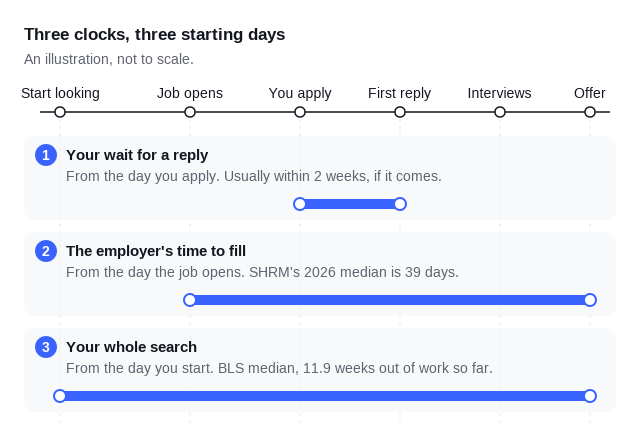
Three clocks, three starting days. An illustration, not to scale. The employer's time to fill, from the day the job opens
SHRM's 2026 benchmarks, from over 4,600 organizations, put the median time to fill a nonexecutive job at 39 calendar days. SmartRecruiters puts the US median at 35 days. Ashby's figures run from 52 to 71 days, by seniority. Federal hiring took 101 days in fiscal 2024, against OPM's new standard of 80.
Why it matters to you. This clock starts before the job is even posted, so your own wait is usually shorter. That's our reading.How long it takes to find a job, and to get one
In October 2026, unemployed people in the US had been out of work for a median of 11.9 weeks, the Bureau of Labor Statistics (BLS) reports. The average was 27.1 weeks, because some searches run very long. That counts people out of work, not people searching while employed. Huntr's users took a median of 102 days to a first offer, counted from the day they started tracking their search. United Way of the National Capital Area's 2026 survey found 28.5 weeks on average.
What makes it shorter. In our reading, it's having several good fits in progress at once, since each one runs on its own clock. Our guide to how many applications it takes to get a job has the numbers. To keep new ones coming, you can see fresh roles ranked by how well you fit.

What to do while you wait, week by week.
These timings are our advice, built on the sources above. Reset them each time you reach a new stage.
The day you apply, write down three dates
Write a date to expect a reply, about 2 weeks out. Add a date to follow up, at 1 to 2 weeks, and a date to move on, at about 3 to 4 weeks. If the posting or a recruiter gives a timeline, use theirs instead.
Applied on the 2nd? Follow up on the 16th, and move on by the 30th.Week 1, keep applying
Don't pause your search for one company. Each process runs on its own clock, and most will be quiet at any given moment. Use the wait to find the next role that fits.
Week 1 to 2, follow up once with a person
Write to the recruiter or the hiring manager, not the portal. Keep it to a few lines, with the role, the date you applied and one easy question. Should you call instead? Email first, and call only if a week passes with no reply. That's our advice.
The words are ready. Our follow-up email guide has seven templates, and who to send each one to.Week 3 to 4, send one last note, then move on
On your move-on date, send one short closing note if you never heard anything. Then stop checking, and count it as a no. Alison Green of Ask a Manager suggests assuming no after about three weeks, for your own peace of mind. Calls do still come months later, so a late yes is a bonus.
If the waiting is wearing you down, our guide to job search burnout has a pace you can keep.At each new stage, ask for the next date
Before every call ends, ask when and how you'll hear back. Then reset your three dates from the answer. The posting rarely says, so the date has to come from a person.
Signs you got the job, and signs you didn't.
No sign is proof, and only a written offer settles it. That's our reading, and every list of signs we read says no single one is certain. What counts is what the employer does, not how the interview felt.
What are signs you are getting the job? They ask for your references, or talk about your start date, notice period or pay. They book the next round before you leave, or introduce you to the team. Indeed's career guide lists several of these, like questions about your notice period or start date and meeting the team.
How do you know if they will hire you, or if a hiring manager wants you? Look for the same actions, above all from the person you'd report to.
How to tell if a job offer is coming? In our reading, a request for references is the strongest hint. How do you tell if you got hired? You get a written offer, so keep applying until then.
How to tell if you didn't get the job? A rejection email, or wording like “not retained”, which our guide to what “not retained” means explains. Other hints are no date when you ask for one, or the job posted again. Lists of bad signs online add a short interview and no talk of next steps or pay. Those are guesses, not answers.
Why did the job get reposted after I applied? In our reading, it's sometimes a copy on another job board, or a role that's always open. Sometimes it's a ghost job with no real hire behind it. If a no does come, here's how to reply to a rejection email in a few kind lines.
While you wait, do this, not that.
Do
- Write down the date you applied, and any date they gave you.
- Ask for the next date at every stage.
- Follow up once or twice, with a person.
- Keep applying while you wait.
- Pick a move-on date, and keep it.
- Search your spam folder for the company's name.
Don't
- Email every few days.
- Stop applying while one company decides.
- Read a portal label as a decision.
- Read meaning into the weekday or the hour.
- Trust an average that counts only replies.
- Take silence as a verdict on your skills.
Questions about hearing back after you apply, answered.
When to assume you didn't get the job?
No source sets one day for every job. Our advice is to assume it about 3 to 4 weeks after applying with no reply, or, after an interview, a week or two past the date they gave you. Alison Green of Ask a Manager says that after 4 to 6 weeks, you're probably not getting a call. Is no response after two weeks a rejection? Not yet, since some replies come later, so follow up once and wait for your move-on date.
Are unsuccessful candidates told first?
Often they aren't told at all, since US employers have no general duty to reply, the Congressional Research Service notes. In our reading, people who were never interviewed tend to hear first, and finalists often wait until the first choice says yes. Ashby puts the median time to archive people its customers won't interview at about 6 days. Do employers tell you if you didn't get the job? Federal agencies must, and so must Ontario employers with 25 or more staff, within 45 days of an interview for a publicly advertised job, for interviews since January 1, 2026.
How common is it to get rejected from a job?
Very common, and usually without a word. In CareerPlug's data from 60,000+ small businesses, 3% of applicants got an interview. In Greenhouse's October 2026 survey, 81% of US candidates had been rejected from a job in the past year without speaking to anyone there. In our reading, that's about the numbers, not about you.
How many interviews before getting hired?
Usually a few rounds. Of the 1,272 job postings from Blynk's searches, mostly senior product roles, 6 postings from 5 employers listed their interview steps, and they had 3 to 5 stages. A typical list ran from a recruiter screen to the hiring manager, a take-home task or case, team rounds and a final with a senior leader. For hired candidates, Ashby puts about two weeks between the first and last interview.
On which day is job rejection most common?
Tuesday is often named, but we found no data behind it. The only day pattern we found is Scoutify's spike of automated rejections on the day people applied. What day do people usually get hired? Same answer, with no measured source. In our reading, the date they gave you matters far more than the weekday.
What is the hardest month to get hired?
Usually December. By the government's count of hires, December had the fewest US hires in 8 of the 9 years from 2017 to 2025, and February was lower in 2021 (BLS, not seasonally adjusted). Hiring slows but doesn't stop. There were still about 3.9 million hires in December 2025. January is crowded, though. Indeed Hiring Lab found job searches in January 2026 ran up to 31% above early December, while postings stayed about level. Which month do companies hire most? By the same count, May to August, with June the top month in most years. Careery's sample also got replies fastest in May and June, and slowest in October.
Why is it so hard to get a job right now in 2026?
Hiring is crowded and slow. Greenhouse counted 244 applications per job in 2025, and its customers' time to fill rose 37% from 2022 to 2025. In BLS figures for October 2026, 27.6% of unemployed people had been out of work for 27 weeks or more. In our reading, that's why a quiet inbox is so common, and why fewer, better-fitting applications help.
At what age is it harder to get hired?
In BLS figures, unemployment tends to last longer with age. In 2025, the median unemployed person aged 20 to 24 had been out of work 9.5 weeks, against 11.8 weeks at 45 to 54. People 65 and older averaged 31.4 weeks, a mean rather than a median. At what age do most people get a job? We found no single figure, but teens aged 16 to 19 had the shortest median, 6.8 weeks.
What is the 7 second rule in resume?
It comes from a 2018 Ladders eye-tracking study, where recruiters spent about 7.4 seconds on a first look at a resume. What is a red flag on a resume? In Resume Genius's 2026 survey of 1,500 US hiring managers, the top answers were job-hopping (65%), heavily AI-made materials (49%) and unexplained gaps (43%). Can employers tell if your resume was written by AI? Usually they can't prove it, since only 33.5% of 600 US hiring managers spotted the AI-written resumes in TopResume's 2025 test, as our guide to whether employers can tell you used AI explains.
What is the 70/30 rule in hiring?
It's an informal rule with two meanings. TestGorilla uses it for hiring someone who meets about 70% of the needs and training the rest. Homebase uses it for weighing skills at 70% and fit at 30%. In our reading, the first is a good reason to apply when you fit most of a posting.
Where the facts come from.
Checked in November 2026. Government figures come from OPM and the Bureau of Labor Statistics, and the NBER study is a peer-reviewed field experiment. Careery, Scoutify, Huntr, SmartRecruiters, Ashby and Greenhouse sell job search or hiring software, and their figures come from their own users or customers, so we name each one where we use it. Where the page gives a timing as advice, the advice is ours. Blynk's count is a read-only text search of 1,272 job postings from Blynk's searches that have at least 200 characters of text (750 employers, mostly senior product roles, first seen October 31 to November 11, 2026). It looked for reply times, process lengths, time to hire and offer promises, and every match was read by eye. A text search can miss unusual wording, and many employers give their timeline on the recruiter call instead.
- Follow-up email after applying
- What “under review” means
- Workday application status
- Ghosted after an interview
- Follow-up email after an interview
- Free job application tracker template
- What shortlisted means
- Hiring freezes and when to apply
- Signs an interview went well
- Kline, Rose and Walters, Systemic Discrimination Among Large U.S. Employers (NBER)
- Scoutify, We timed 24,000 job applications
- Careery, job application response time benchmarks
- Huntr, job search trends Q3 2026
- SmartRecruiters US hiring analysis (GlobeNewswire, March 2025)
- Ashby, Recruiting Operations Benchmarks 2026
- SHRM, Recruiting Benchmarking
- Greenhouse, The Hire Standard recruiting benchmarks
- Greenhouse, US candidate survey, October 2026
- OPM, why haven't I heard back after applying
- OPM, guidance on time to hire under the Merit Hiring Plan (2026)
- OPM, FY 2026-2027 agency priority goals
- BLS, duration of unemployment (Table A-12)
- BLS, unemployed persons by age and duration (2025 averages)
- United Way of the National Capital Area, how long it takes to find a job (2026 survey)
- Robert Half, How to lose a candidate in 10 business days (2021)
- Accountemps (Robert Half), The Art of Following Up (2017)
- Accountemps (Robert Half), thank-you notes and follow-up after interviews (2017)
- Indeed Career Guide, how long to wait to hear back about a job
- The Forage, how long to hear back after a job interview
- Ask a Manager, how long to wait before moving on
- Congressional Research Service, ghost job postings (2025)
- Ontario, requirements for publicly advertised jobs
- CareerPlug, recruiting metrics
- Indeed Hiring Lab, February 2026 labor market update
- HR Dive, the Ladders eye-tracking study
- Resume Genius, 2026 hiring trends report
- TopResume, AI in hiring survey (2025)
- TestGorilla, skills-based hiring and the 70/30 rule
- Homebase, hiring process steps and the 70/30 rule
- US Bureau of Labor Statistics, JOLTS data (hires by month, not seasonally adjusted)
