
How to write a follow-up email after an interview. Without sounding pushy, or waiting forever.
You had the interview. Now you're wondering if a thank-you matters, how long to wait, and whether asking again will hurt. Two short emails do most of the work. Here's when to send each one, what to say, when to stop, and nine templates to copy.

The short answer
- Send a thank-you within 24 hours, to each person you met. Name one real thing from the conversation, and keep it to a few sentences.
- Check in once, one business day after the date they gave you. No date? Wait about a week after the interview, and reply in the same email thread.
- No reply? Send one last short note a week later, then stop. Silence after an interview is common, so keep applying while you wait.
On this page
Why a follow-up email after an interview feels so hard, and what's really going on.
Five worries that stop people sending it, and what to do about each.
“Does a thank-you even matter?”
Most HR managers say they notice it, and fewer candidates send one than you'd think. The section "Does a thank-you email after an interview matter?" has the numbers.
What to do: Send it, and send it early. A few sentences, within a day.
“I don't want to be pushy.”
A thank-you and one check-in aren't pushy. A stream of emails is. Accountemps' own advice is to follow up after a week "in moderation", and it warns that "pestering can get you removed from the short list."
What to do: Plan on two emails, three at most. Each one short, and each with a reason to send it.
“Is it too soon, or too late?”
The advice online disagrees: 24 hours or 48, one week, five to seven business days, two weeks. Most of those numbers come without a source. The one rule nearly every guide shares is the thank-you within 24 hours.
What to do: Let their date be your clock. If they gave no date, wait about a week.
“I only have the recruiter's email.”
In our reading, that happens a lot when a coordinator booked the interview. Harvard Law's career office suggests writing down each interviewer's name during the interview and finding their addresses afterward.
What to do: Ask the recruiter to pass it on. Step 2 below has the words.
“It's been a week. Is silence a no?”
Not on its own. In Greenhouse's 2024 survey of 2,500 workers, 61% of job seekers said they'd been ghosted after a job interview. And for people who do get hired, Ashby's 2026 data puts about two weeks or more between the first and last interview.
What to do: Check in once, then keep going. Hiring often takes longer than it feels.
How to follow up after an interview, in six steps.
From the moment you leave the interview to the moment you stop waiting.
Send a thank-you email within 24 hours
Accountemps and Harvard Law's career office both say to send it within 24 hours. Accountemps gives the reason: some employers make hiring decisions shortly after the round of interviews is over. Email is the normal way to send it, and it arrives in time.
Interview in the morning? Send it that afternoon. Late in the day? Send it the next morning. That's our advice, and it keeps you inside the 24 hours.Write one note per person, even with only the recruiter's email
Met a panel? Harvard Law says one note to each person or one note to the group both work. For a phone or video panel, it suggests one note to the main interviewer that names the others. Our advice: a short, different note to each person, naming something they said. After several rounds, send one after each round.
No email for the interviewer? Reply to the recruiter or coordinator, thank them, and ask them to pass a short note to each person by name. The template "Asking the recruiter to pass on your thanks" below has the words. To find a work email yourself, see how to find the hiring manager. Connected on LinkedIn? Our advice: a short thank-you there is fine too, but email is what HR managers rated most appropriate (94%).Say three things: thanks, one real point, and what's next
Thank them for their time. Then name one specific thing they said, and how your real experience fits it. Accountemps suggests adding a skill you didn't get to cover, or more on a topic you discussed. End with one light line about next steps. Our advice: keep it under about 150 words, and save questions about pay or timing for later.
Instead of a general line like "I'd be a great fit," name what they said: "You mentioned new customers take too long to set up. Setting up new customers was most of my last job, and I rebuilt how we did it."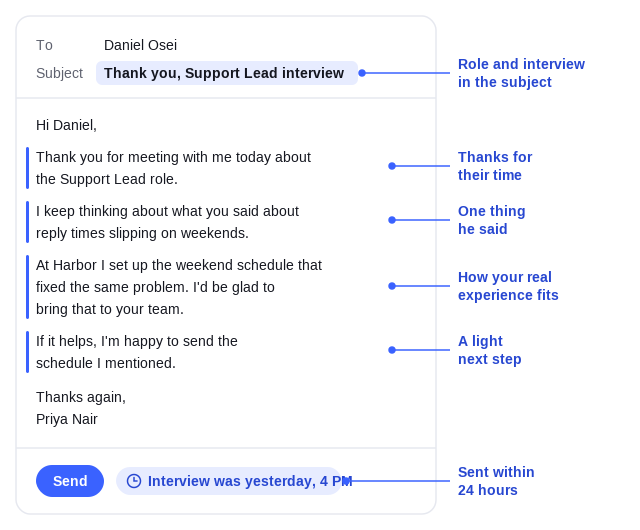
An illustration of a finished thank-you email. The names are made up. Write a subject line that says something
Plain beats clever. Put the job title in it, and the word "interview", so they know what it is before they open it. When you write again later, reply in the same thread, so they see the whole conversation. Avoid "Checking in" on its own, because it tells them nothing.
Try "Thank you, Support Lead interview", "Thank you for today, Priya Nair" or, when you send something new, "The schedule I mentioned, Priya Nair".Send your interview follow-up email after their date
If they told you when they'd decide, wait one business day past that date, then check in once. That's our advice, and several career guides say the same. If they gave no date, Accountemps' advice is to follow up if you haven't heard within a week of the interview. Reply in the same thread as your thank-you. A call is fine too: Accountemps says a phone call or another email both work.
They said Friday? Write on Monday. No date, and the interview was on a Tuesday? Write the next Tuesday.Send one last note, then stop
No reply a week after your check-in? Send one shorter, different note in the same thread, and make it easy to answer. Then stop writing. Two check-ins is our limit, in line with Accountemps' "in moderation". And don't follow up the thank-you itself, because it doesn't need an answer.
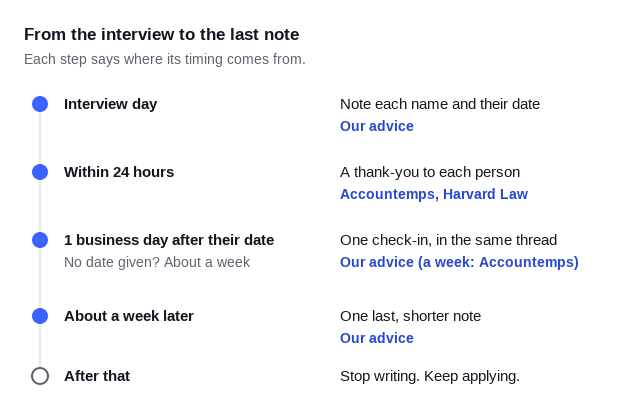
The whole plan on one line. Each step says where its timing comes from.


How long to wait after an interview, and why the advice disagrees.
Two emails, two clocks. The thank-you runs on a short clock: within 24 hours, as Accountemps and Harvard Law both say. The check-in runs on theirs: just after the date they gave you, or about a week after the interview if they gave none.
Why the numbers disagree. Career guides say a week, five to seven business days, or two weeks for the check-in, and most give no source. The only sourced number we found is Accountemps' advice to follow up if you haven't heard within a week. The rest, including one business day after their date, is advice, ours included.
A quiet week is normal. Ashby's 2026 hiring data covers more than 54 million applications. For people hired into business roles, it puts about 14 days between the first and last interview. In technical roles, it's about 18 days from screen to final interview. Our reading: a week can pass between rounds without anything being wrong.
Some decide fast. That's why the thank-you goes early, even when the check-in waits.
After 1 week, after 2 weeks. A week after the interview, with no word and no date? Send your check-in. Two weeks, and still nothing? Send your last note, then stop.
If you have another offer, don't wait for their date. Tell them now, say when you need to answer, and ask if they can share their timing. That's our advice, and the template "When you have another offer" has the words.
No response after an interview? What to send, and when to stop.
No reply to your thank-you? Our reading: that's not a sign of anything. A thank-you doesn't ask a question, so it doesn't need an answer. Don't send a second one.
How long to wait after no response? Give your check-in about a week. That's our advice, and it keeps you to two check-ins in about two weeks.
How to write it politely. Reply in the same thread, so the history is right there. Make it shorter than the last one, and change something: a new line about the role, a link they'd find useful, or an easy way out ("If you've gone with someone else, I'd still like to know"). Skip guilt lines like "I haven't heard back", and skip "just checking in".
Or try another way, once. Instead of the last email: a phone call (step 5), or a LinkedIn note. An invitation note can be up to 200 characters, and free members can add one to only three requests a month. So save it for one person.
Then put the energy elsewhere. Silence is common, so don't let it stall the rest of your search. Keep a list of each interview, who you met and the date they gave, and keep applying. A spreadsheet works, or Blynk's free tracker updates each application from your inbox on its own.
Does a thank-you email after an interview matter? What hiring managers say.
Most HR managers say it counts for something. In Accountemps' 2017 survey, a thank-you from a promising candidate was very helpful to 22% of HR managers and somewhat helpful to 58%. It was not very helpful to 12%, and not helpful at all to 8%.
Fewer people send one. The same HR managers reported getting notes from only 24% of applicants, down from 51% in 2007.
Some notice when it's missing. In a 2017 TopResume survey of 358 recruiters and hiring managers, 68% said a thank-you matters to their decision. And 16% said they had completely dismissed a candidate for not sending one.
Not everyone agrees. Workable argues in its employer guide that thank-you emails shouldn't decide who gets hired, and that customs differ between cultures. No study we found measures whether a thank-you changes who gets the job.
Email or handwritten? Email is fine. HR managers rated email (94%) and a handwritten note (86%) as the most appropriate ways. Harvard Law's career office adds that a handwritten note needs to arrive within a day or two, and shouldn't be mailed to a government employer, because of mail delays.
Our reading: a thank-you rarely decides anything on its own. But it takes a few minutes, and a specific note beats none. Send it.
Nine interview follow-up emails, ready to copy.
Swap the [square brackets] for your details. Keep every line true, and keep the one specific thing specific.
Short thank-you email after a recruiter or phone screen
The same day, to the recruiter. Subject line: Thank you, [Job title] phone screen
Hi [First name],

Thanks for taking the time to talk with me today about the [Job title] role. It was helpful to hear about [one thing they told you, like the team or the hiring steps].

I'm even more interested after our call, and I look forward to the next step.

Best,
[Your name]
[Phone number]
Thank-you email after a hiring manager or panel interview
Within 24 hours. One to each person, each naming something they said. Subject line: Thank you, [Job title] interview
Hi [First name],

Thank you for meeting with me today about the [Job title] role. I keep thinking about what you said about [one specific thing they raised].

It's close to what I did at [Company], where I [one true thing you did that fits]. I'd be glad to bring that to your team.

If it helps, I'm happy to send [a work sample, or more detail on something you discussed].

Thanks again,
[Your name]
Thank-you email after a final-round interview
Within 24 hours, to the person who leads the hiring. Subject line: Thank you, [Job title] final interview
Hi [First name],

Thank you for today, and for the time your team has given me across every round. Meeting [names, or the team] made the role feel very real.

After our talk about [the main challenge they described], I'm more sure this is work I want to do and can do well.

I look forward to hearing about next steps.

Warm regards,
[Your name]
Asking the recruiter to pass on your thanks
When you only have the recruiter's or coordinator's email. Reply to their last message.
Hi [First name],

Thank you for setting up my interviews for the [Job title] role today. I enjoyed meeting [Interviewer 1] and [Interviewer 2].

I don't have their email addresses. Would you mind passing on my thanks? For [Interviewer 1], I really liked our talk about [topic]. For [Interviewer 2], thank you for walking me through [topic].

Thanks so much,
[Your name]
Interview follow-up email when their decision date has passed
One business day after the date they gave you. Reply in the same thread as your thank-you.
Hi [First name],

You said you hoped to choose someone for the [Job title] role around [date], so I'm writing to ask how it's going. Is there any update you can share?

I'm still very interested, and happy to send anything that would help.

Thank you,
[Your name]
No response from the recruiter after the interview: the last note
About a week after your check-in. Reply in the same thread, and keep it shorter than the last one.
Hi [First name],

One last note on the [Job title] role. If you've gone with someone else, I'd still be glad to know, and I'd welcome hearing about future roles on the team.

Thanks for your time through all of this,
[Your name]
Adding something you forgot, or a work sample
Within a day or two of the interview, only if it's real and useful. Reply in the same thread as your thank-you.
Hi [First name],

After our interview I realized I didn't mention [the skill, project or result]. Since you asked about [their question], I thought it might help.

[Two sentences on what you did, or a link to the work sample or a short 30-60-90 day plan.]

No need to reply. I just wanted you to have the full picture.

Best,
[Your name]
When you have another offer
As soon as the other offer arrives, if you'd rather work here. Subject line: [Job title] interview, a timing question
Hi [First name],

I've had an offer from another company, and I need to answer by [date]. [Company] is where I'd most like to work, so I wanted to tell you first.

Is there any chance you can share your timing for the [Job title] role?

Thank you,
[Your name]
Replying to a rejection, to stay in touch
Within a day of hearing no. Reply to their email.
Hi [First name],

Thank you for telling me, and for the time you and the team spent with me. I'm sorry it didn't work out this time, but I learned a lot about [the team or the work].

I'd be glad to stay in touch, and I'd love to hear from you if something similar opens up.

With thanks,
[Your name]
Interview follow-up emails, do this, not that.
Do
- Send the thank-you within 24 hours.
- Write a different note to each person you met.
- Name one real thing from the conversation.
- Wait for the date they gave you before you check in.
- Reply in the same thread when you write again.
- Keep each email to a few short paragraphs.
- Thank them, even when the answer is no.
Don't
- Send the same note to the whole panel.
- Retell your whole resume.
- Ask about pay or the timeline in the thank-you.
- Check in before the date they gave you.
- Send more than two check-ins.
- Open with "I hope this email finds you well" or "just checking in".
- Add guilt lines like "I haven't heard back yet".
Other interview questions people ask, and what they mean for your follow-up.
What is the 80/20 rule in interviewing? A rule of thumb that the candidate talks about 80% of the time and the interviewer 20%, as Welcome to the Jungle puts it. It names no source, and no study we found sets the split. For your thank-you, what the interviewer said in their 20% is usually the one specific thing worth naming.
What are the 5 C's of interviewing? There's no single list. Indeed Canada's is for interviewers: clarity, curiosity, consistency, comfort and confidence. Lists for candidates vary from site to site. Either way, a thank-you that names one real point from the talk shows you were listening.
Why are the first 30 seconds of an interview so important? No study we found times it at 30 seconds. But a 2010 study in the Journal of Applied Psychology found that candidates who made a better impression in the opening minutes of a structured interview got more internship offers. Our reading: the thank-you is your last impression, so make it as specific as your first.
What is usually asked in a 30-minute interview? Indeed says a preliminary interview typically lasts about 30 minutes, often by phone or video, to get basic information about your skills, qualifications and interest. Its example questions: tell me about yourself, why this company, why you're looking for a new job, and your salary expectations. After one, send the short thank-you to the recruiter above.
What is the biggest red flag to hear when being interviewed? SHRM reported an analysis by People Managing People of 5,172 Reddit comments. It names four red flags. The company calls itself a family, the employer seems desperate for you to say yes, long hours are framed as worth it, or they ask personal questions, such as whether you're married. If you heard one, our advice is to still send the thank-you, and ask about it before you accept anything.
Questions about following up after an interview, answered.
How long should I wait to write a follow-up email after an interview?
Send the thank-you within 24 hours, as Accountemps and Harvard Law both advise. For the check-in, wait until one business day after the date they gave you (our advice). If they gave no date, Accountemps suggests following up if you haven't heard within a week of the interview.
How do you politely ask the status of an interview?
Reply to your last email with them, once, after their date. Ask one question that's easy to answer: "Is there any update you can share on the [Job title] role?" Say you're still interested, and offer to send anything that helps. The same words work when you want to ask when you'll hear back, by email or by phone.
Should you follow-up if there is no response after an interview?
Yes, once. A check-in just after the date they gave you, or about a week after the interview, is normal, and Accountemps calls it appropriate. If that gets no reply, send one last short note a week later, then stop.
Is it rude to send a follow-up email after no response?
Not if it's one polite note at the right time. What hurts is too many emails, or a pushy tone: Accountemps warns that "pestering can get you removed from the short list." Keep it short, skip guilt lines like "I haven't heard back", and make it easy to answer.
I sent a follow-up email, but there was no response. What should I do?
Wait about a week, then send one shorter, different note in the same thread. If that gets nothing, stop, and spend the time on your other applications. Two check-ins is our limit, and it's the answer to how many times to follow up.
What are signs you will get a job offer?
Our reading: the only reliable signs are things they do. They ask for references, talk about start dates or pay, or set up another round. Everything else, like a long interview, a friendly tone or a quick reply, is guessing. The same goes for signs it went well, or that you blew it.
Do people still send follow-up emails after interviews?
Yes, though fewer than before. In Accountemps' 2017 survey, HR managers reported getting thank-you notes from only 24% of applicants, down from 51% in 2007. Yet 80% said they take them into account. That gap is why a short, specific note is worth sending.
Should I email everyone I interviewed with?
Yes, if you can. Harvard Law's career office says one note to each person or one to the group both work. Our advice is a short, different note to each, naming something they said. If you only have the recruiter's email, ask them to pass your thanks on.
What is the 30-60-90 rule in an interview?
It usually means a 30-60-90 day plan: an outline of the goals you hope to reach in your first three months if hired. Indeed Canada mentions it especially for management positions. Our advice: if they asked for one, or you talked about your first months, send a short plan with your thank-you or the next day.
How to politely tell a candidate that was not selected?
That's the employer's side, but it helps to know what to expect. Indeed's employer template thanks the candidate for interviewing, says the company is moving forward with another candidate, invites them to apply again and gives a contact. If you get one, a short, kind reply keeps the door open. The rejection template above has the words.
Where the facts come from.
Checked in November 2026. Where a number is advice rather than a finding, the page says so, and the advice is ours. Survey figures come from their publishers (Accountemps, TopResume and Greenhouse), interview timelines from Ashby's 2026 benchmarks, and everything else from each organization's own pages.
- Follow-up email after applying
- How to find the hiring manager
- Free job application tracker template
- How to reply to a rejection email
- How to write a 30-60-90 day plan
- Signs an interview went well
- Accountemps (Robert Half): thank-you notes survey, 2017
- TopResume: thank-you note survey of recruiters and hiring managers, 2017
- Harvard Law School OPIA: interview follow-up and thank-you notes
- Greenhouse: 2024 State of Job Hunting report
- Ashby: Recruiting Operations Benchmarks, 2026
- Workable: should interview thank-you emails count? (employer guide)
- Indeed for employers: interview follow-up email templates
- Indeed: the 30-60-90 day plan interview question
- Indeed Canada: the 30-60-90 day plan for an interview
- LinkedIn Help: personalize invitations to connect
- Welcome to the Jungle: tips for speaking in an interview (the 80/20 rule)
- Indeed Canada: tips for an interviewer (the 5 C's)
- Barrick, Swider and Stewart: Initial evaluations in the interview, Journal of Applied Psychology, 2010
- Indeed: the preliminary interview
- SHRM: candidates reveal 4 biggest red flags in job interviews, 2023
- Blynk: the Job Tracker
- Blynk pricing
