
Signs an interview went well. And which ones really mean something.
You've left the interview and you keep replaying it. Here are the signs an interview went well, sorted by how much each one tells you, the signs that it didn't, and what to do while you wait.

The short answer
- The strongest signs are things they do. They book the next round, ask for your references, or work out a start date or pay with you.
- How it felt is a weak guide. A long, friendly talk can still end in a no, and an awkward one in a yes.
- Only a written offer settles it. Send your thank-you, note the date they gave you, and keep applying.
On this page
Why it's hard to tell if an interview went well, even when it felt great.
If you can't tell whether your interview went well, that's normal. It's hard to judge from the inside, and the research says why.
You're a weak judge of your own interview. interviewing.io, a platform for anonymous technical interviews, compared 254 interviews where both sides rated how it went. How candidates thought they did matched the interviewer's score only weakly. Aline Lerner wrote on its blog that “it is not a strong, predictable correspondence.” Some people who did well didn't think they had.
Many interviewers are there to sell the job, too. Researchers Jennifer Marr and Dan Cable studied interviewers who focused on selling the role. The BPS Research Digest reports that when those interviewers rated people's character, the ratings didn't predict who later did well, unlike ratings from interviewers focused on judging. Our reading: a warm pitch shows they want you to like them. It doesn't show they've picked you.
Good interviews end in a no for reasons outside you. Lupa Hire, a recruiting firm, lists internal candidates, budget freezes, reorganizations and shifting priorities. And a flat interview isn't always a bad one. Professional Alternatives, a staffing agency, notes that structured interviews leave little room for personal touches.
So the signs below are sorted by what the employer did, then what they said, then how it felt. How long to wait for an answer is its own question, covered in our guide to how long it takes to hear back.
Signs an interview went well, from strongest to weakest.
The first two are things the employer did. The middle three are things they asked or arranged. The last one is how it felt. Each comes with what it doesn't mean.
They booked the next step before you left
A second round on the calendar, a task with a due date, or a firm “you'll hear from us by Friday” is the clearest good sign you can get in the room. It means you're still in the running. A date they then keep is better still.
What it doesn't mean: that you're the only one. Other people may have the same next step.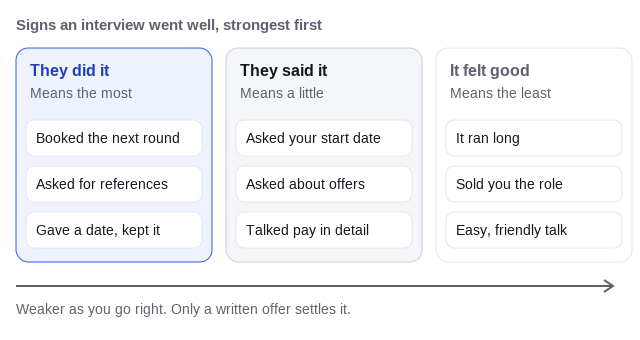
Our sorting of the signs on this page. Things the employer does tell you more than how the talk felt. They asked for your references
Career Sherpa, a career blog by Hannah Morgan, says employers usually ask for references late, as due diligence before settling on one candidate. Blynk's own postings agree. Of 1,330 job postings with full text in Blynk's searches (October 31 to November 12, 2026), 18 list their interview steps. 6 of those name a reference check, and each puts it at or near the end, just before the offer.
What it doesn't mean: an offer. iMPact Business Group, a staffing agency, lists references asked for in a first interview, so some ask early. In our reading, some check more than one finalist.They talked start date, notice period or pay in detail
Questions about when you could start, how much notice you'd give, or what pay you'd need are on every list of good signs. SEEK, the Australian job site, adds a warning. These can be routine questions asked of several candidates, so treat them as possible signals, not a promise.
What it doesn't mean: they've decided. Our reading: pay in real numbers tells you more than a general question about it.You met more people than planned
Being introduced to other team members is a good sign on Indeed's list. Hays, the recruiting firm, counts meeting senior managers too, since they will need to sign off the final hiring decision.
What it doesn't mean: much, if meeting the team was on the schedule all along.They asked about your other interviews or offers
Several lists count this as a good sign. Our reading: they're checking how fast they need to move, which usually means you're someone they'd like to keep. Answer honestly and briefly.
What it doesn't mean: an offer is coming. In our reading, it may be a standard question.They talked as if you had the job, and it felt great
“When you join, you'll work with...” is what Lupa Hire calls assumptive language. An interview that ran long, a pitch for the company and an easy, friendly talk are on most lists too. These are the weakest signs, for the reasons in the section above.
What it doesn't mean: anything on its own. In our reading, some interviewers talk this way with everyone.

Did they talk about next steps? Why that sign depends on the company.
“They told me the next steps” is on every list of signs an interview went well. But you can only read it if you know what the steps are. Most postings don't say. Of the 1,330 Blynk counted, only 18 list their interview steps, about 1 in 75.
Those that do look much alike. Most start with a call with a recruiter or a founder, and most include a task or case study. The 6 that name a reference check put it last or next to last. Where you are on that path matters more than any one moment in the room.
Our advice: before every interview ends, ask the question below. Their answer becomes the yardstick for every sign that follows. A date they keep is a good sign. A date that slips twice is worth noting.
“What are the next steps, and when should I expect to hear from you?”
Signs you didn't get the job, and which ones are real.
What are some signs that a job interview didn't go well? The same rule applies. What they do counts. How the room felt counts much less. Here they are, the real ones first.
You got a rejection email, or a “not retained” status
That's the only certain sign. Portals use their own words for it, and our guide to what “not retained” means covers the common ones. If you want to reply, here's how to respond to a rejection email in a few kind lines.
Their date passed, and one follow-up went unanswered
This is a strong hint, not proof. Career Sherpa notes that silence after your follow-ups could also mean you're the second choice, waiting while the first one decides. If it drags on, our guide to being ghosted after an interview has what to send and when to stop.
The job was posted again
Career Sherpa reads a fresh listing after your interview as a possible restart of the search. An old listing that's still up is weak evidence on its own. In our reading, many stay up until someone accepts.
The interview was cut short
Indeed lists a short interview as a bad sign, then adds that it “isn't necessarily a reflection of the quality of your interview.” Our reading: schedules run over, and some interviewers are simply quick.
They never asked when you could start
Also on Indeed's list of bad signs. Indeed's own caveat is that “they may have just forgotten to ask you this.”
They seemed distracted, or vague about what's next
SEEK names both as red flags, along with an interview that ends early with little conversation. Our reading: each is a weak hint alone. Two or three together are worth taking seriously.
You just feel you blew it
This is the weakest sign of all. In the interviewing.io data above, people who thought they'd done badly were often wrong. In our reading, one shaky answer is rarely the whole story. In a study of 166 interviewers at a university job fair, about 30% of their decisions were made within 5 minutes, and most came later.
What to do after an interview went well, while you wait for their answer.
These steps are our advice, and they help whatever the answer turns out to be.
Tonight, write down what they said
Names, the next step, the date they gave you, and any worry they raised. Lupa Hire suggests the same. You'll want it for your thank-you, your follow-up and the next round.
Within a day, send a short thank-you
Name one thing you talked about. If they raised a concern, answer it in a line. Our guide to the follow-up email after an interview has templates you can copy.
Give your references a heads-up
References tend to come near the end, so a call could come fast. Tell your references the job title, the company and what you'd like them to speak to. A reference who knows the role gives a better answer.
Know your number before they call
If pay came up, an offer may follow quickly. Decide your range and your walk-away point now, not on the phone. Our guide on how to negotiate salary walks through it.
Keep applying, and keep other interviews going
Hays, SEEK and Career Sherpa all tell you to keep your job search going until you have an answer. One company's answer can take weeks. A second option also makes waiting easier, whatever the first one says.
When their date passes, follow up once
Give it a working day or two past the date they gave you, then send one short check-in. If that goes unanswered, pick a day to move on. Our guide to hearing back after an interview has the timings.
After an interview went well, do this, not that.
Do
- Ask for the next step and a date before you leave.
- Write down what they said the same day.
- Send one short thank-you within a day.
- Brief your references.
- Keep applying until you have a written offer.
- Follow up once, after their date.
Don't
- Read an offer into a friendly chat.
- Turn down other interviews while you wait.
- Resign from your current job before the offer is in writing.
- Email every few days for news.
- Take one bad moment as a no.
- Treat an old listing still online as a no.
Questions about whether your interview went well, answered.
What are signs you will get a job offer?
The surest ones come late in the process. They check your references, ask when you could start and how much notice you'd give, or talk pay in real numbers. Career Sherpa calls a reference check due diligence before settling on one candidate. Even then, you may be one of two finalists, so keep going until the offer is in writing.
What are signs the interviewer likes you?
Leah Lambart, a career consultant quoted by SEEK, says an interviewer who thinks you may be the right candidate will tend to show positive body language. That's worth knowing, but liking you isn't the same as choosing you. Some interviewers are warm with everyone, and many are also there to sell the job.
How do I know an interview went well on Reddit?
Among Google's top results for this search is a Reddit thread on r/careerguidance about an internship interview that ran past its time. Threads like it trade the same signs as this page. Read them as one person's story, not as odds. The employer's next step is the real answer.
How do I know if I'm the backup candidate?
Often you can't. Hints that point that way are a decision date that keeps moving, or warm but vague replies to your follow-ups. Career Sherpa notes that silence after follow-ups could mean you're an alternate. In our reading, backups do get offers when a first choice says no, so stay polite and keep applying.
How do you know if you're rejected in an interview?
Usually you don't, not in the room. In our reading, few interviewers say no on the spot. A rejection tends to come later, as an email, a call, or a portal status. Signs in the room, like a short meeting, are hints at most. You know for sure only when they tell you, or when a long silence follows the date they gave you.
How do I know if I blew an interview?
Your own sense of it is a poor guide. In interviewing.io's data, how candidates rated themselves matched the interviewer's score only weakly, and some who did well thought they hadn't. A clearer sign is one Indeed lists, a concern the interviewer raised. If you didn't get to answer it, that's the part to fix. Answer it briefly in your thank-you.
Is it ok to send a follow up email after an interview?
Yes. A short thank-you within a day is normal, and so is one check-in after the date they gave you. Our interview follow-up guide has the templates and timings.
What is a red flag in an interview?
For your chances, Indeed lists an interviewer who voices concerns as a bad sign. A concern you didn't get to answer is the one worth a line in your thank-you. For the employer, SHRM reported four red flags candidates named most, from 5,172 Reddit comments. The company calls itself a family, seems desperate to fill the role, frames long hours as worth it, or asks personal questions.
On which day is job rejection most common?
We found no data that names a day. Tuesday is often said, with no source behind it. The day that matters is the one the employer gave you. If it passes, follow up once.
What are the 3 C's of interviewing?
There's no single list. One version, from Natalie Fisher on Vault, who helps professionals land jobs, names clarity, curiosity and confidence. In our reading, curiosity helps after the interview too. Asking what the next steps are is what lets you read the signs on this page.
Where the facts come from.
Checked in November 2026. The research comes from interviewing.io's own interview data and from two studies summarized by the BPS Research Digest. The lists of signs come from career sites and recruiting firms, which sell job search or hiring services, so we name each one where we use it. Where the page sorts signs or gives advice, that's our reading, and it's marked as ours. The posting count is Blynk's own. It covers 1,330 job postings with full text from Blynk users' searches, first seen October 31 to November 12, 2026, mostly product and senior roles. We searched them for a section on the interview or hiring process followed by named steps, read every match by eye, and kept the 18 that list their steps. A posting that describes its steps in other words could be missed.
- How long to hear back
- Follow-up email after an interview
- Ghosted after an interview
- What “not retained” means
- How to respond to a rejection email
- How to write a 30-60-90 day plan
- interviewing.io (Aline Lerner): people can't gauge their own interview performance (undated post)
- BPS Research Digest: interviewers who focus on selling the job (Marr and Cable, Academy of Management Journal, 2014)
- BPS Research Digest: how quickly interviewers decide (Frieder, Van Iddekinge and Raymark, 2016)
- Indeed Career Guide: 30 signs an interview went well or badly (June 2026)
- SEEK: 7 signs you'll get the job after an interview (November 2026)
- Career Sherpa (Hannah Morgan): 15 signs you didn't get the job (2023)
- Lupa Hire: 15 signs your interview went well, and what to do next
- Hays Luxembourg: how do I know if my job interview went well?
- Professional Alternatives: how to know if an interview went well (2025)
- Vault (Natalie Fisher): 3 traits you need to succeed in interviews (2020)
- SHRM: candidates reveal 4 biggest red flags in job interviews (2023)
- Blynk: Find Jobs
- Blynk pricing
