
Can employers tell if you used AI on your resume? What they can see, and what they actually check.
If you used ChatGPT on your resume and then read that recruiters can always tell, you may be thinking of starting over. Before you do, here's what employers write in their own job postings, what tests of hiring managers found, and what AI detector makers say about their own tools.

The short answer
- Usually, they can't prove it. Most hiring managers say they can tell, but in tests most couldn't. The makers of AI detectors say their own scores aren't proof.
- What gets noticed is sameness, like stock phrases, vague claims and no numbers. What gets you caught is a line you can't explain in the interview.
- The rules employers write are mostly about live interviews, not your resume. A few ban AI in the application too, so read each posting.
On this page
What employers write about AI, in their own job postings.
Rather than guess at employers' rules, we read the ones they wrote. In 1,272 job postings from Blynk's searches (mostly product roles, first seen October 31 to November 11, 2026), 8 employers set a rule about candidates using AI.
Seven of the 8 rules are about interviews. Adobe says "The use of AI or recording tools during live interviews is not permitted unless explicitly invited by the interviewer". Help Scout asks you not to use AI assistants live in its interviews, and adds, "Of course, use any tools you need to prepare". Life360 says some interview exercises may be done "without AI assistance".
One covers the application too. Illumina "prohibits the use of generative artificial intelligence (AI) in the application and interview process." So the rule isn't the same everywhere. Read the posting before you send.
None of the postings said it checks resumes for AI writing, or turns down resumes written with AI. We searched for words like detect, flag and reject near AI, and found none.
Employers' own pages for candidates say much the same. Greenhouse, writing as an employer, says "using AI to assist you in building your resume or cover letter has become a standard practice". It adds that what you send must describe you accurately. Adobe says "AI can help clarify, edit, and organize your thinking, but always maintain your own point of view."
Meanwhile, 27 companies in the same postings said they use AI in their own hiring (26 employers and one job-matching site), mostly to review applications. That's more than three times as many as set any rule for candidates. There's more on that further down.
Can recruiters tell if you used ChatGPT? Most say they can spot AI. Tested, most couldn't.
The belief is strong. In Insight Global's survey of 1,005 US hiring managers in October 2024, 88% said they can tell when candidates use AI on applications, cover letters or resumes. You may have seen that number credited to TopResume, but it's Insight Global's, a staffing firm. In Resume Genius's survey of 1,000 US hiring managers in January 2026, 80% said they can often tell.
The tests say something else. TopResume, a resume-writing company, showed 600 US hiring managers four resumes in May 2025. Just over a third (33.5%) spotted the ones written by AI. Software Finder, a software-review site, ran a blind test with 403 HR staff and hiring managers in November 2024. Its summary reads "Though 60% of hiring managers said they could identify AI-generated applications or resumes, 75% couldn't do so when tested."
So, will employers know if you use ChatGPT? Not from the words alone, as a rule. Even OpenAI says "ChatGPT can't reliably determine whether text was AI-generated or whether it wrote the text". What hiring teams do notice is sameness. CareerOneStop, the US Department of Labor's career site, says employers sometimes get near-identical AI resumes from different people, and reject them right away.
Can employers tell if your resume was written by AI? Our reading of these numbers is that belief is high and tested accuracy is low. A resume gets noticed for sounding like everyone else's. It gets caught when you can't explain a line. The check further down covers both.
Do AI resume detectors work? Read what their own makers say.
OpenAI shut down its own detector. Its AI text classifier caught 26% of AI-written text, and wrongly flagged human writing 9% of the time. OpenAI called it "very unreliable on short texts (below 1,000 characters)". It was withdrawn in July 2023 "due to its low rate of accuracy".
The tools still on offer say the same. Sapling's resume detector page says "false positives and false negatives will occur". QuillBot says detectors give "estimates, not certainty". GPTZero, writing for recruiters, says "no tool is 100% foolproof". Turnitin, built for school essays, needs at least 300 words, and marks scores under 20% with an asterisk because false alarms are more common there.
Studies agree. A 2023 study in the journal Patterns tested seven popular detectors. They labelled more than half of 91 essays by non-native English writers as AI, an average false-positive rate of 61.3%. Another 2023 study tested 14 tools and called them "neither accurate nor reliable".
Our reading is that a resume is the hard case. Bullets are short and follow a pattern, the kind of text these tools handle worst. That may be why people report high scores on resumes they wrote themselves.
Skip the "humanizer". The same Patterns study found that one rewriting prompt cut detection of AI essays "to near zero". That shows how easy detectors are to fool. It doesn't make fooling them useful. Your real risk is a line you can't back up, and a humanizer doesn't fix that.
Does the ATS flag AI-written resumes? And what to do if a checker flags yours.
None we checked says it does. An ATS (applicant tracking system) is the software employers use to collect and sort applications. Greenhouse's help page on its AI matching says it compares applications with the employer's own criteria. It also describes a notice to candidates and a way to opt out. It describes nothing that checks whether a resume was written by AI.
None of the ATS help pages we read describes an AI-writing detector either. Our guide to how an ATS works covers what it does do.
The closest thing is a consistency check. Four companies in Blynk's postings share wording that AI may help find "potential inconsistencies or verification signals in application materials". That's about whether your details hold together, not about who wrote them.
If a free checker says your resume is "100% AI", remember that its makers call it an estimate, not proof. Don't rewrite good, true lines to chase a lower score. Run the line-by-line check below instead. If an employer ever asks, say plainly how you used AI, and talk about the work behind each line. That's our advice.
Is it bad to use AI for your resume? It's OK to use AI to write it, if every line is yours.
Is it fine to use AI for a resume? In the words of the US Department of Labor's career site and of employers like Greenhouse and Adobe, yes. CareerOneStop asks "Is it legitimate to use AI to write your resume?" and answers "Yes." Greenhouse calls it "standard practice". Both draw the same line. CareerOneStop puts it as "Only include true information about you."
Most hiring managers agree, with limits. In TopResume's survey of 600, 52% found AI acceptable for proofreading or drafting. But 30.3% said using AI to write a resume is unacceptable. About 1 in 5 (19.6%) would reject a candidate with an AI-generated resume or cover letter, and 20% see heavy reliance on AI as a red flag.
Is it bad to use ChatGPT for a resume? The tool isn't the problem. Greenhouse says that if what you send is misrepresented, "your candidacy may be disqualified". In Robert Half's survey of more than 2,000 US hiring managers, 32% said they'd changed job descriptions to discourage generic AI responses. Help with wording is fine in most places, but made-up experience isn't fine anywhere.
The exception is real. Illumina bans generative AI in the application itself. If a posting or a careers page sets a rule, that rule beats any advice on this page.
Check your AI-written resume, line by line, before you send it.
In Resume Genius's survey, the AI tells hiring managers named most were unnatural phrasing (51%), repetitive or generic language (44%), and vague or inflated descriptions (41%). These six checks catch those, and the bigger risk too. For prompts that keep AI to your facts from the start, see our ChatGPT resume prompts.
The interview test
For each line, ask yourself, could I talk about this for a minute, with an example? If an interviewer asked "how?", would you have an answer? If not, rewrite it or cut it. This is where made-up lines get caught.
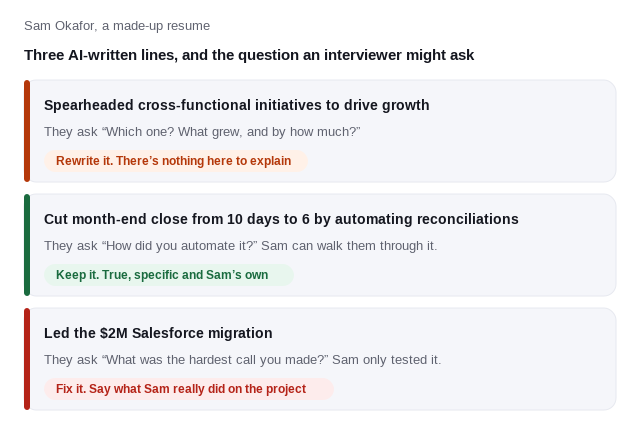
An illustration of the check, not real AI output. The resume is made up. Every title, date and number is yours
Check each one against your own records, like offer letters, old reviews and your LinkedIn. A title that's grown a level, or a number you never gave the AI, is a line you can't back up.
A name, a number or a result in each line
Vague lines are what hiring managers notice. "Drove growth across teams" could be anyone. "Cut month-end close from 10 days to 6" is you. If you don't have the number, say what changed instead of guessing one.
Read it aloud for stock phrases
Simplify, a job-search company, counted stock verbs like spearheaded, leveraged and orchestrated in the first job description of resumes made on its site. By its own count, they appeared in 32.2% in 2023 and 52.0% in 2025. If a line sounds like a press release, say it the way you'd say it to a colleague.
The posting's words, only where they're true
Using the job's own terms helps recruiters find you when they search. CareerOneStop says to use a posting's exact terms only for skills you really have. A skill copied from the posting that you can't show is the line an interviewer will ask about.
Would a colleague recognise it?
Picture someone you worked with reading it. Would they nod? If they'd say "that's not quite what happened", change it back.

Should you tell employers you used AI? Only when they ask, and then plainly.
Two kinds of disclosure get mixed up. One is the employer telling you about its AI. That's common, and Greenhouse gives employers a job-post notice that AI may be used to review applications. The other is you telling them about yours. None of the Greenhouse help pages we read describes a question that asks candidates for it.
When they ask, answer honestly. If a form, a posting or an interviewer asks how you used AI, say in a sentence what you used it for, and that every line is yours. Hiding it is where the risk is. Greenhouse says AI use outside its guidelines "without disclosure or citation" may disqualify you. Life360 says "Undisclosed use of AI not previously discussed with or approved by your Recruiter may impact your candidacy."
In interviews, follow the employer's rule. That's where most written rules are, 7 of the 8 in Blynk's postings. Greenhouse doesn't allow "reading from or referencing AI-produced answers" in its interviews unless agreed. In TopResume's survey, 57% of hiring managers said real-time AI tools should never be used in conversations with employers. Getting ready with AI is a different matter, as Help Scout's posting says.
You don't need a note on the resume itself. None of the 8 rules in our sample asks for one. Tell them in the form or the conversation, when they ask.
AI in hiring, and employers use it too, and what that means for you.
The other side uses AI more than you might think. In Resume Genius's 2026 survey of at least 1,000 US hiring managers, 58% said they use AI to screen resumes and applications. In Insight Global's survey, 99% said they use AI somewhere in hiring.
Here's how employers in Blynk's postings describe it. Circana says it "uses artificial intelligence (AI) to assess resumes for alignment with job requirements". Block says it "may use automated AI tools to evaluate job applications". At least 13 of the 27 say people make the hiring decisions. Twilio puts it as "every hiring decision is made by real Twilions".
What are the downsides of using AI in hiring? In one simulated study, AI models screening resumes favoured those written by the same model. Candidates who used that model were 23% to 60% more likely to be shortlisted, though no real employers took part. Detectors have a bias of their own, as the Patterns study found with non-native writers. And in Robert Half's survey, 67% of HR leaders said reviewing AI-generated applications had slowed hiring.
Some places set rules for employers. New York City's Local Law 144 bars employers from using an automated hiring tool unless it has had a bias audit within a year and candidates are told.
Using AI on your resume, do this, not that.
The short version of everything above.
Do
- Start from your real resume and your own numbers.
- Use AI for structure, wording and spotting what's missing.
- Edit every line until you could explain it in an interview.
- Read each posting's rules on AI, and follow them.
- Say plainly how you used AI if someone asks.
Don't
- Paste the posting and send what comes back.
- Let it add tools, titles or numbers you didn't give it.
- Use AI live in an interview unless you're invited to.
- Run your resume through a "humanizer" to beat a detector.
- Rewrite true lines because a free checker gave them a high score.
Questions about AI on your resume, answered.
Do job recruiters care if you use AI?
Some do, mostly when it shows. In Insight Global's survey, 54% of hiring managers said they would care. In TopResume's, 52% found AI acceptable for proofreading or drafting, while about 1 in 5 (19.6%) would reject an AI-generated resume or cover letter. Our reading is that most care about a resume that's generic or not true, more than the tool behind it.
Do companies reject AI resumes?
Some hiring managers say they would. About 1 in 5 in TopResume's survey (19.6%) would reject a candidate with an AI-generated resume or cover letter, and Software Finder found nearly 1 in 4 would disqualify one. CareerOneStop says employers reject near-identical AI resumes from different people right away. But none of the 1,272 postings we read said it rejects resumes written with AI. Our reading is that for most employers here, the risk is sameness more than the tool.
Can recruiters detect ChatGPT?
Not reliably, with or without software. OpenAI says even ChatGPT can't reliably tell whether text was written by AI, and it shut down its own detector for low accuracy. When TopResume tested 600 hiring managers with four resumes, 33.5% spotted the ones written by AI. What recruiters do notice is generic wording, and claims you can't explain when they ask.
Can interviewers tell if you are using AI?
We found no good test of it, but interviews are where employers' rules are, 7 of the 8 rules in Blynk's postings, like Adobe's ban on AI during live interviews unless you're invited. Life360 says some exercises are done "without AI assistance". Can interviewers tell if you used ChatGPT? Our reading is that the risk is the same either way. It's a follow-up question about your own work that a script can't answer.
What is a red flag on a resume?
For AI, hiring managers in Resume Genius's survey named unnatural phrasing (51%), repetitive or generic language (44%), vague or inflated descriptions (41%) and buzzwords (41%) most. Another 27% named wrong or irrelevant details. In TopResume's survey, 20% called heavy reliance on AI a red flag. The line-by-line check above catches each of these.
What is the 7 second rule in resume?
It isn't a fixed rule. It comes from a 2018 Ladders eye-tracking study, which found that recruiters' first look at a resume averaged 7.4 seconds. The study doesn't say how many recruiters took part, as an ERE article pointed out. For an AI-edited resume, it means your real job title and your strongest true result should be easy to see at the top of each role.
Can my employer see my ChatGPT chats?
Only if your ChatGPT account is one your employer or school manages. OpenAI says the admin of a managed Enterprise, Edu, Healthcare, Business or Teachers account "may be able to access, export, audit, retain, delete" its data, including chat history. You manage a personal account yourself, unless an Enterprise or Edu workspace has verified or claimed it. So write your resume in your own account, not your current employer's.
Should I consent to AI in the hiring process?
It's your call, when you're given one. At least three employers in Blynk's postings, Braze, Thomson Reuters and Pax8, offer an opt-out from AI review. In Greenhouse, an application that opts out is labelled "Needs manual review", so a person reads it. We found no source that says opting out helps or hurts your chances.
Is an AI interview a red flag?
Not on its own, and some employers say they use AI in interviews. Reddit, as an employer, says in its postings that interviews for some roles are "recorded, transcribed and summarized" with AI. Adobe says it tells candidates how it uses AI in hiring, and New York City requires notice when employers use an automated hiring tool. Our reading is that the bigger warning sign is not being told. In Resume Genius's 2026 survey, 20% of organizations don't tell candidates how they use AI.
What is the 30% rule for AI?
There isn't one agreed rule. We found no definition from an employer, a regulator or a hiring body, and Google shows the question for searches about AI in hiring. For your resume, the rules that count are the ones each employer writes down. In Blynk's postings, most of those are about interviews.
Where the facts come from.
Checked on November 12, 2026. Facts about other companies come from their own pages. Each survey is described as its maker ran it, with who was asked, when and whether it measured belief or a test. The job-posting counts are Blynk's own, from 1,272 job postings from Blynk's searches with more than 200 characters of text, mostly product roles, first seen October 31 to November 11, 2026. We found every sentence that mentions AI, matched patterns, then read each match by eye and removed false matches. Counts are by employer, because one employer's notice repeats across its postings. Many employers keep their AI notices on a separate page, so 27 is a floor, not a census, and the counts say nothing about employers outside these searches. Rules quoted from Adobe, Help Scout, Life360, Illumina, Circana, Block, Twilio and Reddit are from their postings in this sample.
- ChatGPT resume prompts that don't make things up
- How to tailor your resume to a job description
- What an ATS-friendly resume really needs
- The best AI resume tailoring tools, compared
- How to use Claude in your job search
- Insight Global: 2025 AI in hiring survey (fieldwork October 2024)
- TopResume: AI in hiring survey, 2025
- Software Finder: AI and the job search (November 2024)
- Resume Genius: hiring insights report (January 2026)
- Resume Genius: AI's impact on hiring, 2026
- Robert Half: AI-generated applications are slowing hiring (March 2026)
- OpenAI: new AI classifier for indicating AI-written text (withdrawn July 2023)
- OpenAI Help: does ChatGPT tell the truth?
- OpenAI Help: data access for your managed ChatGPT account
- Turnitin: AI writing detection update from its chief product officer (May 2023)
- Sapling: resume AI detector
- QuillBot: can AI detectors accurately identify AI-generated resumes?
- GPTZero: AI resume detector, for recruiters (February 2025)
- Liang et al., GPT detectors are biased against non-native English writers, Patterns, 2023
- Weber-Wulff et al., Testing of detection tools for AI-generated text, 2023
- Xu, Li and Jiang, AI self-preferencing in algorithmic hiring (simulated), 2026
- Greenhouse: guidelines for using AI in our interviewing process
- Greenhouse Support: Talent Matching FAQ
- Adobe: AI and your hiring experience
- CareerOneStop: write your resume for current hiring practices
- NYC Department of Consumer and Worker Protection: automated employment decision tools (Local Law 144)
- Simplify: can recruiters tell if AI wrote your resume?
- Ladders: eye-tracking study, 2018 (archived copy)
- ERE: is the 6-second resume scan a myth?
- Blynk: find jobs and tailor your resume
