
Ghosted after an interview. What the silence usually means, and what to do next.
You interviewed, they said you'd hear soon, and now there's nothing. That's common, and it's usually not about you. Here's why employers go quiet, how long to give it, who to write to, the two notes worth sending, and how to pick the day you stop waiting.

The short answer
- It's common, and silence alone isn't a no. In Greenhouse's December 2024 survey of 2,500 workers in the US, UK and Germany, 61% of job seekers said they'd been ghosted after a job interview.
- Wait until the date they gave you, plus a couple of working days, then send one short check-in to whoever set that date, usually the recruiter. No date? Wait about a week.
- No reply a week later? Send one closing note, then stop waiting. Pick that stop date now, and keep your other applications moving.
On this page
Why companies go silent after an interview, and why being ghosted is rarely about you.
Why do companies go silent after an interview? Nobody has measured the reasons. But recruiters give the same few, and most have nothing to do with how you did.
“Did I do something wrong?”
Probably not, and the silence can't tell you. The reasons recruiters give are about the employer: another candidate still deciding, a budget that went away, an internal hire, or slow approvals. You may read that most ghosting happens because the offer went to someone else. No survey we found measures why employers go quiet.
What to do: Don't replay the interview for clues. Career coach Phoebe Gavin told CNBC it's easy to blame yourself, but the failure is the company's.
“Why not just tell me no?”
Why do jobs ghost instead of reject? A no takes a decision, and someone with time to send it. Recruiters are stretched: in its December 2024 report, Greenhouse said its own data showed recruiter workload up 26% in a single quarter. Our reading: silence is often what happens when nobody owns the last email.
What to do: Don't wait for them to own it. Give the silence your own end date, in step 4.
“Is no news bad news?”
Not on its own. Silence looks the same whether they're still interviewing, waiting on an approval, or have moved on. So it can't tell you which. Our reading: the only real answer is a message from them.
What to do: Let a date decide, not the silence. The next section shows how to pick one.
“Should I email again, or is that desperate?”
One short check-in after their date isn't desperate. A stream of emails is. Accountemps, the staffing firm, warns that “pestering can get you removed from the short list.”
What to do: Plan on two notes in total. A check-in, then one closing note.
When silence after an interview becomes ghosting, and how long is too long.
There's no set number of days. Google's own answers for this search give waits from 1 or 2 business days after their date to two weeks. None of the numbers we found comes with data. The one rule with a known source is advice from Accountemps: if you don't hear within a week of the interview, it's appropriate to follow up.
The date they gave you is the line. Our advice: give it until that date, plus a couple of working days. That's where silence turns into ghosting, and where you send your check-in. No date? Use about a week after the interview.
That date usually comes from a person, not the job posting. In 1,272 job postings from Blynk's searches, mostly for senior product roles, only 5 (from 4 employers) said how long you'd wait to hear back or how long interviews take. None promised to tell every candidate the outcome. Our reading: ask how and when you'll hear before you leave each interview.
How long is too long, and when to assume you didn't get the job? No source sets one limit for every job. Our advice: assume it on your stop date, about a week after your check-in, and be glad if you're wrong. Step 4 shows how to set it.
What to do when you're ghosted after an interview, in six steps.
From the day their date passes to the day you stop waiting. The timings are our advice.
Check the date you were given, and your spam folder
Look back at your notes and emails. What date did they give, and who gave it? Then search your spam and other folders for the company's name, in case a reply is sitting there.
They said “by the end of next week”? That Friday is your date. They said “soon”? Treat it as no date, and use about a week.Send one check-in to the person who set the date
That's usually the recruiter or coordinator. Reply in the same email thread where they gave the date, so they see the history. Keep it to a few lines: their date, that you're still interested, and one easy question. The first template below has the words.
They said Friday? Write on Tuesday. That's two working days, which gives a late update time to arrive.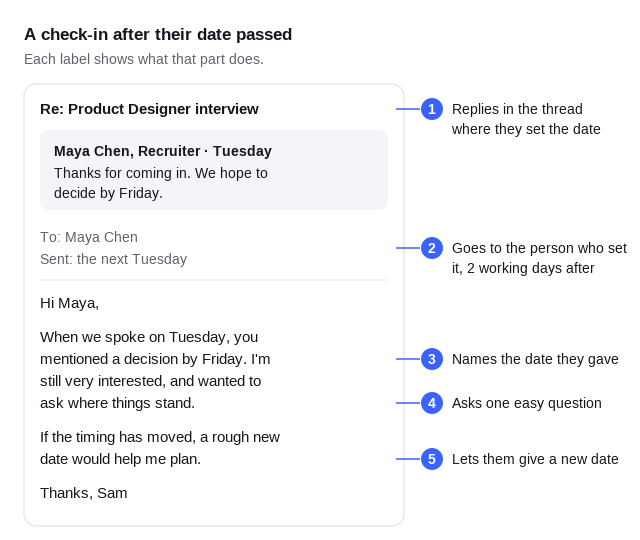
An illustration of a check-in, sent in the same thread. The names are made up. Write to the hiring manager once, if you met them
If the recruiter doesn't answer and you have the hiring manager's email, one short note to them is fine. That's our advice. The Muse suggests writing to another contact when a recruiter goes quiet after several rounds, and Indeed lists reaching out to another person as a step. Never write to a new person each week.
Pick a stop date, and write it down
Our advice: about a week after your check-in. Put it in your calendar or your tracker now, while you're calm. Level Up Careers, a recruiter's newsletter, suggests a similar personal deadline of 10 business days after a final round. When the date comes, you decide, not the silence.
If the waiting is taking over your evenings, our guide to job search burnout has a pace you can hold while you wait.Send one closing note that keeps the door open
On your stop date, send one shorter note in the same thread. Say you'll assume they've moved on, thank them, and ask to hear about future roles. Then stop writing.
If a no arrives later, reply in a few kind lines and ask to stay in touch. It takes a minute, and the next opening there may suit you better.Ask for feedback once, without expecting it
Put the question in your closing note, not in a separate email. In a 2025 survey by Textio, an HR software company, 84% of 1,100 US professionals said they'd never had interview feedback when they didn't get the offer. So ask once, and don't wait on it.

Two short notes for when you've been ghosted, ready to copy.
Swap the [square brackets] for your details. For thank-yous and every other stage, our follow-up email guide has nine more.
Check-in after the date they gave you
Two working days after their date, to whoever set it. Reply in the same thread.
Hi [First name],

When we spoke on [day], you mentioned a decision on the [Job title] role around [date]. I'm still very interested, and wanted to ask where things stand.

If the timing has moved, a rough new date would help me plan.

Thanks,
[Your name]
Closing note on your stop date
About a week after your check-in, if nothing came. Same thread, shorter than the last.
Hi [First name],

I'll assume the [Job title] role has moved ahead without me. Thank you for your time, and for the chance to meet [names, or the team].

If you can share one thing I could do better, I'd be grateful. And if a similar role opens up, I'd like to hear about it.

Best,
[Your name]
Ghosted after the final interview, what's different and what to send.
More people have to say yes. Level Up Careers lists four reasons final rounds go quiet: the budget went away, an internal candidate, cold feet about hiring, or an offer to someone who's still negotiating. That last one means you may be the backup. Our reading: that's why the silence after a final round can drag.
How long is it normal to hear back after a final interview? No data we found says. Use the same plan as after any round: their date plus a couple of working days, or about a week if they gave none.
What to send. The check-in goes to the recruiter. If you met the hiring manager, the one note from step 3 counts most here. Our reading: by the final round, they're usually the one deciding. Make it easy to answer, with one question.
Ghosted after a second interview, or after five? The plan doesn't change with the number of rounds. What changes is how much it hurts. So keep two or three other processes going, as Level Up Careers advises.
Recruiter ghosted you? What to do before or after the interview.
Is it normal for a recruiter to ghost you? It's common, and it can happen at any stage. Indeed's guide to recruiter ghosting lists after you apply and talk to the recruiter, after a phone screen, or after any interview round.
Why do recruiters ignore you, or go silent after an interview? The reasons recruiters give: they're waiting on a slow hiring manager, the role is frozen, or you're the backup while someone else decides. Those are explanations, not measured shares. Indeed adds that senior roles can take months.
What should I do if my recruiter is ignoring me? After an interview, follow the six steps above: one check-in in the same thread, then the hiring manager once. Before you write again, Indeed suggests waiting “a few days to a week.”
Before any interview, the recruiter may have reached out first and vanished, or gone quiet after a phone screen. Our reading: that's often volume, or a role that closed. In Greenhouse's 2026 survey, 81% of US candidates had been rejected from a job in the past year without ever speaking to anyone at the company. So send one follow-up, then move on. Here's how to reach out to a recruiter.
Ghosted after a verbal offer? Ask for the offer in writing, as The Muse advises. It isn't unheard of: in Indeed's 2021 survey, 10% of job seekers said an employer had ghosted them even after a verbal offer.
What are red flags for recruiters? Our reading: silence alone isn't one. A recruiter who can't tell you the next step, who decides, or when you'll hear is worth noting. Ask all three before each call ends.
After being ghosted, do this, not that.
Do
- Ask how and when you'll hear before you leave the interview.
- Send two notes at most: a check-in, then a closing note.
- Write to a person, in the same thread.
- Write your stop date down.
- Keep applying while you wait.
- Thank them, even if the answer is no.
Don't
- Send an angry message. It closes a door you may want later.
- Post about the company in anger.
- Write to a new person every week.
- Read the silence as a verdict on your skills.
- Pause your search for one company.
- Check your inbox every hour.
Other questions people ask after being ghosted, from signs to red flags.
What are signs you didn't get the job? Our reading: only things they do count, and a written no is the only sure sign. Good signs you got the job are actions too: they ask for references, talk about start dates or pay, or book another round. A friendly interviewer, a long talk or a quick reply are guesses. The same goes for signs the interviewer likes you.
They reposted the job. Is it over? The Muse calls a repost usually a signal they're moving on. But a repost can also be a copy on another job board, or a listing that's always open, so our reading is that it's a hint, not an answer. A ghost job is something else: a posting with no real hire behind it, not an employer going quiet on you.
What is the biggest red flag to hear when being interviewed? Our advice: a vague answer to “when will I hear back?” is worth noting. The red flags candidates mention most are in our guide to follow-up emails.
Should I report a company that ghosted me? That's your call. Did They Ghost You keeps an anonymous record of companies that stop responding after interviews. CNBC reported that Toronto marketing consultant Gary Meyer started it in June 2026, and that he reads and approves each report. Our advice: stick to facts, and skip the angry public post.
Questions about being ghosted after an interview, answered.
What does it mean when someone is ghosted after an interview?
The employer or recruiter stops replying, with no update and no rejection. Indeed's career guide counts it as ghosting when a reply is reasonably expected, as after an interview, and says silence after you've only applied is less likely to count. How many days of silence makes it ghosting? There's no set number. Our advice: the date they gave you, plus a couple of working days, is the line.
How common is ghosting after an interview?
Very, and the short answer has the 2024 figure. In Greenhouse's 2026 survey, 45% of US candidates who'd interviewed named being ghosted by the employer as a complaint, the most common one. In Employ's 2025 survey of more than 1,500 US adults, nearly one-third said they'd been ghosted, and nearly half of those more than three times. You may also see “77%”, from Indeed's 2021 survey of 500 US job seekers, but it counts ghosting by an employer at any point since the pandemic began, not only after interviews. If you've been ghosted after an interview or an application, you're far from alone.
Is it normal to not receive a response 2 weeks after an interview?
Yes, and on its own it isn't a no. Ashby's 2026 benchmarks cover more than 54 million applications. For people hired into business roles, they put about 14 days between the first and last interview, and about 18 days from screen to final in technical roles. So two quiet weeks can pass even for the person who gets the job. If their date has passed, send your check-in.
Is ghosting a candidate unprofessional?
Career coach Phoebe Gavin told CNBC that candidates deserve to hear from hiring managers. But in the US it's generally allowed: employers have no general duty to reply, the Congressional Research Service notes. Ontario is the exception. For interviews since January 1, 2026, employers there with 25 or more employees must tell applicants they interviewed for a publicly advertised job whether a hiring decision has been made. They have 45 days from the interview.
Is ghosting worse than rejection?
It can feel that way, because silence has no end. In Employ's 2025 survey, 57% said they expect to hear back within three days if they're not selected. Our reading: a no ends the wait, and silence doesn't. That's why the stop date matters. It gives the silence the ending the employer didn't.
Should I follow up a second time?
Once, as your closing note, about a week after your check-in. That's our advice, and it makes two notes in total. Then stop writing. A third email is unlikely to get an answer the first two didn't, and the time is better spent on other applications.
Can I still get the job after being ghosted?
It happens. One Reddit poster described an offer that came almost four weeks after a final round went quiet. Level Up Careers notes that a backup candidate may get the call if the first choice says no. Nobody has counted how often, so our advice is to plan as if it's a no and keep finding roles that fit, starting with the ones that match your resume best. If the call does come, you'll have more than one option.
Is it OK to reapply after being ghosted?
Yes, if a new role there fits you. Our advice: apply as you would anywhere. If you know the recruiter, a short note saying you've applied again is fine. One silent hiring process doesn't mean the next one will be.
Where the facts come from.
Checked in November 2026. Survey figures come from their publishers (Greenhouse, Employ, Textio and Indeed), interview timelines from Ashby's 2026 benchmarks, Ontario's rule from the province's own guide, and everything else from each organization's own pages. Where the page gives a timing, it's advice, and the advice is ours. Blynk's count is a read-only text search of 1,272 job postings from Blynk's searches that have at least 200 characters of text (750 employers, mostly senior product roles, first seen October 31 to November 11, 2026). It looked for reply times, interview lengths and promises to answer every candidate. Every match was read by eye, as were 20 random postings. A text search can miss unusual wording, and many employers set expectations on the recruiter call instead.
- Follow-up email after an interview
- Job search burnout
- Ghost jobs
- How to reach out to a recruiter
- Free job application tracker template
- How to reply to a rejection email
- Signs an interview went well
- Greenhouse: 2024 State of Job Hunting report
- Greenhouse: 2026 Future of Hiring candidate report (press release, October 2026)
- Employ: 2025 Job Seeker Nation Report (survey by Zogby Analytics)
- Textio: Interview Feedback in 2025
- Ashby: Recruiting Operations Benchmarks, 2026
- Indeed: employer ghosting survey, 2021
- Indeed career guide: what to do after being ghosted following an interview
- Indeed career guide: recruiter ghosting
- The Muse: signs you're being ghosted by a recruiter
- Accountemps (Robert Half): thank-you notes and follow-up advice, 2017
- Level Up Careers (The Random Recruiter): why you got ghosted after a final round interview
- Ontario: Employment Standards Act guide, publicly advertised jobs
- Congressional Research Service: ghost jobs (IF12977), 2025
- CNBC Make It: ghosted after a job interview, there's a website for that (November 2026)
- Did They Ghost You
- Blynk: the Job Tracker
- Blynk Find Jobs
- Blynk pricing
