
How to respond to a job rejection email. Short, kind, and only when it's worth it.
The email says they've gone with someone else, and now you're wondering whether to answer at all. Often you don't need to. When you do, four short sentences are enough. Here's which rejections deserve a reply, what to say, and seven templates to copy.

The short answer
- An automated rejection after you applied doesn't need a reply. If it came from a no-reply address, nobody would read one anyway.
- After an interview, reply within a day or two, in about four sentences. Thank them by name, name one thing you valued, say you'd like to be considered again, and ask for one thing at most.
- Then let it go. Don't argue or ask them to reconsider, and don't wait for an answer. A short, thoughtful reply is a seed for later, not a way to change this decision.
On this page
Should you reply to a job rejection email? It depends on the stage.
Where the no came from decides whether a reply is worth sending. Here's each stage, with a source where there is one and our advice where there isn't.
An automated email after you applied
Alison Green of Ask a Manager says a reply doesn't make sense if you didn't reach the interview stage, because there's no rapport to build on. Grammarly and Fyxer both say you can skip automated rejections.
Reply?: No reply needed. Note it and move on.
A no-reply address, or “please do not reply”
Hiring systems can send candidate emails from an address nobody reads. Greenhouse, for one, lists the no-reply addresses it uses, and companies can set up their own. A reply there goes nowhere.
Reply?: Don't reply to it. If you interviewed, write to the person you met instead.
After a recruiter screen
You've spoken to someone, but only briefly. Our advice: a two-line thanks to the recruiter is kind, but optional. It's most worth it when you'd like them to think of you for other roles.
Reply?: Optional. Two lines, to the recruiter.
After one or more interviews
This is the reply Alison Green says can be worth it, if it went well and you clicked with the interviewer. They may remember you for the next opening, if their first choice falls through, or to refer you somewhere else.
Reply?: Yes. About four sentences, to the person you met.
After the final round
You were close, and the people who decided know your work. In our view, this is the reply most worth sending, and the right place to ask for feedback or to be kept in mind.
Reply?: Yes, with one ask. Feedback, or a future role. Not both.
After someone referred you
Someone put their name next to yours. Our advice: reply to the company as you would at that stage, and tell the person who referred you yourself, with a thank-you.
Reply?: Yes, twice. The company, and the person who referred you.
Got a job rejection email? What it means, and what a reply can do.
How do employers politely reject a job applicant? Indeed's template for employers thanks the candidate for interviewing, says the company is moving forward with another candidate, invites them to apply again and gives a contact. Our reading: that's the polite way to say you're not selected, so if the one you received sounds like that, it's a standard note. “Apply again” is kind, not a hidden signal.
Automated or personal? An automated rejection thanks you for your interest, comes from a general or no-reply address, is signed by a team, and mentions nothing you talked about. A personal one comes from someone you met, by name. Only the second is worth a reply. The picture in step 1 below shows both.
Can a reply change the hiring decision? Very unlikely, Alison Green says. Grammarly and Fyxer both warn against asking them to reconsider. A reply's value comes later, if it comes at all.
Do companies go back to past candidates? Some do. In Gem's 2026 recruiting benchmarks (Gem sells recruiting software), 46% of sourced hires came from “rediscovered” candidates. Those are people already in a company's hiring system, including past applicants. Talent Board's 2023 research says employers “most certainly want their final interview silver medalists to apply again”.
Our reading: neither source says a reply is what gets someone called back. But a short, warm one keeps your name in good standing with the people who would do the calling. That's all it needs to do.
How to reply to a rejection email, in four sentences.
For the rejections worth answering: after an interview, a final round or a referral.
Reply to the person, in the same thread
Hit reply and keep their subject line, so they see the whole conversation. Avoid reply all, and send it only to them. If the employer sent the rejection from a no-reply or general hiring address, Alison Green suggests sending your note to the hiring manager directly, so they see it.
Keep their subject, so it reads “Re: Your application for [Job title]”. Writing a new email? “Thank you, [Job title] interview” is plain and clear.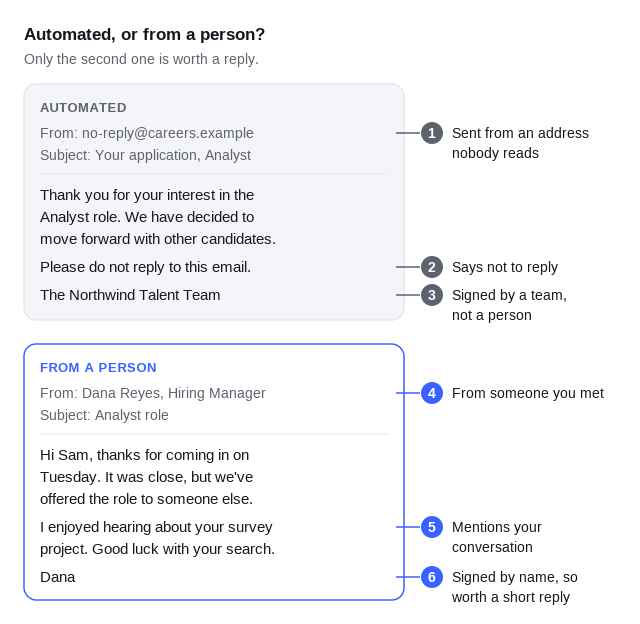
An illustration. Only the second email is worth a reply. The names are made up. Wait until you're calm, then send it within a day or two
The advice on timing varies, and none of it comes with a source. Grammarly says within 24 to 48 hours, after waiting a few hours. Fyxer says 24 to 48 hours in one place and an hour or two in another. Our advice: take a few hours, let the first sting pass so you can reply professionally, then send it that day or the next. Keep the tone polite and warm.
Too late? A week later is still fine, in our view, while they still remember you. Months later, save it for a fresh note when a new role opens.Say thanks, one real thing, and that you'd like to stay in touch
Include three things. First, express your thanks by name, for their time and for letting you know. Then name one specific thing you valued, like a project they described or something you learned in the interview process. Last, say you're still interested in the company, and you'd be glad to be considered for future opportunities. Alison Green says the reply worth sending isn't a perfunctory “thanks for letting me know”, so the specific line matters most.
Instead of “Thanks for the update,” try “Thank you for letting me know, Dana. I really enjoyed hearing how your team rebuilt onboarding, and I'd be glad to be considered if a similar role opens.”Ask for one thing at most, and make it easy to say no
Ask for feedback, or to be kept in mind for a role you name. Not both, and never the reasons they chose someone else. Constructive feedback is rare, because most employers won't share much. In Talent Board's 2023 research, 17% of participating employers said hiring managers give approved detailed feedback to outside candidates. In Textio's 2025 survey, 84% said they'd never had interview feedback when they didn't get the offer.
Easy to say no to: “If you have a moment, I'd welcome one thing I could do better. No worries if that's not possible.” Ask once, and don't follow up on it.Sign off, then stop
Fyxer suggests 75 to 150 words. Our advice is the short end: under about 100. Don't attach your resume again, and don't add a pitch. Then don't write again about this role. One kind message is the whole job.

Rejection email response templates, by stage.
Seven examples, one for each situation. Swap the [square brackets] for your details. Each one is under 100 words, so send it as it is or trim it.
Reply to a rejection email after an interview
Within a day or two, to the person you met. Reply in the same thread.
Hi [First name],

Thank you for letting me know, and for the opportunity to interview for the [Job title] role. I really enjoyed hearing about [one specific thing, like a project or how the team works].

I'd still love to work at [Company], and I'd be glad to be considered if a similar role opens.

Best,
[Your name]
After the final round, with one ask
Within a day or two, to the hiring manager. Ask for one thing only.
Hi [First name],

Thank you for telling me, and for everything your team put into the process. Getting to know [names, or the team] made me even more sure I'd like to work with you.

If you have a moment, I'd welcome one thing I could do better next time. No worries if that's not possible.

I hope our paths cross again.

Sincerely,
[Your name]
Asking for feedback
After an interview, when feedback matters more to you than staying in touch. Ask once.
Hi [First name],

Thanks for letting me know about the [Job title] position, and for your time.

If you're able to share it, I'd really appreciate one or two things that would have made me a stronger candidate. I understand if that's not something you can do.

Thank you,
[Your name]
Asking to be considered for another role
When you've seen another opening there that fits you. Name it.
Hi [First name],

Thank you for letting me know, and for our conversations about the [Job title] role.

I noticed you're also hiring for [Other job title]. My work on [one true thing that fits it] seems close to what that team needs. Would you consider passing my name along, or should I apply directly?

Thanks again,
[Your name]
Two lines to the recruiter after a screen
Optional. Only if the email came from the recruiter you spoke to.
Hi [First name],

Thanks for letting me know, and for the call last week. I'd be glad to hear from you about future roles that fit my background.

Best,
[Your name]
Thank-you to the person who referred you
The same day you hear, so they hear it from you first.
Hi [First name],

I wanted you to hear it from me. [Company] went with another candidate for the [Job title] role.

Thank you again for putting my name forward. It got me in the room, and I learned a lot from meeting [the team, or a person]. I'd be glad to return the favor anytime.

[Your name]
When the rejection came from a no-reply address
A new email to the person you interviewed with, if you have their address. Subject line "Thank you, [Job title] interview".
Hi [First name],

I heard from [Company] that the [Job title] role went to another candidate. Thank you for the time you spent with me during the process. I especially enjoyed [one specific thing you discussed].

If something similar opens on your team, I'd be glad to be considered.

Best,
[Your name]
A reply that backfires, and the same reply fixed.
The reply. “I'm surprised by this decision. I was clearly the most qualified, and I'd like to know why you chose someone else. Could you reconsider?”
Why it hurts. On Ask a Manager, a hiring manager who emails every rejected applicant says the most common bad reply insists the candidate was the most qualified. In one letter to her, an applicant who replied defensively and aggressively to a rejection applied again the next year. The coordinator said she'd seen “red flags” in that reaction.
The same reply, fixed. “Thank you for letting me know. I'm disappointed, because I'd really like to work with you. If a similar role opens, I'd be glad to be considered.”
What changed. The disappointment stays, said once and kindly. The question about why becomes a wish about the future. Nothing asks them to defend the decision, so it leaves a positive impression instead of a bad one.
Replying to a rejection email, do this, not that.
Do
- Reply in the same thread, to the person you met.
- Keep it short, warm and respectful.
- Wait until you're calm, then send it within a day or two.
- Name one real thing from the process.
- Ask for one thing at most.
- Keep it under about 100 words.
- Thank the person who referred you, too.
- Leave the door open for future openings.
Don't
- Reply to a no-reply address.
- Reply all.
- Attach your resume again.
- Ask “why not me?” or ask them to reconsider.
- Treat feedback as criticism to argue with.
- Post about the company or the interviewer.
If they answer, or if they don't. What to do after you reply.
If they send feedback, thank them in one line, and don't debate it. It's rare insight, so treat it as a gift, even the parts you disagree with. Use what you can learn from it to improve your next job application. That's our advice.
If they never answer, that's normal, and it doesn't mean the reply was wrong. Don't send a second note about this role.
What are signs you didn't get the job? Our reading: a written no, like the one you're answering, is the only sure sign, and everything else is a guess.
If you never heard a no at all, that's a different problem. In Greenhouse's 2024 survey of 2,500 workers, 61% of job seekers said they'd been ghosted after a job interview. Our guide to being ghosted after an interview covers the signs and what to send, and the follow-up email after an interview has the timing.
Stay in touch, lightly. Ask a Manager's advice is to connect on LinkedIn and keep in touch now and then. Our advice: write again only when you have a reason, like a new role on their team. In our reading, networking with people who've already met you is easier than starting cold, and a light touch is how you maintain the relationship.
After a job rejection email, put the energy back into the search.
Note where it ended. A no after applying, a no after a screen and a no after the final round mean different things. Our guide to job search burnout reads each rejection by the stage it came at, and what to change if it keeps happening there.
Keep the contact. Write down who you met and what you talked about. If a role opens there later, that's your opening line.
Move to the next role you fit. In our reading, one good application the same day does more than replaying this one. A spreadsheet is enough to keep track, or Blynk's tracker keeps every role, application and reply in one place.
Job offer rejection emails, when it's the offer that gets turned down.
What to say in a job offer rejection email? That's a different email, because you're the one saying no. Grammarly says to thank the employer clearly, state your decision, and avoid overexplaining your reasons. Our advice: a few sentences to the person who made the offer, and one line to keep in touch if you'd like to.
How to respond when someone rejects your job offer? That's the employer's side. Top Echelon's advice for recruiters: respond with grace, thank them for telling you, ask for a reason if they didn't give one, ask if they'd like to be considered for other roles, and move on to other candidates. Our reading: that last step is why Alison Green says a reply can help them remember you if their first choice falls through.
Questions about replying to a rejection email, answered.
Should you respond to a job rejection email?
Only when you've spoken to someone. After an interview, a short, kind reply can be worth sending, says Alison Green of Ask a Manager. An automated rejection after you applied doesn't need one, and Grammarly and Fyxer agree. In our view, a thank-you is never wrong, but before the interview stage it's optional.
What should I reply if I get rejected?
If you interviewed, a short thank-you in the same thread, to the person you met, within a day or two (our advice). Thank them by name, name one thing you valued, say you'd like to be considered for future roles, and ask for one thing at most. After an automated rejection, nothing is needed. The first template above has the words.
How long should a reply to a rejection email be?
Short. Fyxer suggests 75 to 150 words, and Grammarly says to keep it concise. Our advice: three or four sentences, under about 100 words. A long reply starts to read like a case for changing the outcome.
Is it OK to ask for feedback after a job rejection?
Yes, once, and make it easy to say no. Ask for one or two things you could do better, not why they chose someone else. Ask a Manager notes that some employers have a policy of not giving feedback, so don't read anything into silence.
Can you still get the job after a rejection email?
The chance is small for this one. Alison Green says employers are very unlikely to change their mind, though a reply can help them remember you if their first choice falls through. A later job, sometimes. The Muse published one writer's story: turned down for an internship after three interviews, she later emailed the hiring manager, without attaching her resume, and got the next internship. One story, not a promise.
How soon should you reply to a rejection email?
Within a day or two, once the first sting has passed. That's our advice, and Grammarly says 24 to 48 hours. A week later is still fine. After a few weeks, save your note for when a new role opens.
What if the rejection email came from a no-reply address?
Don't reply to it, because nobody reads that inbox. If you interviewed, write a new email to the person you met, as Alison Green suggests. The last template has the words. If you only applied, there's nothing you need to send.
Can I ask to be considered for other roles?
Yes. Our advice: name the role you've seen and say in one line why you fit it, rather than a general “keep me in mind”. Ask whether to apply directly or be passed along, and accept either answer. The template “Asking to be considered for another role” has the words.
Can I reapply to a company that rejected me?
Often you can, but some companies set a wait. Block's job postings, for example, say reapplications to the same role are accepted 90 days after a previous application has been reviewed. Check the posting or the company's career site for the rule. In our view, a different role there is often the better next try.
What if I'm angry about the rejection?
Wait until it passes before you write anything. Say it to a friend first, not to them. Angry replies get remembered: the section “A reply that backfires” shows what it cost one applicant. If you can't write it kindly yet, don't write it yet.
Where the facts come from.
Checked in November 2026. Survey and benchmark figures come from their publishers (Talent Board, Textio, Greenhouse and Gem). Hiring-side advice comes from Ask a Manager (and, for a declined offer, Top Echelon), how no-reply emails work from Greenhouse's own help pages, and Block's reapply rule from Block's own job posting. Where the page gives a timing or a word count, the sources disagree or give none, so it's advice, and the advice is ours.
- Ask a Manager: is it ever worth it to respond to rejection emails? (2025)
- Ask a Manager: how to respond to a job rejection (2013)
- Ask a Manager: how not to respond to a job rejection (2013)
- Ask a Manager: I responded angrily to a rejection (republished 2026)
- Talent Board: 2023 North American Candidate Experience Benchmark Research (brief)
- Textio: Interview Feedback in 2025
- Greenhouse: 2024 State of Job Hunting report
- Gem: key takeaways from the 2026 Recruiting Benchmarks report
- Greenhouse support: no-reply email addresses
- Greenhouse support: rejection emails
- Indeed for employers: interview follow-up email templates
- The Muse: how one short follow-up email landed me my dream job after I'd been rejected
- Block careers: a job posting with the reapplication rule
- Grammarly: how to reply to a job rejection email
- Fyxer: how to respond to a rejection email
- Top Echelon: what to do when a candidate declines the job offer (for recruiters)
- Blynk: Find Jobs
- Blynk: the Job Tracker
- Blynk pricing
