
Resume mistakes that cost interviews. Which to fix first, with the evidence.
If you’ve sent a lot of applications and heard little back, a list of 20 resume mistakes won’t tell you which one matters. Here are the few that hiring managers rank first in real surveys, each with its source, and what to leave off.

The short answer
- Fix typos first. In a 2013 CareerBuilder survey of 2,076 hiring managers and HR staff, 58% said typos would make them automatically dismiss a candidate. It was the top answer.
- Then make it easy to read, and made for this job. A generic resume, not made for the position, came second at 36%. Some hiring software can also misread photos, tables and columns.
- Leave off your photo, birthday, street address and salary history. Most other “mistakes” on long lists, like hobbies or an objective, are a question of space.
On this page
Why resume mistakes lists disagree, and what the surveys say.
Three things people hear about common resume mistakes, and what the studies behind them show.
“One typo and I’m out.”
Accountemps asked more than 300 US senior managers in 2014 how many typos it takes for them to decide not to consider a candidate. 17% said one. 46% said two, and 27% said three. In 2009, 40% had said one.
Check: Has someone else read it? One typo is a risk with some readers, and the cheapest fix there is.
“Recruiters only look at it for 7 seconds.”
That number comes from Ladders, a job site that ran its own eye-tracking studies. In 2012, recruiters spent about six seconds before a first “fit or no fit” call, though most of them had said they spend at least four minutes. In 2018, the first skim averaged 7.4 seconds. It’s the first look, not the full read.
Check: Can someone find your titles, employers and dates at a glance? That’s where the first look went.
“Every list says something different.”
The lists that rank for this search run 11 to 22 items, each given the same weight, and almost none cites a source. Surveys with a stated method do rank them. In CareerBuilder’s, typos came first at 58%, and a photo was 13%.
Check: Are you fixing the big ones first? The three groups below are in that order, the most important first.
Mistakes a person spots first, in the first skim.
These are what a hiring manager or recruiter can see in seconds, and they shape the first impression. Each one has a survey behind it, a fix that takes minutes, and examples where they help.
Typos, spelling and grammar errors
Typos topped CareerBuilder’s 2013 list, at 58%. Spell check won’t catch a real word in the wrong place, such as “manger” for “manager”. Purdue’s career center suggests reading it backwards for spelling, then top to bottom for phrasing. Our advice: proofread it once more, then ask one other person to read it.
Titles, employers and dates that are hard to find
In Ladders’ 2012 study, almost 80% of the time in that first look went to six spots. They were your name, your current and previous titles and employers, the dates of both roles, and your education. In CareerBuilder’s survey, 27% said a resume with no exact dates of employment would make them dismiss a candidate. Our advice: in your work experience section, give each job its title, employer, and month and year, on one line, starting with your most recent role.
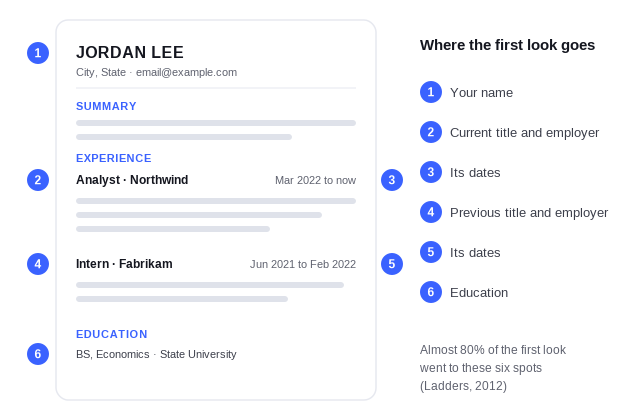
An illustration, labelled. The six spots are from Ladders’ 2012 study; the name and jobs are made up. Duties and responsibilities instead of results
In Resume Genius’s 2026 survey of 1,500 US hiring managers, 42% named vague or generic descriptions of past work as a red flag. Resume Genius sells resume tools, so read it as one company’s survey. Our advice: say what changed because of you, with a measurable result if you have one, rather than list your tasks. How to write resume bullet points covers the wording.
Before. Duties included the weekly sales report. I got it down from [number] hours to [number] and sent it to [number] store managers.
After. Cut the weekly sales report from [number] hours to [number], for [number] store managers.
Use your real numbers, or leave a number out rather than guess.An unprofessional email address
31% in CareerBuilder’s survey said an inappropriate email address would make them dismiss a candidate. Our advice: use a professional email address with your first and last name, at any free email service. Check the rest of your contact information too, such as your phone number and LinkedIn link.

Resume mistakes hiring software can’t read, and how to avoid them.
Before a person reads your resume, an applicant tracking system turns the file into text. Greenhouse, one of these tracking systems, says its automatic reject rules work only on yes-or-no and pick-list questions. But it lists layouts that can break how it reads a resume, and a garbled one is harder for a person to use.
Tables, columns and graphics
Greenhouse lists tables, columns and graphics among the things that can break its resume reading. People liked simple layouts too. In Ladders’ 2018 study, the resumes that did worst had clutter, little white space and more than one column. Our advice: use a simple resume format, with one column, plain section headings, and no heavy design or colors. Blynk’s Resume Builder uses one column and standard headings, so hiring systems read it the way you wrote it.
Contact details in the header or footer
Greenhouse also lists contact details placed in a header, a footer or a text box. Put your name, email, phone and city in the body of the page, at the top.
A scan, a photo or a picture of text
Image uploads and photos are on Greenhouse’s list as well. Send a PDF or Word file made from a document, and check you can select the words in it. The ATS-friendly resume guide covers file types and layout in full, and the best font for a resume covers fonts and sizes.
Mistakes against the job you want, the ones that make a resume look generic.
The next biggest group in CareerBuilder’s survey is about fit with the role you’re applying for. Each of these was named by about a third of hiring managers.
The same resume for every job
36% said a generic resume, not made for the position, would make them dismiss a candidate. Sending one resume to every job leads straight to it. Purdue’s career center says to compare your resume with the position description. Our advice: check that each of its main requirements and qualifications shows up in your experience. How to tailor your resume to a job description shows how to make a tailored version, line by line.
No list of skills
35% named a resume with no list of skills. Our advice: add a short skills section with the hard skills the posting names that you really have, spelled the way it spells them, and show soft skills in a specific result rather than list them. Resume keywords covers how to find them.
Too much wording copied from the job posting
32% named that too. So the fix for a generic resume isn’t pasting the posting in. Our advice: use the posting’s words to describe what you’ve really done, and keep the sentences your own.
What not to put on a resume, and the US reason behind each.
These are personal details, and other information a US employer doesn’t need to judge your work. Leaving them off is the norm in the US. If you’re applying in another country, check its norm first.
Should I put a photo on my resume? In the US, no.
The EEOC, which enforces US job discrimination laws, says employers should not ask for a photograph of an applicant. It also says race, sex, national origin, age and religion are irrelevant to hiring. Greenhouse lists photos among things that can break its resume reading, and 13% in CareerBuilder’s survey said a photo would make them dismiss a candidate. A photo isn’t illegal, but it adds risk and nothing the job needs. That’s our reading.
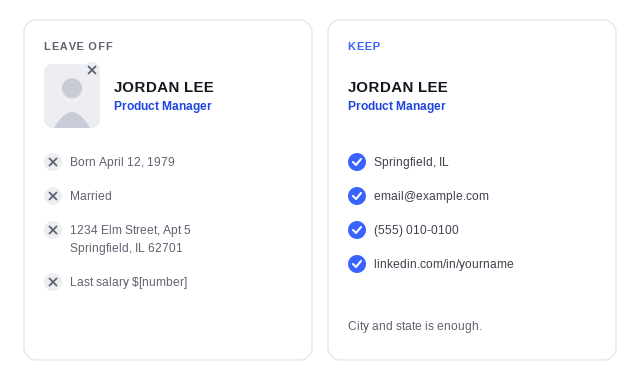
An illustration, labelled. The name and details are made up. Should I put my birthday on my resume? No.
Purdue’s career center lists age among the details to leave off. The Age Discrimination in Employment Act protects people 40 or older, including in hiring, says the EEOC. Our advice: if the job doesn’t ask, leave off graduation years that give your age away too.
Marital status, religion and other personal details
Purdue’s list of what to leave off also includes gender, religion, political affiliation, marital status, ethnicity and visa status. None of them shows what you can do in the job.
Should I put my address on my resume? City and state is enough.
Virginia Tech’s career office says “it is no longer advised to include your street address on your resume to protect your privacy.” It suggests your city or town and state instead. That still tells a company whether you’re local.
Salary history, and the pay you want
Neither belongs on the resume. Several US states ban employers from seeking your salary history, including California, New York, Washington and Massachusetts. California’s law still lets them ask what pay you expect. What to put for desired salary covers that box.
Should I put my GPA on my resume? Early on, if it’s 3.0 or higher.
In NACE’s Job Outlook 2026 survey, 42% of employers said they screen candidates by GPA, down from 73% in 2019. The University of Toledo’s career center suggests including it at 3.0 or above, as a general rule of thumb. Purdue adds that if you list it, be accurate. Our advice: for students and entry-level jobs, list it if it helps, and drop it once you have a few years of work experience to show.
“References available on request”
The University of Minnesota’s education college says not to list references on your resume, or add that line. The University of Cincinnati says it’s no longer necessary. Blynk searched 1,204 job postings from its own searches, mostly senior product roles. None asked for references on the resume or with the application, and the 9 that mentioned them meant a check later on. Resume sections, in order covers references and the other sections.
Should you use “I” on a resume? Leave it out.
Purdue’s career center says not to use first-person pronouns (I, me, my). Start each line with what you did instead, such as “Led”, “Built” or “Cut”.

The rest is a question of space, not risk. An objective statement, a hobbies list, unrelated projects or an old award isn’t a mistake by itself. Including irrelevant information mostly costs space. Our advice: keep it if it helps this job, and cut it when a result needs the room. Resume sections covers what each part is for.
Resume red flags, and when they aren’t a problem.
Resume Genius surveyed 1,500 US hiring managers through Pollfish in June 2026. The red flags they named most were job-hopping at 65% and heavily AI-generated application materials at 49%. Next came a long or unexplained gap at 43%, and vague descriptions of past work at 42%. It’s a resume company’s survey, so treat the numbers as one source.
A gap in your work history. In the same survey, 63% said an unexplained gap raises questions but warrants an explanation. Only 12% called it a significant negative. Our advice: give it one honest line with the dates, such as “Career break, caring for a family member”.
Job-hopping and short stints. Our advice: group short contracts under one heading, such as “Contract roles, [year] to [year]”. If there’s a simple reason you moved, a line in your resume summary or cover letter can say it.
A functional resume that hides dates. Ask a Manager, a long-running workplace advice column, says functional resumes are generally taken as a red flag that something is being covered up. Hiding dates tends to backfire. If you’re changing fields, the career change resume guide shows a layout that keeps them.
Text that reads like AI. In Resume Genius’s 2026 survey of 1,000 hiring managers, the signs they noticed most were unnatural phrasing (51%) and generic language (44%). Vague or inflated descriptions came next, at 41%. Can employers tell if you used AI? covers what they check.
Before you send it, a last check for resume mistakes.
A few final tips before you submit it. Five minutes, any resume, no tool needed.
Do
- Do your proofreading aloud, then read it backwards for spelling, as Purdue suggests.
- Give it to a friend for 7 seconds, then ask for your last title and employer. If they can’t say, move them up.
- Put the posting next to it and make sure its top asks are in your resume, in your own words.
- Keep one plain file, with one column and standard headings.
- Give every job a title, an employer, and month and year dates. Keep the formatting consistent throughout.
Don't
- Claim a title, degree or skill you don’t have.
- Hide keywords in white text, or pad the skills line with skills you don’t have.
- Keep a line you couldn’t explain in an interview, whoever wrote it.
- Add a photo, birthday or street address for a US job.
Questions about resume mistakes, answered.
What is the 7 second rule for a resume?
It comes from Ladders’ eye-tracking studies. In 2018, recruiters’ first skim of a resume averaged 7.4 seconds, up from about 6 seconds in 2012. That’s the first “fit or no fit” look, not the whole review. So put your titles, employers and dates where they’re easy to find.
Is one typo on a resume bad?
It can be. In Accountemps’ 2014 survey of more than 300 US senior managers, 17% said one typo is enough for them to decide not to consider a candidate. Another 46% said two. So for most of them, one typo alone wasn’t enough, but for some it was. Fix every one you can find.
What is a red flag on a resume?
Something that makes a reader stop and wonder. In Resume Genius’s 2026 survey of 1,500 hiring managers, the most named were job-hopping (65%), heavily AI-generated materials (49%), a long or unexplained gap (43%) and vague descriptions (42%). Most can be explained in one line, as the red flags section shows.
What are the 5 P’s of a resume?
There’s no official list. One New Zealand CV writer’s version is presentation, personalization, precision, performance and professionalism. Our reading is that the two that matter most match the surveys, professionalism (no errors) and personalization (made for the job).
What are 5 common mistakes people make on their resume?
In CareerBuilder’s 2013 survey, the five most named were typos (58%), a generic resume not made for the position (36%), no list of skills (35%), a lot of wording copied from the job posting (32%) and an inappropriate email address (31%). Each has a fix above.
Can you fix my resume?
This page can’t edit it for you, but free help with your resume and job search exists. American Job Centers, funded by the US Department of Labor, offer resume help and workshops, and CareerOneStop has a finder for the one near you. To see how hiring software reads yours against a job, use the check in the middle of this page.
Should I avoid using “I” in a resume?
Yes. Purdue’s career center says not to use first-person pronouns (I, me, my). Start each line with the action instead, such as “Built” or “Led”.
Should I put my birthday on my resume?
No, not for a US job. Purdue’s career center lists age among the details to leave off, and the EEOC says age is irrelevant to hiring. The Age Discrimination in Employment Act protects people 40 or older.
How long should my resume be?
Resume length depends on your stage. One page early in your career, and two once relevant work fills them. How many pages should a resume be has the studies and each career stage.
Can employers tell if your resume was written by AI?
Many say they notice signs of it. In Resume Genius’s 2026 survey, unnatural phrasing (51%) and generic language (44%) were the signs hiring managers named most. Can employers tell if you used AI? covers what they check.
Sources, and where to read more.
Checked in November 2026. Each survey is named with its year, its size and who ran it. Some were run by companies that sell resume or hiring services, and the page says so. The advice is ours, and is marked where it’s our reading. To count references, we searched 1,204 job postings from Blynk’s searches, mostly senior product roles, first seen October 31 to November 11, 2026, and read every match by eye. A posting can still ask for references in its application form, which this count can’t see.
- ATS-friendly resume, what it means
- How many pages should a resume be?
- Resume sections, in order
- How to write resume bullet points
- The best font for a resume
- How to tailor your resume to a job description
- Why am I not getting interviews?
- What to name your resume file
- Functional vs chronological resume
- CareerBuilder, common and not-so-common resume mistakes (Harris Poll, 2013)
- Accountemps (Robert Half), one or two resume mistakes enough for most managers (2014)
- TheLadders, job seekers have six seconds (2012)
- Ladders, eye-tracking study, 2018 (PDF)
- HR Dive, recruiters look at resumes for 7 seconds (2018)
- Resume Genius, 2026 hiring trends report (Pollfish, 1,500 hiring managers)
- Resume Genius, hiring insights report (January 2026)
- EEOC, prohibited employment policies and practices
- EEOC, age discrimination
- Purdue Center for Career Opportunities, resumes and CVs
- Virginia Tech Career and Professional Development, resume FAQ
- Greenhouse, unsuccessful resume parse
- Greenhouse, auto-reject rules
- NACE, employer use of skills-based hiring grows (Job Outlook 2026)
- University of Toledo Career Services, resumes
- University of Minnesota CEHD Career Services, work references
- University of Cincinnati, references on a resume
- California Labor Code 432.3 (salary history)
- New York Labor Law 194-a (salary history)
- Washington RCW 49.58.100 (salary history)
- Massachusetts General Laws c.149 §105A (salary history)
- Ask a Manager, resume tricks that will backfire (2015)
- CareerOneStop, find an American Job Center
- CV Writing NZ, the 5 P’s of a CV
- Blynk ATS Check
- Blynk Resume Builder
