
What to put for desired salary. Without pricing yourself out.
You're halfway through an application and a required box says “Desired salary”. Too high and you might be out. Too low and you're stuck with it. Here's what to type, from what 218 real application forms ask and what the hiring systems' own help pages say.

The short answer
- Look for a pay range in the job posting first. If there is one, answer inside it. Nearly half the postings we checked showed pay.
- No range? Type a number you'd happily accept, from a range you've researched for this role, level and place. Match the box: yearly or hourly, base or total, and a range only where it takes text.
- Don't type 0 or 999999. A person reads it as “no answer”. Leave the box blank only if it's optional.
On this page
Why the desired salary box feels like a trap, and what's really going on.
Five worries people have about this box, and what the evidence says.
“Too high, and the system throws me out automatically.”
Employers ask so they can see quickly whether your number fits the budget for the role, which WayUp calls checking “whether you fit the budget”. But the hiring systems' own help pages don't describe a rule that rejects a typed desired salary for being too high. Greenhouse says its auto-reject rules can only be set up on Yes/No, single-select and multi-select questions, so not on a box you type in. Ashby's rules can match a typed answer that contains certain words or is empty. So a person, or a rule the employer chose, sees what you typed.
What to do: Answer honestly. Pick a number you can explain, not one you hope slips past a filter.
“Can I just put 0 to get past it?”
Payscale says typing “negotiable” or “000” can get you around the question. WayUp says not to enter 0, 1 or 999999, because a 0 “can read like you didn't take the question seriously”. Employbridge, a staffing company, says placeholders may get your application flagged, without giving a source. Our reading: none of them gives evidence that a machine rejects a 0, but a person who reads it learns nothing about your salary expectations.
What to do: Type a real number. Choose the lowest figure you'd still say yes to.
“Whoever names a number first loses.”
That's an opinion, not a finding. On a call you can ask for their range first. Of the 1,204 postings in Blynk's searches, 19 said your recruiter can share the salary range. But a required box on a form can't be talked around.
What to do: On a form, answer. On a call, ask for their range first.
“If I lowball, I'm stuck with it for years.”
Not stuck, but it does set the tone. WayUp says your answer is “not a contract”, though it anchors the talk that follows. Payscale says employers typically default to the midpoint of a range when they set starting pay. So the bottom of your range matters more than the top.
What to do: Make the bottom count. Never put a figure there that you'd turn down.
“Why don't they just post the pay?”
Nearly half do. Of 1,477 job postings from Blynk's searches, 701 (47%) showed pay. Some states require it, and the rules differ by state and employer size. Our guide to pay transparency covers which ones.
What to do: Check the posting before anything else. If the range is there, your answer goes inside it.
What 218 real forms ask about desired salary.
We read the forms, not just the advice. On November 12, 2026, we read the live application forms for 218 open jobs in Blynk's searches, at 199 companies. They're on Greenhouse (97), Ashby (96) and Lever (25), and we read each system's public job-board data without submitting anything. Most are senior product roles at tech companies.
About 1 in 3 forms ask for your desired salary. 67 of the 218 forms asked (31%), and 58 of those made the answer required. For jobs in the US it was 44 of 158 forms (28%).
Most desired salary boxes take text. On 56 of the 67 forms, the pay question was an ordinary text box, so a range or a short sentence fits. 8 took numbers only, all on Ashby. 4 had a pick-list of pay bands, like “$50k-$65k” (one form had both). One text box said in its label to enter numbers only.
Salary expectations, desired salary, salary requirements: one question. 41 used “expectations”, 29 “desired” or “target”, and 5 “requirements”. 17 asked for base salary, 16 for total pay with bonus, equity or commission, and 12 for the currency. 3 asked for a monthly or hourly figure. One form said “'flexible' is not an acceptable response”.
A posted range doesn't mean they won't ask. Of US forms whose posting showed pay, 25 of 106 still asked (24%). Where the posting had no pay, 19 of 52 asked (37%). And 3 forms only asked you to confirm you'd read the posted range.
The posting almost never asks. Of 1,272 job postings in Blynk's searches with more than a few lines of text, 1 asked you to include your pay expectations. The question lives on the form, next to the other boxes, like the cover letter upload.
What this doesn't tell you. It covers three hiring systems. Workday, iCIMS and LinkedIn Easy Apply weren't read, and they may use number boxes more. And a box on a form says nothing about how the answer is used.
What to put for desired pay on a job application, step by step.
Six steps, in the order you'll do them. Most take a minute. The research step takes longer the first time, and then you reuse it.
Look for a pay range before you type a desired salary
Before you type anything, search the posting. Press Ctrl+F (Cmd+F on a Mac) and try “$”, “salary”, “pay” and “compensation”. The range is often near the end. If there is one, your answer goes inside it. If the form only asks you to confirm the posted range, confirm it and move on.
What a posted range looks like: “The base salary range for this role is $120,000 to $150,000.” Of 1,477 postings in Blynk's searches, 701 showed pay like this.No range? Check the law, then ask
Some states make employers post pay: California, for example, requires employers with 15 or more employees to include the pay scale in any job posting. Our pay transparency guide lists the others. If the range still isn't there, ask the recruiter. Of the 1,204 postings in Blynk's searches, 19 said your recruiter can share the salary range. Our guide on how to reach out to a recruiter has a short message for it.
Research a range for this role, level and place
Look up what the job pays where it is, at your level. Levels.fyi shows pay by company, level and location, and Payscale prices a job title from salary profiles that people report themselves. Salary.com's free estimate isn't personal, and its detailed report is paid. For hourly jobs, the government's wage data (BLS) lists pay by job and place. We've compared Payscale, Salary.com, Levels.fyi and Glassdoor with Blynk, if you want to see what each one covers.
Write down three numbers: the lowest pay you'd accept, the pay you'd be glad to get, and the top of what the job seems to pay. That's our advice, not a rule.Pick a desired salary you'd be glad to accept
Our advice: the bottom of your range is the lowest pay you'd still say yes to, never lower. Payscale notes that employers typically default to the middle of a range, and warns against a range that's too broad. When the posting has a range, aim somewhere in it that fits your experience. If your number sits above it, read the question on that below.
Instead of “$80,000 to $140,000” try “$118,000 to $130,000”: a range you could defend, with a bottom you'd accept.How to answer desired salary on an application, by the kind of box
A text box: type a short range and say what it covers, like “$118,000 to $130,000 base”. Numbers only: type one number, the one you'd be glad to accept, with no $ sign or commas if the box rejects them. A pick-list: choose the band your number falls in. Optional: you can leave it blank. Then match what the box asks for: yearly or hourly, base pay or total pay, and the currency if the job is abroad.
Read the label twice. “Desired annual salary (USD)” wants a yearly number in dollars. “Desired Salary or Hourly Rate” lets you answer the way the job is paid.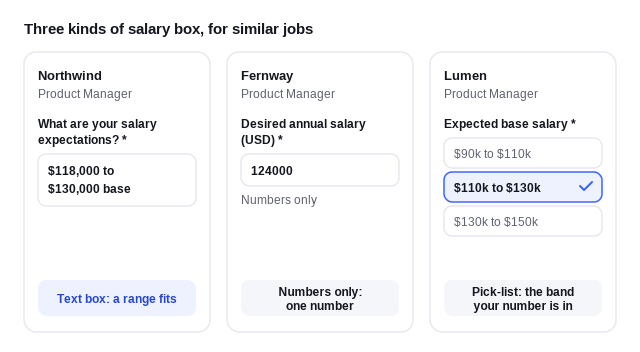
An illustration of the three kinds of salary box. The companies are made up. Keep a note of the desired salary you typed
A recruiter may call weeks later and ask about the number you gave. Write down the figure you entered for each job, with the date and any range in the posting. A spreadsheet works. Blynk's tracker keeps every role, application and message in one place.

Desired salary for hourly jobs, and what $20 an hour is a year.
Hourly or yearly? Give your desired pay the way the job is paid, unless the box says otherwise. If the posting says “$18 an hour”, give an hourly figure. If the box says “annual salary”, convert it. 3 of the 67 forms that asked about pay wanted a monthly or hourly figure.
How to convert. The US Bureau of Labor Statistics (BLS) turns hourly pay into yearly pay with a typical work year of 2,080 hours: 40 hours a week for 52 weeks. So multiply the hourly rate by 2,080. To go the other way, divide by 2,080.
What would $15 an hour be annually? $31,200 a year. What is a desired salary for $16 an hour? $33,280 a year, if the box wants a yearly figure. What is a $20 per hour salary? $41,600 a year. What salary is $25 an hour? $52,000 a year. And $10 an hour is $20,800.
If I make $70,000 a year, how much would I earn per hour? About $33.65 an hour, using the same 2,080 hours. Is $1200 a week a good salary? It works out to $62,400 a year, or $30 an hour for a 40-hour week. Whether it's good depends on the job and the place.
Is your desired pay a good wage? How to tell, at any age.
Is $20 per hour a good wage? Is $16 an hour a decent wage? It depends on the job and where it is, so compare it with that job's local pay. The BLS publishes wages by job for each state and many cities, and the salary sites above show pay by place too. If $20 is at or above what that job pays nearby, it's a fair ask.
Is $20 an hour good at 19? Is $10 an hour good for a 17 year old? What's a good salary for a 20-year-old? Your age doesn't set the pay for a job: the job and the place do. Check the posting for a rate first, and if there isn't one, look up what that job pays nearby and type a number in that range.
Is $70,000 a year considered poor? Can I afford a house with a $70,000 salary? That depends on prices where you live, your debts and your savings, which no general guide can judge for you. For the box on the form, the question is narrower: does $70,000 fit this job's range where it is?
What desired salary and salary requirements mean on a job application.
What is meant by desired salary? The pay you'd want for this job. Unless the box says otherwise, that's base pay, per year for a salaried job and per hour for an hourly one. It's not your current pay, and it doesn't include benefits.
What do they mean by salary requirements? The same thing as desired salary or salary expectations, in different words. On the forms we read, 41 said “expectations”, 29 “desired” or “target”, and 5 “requirements”. Answer them all the same way. 2 said “minimum”, and then they want the lowest you'd accept.
What is a basic salary requirement? On a form, usually your base salary: the fixed pay before any bonus, commission or equity. 17 of the forms we read asked for base salary in so many words. If a form asks for total pay, add the rest, and say so.
Not the overtime rules. If you searched “salary requirements”, you may have seen government pages about overtime pay. Those are about which salaried jobs get overtime, a different topic.
Salary expectations vs salary history, two different questions.
What you want and what you earn now are different questions. Several states limit asking about the second, not the first. California's Labor Code says an employer can't seek your salary history. It also says nothing in that section stops an employer asking about your salary expectation for the job.
Other states with similar rules. New York, Washington and Massachusetts laws also stop employers seeking your salary history. Each lets you share it if you choose to. In our sample, 1 form asked for current salary outright. We don't judge whether any form is lawful, and this isn't legal advice.
What to do on the form. If the box asks what you want, give what you want. You don't have to turn it into your current pay. If a form asks for current pay and you'd rather not say, our advice is to answer with your expectations and keep your current figure to yourself.
How to answer “What are your salary expectations?” Answers to copy, for the form and the call.
Swap the [square brackets] for your numbers. The first three are for a desired salary box that takes text, the rest for a recruiter call or an interview. Negotiating comes later, once there's an offer: our guide on how to negotiate salary picks up there.
Desired salary for a text box, when the posting shows a range
Stay inside their range. Pick the part of it that fits your experience.
$[X] to $[Y] base salary, within the posted range. Open to discussing the full package.
For a text box, when there's no range
Use the range you researched. Naming the source shows it isn't a guess.
$[X] to $[Y] base salary, based on pay for [job title] roles in [city or "remote, US"]. Open to discussing the full package.
For an hourly job
When the job is paid by the hour, or the box asks for an hourly rate.
$[X] an hour. Available [days, shifts or hours a week].
Salary expectations answer for a recruiter call
Early, on the first call. Ask for their range first, then give yours if they ask again.
Before I give a number, could you share the range budgeted for this role? I want to make sure we're in the same place.

[If they ask again:] Based on what I've seen for [job title] roles in [city], I'm looking for $[X] to $[Y] base. Is that in line with the budget?
Later in the interviews
When you know more about the role. Tie the number to what you've learned.
Now that I understand the scope, [one thing you learned, e.g. leading two teams], I'm looking for $[X] to $[Y] base, depending on the full package.
“I'd like to learn more about the role first”
Works on a first call, once. Doesn't work on a required box, or when they've asked twice: then give your range.
I'd like to learn a bit more about the role and the full package before I name a number. What range do you have in mind for it?
Desired salary do's and don'ts, for the box on the form.
The habits that keep your desired salary answer useful to the person reading it.
Do
- Answer inside the posted range when there is one.
- Use yearly base pay, unless the box asks for hourly, monthly or total pay.
- Match the box: one number where it takes numbers, a short range where it takes text.
- Add the currency for a job abroad, or when the form asks. 12 of the forms we read did.
- Make the bottom of your range a number you'd say yes to.
- Keep a note of what you typed for each job.
Don't
- Type 0, 1 or 999999 into a required box. Sources disagree on whether it hurts, and a person reads it as no answer.
- Give your current salary when the form asks what you want. They're different questions.
- Write a range whose bottom you'd turn down.
- Write “negotiable” or “flexible” where the form asks for a figure.
- Mix up hourly and yearly. $25 an hour is $52,000 a year, not $25,000.
- Leave a required box blank. The form won't send.
Questions about desired salary, answered.
What should I put for a desired salary?
A number you'd be glad to accept, inside the posting's pay range if it has one. Nearly half the postings in Blynk's searches showed pay. If there's no range, use one you've researched for the role, level and place. Where the box takes text, type a short range like “$118,000 to $130,000 base”. Most of the pay boxes we read did.
What is a good desired salary for an 18 year old?
Whatever that job pays where it is: age doesn't set the rate. If the posting states a rate, start there. If not, look up local pay for the job (the BLS publishes it by state and city) and type a figure in that range. If the box wants a yearly figure, multiply the hourly rate by 2,080.
Is $70,000 a year a good salary?
It depends on the job and where you live. $70,000 is about $33.65 an hour over a 2,080-hour year. Whether it covers a house or feels tight depends on local prices and your own costs. For the form, compare it with what this job pays nearby, and use the posting's range if it shows one.
Can I put 0 for desired salary?
You can, but it doesn't help. Sources disagree: Payscale says “000” can get you around the question, and WayUp says not to enter 0. The help pages we read don't describe a filter that rejects a typed 0. Greenhouse's auto-reject rules only work on Yes/No and pick-list questions, and Ashby's can match a typed answer only by its words (for example, one that contains certain text or is empty), if the employer sets that up. Either way, a person reads 0 as no answer, so our advice is to type a real desired salary you'd accept.
Do I have to answer my desired salary?
If the desired salary box is required, yes: the form won't send without it. 58 of the 67 forms we read that asked about pay made it required. If it's optional, you can leave it blank and give your range later on a call. Our advice: answer when you have a researched range, because a blank says nothing to the person reading it.
Is it OK to put negotiable?
Only where the box takes text and doesn't ask for a figure. Payscale lists “negotiable” as one way around the question. But one form we read said “'flexible' is not an acceptable response”, so read the label. Our advice: a short range plus “open to discussing the full package” does the same job and still answers.
What if my number is above the posted range?
Then the posted top is the most they planned to pay, so think about whether the job still works for you. If it does, type a figure at or near the top of their range and talk about the rest on a call. If it doesn't, it may not be the job for you. Our guide on how to negotiate salary covers asking for more after an offer.
Should I include bonus or equity?
Only if the desired salary box asks for total pay. On the forms we read, 17 asked for base salary and 16 for total pay with bonus, equity or commission. If it doesn't say, give base pay and add “base” after the number, so it's clear what you mean.
Is my desired salary hourly or yearly?
Answer the way the job is paid, unless the box says otherwise. Salaried jobs: a yearly figure. Hourly jobs: an hourly rate. If the box wants yearly and the job is hourly, multiply by 2,080 hours, the typical work year the BLS uses. So $18 an hour is $37,440 a year.
Can I change my answer later?
Yes. WayUp calls your answer “not a contract”, though it does set the tone. If you learn the role is bigger than you thought, say so on the next call and give your new range, with the reason. Our advice: change it once, early, and explain why.
Where the facts come from.
Checked in November 2026. The advice is ours. Facts about Greenhouse and Ashby come from their own help pages, the laws from their official texts, and the hourly conversion from the BLS. Blynk's counts are its own. Postings: 1,477 job postings from Blynk's searches, mostly for product roles, first seen between October 31 and November 11, 2026. A posting shows pay if Blynk's parsed pay figure is set or its text contains a dollar range such as “$180,000 - $210,000”. Some postings are short or cut off, so 701 is a floor. Forms: on November 12, 2026, the application forms of 218 open jobs from the same searches, at 199 companies (Greenhouse 97, Ashby 96, Lever 25), read through each system's public job-board data. A question counts as a pay question if its label asks about salary, pay, compensation, wage or an hourly rate. Nothing was submitted.
- Pay transparency: where the law says pay must be posted
- How to negotiate salary
- How to reach out to a recruiter
- Do I need a cover letter?
- What DOE salary means
- What to say as your reason for leaving
- Job application questions, answered
- What a salary range means
- Greenhouse: configure auto-reject rules
- Greenhouse: application rules overview
- Ashby: auto-reject applications
- Greenhouse: Job Board API documentation
- California Labor Code section 432.3
- New York Labor Law section 194-a
- Washington RCW 49.58.100
- Massachusetts General Laws chapter 149, section 105A
- BLS: Occupational Employment and Wage Statistics technical note (2,080-hour year)
- BLS: Occupational Employment and Wage Statistics
- Payscale: how to answer “What is your desired salary?” on a job application
- WayUp: what to put for desired salary on a job application
- Employbridge: what to put for desired salary on an application
- Blynk Auto-Apply
