
How many pages should a resume be? One or two, and how to tell which is yours.
If you’ve squeezed years of work onto one page, or wondered if two pages looks padded, the advice online won’t settle it: it argues both ways. Here’s the length for each stage of a career, what the studies and real job postings show, and how to cut or fill a page.

The short answer
- One page early in your career; two once your relevant work fills them. Guides agree on that much, and disagree on the exact year.
- Page one does most of the work. Put what this job asks for at the top, whatever the length.
- The one hard limit is for US federal jobs, where a resume can be two pages at most.
On this page
Why resume length advice disagrees, and what’s really going on.
Three things people say, and what the sources behind them actually show.
“Everyone says one page. Someone else says two.”
Google’s results for this search argue with themselves. On Reddit, a popular comment says “1 page. That’s it.” On LinkedIn, a career coach says “2-pages. Simple.” The top Reddit answer, from someone with 28 years in hiring, is one word: “Two.” Most of it is opinion. The few studies are below.
Check: Are you following a rule, or what this reader needs? The reader is the person filling this job.
“Nobody reads page two.”
In Ladders’ 2018 eye-tracking report, an engaged recruiter spent as much time on a second page as on the first. But time on page two was strongly predicted by how compelling page one was. So a strong start is what gets the rest read.
Check: Would page one alone get you a call? If so, the rest is a bonus, not a risk.
“Two pages fit more keywords for the ATS.”
We found no source for this. No hiring system’s help page we read sets a length limit. Ladders recommends that keywords appear in context. A longer list doesn’t make you a better match; the posting’s words next to real results do. The ATS-friendly resume guide covers the formatting.
Check: Is each of the posting’s words next to something you did? That’s what both a search and a person find.
How long should a resume be? Your length, by career stage.
The line between one page and two isn’t a fixed number of years. It moves with how much of your work is relevant to the job you want. Here’s each stage, with who says it.
Student or first job: one page. Illinois’ career office tells students to keep it to a single page.
Early career: usually one page. Indeed calls that length ideal for students, new graduates and people with 1 to 10 years of experience. That’s its experts’ view, not a study.
Mid-career: one or two pages, by what’s relevant. Resume Worded suggests about one page for every 5 to 10 years of relevant experience. Purdue’s writing lab says to consider two pages once you’re past entry level. It adds that technical and scientific roles may need it.
Senior and executive: two pages is normal. Ladders’ 2018 report says the two-page rule remains for more experienced job seekers.
Changing careers: usually one page, aimed at the new field (our advice): lead with the work that carries over. Older work from the old field can shrink to a line each.
Federal jobs and academic CVs: each has its own rule. The federal one is a hard limit, with its own section below. An academic, medical or research CV is a different document from a resume. Grand Valley State’s career center says CVs often run past 3 pages.
Product managers: the product manager resume guide covers length for PM roles, level by level.
Is a two-page resume bad? What the studies found.
Three companies have looked at real or test results by resume length. Each used its own data, and each has limits worth knowing.
Huntr, a job search tracker, compared its users’ resumes by length across 109,518 applications. Its Q3 2026 report says “2-page resumes did as well as 1-page resumes at every career stage.” Huntr says its findings are most reliable for US tech and professional roles. Huntr says the figures show what went together, not what caused an interview.
ResumeGo, a resume-writing service, ran a test screening with 482 people with recruiting experience: recruiters, hiring managers, HR staff and executives. Each short resume, of 350 to 500 words, had a longer twin of 700 to 850 words with similar experience. They picked the longer version 2.3 times as often. The gap grew with the level: 1.4 times for entry level, 2.6 for mid-career and 2.9 for managers.
They also spent longer on them: 4 minutes 5 seconds, against 2 minutes 24. ResumeGo itself calls the study only a simulation.
Jobscan, which sells a resume checker, reported its own users’ results by resume length in September 2026. For entry-level job seekers, the shortest quarter of resumes did best. For mid-career ones, the shortest quarter did worst. It gives no overall sample size.
Our reading: early in a career, Jobscan’s data favored short, though ResumeGo’s reviewers still picked two pages more often. With experience, a second page isn’t a penalty, and the room can hold real proof. What none of the three could measure is relevance, and that’s the part you control.
Do employers set a page limit? What 1,132 job postings asked for.
Most advice on this question is opinion, so we looked at what employers actually wrote. Blynk counted 1,132 job postings from its own searches, mostly senior product roles. They come from 750 companies and were first seen between October 31 and November 11, 2026. We kept one per company and job title.
None of the postings we could read set a page count for the resume. Only 54 of the 1,132 mention a resume or CV at all, and about half of those are notices to recruiting agencies; the rest mostly say how to send it. Employers wrote about the work and the years, not the length.
They do ask for years. 514 postings name a number of years of experience. The middle answer is 8 years. About 6 in 10 ask for 8 or more, nearly half for 10 or more, and about 1 in 9 for 15 or more.
Our reading: when a job asks for 8 or 10 years, a one-page squeeze can cut the very proof it asked for. Show those years with results, starting on page one.
Should a resume be one page? Early on, yes. Here’s what fits.
One page is right when it holds everything this job would ask you about. For most people, that means school, a first job or two, or a move into a new field. It’s also right when a second page would be mostly empty. That’s our reading of the stages above.
What fits on a one page resume (our rule of thumb): your name and contact details and a two- or three-line summary. Then your recent roles with their best bullets, one line of skills, and education. If that already fills it, you’re done.
Looking for a one page resume template? The free ATS resume template is plain and one column, so you can paste it into any editor. If you’re starting from nothing, Blynk’s Resume Builder fills in a new resume from what you’ve really done and keeps it to one page.
When a 2 page resume is right, and how page two should look.
Our test: use two pages when the second one holds work this job would ask about, not everything you’ve ever done. Then lay it out so page one stands on its own.
Put this job’s proof on page one
Purdue’s writing lab says to put the information that gets attention on the first page, because some employers may skip the rest. So your headline, summary and most relevant recent roles go there. Education and older work go after them.
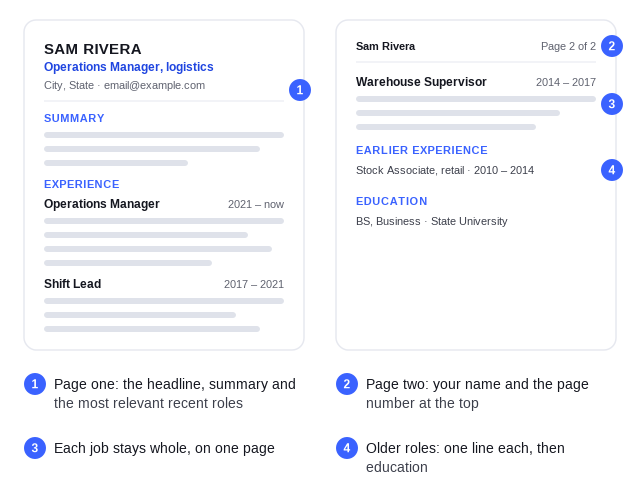
An illustration, labelled. The name and jobs are made up. Repeat your name, and number the pages
Purdue’s writing lab also says to number the pages, with a header or footer after the first. A line such as “Sam Rivera · Page 2 of 2” is enough. If they get separated, the second one still says whose it is.
Keep each job in one piece
Don’t split one job’s details across the break, Purdue’s writing lab adds. Move the whole role down, or trim it so it fits above the break.
How to make a resume 2 pages, without padding
If your work fills a page and a bit, don’t stretch it with spacing or old filler. Add what this job would ask about: results you cut from recent roles, and projects, training or awards the posting names. That’s our advice. If there isn’t enough of that, one page is your length.

How to cut a resume to one page, or two pages down to one.
Work in this order. The cuts at the top lose the least.
Cut what repeats
If two jobs say the same thing, keep the stronger line. If a skill is in your skills list and already proven in a bullet, keep the bullet.
Shrink old roles to one line
A job this posting wouldn’t ask about can keep its title, employer and dates, without bullets. There’s more on how far back to go below.
Use fewer, shorter bullets
Indeed suggests 3 to 7 bullets for each role. Cut the bullets this posting wouldn’t care about first, then shorten the rest to one idea each.
Trim the lists
A long list of tools, an objective statement and “References available on request” take space a result could use (our advice). Keep the skills this job names, in its spelling.
Pull back the lines that spill over
If only 1 to 3 lines run onto page two, Resume Worded says to cut them. Grand Valley State’s career center draws its line at a third: if page two is less than one-third full, consider condensing to one.
Cut words, not the font size
In Ladders’ study, simple layouts did best, and recruiters were put off by clutter and too little white space. Resume Worded calls small font and margin changes a last resort. For sizes, see the best font for a resume.
Never cut these to make a page count: the posting’s job title and top asks, where they describe you. Your most recent role. The results with numbers you can explain. That’s our advice. If keeping them means two pages, use two.
Federal resumes: a strict two-page limit, since 2025.
This is the one place where a length limit is written down. OPM’s Merit Hiring Plan of May 29, 2025 set a two-page limit for federal resumes. Since September 27, 2025, USAJOBS restricts every resume to two pages: the one in your profile, uploads, its own resume builder and searchable resumes.
If your only resume is longer, you’re ineligible. That’s in OPM’s guidance to agencies. It covers competitive and excepted service jobs under Title 5, posted on USAJOBS or anywhere else. Agencies outside Title 5, and judicial and legislative ones, may allow more; the job announcement says so.
Medical and research roles: a CV can go in as an “other document”, alongside the resume.
OPM’s tips for fitting the limit: put the most relevant and recent experience first, use the announcement’s language, and remove outdated or unrelated experience. Give each job’s dates as month and year, with hours per week.
USAJOBS’ format advice: a PDF up to 5MB, a sans-serif font such as Lato, Calibri or Arial, 0.5 inch margins, 14pt titles and 10pt text.
Some pages that rank for this search still say federal resumes run long, or need your full work history. Since September 2025, that advice is out of date.
How far back should a resume go? About 10 to 15 years, set by the jobs you want.
Guides agree on a range, not a number. Indeed says to go back 15 years. A coach in AARP’s guide suggests showing about the last 10.
Let the postings set it. The same coach adds that a posting rarely asks for more than 10 years of experience. Another suggests showing a few years more than the postings ask. So read the years in the jobs you want, and show a little more than that in full.
When to remove old jobs from your resume: when this job wouldn’t ask about them (our advice). You don’t have to delete them. AARP suggests an early career highlights section for older achievements. A one-line “Earlier experience” entry with titles and employers works the same way.
How many previous jobs to list: there’s no set number. List every job inside your window, in full, and older ones as a line each or not at all. That’s our advice.
Age and dates. The Age Discrimination in Employment Act protects people 40 or older, including in hiring, says the EEOC. Questions that may reveal age aren’t banned outright, but the EEOC says they’re looked at closely and may be used as evidence of intent to discriminate. AARP suggests leaving off graduation years and other dates you don’t need.
Questions about resume length, answered.
Do employers like 1 page resumes? Is it okay to have a 1 page resume?
Yes, when it holds what the job asks for. American University’s career center says undergraduates usually have one page of material. It adds that two pages are appropriate once you have significant relevant experience. So short is never wrong by itself; cutting proof the job wants, just to fit, can be.
Is a 3 page resume long? Is a 4 page resume too long?
For most people, yes. Indeed’s guide puts three pages at 25 or more years of experience, or in academia and medicine. Grand Valley State’s career center says a resume should not be more than 2 pages. We found no guide that suggests going to four for a resume. A long academic or medical CV is a different document.
What is the 7 second rule in resume?
It comes from Ladders’ eye-tracking research. In its 2018 study, recruiters’ first skim of a resume averaged 7.4 seconds, up from 6 seconds in its 2012 study. That’s the first look, not the whole review. The resumes that did best had an overview at the top of page one and clear headings.
What are the 3 C’s of a good resume?
There’s no standard list; we found no official source for one. A close match: American University’s career center says employers decide in thirty seconds or less, so your content must be clear, concise and compelling. For length, concise means every line earns its place, at any length.
What is a red flag on a resume?
On length, it’s padding, not the count. One reply on Reddit’s r/ResumeTips, as Google showed it: “nobody rejects a resume for being two pages. They reject it for being padded or unfocused.” Lines that aren’t about this job are what make a resume look long.
What are the top 5 resume mistakes?
Our five, for length: padding to fill space, cutting proof the job asked for just to fit, and shrinking the font and margins. Then splitting one job across the break, and leaving your name off the second sheet. Each has its fix above.
Is resume length different outside the US?
It can be. Resume Worded says two or three pages are more common in the UK and Australia. In many countries the document is called a CV, so check how long resumes usually run in the country you’re applying in.
Sources, and where to read more.
Checked in November 2026. The advice is ours, and is marked where it’s our reading. Reddit and LinkedIn lines are as Google showed them in its results; we didn’t open the threads. How Blynk counted its postings: we kept postings with at least 200 characters of text, one per company and job title. For length, we searched for a resume or CV near a number of pages or a limit, and read every posting that mentions pages or resumes. None set a length. Some postings’ text was cut short, so that means the text we could read. For years, we took the first number written next to “years … experience”; a range counts by its lower end, such as 5 for “5–7 years”.
- Product manager resume: examples by level
- ATS-friendly resume: what it means
- A free ATS resume template
- The best font for a resume
- How to tailor your resume to a job description
- Resume keywords: how to find the right ones
- Resume templates in Google Docs
- How to write an executive resume
- OPM: agency guidance on the two-page limit (PDF)
- OPM: guidance for applicants (copy hosted by the IRS, PDF)
- Ladders: eye-tracking study, 2018 (PDF)
- ResumeGo: a study of resume length
- Huntr: job search trends, Q3 2026
- Jobscan: page length is not what recruiters say they prefer (September 2026)
- Purdue OWL: using two pages or more
- Grand Valley State University: CVs vs resumes
- American University Career Center: resumes
- University of Illinois, LAS career services: resumes
- Indeed: how long should a resume be?
- Resume Worded: key advice on length
- AARP: age-proof your resume
- EEOC: age discrimination
- EEOC: prohibited employment policies and practices
- Blynk ATS Check
- Blynk Resume Builder
