
How to write resume bullet points. Even when you don’t have the numbers.
If your resume reads like a list of duties, and every example online has a percentage you don’t have, start here. This is how to write resume bullet points that show what you did and what changed, what to write without a number, and the STAR method in one line.

The short answer
- Start each bullet with what you did, then say what changed because of it. Keep it to one or two lines, with one idea per bullet.
- Use a real number when you have one. When you don’t, show the scale, the before and after, or who used your work. Never make one up.
- Write three to six bullets for recent roles and fewer for older ones, the most relevant first. The career guides we read give similar ranges.
On this page
Why your resume bullet points read flat, and what’s really going on.
Three worries people have about their bullets, and what the evidence says about each one.
“Every example has a percentage. I don’t have metrics for half my job.”
No source we found says every bullet needs a number, and Resume Genius says that if you can’t include numbers, describe the action and the outcome. TopResume says a bullet without one is fine if it shows an accomplishment tied to the job. Even Quinncia, a resume checker that flags missing numbers, says “Do not make up numbers or lie on your resume”. And in 668 job postings from Blynk’s searches for mostly senior product roles, about 4 in 10 requirements sections ask for a track record or proven success. Far fewer ask for measurable results.
Check: Does each bullet show what changed, with proof you could explain? A number is one kind of proof, not the only one.
“It sounds like bragging, and half the numbers out there look made up.”
In a 2024 thread on Blind, an anonymous forum for tech workers, the top replies called most “improved X by Y%” numbers nonsense or hard to measure. In another thread, a reviewer said they stopped caring about the numbers. One “1000x faster” claim had turned out to be a single filter in a query, so now they treat numbers as a way to start a conversation. Our reading is that a plain fact you can explain isn’t bragging, and a big number you can’t explain is what reads as one.
Check: Could you explain every bullet in an interview, in a minute? Then it’s a fact, not a boast.
“My job was mostly routine. There’s nothing to say.”
Resume Worded’s test helps here. If a bullet could appear in the job description, it’s a duty, not an achievement. Indeed Flex, which writes for hourly and shift workers, suggests counting what you did even when nobody gave you metrics. Count how often, how complex, the tools you used and the standards you met. Routine work done well, at volume, for people who relied on you, is worth a bullet.
Check: Would this bullet be true of anyone in the job? Then add the part that was yours.
How to write resume bullet points, step by step.
Do this once for each role, starting with your most recent job. It works for any kind of work.
List what you did, in plain words
Before you write a single bullet point, make a rough list for the role, one line per thing you did. Write it the way you’d tell a friend, not the way a resume sounds. Our advice is to look at old performance reviews, emails you were thanked in and the projects on your calendar, since they hold the details you’ve forgotten. Don’t polish anything yet.
Ask what changed because of each one
Next to each line, write what was different because you did it. Think about time, money, quality, people and scale. Let’s Eat Grandma, a resume writing service, lists things to count besides money, such as time saved, people affected, pageviews, test scores and fewer complaints or tickets. If nothing changed, it may still show scale, such as how many, how often or how big.
Lead with a verb that fits what you owned
Start each bullet with a past-tense action verb that says what you really did. Indeed Flex makes the point that the verb should match what the role would own, so a plain verb that’s true beats a grand one that isn’t.
Led, managed, trained for people you were responsible for. Built, set up, launched, wrote for something you made. Cut, reduced, fixed, saved for something you made smaller or better. Grew, won, raised for something you made bigger. Handled, processed, resolved, answered for a volume of work.Add the proof you really have
Use the strongest true proof you’ve got. A real number is best, when you were measured on it or can count it. If you don’t have one, go down the ladder in the picture below. Our advice: an estimate is fine if you can say how you got it, and you mark it with “about”. A number you can’t explain is invented, and an interviewer may ask.
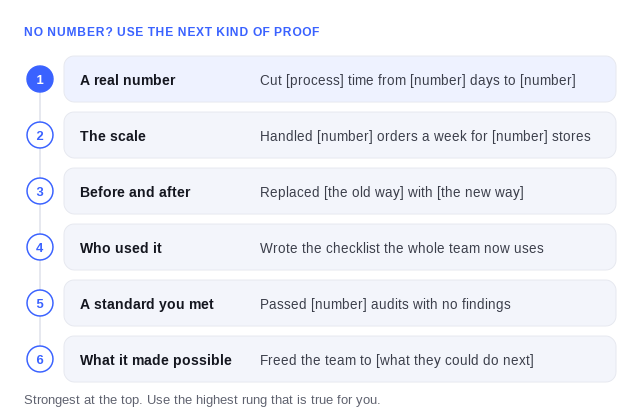
An illustration of our advice. The examples use placeholders, not real results. Shape it into one or two lines
Put it together as verb, what you did, then what changed. TopResume and Resume Genius both say one or two lines, and Resume Genius says one highlight per bullet. Cut “Responsible for”, “I” and “helped to” and any words that don’t add a fact. If a bullet runs to three lines, it usually holds two ideas, so split it.
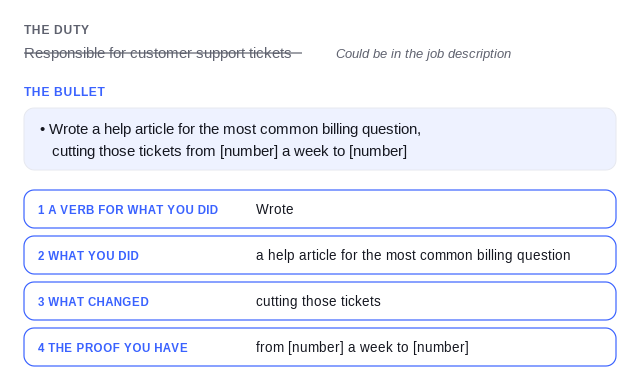
An illustration. The person’s work is made up, and the brackets are for your own figures. Put the bullets in order for the job you want
Put the bullet that matters most to the job you’re applying for first. Indeed and TopResume both say to lead with the most important one. Use the posting’s own words where they’re true of your work. The resume keywords guide shows how to find them, and the tailoring guide shows how to reshape the same bullets for each job without stretching the truth.


Resume bullet points examples, before and after, by kind of work.
Each example starts with the notes from step 1 and only rewords them, so no number or result appears in an after that wasn’t in its before. That’s the rule to follow with your own. The people are made up, and the [square brackets] are for your own facts. The Copy button copies the bullets only. For product roles, the product manager resume guide has its own examples.
Customer support
Answering tickets, calls or chats. The result was in the notes all along.
BEFORE, YOUR NOTES IN PLAIN WORDS
- Answered customer emails and chats, [number] a day
- The same billing question kept coming up, so I wrote a help article for it, and those tickets went from [number] a week to [number]
- Trained the [number] new hires on our ticket system

AFTER, THE BULLETS
- Answered [number] customer emails and chats a day
- Wrote a help article for the most common billing question, cutting those tickets from [number] a week to [number]
- Trained [number] new hires on the ticket system
Operations
Running a process, a site or a shift. Before and after does the work here.
BEFORE, YOUR NOTES IN PLAIN WORDS
- Did the weekly stock count for the warehouse, [number] product lines
- Counts used to take [number] days, then I moved them to scanners and a shared spreadsheet and they took [number]
- I was the one other shifts called when an order went missing, and I tracked it down

AFTER, THE BULLETS
- Ran the weekly stock count across [number] product lines
- Moved stock counts to scanners and a shared spreadsheet, cutting them from [number] days to [number]
- Tracked down missing orders for other shifts as the team’s go-to contact
Sales
Accounts, targets and new business. Use the numbers you were really measured on.
BEFORE, YOUR NOTES IN PLAIN WORDS
- Called and emailed the small businesses in my territory, [number] accounts
- Brought in [number] new accounts last year, [number] percent of my target
- Started doing a check-in call [number] days after a customer signed, and now the whole team does it

AFTER, THE BULLETS
- Managed [number] small business accounts across [territory]
- Won [number] new accounts in [year], [number] percent of target
- Started a check-in call [number] days after signing, now used by the whole sales team
Admin and office
Keeping people and an office running. The scale and who relied on you are the proof.
BEFORE, YOUR NOTES IN PLAIN WORDS
- Booked travel and meetings for [number] managers
- Supply orders were all over the place, so I set up one order form and a monthly order day, and rush orders mostly stopped
- Kept the office calendar for all [number] people

AFTER, THE BULLETS
- Booked travel and meetings for [number] managers
- Set up one supply order form and a monthly order day, ending most rush orders
- Kept the office calendar for [number] people
Retail and hourly work
Shifts, the register and the floor. How often and what you were trusted with count.
BEFORE, YOUR NOTES IN PLAIN WORDS
- Worked the register and the sales floor, weekends and closing shifts
- Handled returns and complaints when the manager was away
- Closed the store and counted the till, and my till always balanced

AFTER, THE BULLETS
- Handled returns and complaints when the manager was away
- Closed the store and counted the till, which always balanced
- Worked the register and sales floor on weekend and closing shifts
Entry level and students
Class projects, campus jobs and volunteering count. Say who used the work.
BEFORE, YOUR NOTES IN PLAIN WORDS
- Group project for my marketing class, we surveyed [number] students about the campus café
- I made the charts for our findings, and the café owner used them to change the menu
- Tutored [number] students a week at the writing center

AFTER, THE BULLETS
- Surveyed [number] students about the campus café with classmates, for a marketing class project
- Made the charts for the team’s findings, which the café owner used to change the menu
- Tutored [number] students a week at the campus writing center
Resume bullet points without numbers, and how to quantify what you did honestly.
Many guides tell you to quantify and stop there. If you were never given metrics, that advice leaves you guessing, and a guess on a resume is a risk. Here’s what to do instead, from the strongest proof to the plainest.
Count what you can check. Old reports, dashboards, invoices, schedules and your sent email often hold real numbers. A number you can point to is the best proof there is.
Show the scale. How many people, orders, accounts, students or sites. How often, such as daily or every shift. How big, such as a budget or a team. Indeed Flex calls this quantifying even when you were never given metrics.
Describe the before and after. “Counts used to take [number] days, and now they take [number]” needs no percentage. It tells a reader what you changed and lets them judge the size.
Say who used it, or what you were trusted with. A template the whole team now uses, or being chosen to train new hires, is proof someone else checked your work.
Our advice on estimates: write “about” and be ready to say how you worked it out. If the real figure is confidential, describe the scale instead of the figure. And if you can’t explain a number, leave it out, since a reviewer who doubts one number may doubt the rest.
Resume accomplishments examples, by the kind of proof you have.
Pick the kind of proof you really have, then fill in the brackets with your own facts. If you can’t fill a bracket truthfully, use a set further down.
A real number
You were measured on it, or you can count it from records you can check.
- Cut [process] time from [number] days to [number] by [what you changed]
- Grew [what you grew] from [number] to [number] in [time]
- Saved [amount] a year by [what you changed], from [where the figure comes from]
The scale
How many, how big or how often. Most jobs have this even when nobody tracked results.
- Handled [number] [calls, orders or tickets] a [day or week]
- Supported [number] [people, stores or customers] across [area]
- Managed a [budget, schedule or inventory] of [size] for [team or site]
Before and after, without figures
Say what it was like, then what it was like after you changed it.
- Replaced [the old way] with [the new way], so [what got easier or faster]
- Fixed [a problem that kept coming back], and it stopped coming up
- Turned [a manual task] into [a checklist, template or tool]
Who used it
Your work was picked up by other people. That is proof someone else checked it.
- Wrote the [guide, template or checklist] that [team] now uses for every [task]
- Built [the tool or process], later used by [number] other [teams or sites]
- Made the [report or analysis] [manager or client] used to decide [what they decided]
A standard you met, or trust you earned
Routine work done reliably, or more responsibility because of it.
- Passed [number] [audits or inspections] with no findings
- Met every [deadline] for [project or client] over [time]
- Chosen to train new hires on [system] after [time] in the role
What it made possible
Nothing to count, but your work let someone else do more.
- Freed the team to [what they could do next] by taking over [task]
- Set up [the process], so [team] could [start or finish something] sooner
- Cleared [the backlog or blocker], so [project] could go ahead
The STAR method on a resume, and Google’s XYZ formula, in one bullet point.
STAR stands for situation, task, action and result. It wasn’t made for resumes. DDI, the firm that introduced the Targeted Selection interviewing system, says it invented the STAR method as part of behavioral interviewing, and its FAQ dates that to 1974. DDI’s own version has three parts, with the situation and task as one. It’s built for spoken answers in an interview.
A bullet point has one or two lines, so most of STAR won’t fit. Resume Worded suggests letting the situation and task stay implicit on a resume, so the action and the result carry the line. Take the story “the new office’s Wi-Fi kept dropping, and I was asked to fix it before an audit. I mapped the dead spots and moved [number] access points, and the dropouts stopped”. On a resume, it becomes “Mapped the office’s Wi-Fi dead spots and moved [number] access points, ending the dropouts before [the audit]”, and the full story waits for the interview.
The XYZ formula is the one Laszlo Bock, then Google’s SVP of People Operations, gave in a 2015 Reddit Q&A. He said to write all your accomplishments in the format “accomplished X by doing Y as measured by Z”, as Nextgov reported it. It works well when you have a true Z. When you don’t, use the proof that you have, as in the section above.
Our reading: STAR, XYZ and the P.A.R. formula some career centers use are the same idea in different orders. Each asks what you did and what changed. Pick one and use it for every bullet, so your resume reads the same way all the way down.
Achievements on a resume, where they go and how to tell them from duties.
Put achievements inside each job’s bullets, under the role where they happened, so a reader sees what you did and where. A duty says what the job was, while an achievement says what you did with it. If a line could be copied from the job description, rewrite it with what changed.
A separate achievements section is rarely needed. Our advice is to use one only for things that belong to no single job, such as an award or a result across several roles. Otherwise it splits your best proof away from the context that makes it believable.
Lead with the achievement the job you want cares about most. The same three bullets can be ordered differently for different jobs. Or let Blynk shape your resume for each job. Blynk reads what each job is looking for and shapes your resume around it, bringing your strongest proof to the top and your most relevant work forward. Everything comes from what you’ve really done.
Resume bullet point mistakes, and what to do instead.
From the sources on this page and the guides that rank for this search.
Do
- Keep one idea per bullet.
- Use past tense for past roles and present tense for your current one, as Resume Genius and Careerflow advise.
- Use the posting’s own words where they’re true of your work.
- Use one plain bullet symbol all the way through, such as a round dot or a hyphen.
- Either end every bullet with a period or none of them.
- Put the most relevant bullet first in each role.
Don't
- Start with “Responsible for”.
- Let a bullet run to three lines or more.
- Add a number you can’t explain in an interview.
- Mix bullet styles or nest sub-bullets several levels deep.
- Repeat your job title or the company name inside the bullet.
- Copy the job description word for word.
Questions about resume bullet points, answered.
Can I use bullet points in my resume?
Yes. Our reading is that for your work experience they’re usually better than paragraphs. In a 2018 eye-tracking study by Ladders, as HR Dive reported it, resumes with simple layouts and bulleted accomplishments did well, and long sentences did poorly. HR Dive’s report gives no sample size. A short paragraph still works for a summary at the top.
Does every resume bullet point need a number?
No. Resume Genius and TopResume both say a bullet without a number is fine if it shows what you did and the outcome. Use a real number when you have one. When you don’t, show the scale, the before and after, or who used your work. Our advice is to estimate only when you can say how you got the figure, and to write “about”.
How many bullet points per job on a resume?
About three to six for recent roles, and one to three for older ones. The guides we read differ a little. TopResume says 3 to 5 a position, and Resume Genius about 3 to 6. Resume Worded says 4 to 6, with up to 7 or 8 for your latest role as “a ceiling, not a target”. Careerflow suggests 4 to 6 for your newest role, 3 to 5 for other recent ones and 1 to 3 for older ones.
How long should a resume bullet point be?
One or two lines. TopResume and Resume Genius both say so, and Resume Genius adds one highlight per bullet. If a bullet runs longer, it usually holds two ideas, so split it.
Should resume bullet points end with periods?
Either way is fine, as long as you’re consistent. Resume Genius calls it a style choice, and Careerflow suggests skipping them. Our advice is to match whatever you do in your summary, and to use the same rule on every bullet.
How do I type a bullet dot?
In Microsoft Word, type an asterisk and a space and Word starts a bulleted list, or select your lines and choose Home, then Bullets. In Google Docs, click the Bulleted list button in the toolbar, or press Ctrl+Shift+8 (Command+Shift+8 on a Mac). On a Mac, Option-8 types a bullet, which Apple’s Pages guide gives as one way to start a list.
How to build a strong resume?
Our advice is to start from the job you want, then show proof you can do it. Use one column and standard section headings, a short summary, and work experience written as bullet points that say what you did and what changed. Then shape it for each job. The resume sections guide covers what goes where, and the ATS-friendly resume guide covers the format.
What are the 7 steps of a resume?
There’s no official seven-step list, and career sites use different ones. Ours would be to pick the job you’re aiming for, add your contact details and write a short summary. Then write your experience as bullet points, list your skills and add your education. Last, check it and shape it for each job.
What are the 5 P’s of a resume?
There’s no standard list. One career site, CV Writing NZ, names presentation, personalization, precision, performance and professionalism, and the resume mistakes guide covers the rest.
What is a red flag on a resume?
A talent acquisition expert quoted by Welcome to the Jungle in 2024 named typos, unexplained gaps, an untailored resume and duties without achievements. The resume mistakes guide has more.
Sources, and where to read more.
Checked in November 2026. The advice is ours where we say so. Blynk’s count comes from 668 job postings from Blynk’s searches for mostly senior product roles (464 companies, first seen October 31 to November 11, 2026), one per company and title, each with a requirements section. We matched “track record” and “proven” or “demonstrated” success in that section and checked samples by eye, so it shows a pattern, not a rule for every job. 290 of the 668 (43%) ask for a track record or proven or demonstrated success. Words about numbers (metrics, KPIs, measurable) appear in 233, but in a sample of 12 only about 2 asked the candidate for measurable results, and most described the job’s own metrics. Counted November 12, 2026. The people and companies in the examples are made up, and the [square brackets] are for your own facts.
- How to write a product manager resume
- How to tailor your resume to a job
- How to find resume keywords
- What an ATS-friendly resume means
- ChatGPT resume prompts that stay true
- DDI: what is the STAR format
- Nextgov: advice from Google’s hiring chief, Laszlo Bock (2015)
- HR Dive: Ladders eye-tracking study (2018)
- Resume Worded: how to write resume bullet points
- Resume Worded: how many bullet points per job
- Resume Worded: the STAR method on a resume
- Resume Genius: resume bullet points
- TopResume: bullet points on a resume
- Careerflow: resume bullet points
- Indeed: bullet points for a resume
- Indeed Flex: how to write effective resume bullet points
- Let’s Eat Grandma: resume bullet points
- Quinncia help: I can’t add a quantification
- Blind: how many “improved X by Y%” do you have in your resume (2024)
- Blind: are numbers and metrics actually important on a resume (2024)
- Microsoft Support: create a bulleted or numbered list in Word
- Google Docs Editors Help: add a numbered or bulleted list
- Google Docs Editors Help: keyboard shortcuts
- Apple Support: format lists in Pages on Mac
- Welcome to the Jungle: recruiter confessions, 6 resume red flags (2024)
- CV Writing NZ: the 5 P’s of a CV
