
Functional resume or chronological? Which resume format to use, and when.
You’ve probably heard “use a functional resume” and “functional resumes are a red flag” in the same week. Both can’t be right for you. Here are the three resume formats, what each shows a reader, and a straight pick for your situation, with templates to copy.

The short answer
- Most people should use a chronological resume: your jobs listed newest first, each with its dates.
- Changing fields, back from a gap, or your best work is older? Use a hybrid, also called a combination resume. A short summary and skills go on top, then the same dated history.
- A functional resume groups your experience by skill and pushes the dates down or leaves them out. Portland State’s career office says many employers find it hard to follow, and Ask a Manager says it can look like you’re hiding something. If you use one, keep the dates.
On this page
Why picking a resume format feels so confusing, and what’s really going on.
Four worries people bring to this question, and what the evidence says about each one.
“Everyone tells me something different.”
They do, and the surveys disagree too. In a 2009 Accountemps survey of 100 senior executives in Canada, 61% preferred a chronological resume and 18% a functional one. In Novorésumé’s 2025 survey of more than 200 HR people, 47.5% said they prefer skills-based resumes and 39.1% reverse-chronological ones. Novorésumé sells resume templates and doesn’t say how it found the people it asked. Neither survey measured who got interviews.
Check: Can a reader see what you did, where, and when? Our advice: any format that passes that test will do.
“A functional resume will hide my gap, or my age.”
Ask a Manager, a long-running workplace advice column, says functional resumes are generally taken as a red flag that something is being covered up. Robert Half, a staffing firm, tells hiring managers the format is “often used to conceal large employment gaps or lack of experience,” and to check the dates. One commenter on Hacker News was told that hiding the dates “just screamed ‘old’.”
Check: Are the dates still on the page? Then there’s nothing for a reader to wonder about.
“The software will throw out the wrong format.”
Not the way people fear. When Greenhouse, a hiring system, can’t read a resume, it says the file “has only been attached” and the details are typed in by hand. But hiring software does read dates. Lever, another hiring system, lets recruiters filter by years of experience “calculated based on parsed dates.” No dates, nothing to count.
Check: Does your resume have clear sections, one column and a date on every job? That’s what an ATS-friendly resume means.
“My best experience is old, unpaid or from another field.”
You can move it up without hiding anything. The career centers at UC San Diego and Portland State both suggest a relevant experience section first, then an additional experience section, each in reverse chronological order.
Check: Is your best evidence in the top half of the page? If not, the hybrid layout below fixes that.
The three resume formats, chronological, combination and functional.
Each format holds the same facts. What changes is what a reader sees first, and where the dates go.
Chronological resume: your jobs, newest first
A chronological resume lists your work starting with your current or most recent job and going back in time. Each job has a title, an employer, dates and a few bullet points. A summary, skills and education sit around it. James Madison University’s career center calls it “the most common resume format and the one most employers prefer,” and the Purdue Online Writing Lab calls it “very conservative.” Purdue says it is “most useful for people who have work experience in positions which are closely related to their desired employment.”
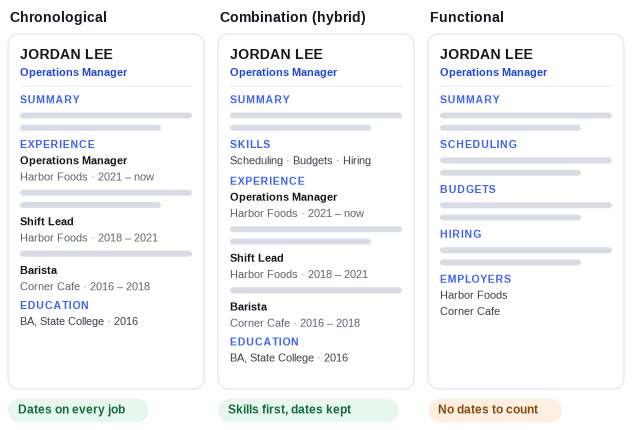
An illustration: the same made-up career in all three formats. The person, jobs and dates are made up. Combination resume, or hybrid resume: skills on top, dates kept
A combination resume opens with a short summary and a skills section, then gives the same dated work history as a chronological one. James Madison University describes it as giving work history and skills equal weight. Portland State calls it a chronological/functional resume, with the most related experience listed first. Jobscan, which sells resume tools, recommends a hybrid over a functional resume. Hybrid and combination are two names for the same thing.
Functional resume: grouped by skill, dates pushed down or left out
A functional resume, also called a skills-based resume, groups what you’ve done under three or four skill headings, such as project management or customer service. Jobs, titles and dates move to a short list at the bottom, or drop off. James Madison University says it suits people changing fields or with limited experience, and “can be more effective than the chronological format” in those cases. The Purdue Online Writing Lab says it “works well for people who have had internships or cooperative experiences.”

Functional vs chronological resume: what each one tells a reader.
A chronological resume answers the reader’s first questions at once: what you do now, where, and for how long. A functional resume answers a different question first, what you can do, and leaves the reader to work out when and where you did it.
Many job postings ask for a number of years. Of the 1,330 job postings with a full description in Blynk’s searches from October 31 to November 12, 2026, 617 (46%) asked for a number of years of experience. Where the number was written in digits, the middle ask was 8 years. These were mostly senior product roles, so treat the 8 as a picture of that market, not of every field.
Someone has to count those years from your dates. A recruiter reading your resume does it by eye. Lever, a hiring system, does it with a filter on years “calculated based on parsed dates.” Our reading: a resume without dates gives both of them nothing to count.
The evidence on employers is thinner than the advice. We found no study of which format gets more interviews. The two surveys above disagree, and one is 17 years old. Portland State’s career center says “Many employers find functional resumes difficult to follow” and recommends “a chronological or chronological/functional resume.”
Our advice: start with a chronological resume. If your best evidence would sit too far down the page, switch to a hybrid. Use a functional resume only when you have little paid work to show, and keep a dated list of what you did have.
Which resume format to use, for seven common situations.
Find the line that sounds most like you. Where a sentence is our advice and not a source’s, it says so.
A steady history in one field: chronological
Your recent jobs already match the job you want, so lead with them. The Purdue Online Writing Lab says this format is “most suited to people who have not had long periods of unemployment time between jobs.”
Changing careers: a hybrid
Our advice: put a two-line summary that names the new role, and the skills it asks for, on top. Then keep your real titles and dates, with the bullets that fit the new field first. The career change resume guide walks through it with examples.
A gap in your work history: chronological or hybrid, dates kept
Our advice: keep the dates and give the gap one honest line, such as caregiving, study or a layoff, instead of hiding it with a format. The gap is visible either way, and a missing timeline raises more questions than a short note. How to explain an employment gap covers the wording.
A first job or still a student: a hybrid, education first
Our advice: put education, projects and internships on top, then any jobs with dates. The Purdue Online Writing Lab says a functional layout “works well for people who have had internships or cooperative experiences,” so a skills-led page is also fine here. Keep the dates on whatever you list.
A long career: chronological, older jobs shortened
Our advice: give your last several roles full bullets, and shrink older ones to a title, an employer and dates, or a single line. You show depth without making the reader dig. A functional layout tends to read as hiding the years, the very thing you were trying to avoid.
Freelance or contract work: chronological, one dated entry
Our advice: list your freelance work like a job, your business name or “Freelance,” the dates, and your biggest clients and results as bullets. Robert Half notes that some career experts recommend a functional resume for “workers with extensive freelance or contract experience,” but in our view a dated entry can show the same strengths. The freelance work guide shows how.
Many short jobs: chronological, grouped
Our advice: if several short roles came through one staffing agency, or were all contracts, group them under one heading with one date range and list the clients below. The reader sees one steady thread instead of six short stints.
Resume format templates, three skeletons to copy.
Section order only, with [square brackets] to fill in. Paste one into a plain document and keep it to one column. The functional skeleton keeps the dates on purpose.
Chronological resume
For a steady history in the field you’re applying to.
[YOUR NAME]
[City, State] | [email] | [phone] | [LinkedIn URL]

SUMMARY
[Two lines. Your role, your years in it, and one result.]

EXPERIENCE
[Job title], [Company], [City]   [Month Year] to Present
- [What you did, and what changed because of it]
- [What you did, and what changed because of it]

[Job title], [Company], [City]   [Month Year] to [Month Year]
- [What you did, and what changed because of it]

SKILLS
[Skill], [Skill], [Skill], [Tool], [Tool]

EDUCATION
[Degree], [School]   [Year]
Combination resume (hybrid)
For a career change, a return after a gap, or when your best work is older.
[YOUR NAME]
[City, State] | [email] | [phone] | [LinkedIn URL]

SUMMARY
[Two lines naming the role you want and the real work that fits it.]

SKILLS
[Skill the job asks for], [Skill], [Skill], [Tool], [Certification]

RELEVANT EXPERIENCE
[Job title], [Company]   [Month Year] to [Month Year]
- [The work that fits the new role, first]
- [A result you can explain in an interview]

ADDITIONAL EXPERIENCE
[Job title], [Company]   [Month Year] to [Month Year]
- [One line on the job]

EDUCATION AND TRAINING
[Degree or course], [School or provider]   [Year]
Functional resume, with dates kept
For little paid work to show, such as students or people returning to work.
[YOUR NAME]
[City, State] | [email] | [phone] | [LinkedIn URL]

SUMMARY
[Two lines naming the role you want and why you fit it.]

[SKILL AREA ONE, such as CUSTOMER SERVICE]
- [What you did, where, and the result]
- [What you did, where, and the result]

[SKILL AREA TWO, such as ORGANIZING EVENTS]
- [What you did, where, and the result]

WORK AND VOLUNTEER HISTORY
[Role], [Organization]   [Month Year] to [Month Year]
[Role], [Organization]   [Month Year] to [Month Year]

EDUCATION
[Degree or program], [School]   [Year]
Reverse chronological resume, and when yours can be out of order.
A reverse chronological resume is the same thing as a chronological one. “Reverse” just means newest first, the same order Purdue gives for a chronological resume. Portland State’s career center puts it plainly: list jobs “in reverse chronological order starting with your most recent job.”
You can change the order of sections, not the order inside them. If an older job fits the new role better than your current one, split your experience. UC San Diego’s career center suggests a relevant experience section and an additional experience section, and says “Your experiences should be in reverse chronological order within each section.”
Our advice: don’t shuffle jobs inside one section to put the best one first. A reader who sees 2019 above 2023 has to stop and work out why. The two-section layout gets the same job to the top, and the dates still make sense.
Resume format mistakes, and what to do instead.
The common ones, from the career centers and hiring systems on this page.
Do
- Put a month and year on every job, even on a functional resume.
- Keep your real job titles.
- Use one column and plain section headings, like Experience and Skills.
- List jobs newest first within each section.
- Back every skill you list with something you did.
- Pick the format for the reader of this job, not for your own comfort.
Don't
- Use a format to hide a gap, your age or a short job.
- Drop the employer names from a skills-based resume.
- Shuffle jobs out of date order inside one section.
- Put your contact details in a header or text box, or your dates in a second column.
- List skills with nothing under them to prove them.
Questions about functional and chronological resumes, answered.
What do you mean by functional resume?
A functional resume, or skills-based resume, groups your experience under skill headings instead of listing your jobs by date. Jobs, titles and dates move to a short list at the bottom, or leave the page. James Madison University’s career center says it suits people changing fields or with limited experience.
Are functional resumes a red flag?
To many readers, yes. Portland State’s career center says “Many employers find functional resumes difficult to follow,” and Ask a Manager says hiring managers generally take them as a red flag that something is being covered up. It isn’t automatic: a functional resume that keeps every date and employer reads far better than one without them.
Do employers like functional resumes?
Most of the advice says no, and the surveys are mixed. In a 2009 Accountemps survey of 100 Canadian executives, 61% preferred chronological and 18% functional. In Novorésumé’s 2025 survey of more than 200 HR people, 47.5% preferred skills-based resumes. Novorésumé sells templates and doesn’t say how it found the people it asked. We found no study of which format gets more interviews.
Which type of resume is most effective?
For most people, a chronological resume, because it answers what you did, where and when at a glance. If your best evidence is older or from another field, a hybrid does better. That’s our advice; we found no study of which format gets more interviews. The section on picking by situation above covers seven cases.
What does chronological CV mean?
A chronological CV or resume lists your work in time order, starting with your current or most recent job and going back. Each entry has a title, an employer and dates.
Can my resume be out of chronological order?
The sections can be, but not the jobs inside them. To put an older, more relevant job first, use a relevant experience section and then an additional experience section. UC San Diego’s career center says to keep each one “in reverse chronological order within each section.”
What are the 7 parts of a resume?
There’s no fixed list. The usual parts are contact details, a summary, experience, skills and education, plus extras such as certifications, projects or volunteering. Every format uses the same parts and only changes their order. The resume sections guide covers what goes in each one.
What are resume keywords?
They’re the words for skills, tools and duties that a job posting uses, and that a recruiter may search for in a hiring system. Any format can hold them; a chronological resume ties each one to a dated job. The resume keywords guide shows how to find the right ones.
What is a red flag on a resume, and what should you not include?
Anything that makes a reader stop and wonder, such as a gap with no explanation or a job with no dates. Hiring manager surveys also name job-hopping and vague descriptions, and for a US job a photo or your birthday is best left off. The resume mistakes guide has those surveys and the full list.
Can ChatGPT build a resume, and can employers tell?
It can draft one in any of these formats, but it can also make up results you never had. Give it your real facts and check every line. These ChatGPT resume prompts are written to stop it inventing things, and can employers tell if you used AI covers the second question.
Sources, and where to read more.
Checked in November 2026. The advice is ours, and is marked where it’s our reading. The posting count is Blynk’s own: 1,330 job postings with a full description, from Blynk’s searches (mostly senior product roles), first seen October 31 to November 12, 2026. We counted postings that put a number of years within a few words of “experience” and read 55 matches by eye; all were real requirements. Other wordings were missed, so 617 is a floor. The middle ask uses the first number of a range. The people and jobs in the illustration and templates are made up.
- How to list skills, certifications and education on a resume
- Career change resume: how to write one
- How to explain an employment gap
- ATS-friendly resume: what it means
- Free ATS resume template
- How long should a resume be?
- How to list freelance work on a resume
- Resume mistakes that cost interviews
- Purdue OWL: chronological resume sample
- Purdue OWL: functional resume sample
- James Madison University career center: choosing a format
- Portland State University careers: writing a resume
- UC San Diego career center: resume guide
- Ask a Manager: resume tricks that will backfire on you (functional resumes)
- Robert Half: resume red flags to watch for
- Jobscan: functional resume template, should you ever use one?
- Lever help: advanced search and rediscovery (years from parsed dates)
- Greenhouse help: unsuccessful resume parse
- Accountemps survey of Canadian executives, 2009 (newswire.ca)
- Novorésumé: 2025 HR survey
- Hacker News comment on hiding dates (Nov 2022)
- Blynk Resume Builder
- Blynk pricing
