
How to list skills on a resume, plus certifications, education and references.
If you've read five resume templates that disagree on where your skills, certifications and education go, here is one clear answer for each. Below is how to write every section, with examples, and how often real job postings require a degree or a certification.

The short answer
- Skills. List the hard skills and tools the job asks for that you really have, in the posting's words, grouped if there are many. Then prove the important ones in your bullets.
- Certifications and education. Give each its own plain heading. Write a certification as name, issuer and year. Write education as degree, school and year, and put it first only early in your career or when the job requires it.
- References. Leave them off the resume. Keep 3 to 5 on a separate page for when you're asked.
On this page
What job postings really ask for, in skills, certifications, education and references.
Every resume guide says to include what the job asks for. We checked how often a job really insists. Blynk read 190 job postings from its searches line by line (mostly product roles from 169 employers, first seen October 31 to November 11, 2026). Then we sorted every degree and certification line by its own words.
A degree is often preferred, not required
77 of the 190 postings mentioned a college degree. About half of those (39) accepted equivalent experience or another route, or called the degree preferred. Only 2 of the 51 that mentioned a master's or MBA required one outright. NACE, the US association of colleges and employers, found that about half of employers have roles where experience can stand in for a degree. So apply when you meet most of the rest, and list your education honestly.
No posting required a certification without another way in
12 of the 190 mentioned a certification, such as a PMP, CFA or CSPO. 11 called it a plus, and the other asked for a CFA or equivalent experience. These were mostly product roles, and jobs that need a license by law, such as nursing, are a different case. So list the ones you hold that the job names, and don't collect more just for the resume.
No posting asked for references up front
We also searched 1,204 job postings from Blynk's searches over the same dates, mostly for product roles. None asked for references in the job description. The 9 that mentioned references meant a check later on, after interviews or an offer. So leave them off the resume, and have 3 to 5 people ready on a separate page.
A posting asks for about a dozen things
The median posting in our sample had 11 requirement lines. A list of 30 skills hides the few that match, and a reader skims it in seconds. So keep the skills this job asks for, and prove the important ones in your bullets.
Which resume sections you need, and where each one goes.
In Ladders' 2018 eye-tracking study, a recruiter's first skim of a resume averaged 7.4 seconds (the “7 second rule”), and resumes with clear headings did best. Greenhouse, a hiring system, lists “no clear sections” among the causes of a failed resume parse. So use plain headings. For the full layout, see the free ATS resume template.
Every resume
- Contact details, in the body of the page, not the header.
- Experience, newest first, with results in the bullets.
- Skills, a short list in the posting's words, usually after Experience.
- Education, one line per degree. First early in your career, last after that.
When they help
- A summary of two or three lines at the top, when it helps a quick skim.
- Certifications, when you hold one the job names or one that proves a skill it asks for.
- Projects, volunteer work or languages, under plain headings, when they show what the job needs.
- References, never on the resume itself. Keep them on a separate page.
How to list skills on a resume, in six steps.
What should you write in the skills section of your resume? The skills this job asks for, that you can prove. Here is how to pick them and lay them out.
Pull the skills from 3 to 5 postings you want
Open three to five job postings for the role you're going for. Note the skills, tools and qualifications they repeat. Those are the words recruiters search for, so they're the ones to use. How to find resume keywords shows how to count them.
Keep only the skills you can back up
Cross off anything you couldn't talk about for two minutes in an interview, or point to in a bullet. A skills list is a claim. A recruiter who reads “forecasting” will look for where you did it.
Put hard skills in the list, and show soft skills in bullets
Hard skills are things you can test or show, such as a tool, a method, a language or a trade. Those go in the Skills section. Soft skills, such as communication or leadership, prove little in a list, so show them in a bullet. Resume Worded and The Interview Guys give the same advice.
20 hard skills, by kind. Tools · Excel, Salesforce, Figma, Jira, QuickBooks, Google Analytics.
Methods · forecasting, A/B testing, budgeting, bookkeeping, user research.
Technical · SQL, Python, Tableau, AWS.
Languages · Spanish (fluent), French (working knowledge).
Hands-on · forklift operation, welding, phlebotomy.
A soft skill, shown in a bullet. “Led a weekly review with sales and support that cut repeat tickets by a third.”Group them when the list gets long
Past about 10, a flat list is hard to skim (our advice). Group the skills by kind, such as Tools, Methods and Languages, one line each. Resume Worded suggests 8 to 12 skills and shows them grouped. We found no study behind any exact number, so treat it as a range, not a rule.
Before. Excel, teamwork, Salesforce, hard-working, forecasting, SQL, Microsoft Word, budgeting, Tableau, communication, pricing
After. Analysis | forecasting, pricing, budgeting
Tools | SQL, Excel, Tableau, Salesforce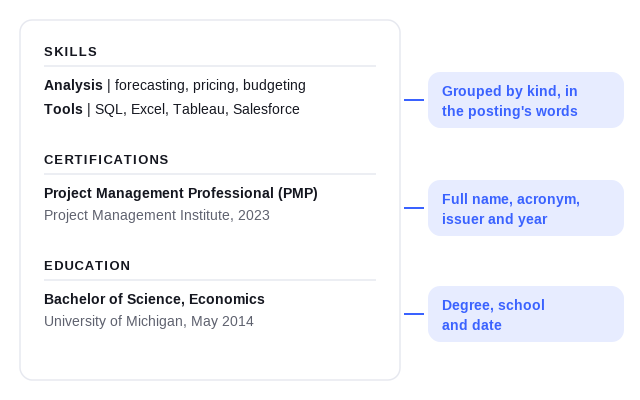
An illustration of the Skills, Certifications and Education sections. The details are made up. Write the full name and the acronym once
Greenhouse's candidate search matches the words a recruiter types, and its help page describes no link between an acronym and its full form. MIT's career office says not to abbreviate keywords. So write “Search Engine Optimization (SEO)” once, and the short form after that.
Put this job's skills first, and type them into the form too
Order each line by what this posting asks for most. Then look at the application form. Workday says its skills and languages fields aren't filled in from your resume, so type them in where the form has them. Blynk's ATS Check lists the skills the posting asks for, with the ones you have and the ones you're missing.

Skills section examples, three ways to lay it out.
Copy the layout, not the words, and swap in the skills your target postings ask for that you really have. Each one is plain text in one column, with a bar between the group and its skills. The details are made up.
Grouped by kind
For an office or operations role with a mix of tools and methods.
SKILLS
Operations | scheduling, vendor management, budgeting, inventory control
Tools | Excel (pivot tables, XLOOKUP), QuickBooks, Salesforce
Languages | Spanish (fluent)
Technical, by stack
For a technical role where the tools are the job.
TECHNICAL SKILLS
Languages | Python, SQL, JavaScript
Data | PostgreSQL, Tableau, dbt
Cloud | Amazon Web Services (AWS), Docker
Short, two lines
For a role like product management, where the bullets carry the proof and the list stays short.
SKILLS
Product | user research, A/B testing, pricing, roadmaps
Tools | SQL, Amplitude, Figma, Jira
How to put certifications on a resume, and where they go.
A certification line answers one question for the recruiter. Do you hold the one this job named? Make that easy to see.
Give them their own section, with a plain heading
Use “Certifications”, or “Licenses and Certifications” if you hold both. Put the section after Experience, or above it when the job requires the credential (our advice). If you have just one that fits the job, it can sit at the end of your Skills section instead.
Describe each certification the same way
Write the full name with the acronym, the issuing body and the year you earned it. Add the expiry date if it has one, and a credential ID if the issuer gives you one. Spell the name the way the posting does. Jobscan says half of the recruiters in its own survey (50.6%) filter candidates by certifications and licenses.
Examples of certifications, written out (the years are made up)
Project Management Professional (PMP), Project Management Institute, 2023
Certified Scrum Product Owner (CSPO), Scrum Alliance, 2024
Chartered Financial Analyst (CFA), CFA Institute, 2022
Certified Public Accountant (CPA), Texas State Board of Public Accountancy, 2021Put a required one next to your name too
If the posting requires a credential, such as a CPA, show it at the top as well. “Jordan Lee, CPA” is common practice. We couldn't find PMI's own rule on this, so treat it as a habit, not a rule.
Mark a certification in progress, with a date
List it with the month you expect to finish, such as “Certified Scrum Product Owner (CSPO), Scrum Alliance, expected March 2027”. Without “expected”, it reads as earned, and that's a claim that falls apart in an interview.
Leave off expired, unrelated or very old ones
List an expired credential only if the job values it, with the years you held it (our advice). Leave off courses that have nothing to do with the job. For product roles, the product manager resume guide covers MBAs and credentials like the CSPO.
How to list education on a resume, for every case.
Lever, a hiring system, turns your resume into fields that recruiters filter on, and education is one of them. So keep each degree to one clean line, newest first.
A finished degree, on one line
Write the degree, your major, the school and the month and year you graduated (our advice). The University of Toledo's career center puts the degree, major and date together, as in “Master of Science, Biology, May 2023”, with the school on the line below. Toledo says to include your GPA “if it is a 3.0 or above”, as “a general rule of thumb”.
Bachelor of Science, Economics, University of Michigan, May 2014A degree in progress, with the expected date
Write the degree as you will hold it, then the month and year you expect to finish. Toledo's career center asks for the same, the full name of the degree, your major and your expected date of graduation.
Bachelor of Arts, Psychology, Ohio State University, Expected May 2027A degree you didn't finish, written honestly
List the school, what you studied and the years you were there, plus credits if they help. Never write the degree name alone, because it reads as finished. An honest line still shows the study.
Business Administration coursework, 60 credits, Austin Community College, 2019 to 2021No degree? Lead with your experience
Put Experience first and Education last, or leave Education off if there's nothing to list. In our sample, about half of the degree mentions accepted equivalent experience or called the degree preferred, so the line isn't always a wall. List certifications and training that cover what the job asks for.
Education first early on, or when the job requires it
Early in your career, put Education first. After that, it goes below Experience. Move it up when the job requires a specific degree you hold, such as a nursing or engineering degree, so it's seen at once.
Keep the graduation year early on, and drop it later if you like
AARP suggests removing graduation years and other dates you don't need. Federal law protects job seekers 40 and older from age discrimination in hiring, the EEOC says. Dropping the year later in your career keeps the focus on your recent work (our advice).
Do you put references on a resume? Usually not. Here are the five rules.
Should references be listed on a resume? Not unless the posting asks. The University of Minnesota's education college career office puts it plainly, “do not list your references on your resume”. None of the 1,204 job postings we checked asked for them up front.
Leave them off, and drop “available upon request”
The University of Cincinnati's career blog says the line “used to be a common practice” and that “it's no longer necessary”. UMN says to leave it out too. The space is better used for your work.
Keep 3 to 5 on a separate page
Use the same header as your resume. For each person, give their name, job title, company, phone, email and how you know them. UC and UMN both suggest 3 to 5 people.
Pick people who saw your work
A former manager is best, then a senior colleague, a client or a teacher who knows your work. Who should you not put as a reference? Family, anyone you haven't asked, and anyone who might be lukewarm about you (our advice).
Know when a character reference fits
A character reference is someone who knows you personally rather than as a worker, such as a coach or a volunteer leader. Use one only when the employer asks for it, or when you're starting out and have no work references yet (our advice).
Ask first, and tell them about the job
UC's career blog says to ask before you list anyone. Send each person the posting and a line on what you'd like them to mention. Jobscan says references usually come up late, such as after a final interview or near an offer. In our count, the 9 postings that mentioned references meant a check at that stage.
Mistakes in the skills, certifications and education sections, and what to do instead.
The common mistakes in these sections, side by side with their fixes. Most of them are about one thing. Every line should hold up when someone checks it.
Do
- Skills in words, with a level where it helps, such as “Spanish (fluent)”.
- Only the skills you can point to in a bullet.
- The full name and the acronym, once.
- “Expected March 2027” on anything unfinished.
- The years you studied, for a degree you didn't finish.
- References on their own page, ready when asked.
Don't
- Skill bars, stars or charts. Greenhouse lists graphics among the causes of a failed resume parse, and a bar has no words to read. More in the ATS-friendly resume guide.
- A list of 30 skills, or basic tools nobody asked about, such as Microsoft Word.
- An acronym on its own.
- A certification you're still studying for, written as earned.
- A degree name alone when you didn't finish it.
- “References available upon request.”
Questions about skills, certifications and education on a resume.
What are 5 good skills to put on a resume?
The five the job posting asks for that you really have and can point to in a bullet. For basic skills, five that nearly every job uses are reading, writing, numbers, computer skills and communication (our advice). Canada's Skills for Success, in the next answer, covers all five. On the resume, name the specific thing, such as “Excel” instead of “computer skills”.
What are 9 essential skills?
The best-known list of nine is the Government of Canada's Skills for Success (our reading). Adaptability, collaboration, communication, creativity and innovation, digital, numeracy, problem solving, reading and writing. They're general skills, so on a resume show the few a job names, with proof in your bullets.
Is a 3.7 GPA good to put on a resume?
Yes, early in your career. The University of Toledo's career center says to include your GPA “if it is a 3.0 or above”, as “a general rule of thumb”. Fewer employers screen by it now, though. In NACE's Job Outlook 2026 survey, 42% of employers screened candidates by GPA, down from 73% in 2019. After your first job or two, it can go (our advice).
Can I put my friends as references?
Not as work references. Those should be people who saw your work, such as a manager or a colleague. A friend can be a character reference if the employer asks for one, as long as they aren't family (our advice).
What is a red flag on a resume?
Anything that doesn't hold up when someone checks it, such as an unfinished degree written as finished, or a skill you can't talk about. The common mistakes in these sections are in the list above. You may also see “the 5 P's of a resume”. Different sites give different lists, so there's no single version to follow.
How many skills should I put on my resume?
About 8 to 12 is a sensible range, and it's what Resume Worded suggests. We found no study behind any exact number. The posting is a useful check. The median posting in our sample had 11 requirement lines, so a list far longer than that is probably padded (our reading).
Should soft skills go in the skills section?
Mostly not. Resume Worded and The Interview Guys keep the list to hard skills and show soft skills in bullets, such as a result you got by leading or persuading people. If a posting names a soft skill, one or two in the list is fine (our advice).
Where do online certificates (Coursera, Google) go?
Under “Certificates” or “Courses”, with the provider and the year, such as “Google Data Analytics Professional Certificate, Coursera, 2025”. List the ones that cover a skill the job asks for. A course certificate shows you finished a course. A certification usually comes from a professional body after an exam, so keep the two under separate labels (our advice).
What do I put for education if I'm still in high school?
Your school, its city and the month and year you expect to graduate, plus a GPA of 3.0 or higher, honors or classes that fit the job. Once you have a college degree or a few years of work, high school can come off (our advice).
What does “or equivalent experience” mean?
That the employer will count work experience in place of the degree. NACE's 2025 survey found that about half of employers have roles like this, and the most common swap is one year of experience for each year of school. So make those years easy to see in your Experience section.
Where the facts come from.
Checked in November 2026. The advice is ours unless a source is named. Facts about hiring systems come from their own help pages. Blynk's counts are its own. The first is 190 job postings from Blynk's searches, mostly product roles from 169 employers, first seen October 31 to November 11, 2026. Blynk split each posting into requirement lines, and we read every degree, master's and certification line by eye and sorted it by its own words (required, or equivalent, preferred, a plus). The second is 1,204 job postings from Blynk's searches over the same dates, mostly product roles, searched for references, with every match read by eye. A posting can still ask for references in its application form, which this count can't see. Neither sample covers fields where a license is the law, such as nursing.
- How to find resume keywords
- Free ATS resume template
- How to make an ATS-friendly resume
- Tailor your resume to a job
- Product manager resume
- Resume templates in Google Docs
- Freelance and contract work on a resume
- Functional vs chronological resume
- How to ask someone to be a reference
- Greenhouse, unsuccessful resume parse
- Greenhouse, search candidates using Boolean queries
- Lever, using advanced search and rediscovery
- Workday, resume parsing for prospects and candidates
- MIT Career Advising and Professional Development, make your resume ATS friendly
- NACE, employer use of skills-based hiring practices grows (Job Outlook 2026)
- NACE, half of employers have roles that offer a degree equivalency (2025)
- University of Toledo Career Services, resumes
- University of Minnesota CEHD Career Services, work references
- University of Cincinnati, should you put references on your resume (2025)
- Jobscan, how to list certifications on a resume
- Jobscan, references on a resume
- AARP, how to age-proof your resume
- EEOC, age discrimination
- Ladders, eye-tracking study (2018, archived)
- Resume Worded, skills section advice
- The Interview Guys, how to list skills on a resume
- Government of Canada, Skills for Success
