
Career change resume. Show what carries over, without stretching the truth.
If your resume still reads like your old job, it’s easy to feel your experience doesn’t count. Most of it does. It’s just in the wrong order, and in your old field’s words. Here’s how to write a career change resume that fixes both, with examples by switch and a count of how strict 1,204 job postings really were.

The short answer
- Keep your real job titles and dates. A career change resume re-orders your past; it doesn’t hide it. A chronological or hybrid layout does that.
- Open with two lines that name the new role and the real work that fits it. In each job, put the bullets that match the new field first, in its words.
- Read 10 to 20 postings for the new role first. Add a short skills line and any real training they ask for, then fit the resume to each job.
On this page
Why a career change resume gets passed over, and what’s really going on.
Five worries career changers name, and what the evidence says about each one.
“My experience doesn’t count.”
It counts more than you think. A 2019 review of 81 samples found that the amount of work experience people had before a job barely predicted how well they did in it. The corrected correlation was .06. That doesn’t make experience useless. It means potential employers can say yes to someone new to the field, if they can see the work that fits.
Check: Can a reader see your matching work in the new field’s words? That’s what carries over.
“The software will screen me out for the wrong titles.”
Greenhouse, an applicant tracking system, says its Talent Matching “does not automatically advance or reject candidates.” Its automatic rejections run on answers to the employer’s own questions. Recruiters search and filter, so the posting’s words help you come up. The ATS-friendly resume guide covers the format.
Check: Does your resume use the posting’s words for work you’ve really done? And did you answer every screening question?
“I’ll use a skills-only resume so the switch doesn’t show.”
Alison Green, a hiring manager who writes the Ask a Manager column, says employers know that format is generally used to disguise limited or outdated experience. So it’s “generally taken as a red flag.” It also hides your career path and how recent your work is.
Check: Can a reader see where and when you did each thing? Dates make a switch easy to follow.
“They can’t tell what I actually did.”
A recruiter on the Teacher Career Coach podcast says teachers often think they lack skills because they call them something else. They keep classroom words that people outside schools can’t follow. In our reading, the same happens in other fields too. The work fits, but the words don’t.
Check: Have you swapped your old field’s words for the new one’s, and spelled out every acronym? Only for work you really did.
“I don’t meet every requirement, so why apply?”
Many requirements are softer than they look. In the job postings Blynk counted, about half marked some requirements as only preferred, and some said outright to apply anyway. The numbers are further down this page.
Check: Which lines are must-haves, and which are only preferred? A missing nice-to-have isn’t a reason to skip.
Functional, chronological or hybrid: which career change resume format works?
A functional resume puts your relevant skills at the top and plays down your background: where and when you used them. A chronological resume lists your jobs, newest first. A hybrid, or combination, resume does both: a summary and skills on top, then your dated work history.
We found no study of which format gets career changers more interviews. What exists is opinion and one survey, and they disagree.
Against a functional resume: Ask a Manager says hiring managers generally take it as a red flag. Huntr, a job search tool, says screeners often distrust it. Rezi and Jobscan, which both sell resume tools, recommend a hybrid or a modified reverse-chronological resume instead.
For it: Coursera and Excelsior University’s writing lab suggest a functional resume for a switch. In Novorésumé’s 2025 survey of more than 200 HR people, 47.5% said they prefer skills-based resumes and 39.1% reverse-chronological ones. Novorésumé sells resume templates and doesn’t say how it found the people it asked.
Our advice: use a hybrid. Put a two-line summary and a short skills line on top, then your real jobs with dates, each led by the work that fits the new field. You get your skills up front without hiding anything.
How to write a resume for a career change, in seven steps.
In order, from research to the version you send. Steps 1 and 2 take the longest, and they decide everything after them.
Read 10 to 20 postings for the new role
Pick postings for the exact target role, not the new industry in general. Note each skill, qualification, tool and duty, and count how many postings ask for it. Mark which lines say required and which say preferred. The few things most postings ask for are what your resume has to show. The resume keywords guide has a tally sheet for this.
Find your transferable skills, with proof
Transferable skills are skills you used in one kind of job that another kind needs too: communication, leadership, planning, customer service, problem-solving, working with data. For each thing the postings repeat, find something you really did, and what changed because of it. Nielsen Norman Group, a research firm, warns that a bare list of skills reads as keyword stuffing. So tie each skill to a result.
Translate, don’t inflate: a teacher’s IEP becomes “compliance and data tracking”, and a caseload becomes “a client portfolio” (examples from the Teacher Career Coach recruiter). The same recruiter says not to claim software you haven’t used.Write a two-line career change resume summary
At the top, under a headline with the role you’re applying for, say the move you’re making and your most relevant experience. Then give one result. Huntr looked at 22 resumes from career changers who reached the interview stage, and 21 of them opened with a summary. Those are Huntr’s own users, not a study. Skip labels like “passionate” or “results-driven”; the examples below show what to say instead.
Example (made up): “Teacher moving into instructional design. For eight years I’ve planned courses, written the materials and measured what students learned, for groups of up to 30.”Put the matching work first in each role
Inside each job in your experience section, move the bullets that match the target role to the top, and reword them in its words. Turn duties and responsibilities into accomplishments: what you did and what changed. Cut the bullets the new field won’t care about, or fold them into one line. Previous jobs that don’t relate can shrink to a title, a company and dates.
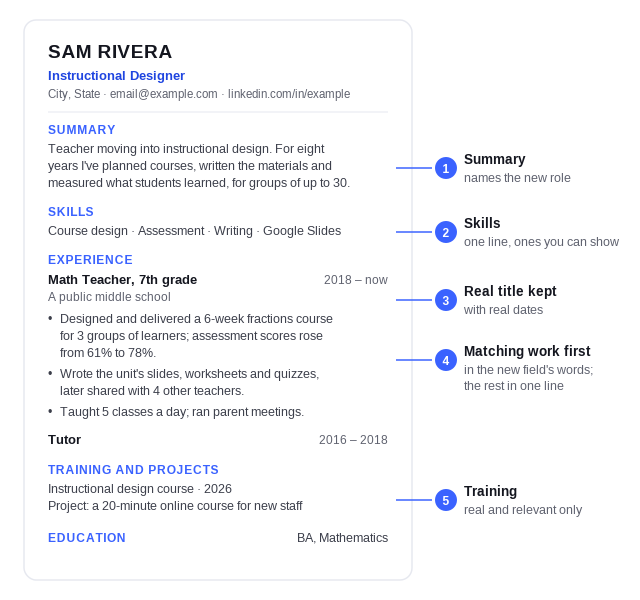
An illustration of a career change resume. The person, school and numbers are made up. Keep your real job titles, and explain an odd one
Don’t rename a job to sound like the new field. If your real title doesn’t say what you did, Ask a Manager suggests adding the plain version in brackets, such as “Intelligence Engineer (Accounting Consultant)”. Employers then know what the job was, and a call to check it still matches. The bullets do the rest.
Add a skills section, training and projects
Give the skills section one or two lines, in the postings’ spelling, with technical skills and tools you can show. Add certifications, online courses, workshops, bootcamps, volunteer work, freelance work and projects, if they’re real and relevant. In Huntr’s 22 career-changer resumes, 14 listed a certificate, bootcamp or training. List the few that match the postings, not every course you’ve started.
Fit it to each job
Before each application, check the summary, the top bullet in each role and the skills line against that job posting. Swap in its words where they describe your real work. How to tailor your resume to a job description has the full steps.

What job postings really require, and what’s only preferred.
When you’re changing careers, a list of requirements can read like a wall. So we counted what postings say. Blynk looked at 1,204 job postings with a full description, from its own searches for product roles, mostly senior, first seen October 31 to November 11, 2026.
Degrees are often flexible. 315 postings mention a bachelor’s degree, about 1 in 4. About half of those (151) also accept equivalent experience or call the degree preferred. That’s a floor, since we only counted that wording in the same sentence.
Many lines are only preferred. About half the postings (588) marked some requirements as preferred or nice to have.
Some say apply anyway. 41 of the 1,204 tell people outright to apply even if they don’t meet every requirement. Some jobs were posted twice, so that’s 36 distinct jobs at 33 companies, or about 1 in 30 postings. Keenable’s says: “If you do not match every requirement, you should still apply.” GitLab’s says “many successful candidates do not meet every single requirement.”
Read these numbers with care. They come from product roles, so they aren’t a picture of teaching, nursing or sales jobs. We matched the wording and read each match, so other phrasings were missed. And a line inviting you to apply promises nothing.
What it means (our reading): a preferred line you don’t meet isn’t a reason to skip a job. A hard requirement, such as a license or a tool the whole job runs on, can be. Meet it first, or show the closest real thing you’ve done.
Career change resume examples: transferable skills, by career switch.
Seven common switches. Each shows what carries over and one bullet rewritten in the new field’s words. The people and numbers are made up, and each “after” uses only the facts in its “before”. A plain template to copy comes last.
Teacher to instructional designer
Carries over: planning how people learn, writing the materials, and checking that it worked.
Before
- Planned and taught a 6-week fractions unit for 3 classes of 7th graders; quiz scores rose from 61% to 78%.

After
- Designed and delivered a 6-week fractions course for 3 groups of 7th-grade learners; assessment scores rose from 61% to 78%.
Teacher to customer success
Carries over: keeping many people on track at once, and explaining hard things simply.
Before
- Managed a caseload of 24 students with learning plans; met each family every term and wrote their progress reports.

After
- Managed a client portfolio of 24 (students with learning plans, and their families); held a progress review with each one every term and wrote the report.
Sales to account management
Carries over: keeping customers, not just winning them.
Before
- Sold scheduling software to 40 dental clinics; called each one a month after setup, and 36 of them renewed the next year.

After
- Kept 36 of 40 dental clinic accounts for a second year, with a check-in call to each one a month after setup; first sold all 40 the scheduling software.
Operations to product management
Carries over: finding where a process breaks, deciding what to fix first, and getting teams to change it.
Before
- Ran the returns desk. Found that most delays came from missing labels; worked with the warehouse and IT on a new label step. Returns went from 9 days to 4.

After
- Found that missing labels caused most returns delays, then worked with the warehouse and IT teams to add a label step; returns went from 9 days to 4.
Military to project management
Carries over: planning, leading people and moving equipment on a deadline. Spell out ranks and acronyms.
Before
- Platoon sergeant. Led 32 soldiers; planned and ran the move of 60 vehicles to a training site in 10 days with nothing lost.

After
- Led a team of 32 (as platoon sergeant) and planned the 10-day move of 60 vehicles to a training site, with nothing lost.
Retail to HR
Carries over: hiring, training and scheduling people.
Before
- Store manager. Hired and trained 15 seasonal staff each year, and wrote the weekly schedule for a team of 30.

After
- Hired and onboarded 15 seasonal employees each year, and scheduled weekly shifts for a team of 30 (as store manager).
Nurse to health tech
Carries over: how clinical teams really work, and the software they use. Name only systems you’ve used.
Before
- Charge nurse on a 28-bed unit. Trained 12 nurses on the new electronic health record, and passed their problems with it to IT.

After
- Trained 12 nurses on a new electronic health record (EHR) on a 28-bed unit, and gathered their feedback for the IT team.
A career change resume template
One column, in this order. Paste it into any editor and fill in the [square brackets].
[YOUR NAME]
[Headline, the role you want in the postings’ words]
[City, State] · [email] · [LinkedIn profile link]

SUMMARY
[Your field now] moving into [the new role]. [The real work that fits it, in the new field’s words.] [One result.]

SKILLS
[3 to 6 skills the postings repeat and you can show] · [Tools you really use]

PROFESSIONAL EXPERIENCE
[Your real job title] ([plain version, if the title is unclear]) · [Company] · [Start year] to [End year or Now]
- [The work that matches the new role, and what changed]
- [Second matching result]
- [One line for the rest of the job]

[Older job title] · [Company] · [Start year] to [End year]
- [One line, or none]

TRAINING AND PROJECTS
[Course or certificate] · [Provider] · [Year]
[Project, what you made, for whom, and what happened]

EDUCATION
[Degree] · [School] · [Year]
Career change resume summary and objective examples, and when to use which.
Our rule: write a summary when your real work already matches much of the new role. For a big jump with little or no experience in the new field yet, use a one-line resume objective, or a summary that leads with your training, and name the role and your proof. Nielsen Norman Group tells career changers to skip objectives. HR people are split: in Novorésumé’s survey, for entry-level roles, 48.5% felt neutral about one, 37.6% positive and 13.9% negative. The samples are made up; put your real numbers in the [brackets].
Summary: teacher to instructional designer
Your planning and teaching work already matches most of the role.
Teacher moving into instructional design. For [N] years I’ve planned courses, written the materials and measured what students learned, for groups of up to [N]. Most recently, [the change in scores or completion you can show].
Summary: sales to customer success
You already look after customers once they’ve signed.
Account manager in software sales, moving into customer success. I set up new customers, check in after launch and keep accounts renewing; [N] of my [N] accounts renewed last year.
Summary: operations to product management
You’ve found problems, picked fixes and shipped them with other teams.
Operations lead moving into product management. I find where a process breaks, decide what to fix first and ship the change with engineering and other teams. Most recently, [the change, such as returns time from X to Y days].
Summary: military to project management
You’ve planned and led work against a deadline. Use civilian words.
[Your rank or role] in the [branch of service], moving into project management. For [N] years I’ve led teams of up to [N] and planned moves of people and equipment on fixed deadlines. [A certification, if you hold one.]
Summary: retail to HR
You’ve hired, trained and scheduled people as a manager.
Store manager moving into HR. For [N] years I’ve hired, onboarded and scheduled teams of up to [N], and handled [the HR work you did, such as reviews or policy questions].
Summary: nurse to health tech
You’ve used, taught or helped roll out clinical software.
Registered nurse moving into health tech, with [N] years on [type of unit] and hands-on work rolling out [the system you used]. I know how clinical teams use software, and where it gets in their way.
Summary: career change with no experience
Little matching work yet, but real training or a project in the new field. Lead with that.
[Your field now] moving into [the new role], with a [course or certificate] in [the new field] ([year]). [One project, volunteer or freelance result in the new field.] [The closest real skill from your current work, in the new field’s words.]
Objective: career change with no experience
A big jump, with little or no matching work yet.
Seeking a [role] role, bringing [N] years of [your field] work in [the closest real skill] and a [course or certificate] in [the new field] ([year]).
Objective: an example
A restaurant manager moving into data analysis.
Seeking a junior data analyst role, bringing 6 years of weekly sales and stock reports in Excel as a restaurant manager, and a data analytics certificate (2026).
One bullet, rewritten for a new field, with the same facts.
Many examples online “improve” a bullet by adding numbers the original never had. A number you can’t back up won’t survive the interview. Here’s one bullet from a made-up teacher moving into marketing, rewritten using only what was already there.
Before: “Responsible for the school’s parent newsletter. Surveyed 200 parents about what they read, cut it from 8 pages to 2 and moved it to email. Opens went from 22% to 51%.”
After: “Raised email open rate from 22% to 51% after surveying 200 readers, cutting a newsletter from 8 pages to 2 and moving it to email.”
What changed: the result moved to the front, “opens” became the marketing term “open rate”, and “responsible for” went. Nothing was added. The resume bullet points guide has more on writing them.
Doing this for every job you apply to adds up. Blynk’s tailoring reads what each job is looking for and shapes your resume around it. Everything comes from what you’ve really done.
Career change cover letter: when to write one, and what to say.
A resume can show the switch, but it can’t say why you’re making it. A cover letter can. But don’t count on it being read: in Novorésumé’s survey, nearly 40% of HR people said they don’t read cover letters. So your resume has to make sense on its own. Do I need a cover letter? covers when one is worth writing.
Keep it to three short paragraphs. First, the role and the switch in one or two lines, and why this new career. Second, two real results that match the posting’s top asks. Third, what you’ve done to get ready, such as a course or a project, and a plain close.
Example opening (made up): “I’m applying for the Instructional Designer role. For eight years I’ve designed and taught courses for groups of up to 30. The part I’m best at is turning a hard topic into steps people can follow, which is the work your posting describes.”
Career change resume mistakes, and what to do instead.
The common ones, from the sources on this page and the guides that rank for this search.
Do
- Keep your real job titles and dates.
- Reframe duties and responsibilities as accomplishments.
- Name the new role in your summary, with the real work that fits it.
- Lead each job with the bullets that match the new field.
- Swap your old field’s words for the new one’s, and spell out acronyms.
- Add real training, projects, volunteer or freelance work.
- Fit the summary, top bullets and skills line to each job.
Don't
- Use a skills-only resume to hide your history.
- Rename or inflate a title you held.
- List every course you’ve ever started.
- Claim a skill or software you can’t show.
- Add a number you can’t explain in an interview.
- Send the same resume to every job.
Questions about career change resumes, answered.
How do I write a career change resume with no experience in the new field?
Start from the relevant experience you already have: the work and achievements the new role also needs. Lead each job with it. Add real training, a project, or volunteer or freelance work in the new field, described like a job. Keep your titles and dates, and open with the no-experience summary or objective above. If you’re moving into product management, the product manager resume guide has a section for people without the title.
How do I explain a career change on my resume?
In the summary, in two lines: the role you want, and the real work that fits it. The rest of the resume backs that up, with the matching bullets first in each job. A cover letter, if you send one, can say why you’re switching.
Do I need a functional or skills-based resume to change careers?
No. We found no study showing that either format gets career changers more interviews. Ask a Manager says a functional resume is generally taken as a red flag; in a vendor survey by Novorésumé, 47.5% of HR people said they prefer skills-based resumes. Our advice: a hybrid, with a summary and skills on top and a dated history below.
What is a good objective for a resume for a career change?
One line that names the role and your proof, and only when you have little matching work yet. If your work already fits, write a summary instead. For example (made up): “Seeking a junior data analyst role, bringing 6 years of weekly sales and stock reports in Excel as a restaurant manager, and a data analytics certificate (2026).”
How do you put transferable skills on a resume?
The best place to highlight transferable skills is inside your bullets, with a result, in the new field’s words. Transferable skills are ones you used in one job that another job needs too, such as communication, time management, teamwork, training people or working with data. A short skills line can repeat the main ones. Nielsen Norman Group warns that a bare list reads as keyword stuffing.
Should I keep my old job titles on a career change resume?
Yes. Don’t rename a job to fit the new field. If a title is unclear, Ask a Manager suggests adding a plain version in brackets, such as “Intelligence Engineer (Accounting Consultant)”. Let the bullets show the work that carries over.
Should a career change resume be one page or two?
As long as each line helps this job. Huntr’s 22 interview-stage career-changer resumes had a median of 1.87 pages, and in Novorésumé’s survey 68.3% of HR people called two pages ideal. Older jobs that don’t relate can shrink to one line each. The resume length guide goes further.
How do you explain a career change in a cover letter?
Say the role and the switch in the first lines, and why this field. Then give two real results that match the posting, and say what you’ve done to get ready, such as a course or a project. Three short paragraphs is enough.
What mistakes should you avoid on a career change resume?
The big ones: hiding your history behind a skills-only format, and renaming a title. Others are keeping your old field’s jargon, listing every course, claiming software you haven’t used, and sending the same resume to every job.
What is an example of a career change statement?
It’s one or two lines at the top that say where you’re going and why you fit. For example (made up): “Store manager moving into HR. For six years I’ve hired, onboarded and scheduled teams of up to 30.” Keep it to facts you can talk about in an interview.
Sources, and where to read more.
Checked in November 2026. The advice is ours, and is marked where it’s our reading. The posting counts are Blynk’s own: 1,204 job postings with a full description (over 300 characters), from Blynk’s searches for product roles, mostly senior, first seen October 31 to November 11, 2026. The “apply anyway” count is a floor: we matched the wording and read every match, so other phrasings were missed. It found 41 postings, which are 36 distinct jobs at 33 companies. These are product roles, not a picture of other fields. The people, companies and numbers in the examples are made up.
- How to tailor your resume to a job description
- Resume bullet points: how to write them
- Product manager resume: examples and what each level needs
- Resume keywords: how to find the right ones
- Do I need a cover letter?
- ATS-friendly resume: what it means
- What to say as your reason for leaving
- Freelance and contract work on a resume
- How to explain a career gap
- Functional vs chronological resume
- How to change careers
- Ask a Manager: resume tricks that will backfire on you (functional resumes)
- Ask a Manager: speed round (a job title that doesn’t describe the job)
- Van Iddekinge, Arnold, Frieder and Roth (2019): prehire work experience and job performance, Personnel Psychology
- Florida State University: summary of the work experience study
- Nielsen Norman Group: effective resumes for UX career changers
- Novorésumé: 2025 HR survey
- Huntr: career change resume examples and data
- Teacher Career Coach: teacher skills on a resume
- Greenhouse help: Talent Matching
- Greenhouse help: application rules overview
- Rezi: career change resume
- Jobscan: career change resume
- Coursera: career change resume
- Excelsior OWL: career change resume
- Blynk Find Jobs
- Blynk: tailoring
- Blynk Resume Builder
