
Overqualified for a job? Apply anyway, and answer the worry before they ask.
You have more experience than the job asks for, and you still want it. Maybe you’ve already heard the word in a rejection. Here’s how to tell if you’re overqualified for a job, what employers worry about, and what to write and say.

The short answer
- Overqualified means you have more experience, skills or education than a job asks for. To an employer it’s a worry: that you’ll leave soon, get bored, cost too much or be hard to manage.
- If you have a real reason to want the job, apply. Trim your resume to this job, keep every real title, and say why in one line of your cover letter.
- In the interview, raise it yourself. Give your reason, what you bring, and that you plan to stay.
On this page
What overqualified for a job means, and the four worries behind the word.
The plain meaning. Being overqualified means having more education, training or experience than a job calls for. That’s close to Merriam-Webster’s definition. It can be more years, a bigger title, a degree the job doesn’t need, or skills it will never use.
To the employer, it’s a worry, not a compliment. Between them, the career pages that rank for this search, like Coursera, Indeed and Mac’s List, name four. Here they are, in plain words.
You’ll leave soon. They think you’ll take the job while you look for one at your level, then go. In our view, hiring your replacement costs them time and money.
You’ll be bored. Work you mastered years ago may not hold your interest for long.
You’ll cost too much. They expect you to want more than the budget, now or at your first review.
You’ll be hard to manage. A manager may wonder if you’ll take direction, or want their job.
Sometimes the word covers another reason. “Overqualified” can be a polite way to say they chose someone else. Career coach Jessica Hernandez told CNBC it can also be “coded language” for age bias. There’s more on that below.
Do overqualified workers really leave? What the research and the postings say.
Not when they’re treated well. Researchers Berrin Erdogan and Talya Bauer of Portland State University tested the “don’t hire them” rule in a chain of retail stores. Overqualified workers who felt valued and had a say in their work did well and stayed. “They only left sooner if they were not empowered,” Erdogan told the university’s magazine.
You won’t see the word in the posting. We read 1,535 job postings from Blynk’s searches, mostly for senior product roles. Not one said “overqualified” or “too senior”. You meet the word later, in a rejection or an interview question. So it pays to answer the worry before it’s spoken.
Are you overqualified for a job? How to tell, in four checks.
Run these four checks against the posting first. Our rule of thumb: one check alone doesn’t make you overqualified. Three or four together probably do.
Read how the posting states experience
Most postings set a floor, not a ceiling. Of 572 postings in Blynk’s searches that give a number of years, 515 give only a minimum, like “5+ years”. Just 57 give a range with a top, like “3-5 years”. Having more years than a minimum doesn’t make you overqualified. Being well past the top of a range is the signal.
Check the title and who it reports to
Would you report to someone at your level today, or manage fewer people than you do now? Some postings say who the role reports to. If that boss has your current title, it’s a step down, and they’ll notice.
Compare the pay
If the posted pay is well below what you earn, expect the money question. Of the 1,535 postings in Blynk’s searches, 565 show pay, so you can often check before you apply. Indeed lists earning more in your current role as one sign you’re overqualified.
Read the duties
If you’ve done every duty on the list for years and could teach them, you’re over the bar. That’s Indeed’s first sign: you exceed every requirement. If some duties would still stretch you, note them. They’re your best answer to the boredom worry. On Find Jobs, you can open any job to see what you already have in green and what you’re missing in red.
Should you apply for a job you’re overqualified for? Good reasons, and when to skip it.
Yes, if you have a real reason. The reason is what turns “overqualified” from a worry into a fit. These work, if they’re true for you.
Back to hands-on work. You managed people and miss doing the work yourself. A career change. You’re starting lower in a new field, and the career change resume guide covers that resume.
Fewer hours or less travel. You want a job that fits the rest of your life. The company or the mission. You want in, and this role is the door.
A move or a layoff. You need a good job where you are, now.
Skip it if you’d resent it. If the pay would sting every month, or you’d leave the day something better came, the employer’s worry is right. Our advice: be honest with yourself before you’re honest with them.
Fit beats volume. Ten applications that fit beat a hundred that don’t. A step down is a good fit only if you’d say yes to the offer.
Your overqualified resume, trimmed to the job, and still true.
The aim isn’t to look less experienced. It’s to show the experience this job needs, first. Here’s how, in four steps.
Lead with recent, relevant work
Put the roles that match this job at the top, and the bullets that match its duties first. Jessica Hernandez, an executive resume writer, told CNBC to list your last three roles first. Older jobs go in a separate “previous experience” section.
Keep the real title, cut what this job doesn’t need
Keep every title and date range as it was, and trim the bullets instead. AARP suggests playing down management history when you apply for a lower-level job. Keep one line on the size of what you ran, and lead with the hands-on work. Changing a title isn’t trimming. It’s a claim a reference check can undo.
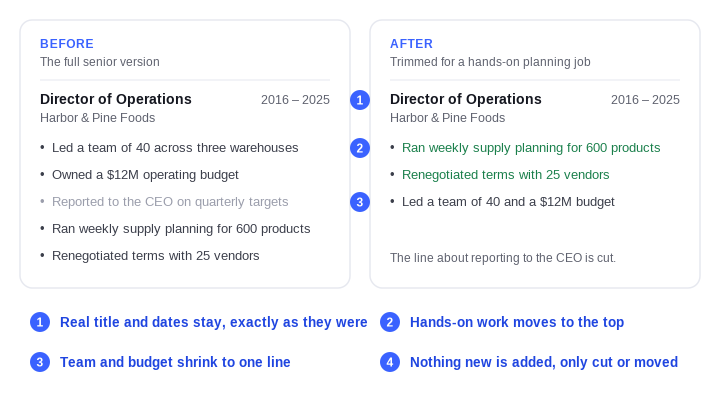
An illustration of one job, trimmed for a hands-on role. The company is made up. Trim the old and the extra
AARP suggests leaving out dates and details from more than 15 years ago, and not stating your total years of experience. If the job doesn’t need your advanced degree, Hernandez suggests moving education to the bottom. Older candidates can drop graduation dates too. Leaving something out is a choice, but changing what happened isn’t. The resume length guide helps you decide what to cut.
Say why in your summary
Two lines at the top can answer the question before anyone asks it. TopResume suggests using your summary to say why you want this kind of role. For example: “Operations leader returning to hands-on supply planning, inventory and vendor work.” For senior roles, the executive resume guide covers the rest.

Overqualified cover letter lines and interview answers, words to copy.
Pick the ones that are true for you. Swap the [square brackets] for your details. Say the interview answers in your own words.
Cover letter, back to hands-on work
One or two sentences near the top, after you name the role.
After [number] years leading [team or function], I want to get back to the work itself. This role is [the hands-on part you want], and that is the part of my career I enjoyed most and did best.
Cover letter, career change
When the step down comes with a new field.
I am moving from [old field] into [new field], and I know that means starting closer to the ground. I am applying for this role because it uses what carries over, like [skill], while I learn [the new part] properly.
Interview, why do you want this job?
The question behind “aren’t you overqualified?”. Your reason, what you bring, and your plan to stay.
I have done the bigger version of this job, and I learned what I enjoy most, which is [the work this role does]. I would bring [one thing, like less training time or help for newer people] from day one. I am looking for a role I can stay in and do well, and this is it.
Interview, fewer hours or less travel
If balance is the real reason. Say it plainly, then turn to the work.
I spent [number] years in a role with [heavy travel or long hours], and I am choosing a job that fits the rest of my life. That is a long-term choice, not a stopgap. What I like about this role is [a specific part of it].
Interview, after a layoff
Name it once, then look forward, so it doesn’t sound like a stopgap.
My role at [company] was cut in [month and year]. I used the time to think about what I want next, and it is this kind of work, [the work], at a company like yours. I am not looking for a placeholder.
Interview, won’t you be bored?
Answer with what would still stretch you.
I do not think so. I know [the core of the job] well, which frees me to get good at [something in the role that is new to you]. And I enjoy helping newer people on a team.
Interview, the pay question
Know the posted pay first. Give a real number you can live with, not a hope.
I know this role pays less than my last one, and I applied knowing that. Pay of around [amount] works for me, and I would not be looking to leave over it.
How to answer “you’re overqualified” in an interview, in three parts.
Raise it before they do. AARP and CNBC’s Hernandez give the same advice: don’t leave the interviewer to guess. Hernandez calls it addressing “the elephant in the room”. You don’t need to say the word itself. Coursera suggests naming the gap without calling yourself overqualified.
Then answer in three parts. First, your reason, in one true sentence. Second, what you bring, like less training time, judgment, or help for newer people. Third, that you plan to stay, which Indeed calls stating a commitment. Our advice: say what you’re looking for, not a promise you can’t keep, like “forever”.
Settle the money early. Check the posted pay before you apply. Mac’s List advises being clear and reasonable about pay. Indeed suggests being open to less, with a floor you won’t go below. If a form asks for your desired salary, the desired salary guide covers what to put.
Show you’ll take direction. Our advice: if you’ve managed people, say what you valued in good managers you’ve had. That answers the “hard to manage” worry without arguing with it.
Told you’re overqualified? What it can mean, and what to do next.
It may not be the whole reason. “Overqualified” is short and polite, and it rarely comes with detail. It can mean any of the four worries, or that another finalist fit better. Take it as news about that role, not a verdict on you.
Ask once, then move on. A short reply that thanks them and asks what you could do differently sometimes gets a real answer. Often it won’t, and that’s fine. The rejection reply guide has words for it.
If you think it means age. In a 2013 AP-NORC poll of adults 50 and older, 32% of those who had looked for work in the past five years were told they were overqualified. The EEOC says the federal Age Discrimination in Employment Act protects applicants 40 or older, at private employers with 20 or more employees. Whether a rejection broke that law is a legal question, so start with the EEOC’s fact sheet. This isn’t legal advice.
Aim the next one better. Our advice: if you keep hearing it, look at the level of the jobs you pick, not just your resume. A half-step down, or the same level in a new field, often fits better than a big drop. If time between jobs is part of your story, the employment gap guide covers how to explain it.
Underqualified for a job instead? When to apply anyway.
The opposite worry. Underqualified means you lack some of what a job asks for. It’s often less of a problem than it feels, because postings mix must-haves with nice-to-haves. Of 233 postings Blynk read line by line in November 2026, 169 (73%) have at least one requirement marked as good to have, not a must, like “MBA preferred”.
Our advice: apply if you meet the must-haves and can show how you’d close the rest. Missing a good-to-have isn’t a reason to stay out. Missing a hard requirement, like a license the job legally needs, is.
Do’s and don’ts when you’re overqualified for a job, on the resume and in the interview.
The habits that turn “overqualified” from a worry into a fit.
Do
- Apply when you have a real reason, and say it.
- Lead your resume with the work this job needs.
- Keep every real title and date range.
- Raise the worry yourself in the interview.
- Check the posted pay before you apply.
- Say what you’d still learn in the role.
Don’t
- Change a title to look more junior.
- Call yourself overqualified.
- Promise to stay forever.
- Apply for a job you’d leave the day something better came.
- Argue with an “overqualified” rejection.
- Hide everything senior. Trim it, and keep the scale in one line.
Questions about being overqualified for a job, answered.
How to not take job rejection personally?
Treat it as a decision about one role, made with information you didn’t have. “Overqualified” in particular is about the employer’s worries, like turnover or budget, more than about you. Ask once for feedback, keep anything useful, and put your energy into the next job that fits. If it’s wearing you down, the job search burnout guide has ways to pace yourself.
Why am I not getting a job?
Often it’s fit, not effort: roles far above or below your level, or a resume that doesn’t show the posting’s must-haves near the top. If you keep hearing “overqualified”, look at the level of jobs you’re choosing. The why am I not getting interviews guide walks through the common causes.
At what age does it become difficult to get a new job?
No source gives one age. But older job seekers do report it. In a 2013 AP-NORC poll, 43% of adults 50 and older who had looked for work in the past five years had met employers concerned about their age, and 32% were told they were overqualified. The EEOC says federal law protects applicants 40 or older from age discrimination at private employers with 20 or more employees. This isn’t legal advice.
Is it bad to be overqualified for a job?
Not in itself. It raises worries you can answer: that you’ll leave, be bored, cost too much or be hard to manage. Erdogan and Bauer’s retail study found overqualified workers left sooner only when they weren’t empowered. Answer the worries in your resume, your cover letter and the interview.
What are the benefits of hiring someone overqualified?
Less training time, and someone who can train or mentor newer people. Those are points Indeed makes, and they’re yours to make in the interview. The research backs part of it: Erdogan and Bauer found overqualified workers who felt valued and had a say in their work did well and stayed.
Should I take a lower salary if I’m overqualified?
Only one you can live with. Indeed suggests being open to less, with a floor you won’t go below. Check the posted pay first: 565 of the 1,535 postings in Blynk’s searches showed it. If you’d resent the number, the worry that you’ll leave is right, and it may not be your job.
Should I leave my degree off my resume?
You can move it down. CNBC’s Hernandez suggests moving education to the bottom when the degree isn’t required, and older candidates can drop graduation dates. Never claim a degree you don’t have, and keep any degree the job asks for.
Should I tell them I’m overqualified?
Not in those words. Coursera suggests naming the gap without calling yourself overqualified. Say why you want this role, what you bring, and that you plan to stay. The interview answers above give words for each.
Where the facts come from.
Checked in November 2026. The advice marked as ours is ours. The meaning and the employer worries come from the career pages that rank for this search, the age facts from AP-NORC and the EEOC, and the research from Portland State University. This isn’t legal advice. Blynk’s counts are its own, from 1,535 job postings in Blynk’s searches first seen October 31 to November 12, 2026, mostly senior product roles. A posting counts as giving years when a number of years sits a few words before “experience”. A range has a top, like 3-5 years, and a floor doesn’t, like 5+ years. The good-to-have count comes from 233 of those postings whose requirements Blynk read line by line from November 2 to 12, 2026, rechecked November 13. A posting counts when any line, or any part of a line, is marked good to have, like “MBA preferred” in “BA/BS required, MBA preferred”.
- Executive resume
- How to explain a career gap
- Executive job search
- Career change resume
- Your reason for leaving a job
- How to respond to a job rejection email
- Merriam-Webster: overqualified
- AP-NORC Center: Working Longer, older Americans’ attitudes on work and retirement (2013)
- Portland State Magazine, Fall 2011: Berrin Erdogan on overqualified workers
- Erdogan and Bauer (2009), Journal of Applied Psychology: Perceived overqualification and its outcomes
- EEOC: Age discrimination fact sheet
- CNBC Make It (December 2025): How to address being overqualified in a job interview
- AARP (2020): Tips to get past being called overqualified
- Indeed: Being overqualified, what it means and why it matters
- Coursera: What to do if you are overqualified for a job
- TopResume: Overqualified for a job
- Mac’s List: What employers really mean when they say you’re overqualified
- Blynk: ATS Check
