
Your reason for leaving a job. Short, true, and the same everywhere.
A form wants a reason for leaving each job, or an interviewer asks why you’re looking. Maybe you were laid off, or let go, and you worry the truth will sink you. Here’s what to write and what to say, from real forms and the rules on what employers can check.

The short answer
- On the application, write one short, true line for each job, like “Laid off, position eliminated”, “Contract ended” or “Left for a role with more responsibility”. Many online forms don’t ask at all.
- If you were fired, don’t call it something else. “Let go” is true and neutral. Employers can check your dates, and sometimes the reason.
- In the interview, give the same reason in one sentence. Then say what you want next, and why this job fits it.
On this page
Where the reason for leaving box shows up, and where it doesn’t.
We read the forms, not just the advice. On November 12, 2026, we read the live application forms of 218 open jobs in Blynk’s searches, at 199 companies. They’re on Greenhouse (97), Ashby (96) and Lever (25), mostly product roles at tech companies. We read each system’s public job-board data and submitted nothing.
Not one of the 218 forms asked why you left a job. None had a work history section at all. 3 asked the forward-looking version: “What are you looking for in your next role?” One added “and why now?”. 38 asked for your current or most recent employer or job title.
The box lives on longer work history forms. The Missouri Public Service Commission’s application has a “Reason for leaving” line under each job, next to “May we contact your supervisor?”. Virginia’s general state job application has a reason for leaving field for each job. NEOGOV, hiring software that public employers use, puts “Reason for Leaving” in its work history. UPMC, a large health system, asks for it on its careers site but marks it optional.
Federal jobs and background checks ask too. The federal government’s OF 306 form asks whether, in the last 5 years, you were fired, quit after being told you’d be fired, or left by mutual agreement because of specific problems. And HireRight, a background check company, says that when it checks your past jobs, some employers also ask for the reason for termination and whether you’re eligible for rehire.
How long should it be? On the paper forms we read, one line. The “50 to 150 characters” quoted online has no source we could find. Save the story for the interview.
What this doesn’t tell you. Our count covers three hiring systems. We didn’t read Workday, iCIMS or Oracle forms. The other boxes on a typical form are in our guide to job application questions.
How to write your reason for leaving on a job application, in four steps.
Each step takes a minute. Do it once for every past job, then reuse the same lines on every form.
Read what the box wants
Is it a text box or a pick-list, and is it required? A text box takes a short line in your words. A pick-list makes you choose, and the choices can be blunt. On Blind, one person’s HireRight dropdown offered “dismissal for any other reason” and saying they resigned, among a few choices. If the box is optional, you can leave it blank, but our advice is to fill it in anyway.
Name what happened, in plain words
Was it your choice or the employer’s? The Bureau of Labor Statistics (BLS) counts layoffs and discharges as “involuntary separations initiated by the employer”, and quits as leaving by choice. Use the words that match: laid off, let go, resigned, contract ended, or still employed. A box that names the wrong one is the problem, not the reason itself.
Keep it to one line, and point forward if there’s room
One short phrase is enough. If the box has room, add where you were heading, like “Left for a role with more responsibility”. Leave out blame, managers’ names and feelings. The examples below give one line for each situation.
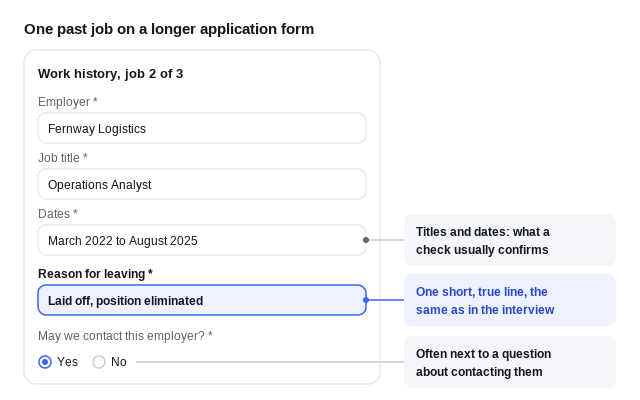
An illustration of a reason for leaving box in a work history section. The company is made up. Match it to everything else you say
The same reason should appear on the form, on any background check form, and in the interview. Missouri’s form, for example, asks if they may contact your supervisor, and HireRight says it generally contacts previous employers directly. Keep a copy of the line you wrote for each job, so you give the same answer weeks later.
A quick test: if your old manager read your line aloud, would they nod? If yes, it’s the right one.

Reason for leaving examples for the application, one line to copy for each situation.
Pick the one that’s true for you. Swap the [square brackets] for your words. Each line fits a one-line box.
Laid off
Your job was cut. It’s the plain word people expect. Don’t write that you chose to leave.
Laid off, position eliminated in a restructuring
Company or office closed
The business shut down, or the office or team closed.
Company closed
Contract or temporary job ended
The work had an end date and reached it. Say it ended as planned, so it doesn’t sound like a firing.
Contract ended as planned
Fired or let go
If you were fired, for performance or anything else. True and neutral. Don’t write “mutual separation” unless it was mutual, or “resigned” unless you did.
Let go. Happy to explain in an interview.
Asked to resign
If you resigned because you were asked to. The federal OF 306 asks if you quit after being told you’d be fired, so answer that one honestly if you see it.
Resigned at the employer’s request
Left for a better role
The most common good reason. Name what you moved toward.
Left for a role with more responsibility
Left for higher pay
Pay is a normal reason. Say it as what you moved toward, not what you ran from.
Left for a role with higher pay
Changed careers
You left to move into a new field or to train for one.
Left to move into [new field]
Moved away
You or your family moved.
Relocated to [city or state]
Caring for family
Caring for a parent, a partner or a new baby. You don’t owe the details. For your own health, see the questions below.
Left to care for a family member
Went back to school
Full-time study or a training program.
Left to study full time
Still employed
For your current job. Don’t leave a required box blank.
Currently employed
Reason for leaving when you were fired, true words, and nothing that misstates it.
Say what happened, in neutral words. “Let go”, “Terminated” and “Discharged” are all true if you were fired. They say what happened without blame. If a pick-list forces a choice, choose the option that’s true, even if it reads harshly. You’ll explain in the interview.
Don’t swap in a different fact. Some advice pages suggest “mutual separation” or “not a good fit” for a firing. If it wasn’t mutual, that’s untrue, and some forms ask the exact question. The federal OF 306 asks separately if you were fired, quit after being told you’d be fired, or left by mutual agreement because of specific problems. It says a false answer may be grounds for not hiring you, or for firing you later, and can be punished by a fine or prison.
Other forms say the same. The Missouri Public Service Commission’s form says an omission or misstatement is grounds for rejection, or for “immediate discharge if I am employed, regardless of the time elapsed before discovery”. A short true line is safer than a smooth one that isn’t.
In the interview, take one sentence for what happened and one for what changed. That’s our advice. Say it without blaming anyone, then move to why you want this job. There’s a sample below.
Can employers check your reason for leaving? What a background check can show.
A background check needs your permission. The Federal Trade Commission (FTC) says an employer must tell you in writing, in a separate notice, and get your written permission before getting a background report from a company. The report can include your work history. If they decide against you because of it, they must first give you a copy and a summary of your rights. You can dispute anything wrong in it.
What a check usually confirms. HireRight says an employment check usually covers your job titles and start and end dates. It adds that some employers also ask for the reason for termination, and whether you’re eligible for rehire. HireRight says it generally contacts previous employers directly, and that discrepancies generally “will be noted” on the background report.
What a former employer will say varies. You may read that the law only lets old employers confirm your dates, but we found no source for that. It can be the employer’s own policy, or a term in a severance agreement: one person on Blind said theirs limited the employer to confirming dates.
Missouri goes the other way. Say you worked at least 90 days for a corporation there with 7 or more staff. If you ask by certified mail within a year, and name the law (section 290.140), it must state in writing, within 45 days, the true cause, if any, of your firing or quit.
So the safe answer is the true one. Rules vary by state and by employer, and this isn’t legal advice. But your dates and job titles are the easiest thing to check, and your reason may be checked too.
How to explain being laid off, on the form, in the interview, on your resume.
Layoffs are common. In September 2026 alone, the BLS counted 1.6 million layoffs and discharges, 1.0% of everyone employed. That count includes firings for cause, so it isn’t layoffs only. As one person on Blind put it, “Layoffs aren’t the employees fault, by definition.”
Explain a layoff on the application
Write “Laid off” and the reason in a few words, like “position eliminated” or “company closed”. Don’t write that you chose to leave. That isn’t true, and a background check asks the employer, not you.
How to explain a layoff in an interview
Two or three sentences. Say what the company did and why, if you know. Then say what you did next or what you want now, and why this job fits it. Keep it calm and brief. One person on Blind called a layoff “usually an easy one to explain”, so don’t over-explain.
For example: “My team was cut when the company closed its Denver office. Since then I’ve finished a data course, and I’m looking for an operations role where I can use it, which is why this one caught my eye.”How to explain a layoff on your resume
Our advice: you usually don’t. A resume lists your jobs, dates and results, not why each one ended. If the gap since then is long, cover it in a cover letter or the interview. Our guide to a career change resume helps if the layoff is pushing you into a new field.
Good reasons for leaving a job, and why employers ask.
Why they ask. Our reading: recruiters and hiring managers want three things from your answer. Did you leave by choice or were you let go? Is the story the same on every form and in every interview? And would whatever pushed you out of your last job push you out of this one?
Good reasons, if they’re true. Most are about a better opportunity: career growth and advancement, better pay or compensation, more responsibilities, or a career change into a new industry. Others are about fit: a better work environment or company culture, work-life balance or flexible hours. And some aren’t your decision at all: a move, family or health circumstances, going back to school, a layoff, a restructuring or a contract that ended.
These are the reasons people really give. In Pew’s survey of people who quit a job in 2021, the top reasons were low pay, no chance to advance and feeling disrespected. Child care, inflexible hours, benefits and moving also made the list. So an honest answer is usually a common one.
Hard reasons, said well. Conflict with management or coworkers, or a workplace you’d call toxic, can be true reasons too. Our advice: don’t hide them, and don’t dwell on them. Name what you want instead, like “a team that gives clear, regular feedback”. In our view, blame, oversharing and a story that changes from one form to the next are the real red flags.
Why are you looking for a new job? Your reason for leaving, said in the interview.
The same reason, plus where you’re heading. Our advice is three parts: the true reason in one sentence, what you want in a new role, and why this job fits your skills and goals. The form had the short version. During the interview, it’s the same answer with room to breathe.
Money is a fine reason. In Pew’s survey, 63% of people who quit a job in 2021 named low pay, and 56% of those working again said they now earned more. So you don’t have to hide it. Say it as what you want next, like “a role with higher pay and more scope”.
Keep it positive, and don’t complain about your last boss. Even if they were the reason, focus on what you want instead. “I want a team that ships every week” lands better than “my manager never let us ship”. Our reading: the interviewer is listening to how you handle it as much as to the reason.
Short stays need one line, not a defense. The BLS puts the median time with one employer at 4.1 years, and at 3.0 years for people aged 25 to 34. If you left after a few months, give the true reason in one line and show what you’re looking for now.
Keep it the same as the form. If you wrote “Laid off” on the application, the interview answer starts with the layoff. Your story should match.
Reason for leaving sample answers, for the interview, by situation.
Say them in your own words. Swap the [square brackets] for your details. Each takes under 30 seconds.
Still employed, looking for growth
When you’re leaving a job you still have. Keep it about what you want, not what’s wrong with your current employer.
I’ve learned a lot in [number] years at [company], and I’ve grown as far as I can in my current role. I’m looking for [what you want next], and this role offers exactly that.
Laid off
Name the layoff first, then move forward.
My role was eliminated when [company] [restructured, closed a team or cut costs]. Since then I’ve [what you did]. I’m looking for [what you want next], which is why this role stood out.
Fired or let go
One sentence on what happened, one on what changed. No blame.
I was let go from [company] after [the honest reason, briefly]. It taught me [what you learned], and since then I’ve [what you changed]. That’s a big part of why this role fits.
Contract ended
Make clear it ended as planned.
My contract at [company] ended as planned in [month]. I enjoyed [the work], and now I’m looking for a permanent role where I can [what you want to do].
Changing careers
Show the link between the old job and the new one.
I’ve spent [number] years in [old field], and the part I enjoyed most was [the overlap]. I want to do that full time, and this role is a chance to.
Left after a few months
Be brief and true. Show you chose this job with care.
The role turned out to be [the honest difference, briefly], so I left after [number] months. This time I’ve looked closely at the work, and this role is what I’m after.
Still in the job? How much notice to give, and how to resign professionally.
Two weeks is the custom. A contract or handbook can set a different notice period, so check yours before you set a date. In California, the law plans for both cases. Quit with 72 hours’ notice and you’re paid in full on your last day. Without notice, final pay is due within 72 hours.
Forms may ask when you can start. 25 of the 218 forms we read asked your start date or notice period, and 21 made it required. Know your notice before you apply.
Resign so the reason stays simple. Our advice: tell your manager first, in person or on a call. Then confirm in a short written note with your last day. Offer to hand over your work. Keep the reason neutral, because a later background check may ask why you left and whether you’re eligible for rehire.
Reason for leaving do’s and don’ts, on the form and in the interview.
The habits that keep your answer short, true and the same everywhere.
Do
- Write one short, true line for each job.
- Use the same reason on the form, the background check and in the interview.
- Use neutral words for a firing, like “Let go”.
- Choose the true option when a pick-list forces you.
- Keep it positive and concise: what you left for, not what went wrong.
- Keep a copy of what you wrote for each job.
Don’t
- Write “see resume” in the box.
- Use negative words about a former employer, or name your old manager.
- Leave a required box blank. The form won’t send.
- Write “mutual separation” or “resigned” if you were fired.
- Write “personal reasons” for every job. Our advice: it reads like hiding.
- Give a diagnosis. You don’t owe one.
Questions about reasons for leaving a job, answered.
What should you put as a reason for leaving a job?
One short line that’s true, and the same as you’ll say in the interview. For example, “Laid off, position eliminated”, “Contract ended”, “Left for a role with more responsibility”, “Relocated to Denver” or “Currently employed”. If you were fired, “Let go” is true and neutral. The examples above have a line for each situation.
How much notice should I give my employer?
Two weeks is the custom. Your contract or handbook may set a different period, so check it first. In California, the law covers both cases: quit with 72 hours’ notice and you’re paid on your last day, or without notice within 72 hours. 25 of the 218 forms we read asked when you could start or your notice period.
How do you resign professionally?
Our advice: tell your manager first, in person or on a call. Then send a short written note with your last day, and offer to hand over your work. Keep the reason neutral and true. HireRight says a later background check may ask the reason you left and whether you’re eligible for rehire.
What is the best answer for reasons for job change?
The true reason in one sentence, then what you want next and why this job offers it. Growth and pay are the most common real reasons: in Pew’s survey of people who quit in 2021, 63% named low pay and 63% no chance to advance. Say it as what you’re moving toward, like “a role with more scope”.
What was the best reason you left your previous job?
The best reason is the true one, said briefly and pointed forward. If you were laid off, say so. If you were fired, say so in one sentence, then what you learned. Our advice: a calm, short answer matters more than a perfect reason. The sample answers above cover six situations.
What are 5 reasons to work?
People’s reasons to stay in a job mirror their reasons to leave one. Pew’s survey of people who quit in 2021 found low pay, no chance to advance, feeling disrespected, inflexible hours and poor benefits among the main reasons. So five reasons to work somewhere are fair pay, room to grow, respect, flexible hours and good benefits. In an interview, the one you name should be true for you.
Can I just write “personal reasons”?
You can, and it’s true for some jobs. But our advice is not to use it for every job, because it can read like hiding something. A few plain words work better: “Left to care for a family member”, “Relocated” or “Left to study full time”. You never owe a diagnosis or private details.
Do I have to give a reason for leaving on an application?
Only if the form asks, and many don’t: none of the 218 online forms we read did. Where it’s required, the form won’t send without it. Where it’s optional, like on UPMC’s careers site, you can leave it blank. Our advice: “Will discuss in interview” on its own, with no reason, reads like you’re hiding something. A short true line is better.
What if I left a job after only a few months?
Give the true reason in one line, like “Left after 4 months for a role closer to my field”. For context, the BLS puts the median time with one employer at 3.0 years for people aged 25 to 34. In the interview, say what you learned about what you want, and why this job is it.
What do I put if I left for health reasons?
A few neutral words, like “Left for health reasons” or “Left to care for a family member”, are enough. The EEOC says that before a job offer, employers may not ask disability-related questions, such as how many days you were sick last year. You don’t have to reveal a need for accommodation while applying.
Where the facts come from.
Checked in November 2026. The advice is ours. Facts about forms come from the forms themselves and the hiring systems’ own help pages, the rules from the FTC, the EEOC and state law, the numbers from the BLS and Pew, and the quotes from job seekers from public posts on Blind. This isn’t legal advice. Blynk’s count is its own: on November 12, 2026, the application forms of 218 open jobs in Blynk’s searches, at 199 companies (Greenhouse 97, Ashby 96, Lever 25), mostly product roles at tech companies, read through each system’s public job-board data. A question counts if its label asks why you left, about leaving, or for a work or employment history. Nothing was submitted.
- Job application questions: how to answer each one
- What to put for desired salary on a job application
- Career change resume
- Why am I not getting interviews?
- Job search burnout
- How to explain a career gap
- How to give two weeks notice
- OF 306, Declaration for Federal Employment (copy on justice.gov)
- Missouri Public Service Commission: application for employment
- Virginia DHRM: general state job application
- NEOGOV: work history
- UPMC careers help: work experience
- HireRight: what is in an employment verification
- FTC: employer background checks and your rights
- Missouri Revised Statutes section 290.140 (service letters)
- BLS: Job Openings and Labor Turnover, September 2026
- BLS: JOLTS definitions
- BLS: Employee tenure, January 2026
- Pew Research Center: why workers quit a job in 2021
- EEOC: job applicants and the ADA
- California DIR: paydays, pay periods and final wages
- Blind: do I need to put laid off in a job application (June 2022)
- Blind: HireRight, fired from previous job (November 2024)
- Blynk Auto-Apply
