
Executive resume. Two pages of proof, written for the role you want.
If your resume hasn’t changed in years, it probably reads like a career history. An executive resume is different. It’s proof that you’ve run something the size of the job you want. Here’s the structure, examples by level, and what senior job postings really ask for.

The short answer
- Prove scope and results, not duties. The top third of page one names the role you want, the size of what you’ve led, and two or three results with real numbers.
- Two pages is the usual length. A third page is for board roles or publications a job asks for, not for older jobs.
- Write each version for the posting. In 608 senior job postings for product roles that we read, strategy came up in 78% and P&L in 8%. So lead with what that job asks for.
On this page
Why your executive resume isn’t getting calls, and what’s really going on.
Five ways a senior resume goes wrong. Most of them are on one executive search firm’s list of red flags.
“It’s 25 years on three pages.”
Cowen Partners, an executive search firm, lists a resume that runs many pages as a red flag. Robert Half’s guide opens with the same idea: executive resumes are not career biographies.
Check: Does page one hold your best results from the last 10 to 15 years? Older roles can shrink to a line each.
“It says strategic leader, with nothing behind it.”
Claims with no data or results behind them are on the same list. A reader can’t check “visionary”. They can check what changed while you were in charge.
Check: Is there a number, or a before and after, next to each claim? If not, cut the claim or prove it.
“It reads like my old job descriptions.”
Cowen names day-to-day duties in place of career highlights. At this level, a reader assumes you ran meetings and budgets. They want to know what was different when you left.
Check: Does each bullet say what changed? Duties belong in one line of context, not in bullets.
“I send the same one to every posting and search firm.”
Using one resume for every job is on the list too. Robert Half puts it plainly: “The job description is the blueprint. Your resume is where you show proof of success.”
Check: Are the posting’s title and top three asks in your top third? In its words, next to a result.
“Nobody can tell what level I’m going for.”
Cowen’s last red flag is a target role and brand that aren’t clear from the first few lines. On Blind, one reviewer said a list of senior titles at one company “shows, senior, senior, senior” instead of growth.
Check: Does your headline name the role you want? Then let the results show the level.
What senior job postings ask for, and what your executive resume should prove first.
Most executive resume advice says to lead with P&L and board work. So we checked what senior postings actually ask for. Blynk read 608 VP, Head of, C-level and director job postings for product roles from its own searches. They come from 471 companies and were first seen between October 31 and November 12, 2026.
The sample, exactly: 368 VP titles, 194 Head of titles, 39 C-level titles (mostly Chief Product Officer) and 7 director titles. Every title is a product role, so this is a picture of senior product leadership, not of every executive job.
Strategy and people come first. Strategy comes up in 78% of the 608. Working with the CEO, the executive team or senior leadership comes up in 41%. Leading, building or hiring a team comes up in about half. (That pattern is loose, so we round it down.)
Money comes next. Revenue is in 32%. A budget is in 10%.
P&L and the board are rare. P&L or profit and loss comes up in 8%, and the board in 10%. An MBA is in 11%. “Hands-on” is in 24%, more often than either.
Years: 366 postings name a number of years. The median of the highest number each one names is 10, for VP, Head of and C-level alike.
What it means for your resume (our reading): for roles like these, prove the strategy you set, the team you built and the executives you worked with, first. Put P&L or board work at the top when the posting asks for it. We counted a word anywhere in a posting, so company blurbs count too.
How to write an executive resume, top to bottom.
From the first line down, in the order a reader meets it. Build one strong version first, then adjust it for each role.
Start from one posting you want
Robert Half’s advice is to build a strong baseline resume, then adjust it for each role using the job description. Pick one posting you’d really take. Mark its title, the two or three things it asks for most, and the size of the team or business it describes. Everything below should prove those.
Header and headline: the role you want
Under your name, city, email and LinkedIn link, write the title you’re going for, in the posting’s own form. Cowen Partners counts a target role that isn’t clear in the first few lines as a red flag. Keep your past titles as they were; only the headline points forward.
Example (made up): the posting says “VP, Operations” → your headline: “VP of Operations, multi-site manufacturing”.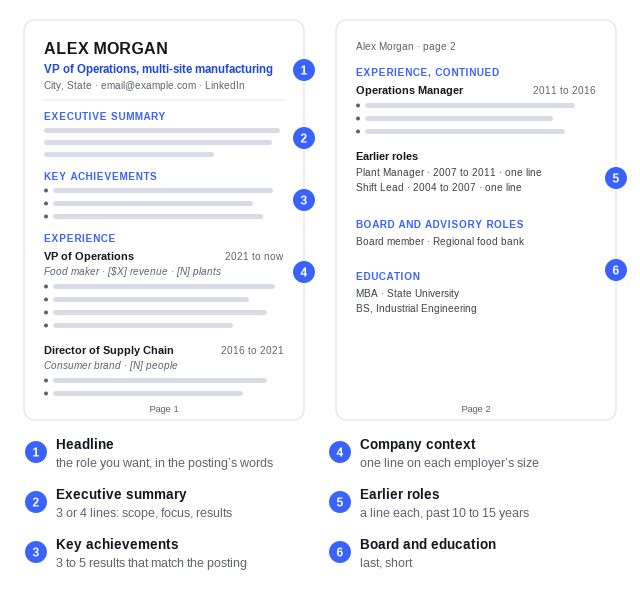
An illustration of a two-page executive resume. The name and companies are made up. Write a short executive summary
Yes, an executive resume should have one. Robert Half says to skip “I” and keep sentences short. Cover your role and scope, your strategic focus, and the outcomes you’re known for. Three or four lines is plenty. Write it last, as Resume Genius and Arielle Executive both advise, once you know your best proof.
Add three to five key achievements
Pick your biggest results from across your career and put them right under the summary. Choose the ones that match the posting’s top asks, each with a number or a clear before and after. Adrienne Tom, an executive resume writer, put it this way on Jobscan: “Leverage prime resume real estate – the top 1/3 of the file – to showcase why you are the candidate of choice.”
Experience: company context, then results
Under each employer, add one line on its size: revenue, headcount, stage or markets. Resume Genius suggests a sentence or two on the company and your remit. Then write three to five bullets, each with the scope, what you did and what changed. Give the last 10 to 15 years in detail; older roles can be a line each. The resume bullet points guide has the formula.
Board roles, education and certifications last
Board seats and advisory roles get their own short section, if you have them. Education and certifications go at the end. Robert Half’s list of what no longer belongs includes objective statements, a home address, graduation dates or GPA, and “references available upon request”.
Save it as a plain file
Use one column, standard headings and a common font, with no tables, text boxes or graphics. That’s what Ivy Exec advises in an article the University of Maryland’s business school shares. Send a PDF or Word file, whichever the posting asks for.

Executive resume examples, summaries and bullets by level.
Samples with made-up companies. The [square brackets] are for your real numbers, so nobody copies an invented figure. Keep only what you’ve really done.
A two-page executive resume template
One column, in this order. Paste it into any editor and fill in the brackets.
[YOUR NAME]
[Target title, in the posting’s words]
[City, State] · [email] · [LinkedIn profile link]

EXECUTIVE SUMMARY
[Your role and the size of what you lead.] [Your focus, in the posting’s words.] [The result you’re best known for.]

KEY ACHIEVEMENTS
- [Biggest result that matches the posting’s first ask]
- [Second result]
- [Third result]

EXPERIENCE
[Job title] · [Company] · [Start year] to [End year or Now]
[One line on the company, such as revenue, headcount, stage or markets]
- [Scope, what you did, what changed]
- [Result]
- [Result]

[Earlier title] · [Company] · [Years]
- [One line, your best result there]

BOARD AND ADVISORY ROLES
[Role] · [Organization] · [Years]

EDUCATION
[Degree] · [School]
[Certification, only if the posting asks for it]
The company context line
One line under each employer, so a reader can judge your scope.
[Company] is a [kind of business] with [$X] in revenue, [N] people and [N] markets.

Example
A privately held food maker with [$X] in revenue, [N] plants and [N] employees.
Director (sample)
Running a function, aiming at a bigger scope.
Executive summary
Director of supply chain for a regional food maker, leading [N] people across planning, purchasing and logistics. Owns how goods move and what it costs, working with finance and sales on every change. Best known for cutting delivery costs by [X%] in [N] years.

Key achievements
- Rebuilt the planning process across [N] plants, raising on-time delivery from [X%] to [Y%].
- Renegotiated [N] supplier contracts, saving [$X] a year.
- Hired and trained [N] planners, and promoted [N] of them to lead roles.
VP (sample)
Leading an organization and answering to the executive team.
Executive summary
VP of operations for a multi-site manufacturer with [$X] in revenue. Leads [N] people across [N] plants, sets the operating plan with the CEO, and owns cost, quality and safety. Best known for raising margin by [X] points while the business grew [X%].

Key achievements
- Built a new operations leadership team of [N], hiring [N] plant managers.
- Set a three-year operating strategy with the executive team, cutting cost per unit by [X%].
- Led the integration of an acquired plant, reaching full output in [N] months.
- Presented the operations plan to the board every quarter.
C-level (sample)
Running the company or a whole function, answering to a board.
Executive summary
Chief operating officer for a growth-stage consumer brand. Runs operations, supply chain and customer service, [N] people in [N] countries, reporting to the CEO and the board. Best known for taking the company from [$X] to [$Y] in revenue while keeping margin above [X%].

Key achievements
- Grew revenue from [$X] to [$Y] in [N] years as part of a [N]-person executive team.
- Opened [N] new markets, each profitable within [N] months.
- Led the operating plan behind a [$X] funding round and presented it to investors.
- Rebuilt the leadership team, hiring [N] of [N] direct reports.
A key achievements block
Three to five lines under the summary, picked for each posting.
KEY ACHIEVEMENTS
- Grew [business or product] from [$X] to [$Y] in [N] years.
- Built and led a team of [N], across [functions or countries].
- Cut [cost or time] by [X%] by [what you changed].
- Set the [strategy or plan] with the CEO and executive team, and delivered [result].
How long should an executive resume be? Two pages, and when a third is fine.
The advice doesn’t agree. Robert Half says most executive resumes should be one to two pages, and three may suit CEOs with board experience. Purdue’s writing lab says a senior manager or executive resume “may require three or more pages”. Arielle Executive, a resume writer, says three is usual. Robert Half’s rule of thumb is the useful part: “Length should always be justified by relevance, not tenure.”
What the evidence shows. In ResumeGo’s study, 482 people with hiring experience screened sample resumes. They picked the two-page version 2.9 times as often for managerial jobs. ResumeGo sells resume writing and calls it “only a simulation”.
Tracker data points the same way. In Huntr’s Q3 2026 data, 6.4% of applications with a two-page resume from people with 10+ years led to an interview. It was 5.8% for one page and 5.7% for three or more. That’s a link, not proof of cause.
Page two gets read when page one is good. Ladders’ 2018 eye-tracking study found an engaged recruiter spends as much time on page two as on page one. How long they spend there depends on how strong page one is.
Our advice: two pages. Add a third only for board roles, patents or publications that a job asks for. The resume length guide covers page counts at every career stage.
The best executive resume format, and what it should look like.
Reverse chronological, with key achievements on top. List roles from the most recent back, the order Indeed’s executive resume guide advises. Jobscan’s executive writer calls a version with an achievements section up front a hybrid. It shows your best results first and your path second. A resume grouped only by skills, with dates hidden, makes a reader work out your path (our reading).
Plain and easy to scan. Ladders’ study found simple layouts with clear section and job headings did best, and the first skim averaged 7.4 seconds. One column, standard headings, bold titles and white space.
Hiring software reads it too. Senior roles go through the same hiring systems as other jobs. In our sample, Workday (122 postings) and Greenhouse (75) were the most common. Greenhouse, one of them, says its Talent Matching “does not automatically advance or reject candidates.” Recruiters search and filter, so the posting’s words should appear next to your real results. The ATS-friendly resume guide covers the layout.
Director, VP or C-level resume: what changes at each level.
The higher the role, the more the resume is about the whole business. Our count shows it. Working with the CEO, the executive team or senior leadership comes up in 31% of Head of postings, 44% of VP postings and 24 of the 39 C-level postings. The board comes up in 8%, 9% and 9 of the 39.
Director resume: lead with the function you run and what it delivered. Show the team, the budget and one or two changes that moved a company number.
VP resume: lead with the organization you built and the strategy you set across functions. Name the executives you worked with and the decisions you took to them.
C-level resume: lead with the company. Show growth, the board and investors where that’s true, and the leaders you hired. Keep it to the few results a board would ask about.
What doesn’t change (our reading): every level needs the role in the headline, proof next to every claim, and two pages at most for most people. For VP of Product and Chief Product Officer samples, see the product manager resume guide. For where senior roles are posted and how they fill, see the executive job search guide.
Executive resume red flags, and what to do instead.
The don’ts are the red flags Cowen Partners, an executive search firm, names. The dos are what to write instead.
Do
- Make the role you want clear in the first lines.
- Back every claim with a result, a number or a before and after.
- Keep each bullet to one or two lines.
- Write a short executive summary instead of an objective.
- Show career highlights, with duties in one line of context.
- Adjust each version for the posting you’re sending it to.
- Proofread every date, title and number, then ask someone to read it.
Don't
- Leave the reader to guess your target role.
- Make claims with nothing behind them.
- Write bullets that run to several sentences.
- Open with a long objective about your career goals.
- List day-to-day duties.
- Send one resume to every job.
- Let spelling or grammar errors through, or run to many pages.
Questions about executive resumes, answered.
Is hiring software rejecting my executive resume?
Probably not on its own. Greenhouse says its Talent Matching doesn’t automatically advance or reject candidates. Its automatic rejections act on answers to the employer’s own questions. So answer every question fully, use the posting’s words for your real work, and keep the layout plain. You can also see how hiring software reads yours against the job.
How long should my executive resume be?
Two pages for most people. Robert Half says one to two, with three for some CEOs with board experience. In Huntr’s data, two-page resumes from people with 10+ years did a little better than one page or three. Put your best results on page one.
Should I add an executive summary to my resume?
Yes. Three or four lines under your headline: your role and scope, your focus, and the outcome you’re known for. Robert Half says to avoid “I” and keep sentences short. Write it last, and change it for each posting.
Can you provide a sample executive summary for a resume?
Here’s one, with made-up details: “VP of operations for a multi-site manufacturer with [$X] in revenue. Leads [N] people across [N] plants and sets the operating plan with the CEO. Best known for raising margin by [X] points.” There are director and C-level ones in the examples above.
What is the best format for an executive resume?
Reverse chronological, with a short summary and three to five key achievements at the top. Jobscan’s executive writer calls that a hybrid. Use one column and standard headings. Ladders found simple layouts with clear headings did best in its eye-tracking study.
What is a red flag on a resume?
Cowen Partners, an executive search firm, lists eight. Four are about length and proof: long bullets, a long objective, many pages, and claims with nothing behind them. The others are careless errors, duties in place of highlights, one resume for every job, and a target role that isn’t clear in the first lines.
Can you provide a CV template for a senior management position?
In the US, a senior manager usually sends a resume. Purdue’s writing lab says jobs in academic or scientific fields will likely ask for a CV, a longer document. Recruiters outside the US, such as Page Executive, say “executive CV” for the same thing. Either way, the two-page template in the examples above works for senior management roles.
Can you provide some examples of executive resumes for 2026?
Yes, above: a two-page template, a company context line, director, VP and C-level samples, and a key achievements block. They use made-up companies and [brackets] for your real numbers, so you only ever write what you’ve done.
Do I need P&L or board experience on an executive resume?
Only if you have it, and put it up front when the posting asks for it. In 608 senior postings for product roles we read, P&L came up in 8% and the board in 10%. Strategy came up in 78%, and working with the CEO or executive team in 41%.
Is an executive resume writer worth it?
It can be if you can’t see your own work clearly, or need it fast (our view). Ask to see samples for your level, ask who writes it, and check that every number will be yours. Whoever writes it, you’ll still adjust it for each posting.
Sources, and where to read more.
Checked in November 2026. The advice is ours, and is marked where it’s our reading. The posting counts are Blynk’s own: 608 VP, Head of, C-level and director job postings for product roles from Blynk’s searches, from 471 companies, first seen between October 31 and November 12, 2026. One per company and job title. We dropped postings whose text was cut short, and bank titles where vice president is a rank, such as “Product Manager, Vice President”. We counted postings that mention each word anywhere, so company blurbs count. “Leading a team” uses a loose pattern, so we report it as about half. The years figure is the highest number written next to “years”, so it’s rough. Samples on this page are made up.
- Executive job search: how VP and C-level roles get filled
- How to write a product manager resume
- How many pages should a resume be?
- How to write resume bullet points
- ATS-friendly resume: what it means
- How to tailor your resume to a job description
- Applying when you're overqualified
- Robert Half: how to create a captivating executive-level resume
- Cowen Partners: executive resume red flags (2023)
- Jobscan (Adrienne Tom): executive resumes, what matters most must appear first (2018)
- University of Maryland Smith School, from Ivy Exec: crafting an executive resume (2026)
- Purdue OWL: using two pages or more
- Arielle Executive: how to write an executive resume (2026)
- Resume Genius: executive resume examples
- Indeed: executive resume template
- ResumeGo: a study of resume length
- Huntr: job search trends, Q3 2026
- Ladders: eye-tracking study, 2018 (PDF)
- Greenhouse help: Talent Matching
- Greenhouse help: application rules overview
- Page Executive: how to write an executive CV
- Blind: one page vs two page, which tells the better story? (2025)
- Blynk ATS Check
