
Your career gap, explained. One honest line on the resume, the form and in the interview.
Months or years out of work, and an application in front of you. Maybe you were laid off, raised children, cared for a parent or got sick, and you worry the gap ends things before anyone reads on. Here’s what to write and say, with lines to copy and what the research found.

The short answer
- A career gap is common, and it usually needs one honest line, not a cover story. Name it with its dates, like “Career break, caring for a parent, March 2024 to June 2025”.
- Say the same thing on your resume, the application form and in the interview. Forms with a work history section can ask for the month and year, so dates don’t hide a gap.
- In the interview, give the reason in one sentence, then talk about the work. Say what you did or kept up, and why this job fits.
On this page
Why a career gap feels like it will sink you, and what the evidence says.
Four worries people with a gap name, and what the sources say about each.
“A gap is an automatic red flag.”
It’s a question more than a verdict. In Resume Genius’s 2026 survey of 1,500 US hiring managers, 43% named a long or unexplained employment gap as a red flag. But 63% said an unexplained gap raises questions that warrant an explanation, and 12% called it a significant negative. Resume Genius sells resume tools, so read it as one survey.
Check: Does your gap have a reason written next to it? Unexplained is the part they mind.
“The software will throw me out for the gap.”
We found no source showing that hiring software rejects a resume for a gap. The job postings don’t ask for unbroken work either. Blynk read 1,160 job postings with full descriptions, from its searches for product roles between October 31 and November 12, 2026. None mentioned a career gap or a career break, and none asked for continuous employment. 577 asked for a number of years of experience.
Check: Do your dates add up to the years the posting asks for? That’s the number postings name.
“I’ll have to explain my health.”
You don’t owe a diagnosis. The US Equal Employment Opportunity Commission (EEOC) lists medical questions employers may not ask before a job offer. One is “How many days were you sick last year?” It also says the law doesn’t require you to tell an employer about a need for accommodation at any particular time. This isn’t legal advice. The EEOC’s page has the details.
Check: Can you say it in one sentence, with no medical detail? Our advice: “a health issue, now behind me”, if that’s true.
“It’s safer to hide it.”
Saying nothing did worse in the one large test we found. In a 2019 field experiment by ResumeGo, a resume company, applicants who gave a reason for their gap were called back 6.8% of the time. Those who gave none were called back 4.3% of the time. And a hidden gap can leave your resume and the application form with dates that don’t match.
Check: Would your resume and your form tell the same story? They should, word for word.
What counts as a career gap, and how common a gap in employment is.
There’s no official definition. A career gap, or employment gap, is time away from the workforce between jobs, for any reason. Our reading: a few months between jobs is a normal job search, and nobody expects a line for it.
Gaps are common. In LinkedIn’s 2022 survey, 64% of women said they had taken a career break at some point. The top reasons were parental leave (22%), medical leave (17%) and mental health reasons (14%). LiveCareer, a resume company, reports that more than half of job seekers had a gap of at least a month in 2025. And 1 in 4 had one of a year or more, as AARP quotes it.
Long searches are common right now, too. In October 2026, 1.96 million people in the US had been unemployed for 27 weeks or more. That’s 27.6% of everyone unemployed, according to the Bureau of Labor Statistics (BLS).
Common reasons for a career break in a family are parental leave and raising children full time. Others are being a caregiver for a sick parent, partner or child, moving for a partner’s job, or extended leave after a death in the family. LinkedIn’s profile has a career break entry with 13 options, including caregiving, and health and well-being.
Does a career gap hurt your chances? What two field experiments found.
Researchers have tested this with made-up resumes sent to real jobs. Two studies are worth knowing. Both counted callbacks for interviews, not job offers.
Giving a reason helped. From January to July 2019, ResumeGo sent applications to 36,510 openings on ZipRecruiter, Indeed and Glassdoor, with gaps from none to 5 years. With a reason given, the callback rate was 6.8%. With none, it was 4.3%.
Training did best. Of the reasons tested, additional training or education got the most callbacks, at 8.5%. ResumeGo sells resume writing, so it has a stake in that message.
Length matters, but not in a straight line. In the same study, callbacks fell slightly with each year of gap, up to 2 years. Between a 2-year and a 3-year gap, they fell from 9.8% to 4.6%.
The first months out of work count most. Economists Kory Kroft, Fabian Lange and Matthew Notowidigdo sent 12,054 made-up resumes to real job postings in 100 US cities. Callbacks fell as time out of work grew, mostly in the first eight months. A J-PAL summary of the study says callbacks at eight months were about 45% lower than at one month, and fell no further after that. The made-up applicants averaged 27 years old, with 5 years of experience.
Our reading: you can’t shorten a gap you already have. You can give it a reason, show what you did with the time, and apply to jobs you fit sooner rather than later.
How to explain an employment gap on your resume, in five steps.
Do this once, then use the same line on every application. One-line examples for each reason come right after.
Decide whether the gap needs a line
Our advice: a few months between jobs needs nothing. A gap of about six months or more, or one that’s still open, gets its own line, so a reader doesn’t have to guess. If your resume only goes back 10 to 15 years, older gaps don’t show at all.
Keep the month on every date
Some advice on resume gaps says to show years only, so a short gap disappears. The experts AARP asked are split. One calls it fine, and another warns that “2019 to 2020” could mean one month or two years. Our advice is to keep months. Job application forms with a work history section can ask for the month and year anyway, so a year-only resume can look like it doesn’t match.
Give the gap its own line, with dates and a reason
Put it in your experience section in date order, like a job, with a plain reason and the dates. One expert AARP asked suggests the same kind of single line, like “Career break for caregiving responsibilities”. The examples below give one line for each reason.
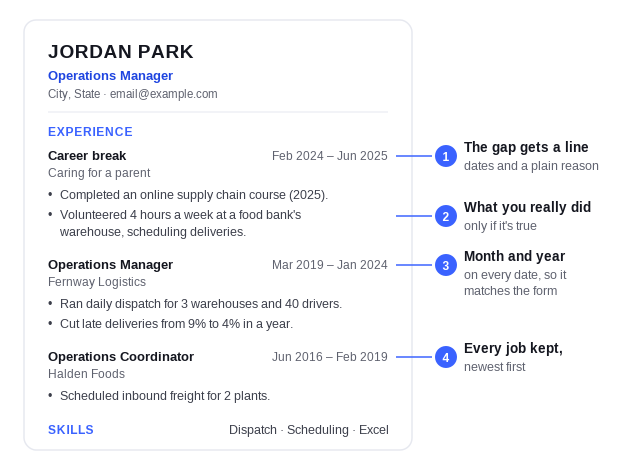
An illustration of a career break line on a resume. The name and companies are made up. Add what you really did, if it fits the job
Online courses, a certification, volunteering, projects or real freelance work can go under the gap line as one or two bullets. This kind of professional development shows your skills are recent. In ResumeGo’s test, training or education was the best-performing reason. Only add what’s true. Calling a gap freelance work when it wasn’t is a risk our guide to freelance work on a resume covers.
Keep a dated history, not a skills-only layout
A functional resume lists your skills and plays down your dates. Alison Green, who writes the Ask a Manager column, says employers know that format is generally used to disguise limited or outdated experience. So it’s “generally taken as a red flag.” Keep your work experience with dates, newest first, so your employment history reads clearly. Then open with two lines that name the job you want and highlight your relevant skills. Our career change resume guide compares the formats.

Employment gap explanation examples for your resume, one line for each reason.
Pick the one that’s true for you. Swap the [square brackets] for your details. Each goes in your experience section, in date order.
Laid off, still looking
Your job was cut and you’re searching. Say what happened and what you’re doing now.
Job search after a layoff, [Month Year] to present
Completed [course or certificate] while searching
Raising children
Plain words read better than a job title for it.
Career break, full-time parent, [Month Year] to [Month Year]
Caring for a family member
If you were a caregiver. No need to say who or why beyond this.
Career break, caring for a family member, [Month Year] to [Month Year]
Health
No diagnosis. Add “now resolved” only if it’s true.
Career break for health reasons, now resolved, [Month Year] to [Month Year]
Study or training
List it here, and in your education section if it’s a degree.
Full-time study, [course or degree], [school], [Month Year] to [Month Year]
Moved for a partner’s job
A move explains a gap on its own.
Career break, relocation to [city] for family, [Month Year] to [Month Year]
Planned break or travel
Name it as planned, and add anything you did that fits the job.
Planned career break, travel and [project or course], [Month Year] to [Month Year]
Freelance or your own business
Only if you really did the work. Real clients and results make it a job.
Freelance [your field], [Month Year] to [Month Year]
[Number] clients, including [type of client]
A gap in employment on the application form, where the dates are month and year.
Work history forms can ask for the month, not just the year. The Missouri Public Service Commission’s application asks for each job’s “DATES OF EMPLOYMENT (Month/Year)”, from and to. The US Treasury tells people applying for federal jobs to list start and end dates with the month and year, and the hours worked each week. So a gap shows on the form even if your resume shows years.
Some forms ask for no work history at all. For our reason for leaving guide, on November 12, 2026, Blynk read the live application forms of 218 open jobs on Greenhouse, Ashby and Lever, mostly product roles at tech companies. None had a work history section. There, your resume carries the gap line.
If the form asks about gaps, use the same line. A text box that asks you to explain gaps gets the line from your resume, said the same way. If the form lists only jobs, our advice is to add the break as its own entry where the form allows it. Missouri’s form asks for paid and volunteer experience, so volunteering counts there. Never invent a job to fill the dates.
A background check can confirm your dates. The Federal Trade Commission (FTC) says an employer needs your written permission to get a background report from a company, and the report can include your work history. You can dispute anything wrong in it. So the safe dates are the true ones.
The reason for leaving box often sits next to the dates. Our guide to your reason for leaving a job has a short line for each situation.
How to answer “Can you explain your employment gap?” in an interview, in three sentences.
Three parts, about 20 seconds. Our advice: say the reason in one sentence. Say what you did or kept up during the gap. Then say why you’re ready for your next job, and why this one.
Brief and concise beats a long story. Indeed’s sample answer uses the same three parts. In our view, that’s the best answer for a gap in a job interview, and the way to justify one. Say it plainly, then move forward. Prepare it like your other interview questions, and your readiness shows.
Bring a long gap up yourself. In LinkedIn’s survey, 52% of hiring managers said candidates should bring up their career break during the interview. And 51% of hirers said they’re more likely to contact a candidate who gives context about one. A sentence in your answer to “Tell me about yourself” does it.
Don’t apologize, and don’t overshare. The gap is a fact, not a confession. For health, our advice is one sentence with no diagnosis. Before a job offer, the EEOC says employers may not ask questions like “Have you ever been treated for mental health problems?”
If you were laid off, say so first. A layoff needs no defence. Our guide on what to do after a layoff covers severance and the first two weeks.
Practise it out loud. Say it to a friend, or record yourself, until you can say it with confidence, like a fact you’ve stated before. Then stop, and let them ask the next question.
Career gap interview answers to copy, by reason.
Say them in your own words. Swap the [square brackets] for your details. Each takes under 30 seconds.
Laid off, then a long search
Name the layoff, show you used the time, then point to the job.
My role was cut when [company] [restructured]. I’ve spent the time since looking for the right next role, and I finished [course] along the way. This job uses what I did at [company], like [one result], which is why I applied.
Raising children
No apology. Say you’re ready, and what you kept up.
I took [number] years off to raise my children. They’re in school now, and I’m ready to work full time again. I’ve kept up with [field] through [course, volunteering or reading], and this role fits what I did at [company].
Caring for a family member
Say it’s settled, if it is. You don’t need to say who.
I stepped away to care for a family member. That’s settled now, and I’m ready to come back full time. Before that I [one result at your last job], and that’s the work I want to do here.
Health
Only if it’s true that it’s behind you. No diagnosis.
I took time off for a health issue, which is behind me now. I’m ready to work full time, and I’ve been [what you did to stay current]. What drew me to this role is [reason].
Study or training
Tie what you learned to the job.
I left to complete [degree or course] full time. It gave me [skill], which this role asks for, and I’m ready to put it to work.
Planned break or travel
Planned is the key word. End on what you want now.
After [number] years at [company], I took a planned break to [travel, rest or a project]. I came back clear on what I want, which is [kind of work], and this role is that.
Still looking
For a gap that’s still open. Show you’ve been choosy, not idle.
I’ve been looking for the right role since [month]. I’ve been selective, and I’ve used the time to [course, volunteering or project]. This one fits because [reason].
Your career gap in a cover letter, and on LinkedIn.
In the cover letter, one sentence, if any. Advice splits. Indeed suggests using it to give context for a longer gap and tie it to your career goals. Resume Genius says not to mention gaps there, and to keep the letter on your skills and achievements.
Our advice: if the gap is long or still open, mention it in one sentence near the end. Then go back to why you fit, and what you’d bring to potential employers. Our guide to whether you need a cover letter covers when to write one at all.
On LinkedIn, use the career break entry. Since 2022, LinkedIn has let you add a career break to the experience section of your profile, with 13 options, including caregiving, and health and well-being. Use the same reason and dates as your resume, so the two match when you’re returning to work.
If your career gap is still growing, what to do this month.
Apply now, and apply well. In the Kroft study, callbacks fell most in the first eight months, so the early months are worth using. Ten applications to jobs you fit beat a hundred to jobs you don’t. On Blynk’s Find Jobs, every job gets a match score against your resume, so the strongest ones sit at the top.
Give the gap something to say. A short online course, a certification, volunteering or a project you can name. In ResumeGo’s test, training or education was the best-performing reason. Pick something the jobs you want ask for.
Look after yourself. A long search wears people down. Our job search burnout guide looks at the quietest months for hiring, and at ways to keep going.
Career gap do’s and don’ts, on paper and out loud.
The habits that keep a gap short to explain.
Do
- Give a gap of about six months or more its own line, with dates and a reason.
- Keep the month and year on every date.
- Use the same reason on the resume, the form, LinkedIn and in the interview.
- Add a course, volunteering or real freelance work if it fits the job.
- Say it in one sentence, then talk about the work.
- Bring up a long gap yourself, before they ask.
Don’t
- Stretch a job’s dates to cover the gap. That’s lying, and a check can find it.
- Invent a job, or call the gap freelance work when it wasn’t.
- Rely on a skills-only resume to hide it.
- Give a diagnosis, or more personal detail than one sentence.
- Apologize, or blame a former employer.
- Let the dates on your resume and the form differ.
Questions about career gaps, answered.
Is a gap in employment a red flag?
To some readers, if it’s unexplained. In Resume Genius’s 2026 survey of 1,500 US hiring managers, 43% named a long or unexplained gap as a red flag. And 63% said an unexplained gap raises questions that warrant an explanation. So give yours one honest line, with dates.
Is a 1 year gap bad on a resume?
Not on its own. In ResumeGo’s 2019 field experiment, callbacks fell only slightly with each year of gap, up to 2 years, and a gap with a reason did better than one without. Give it a line with a reason, and add anything real you did that year.
How to explain a 2 year gap in a resume?
Give it its own line in your experience section, with month and year dates and a plain reason, like “Career break, caring for a family member”. Add a course, volunteering or real freelance work under it, if it fits the job. In ResumeGo’s test, callbacks dropped most between a 2-year and a 3-year gap, from 9.8% to 4.6%. Our reading: the longer the gap, the more that line matters.
What is the best answer for a gap in an interview?
Give three short parts. Say the reason in one sentence, what you did or kept up, and why you’re ready for this job. No apology, no diagnosis. The sample answers above give one for each reason.
What is meant by gaps in employment?
It’s time between jobs when you weren’t working, for any reason. That could be a layoff and a job search, raising children, caring for someone, health, study or travel. There’s no official length. Our reading: a few months between jobs is a normal search, and a gap of about six months or more is worth a line.
Can you provide some examples of career breaks due to family reasons?
Parental leave, raising children full time, caring for a sick parent, partner or child, moving for a partner’s job, and time after a death in the family. In LinkedIn’s 2022 survey, parental leave was the top reason women gave for a career break, at 22%.
Can I put a 3 month job on my resume?
Yes, if it’s relevant or it would otherwise leave a gap. List it with month and year dates like any job. A contract or temporary role can say so next to the title. If you left early, one short, true reason covers it. Our reason for leaving guide answers what to say after only a few months.
What is a red flag on a resume?
Something that makes a reader stop and wonder. In Resume Genius’s 2026 survey, job-hopping topped the list at 65%, and a long or unexplained gap came third, at 43%. Our resume mistakes guide goes through the rest.
What is the 7 second rule in resume?
It comes from a 2018 eye-tracking study by Ladders, a job site. Recruiters’ first skim of a resume averaged 7.4 seconds. It’s one company’s study, so treat it as a first glance, not a rule. For a gap, it’s a reason to put the reason on the line itself, where a skim will see it.
Do I have to say my career gap was for health reasons?
You choose how much to say. Our advice: one sentence, with no diagnosis, like “a health issue, now behind me”, if that’s true. The EEOC says employers may not ask medical questions, like how many days you were sick last year, before a job offer. This isn’t legal advice. The EEOC’s page on job applicants has the details.
Where the facts come from.
Checked in November 2026. The advice is ours. The numbers come from two field experiments, LinkedIn, the BLS and surveys by resume companies, each named where it appears. The rules come from the EEOC, the FTC and the forms themselves. This isn’t legal advice. Blynk’s count is its own: the 1,535 job postings Blynk collected from its searches for product roles between October 31 and November 12, 2026, 1,160 of them with a full description, searched for words about gaps, career breaks, continuous employment and years of experience, with matches checked by eye. The form count comes from Blynk’s reason for leaving guide.
- Reason for leaving a job: what to write and what to say
- Laid off? Severance negotiation and your first two weeks
- Career change resume
- How to list freelance work on a resume
- Resume mistakes that cost interviews
- Job search burnout: how to keep going
- Do I need a cover letter?
- Applying when you're overqualified
- ResumeGo: how resume employment gaps affect interview chances (field experiment, 2019)
- Kroft, Lange and Notowidigdo: Duration Dependence and Labor Market Conditions (NBER working paper 18387)
- J-PAL: summary of the duration dependence field experiment
- LinkedIn: a new way to represent career breaks (March 2022, with its survey)
- US Bureau of Labor Statistics: unemployed persons by duration of unemployment, October 2026
- Resume Genius: 2026 hiring trends report (Pollfish, 1,500 US hiring managers)
- AARP: 8 tips for explaining employment gaps on your resume (January 2026, with LiveCareer’s figures)
- EEOC: job applicants and the Americans with Disabilities Act
- US Treasury: tips for building an effective federal resume
- Missouri Public Service Commission: application for employment
- FTC: employer background checks and your rights
- Ask a Manager: resume tricks that will backfire on you (functional resumes)
- Indeed: how to explain a career gap in an interview
- Resume Genius: how to explain employment gaps on a resume
- HR Dive: eye-tracking study shows recruiters look at resumes for 7 seconds (Ladders, 2018)
