
How to negotiate salary. What to say, and how much to ask for.
You have an offer and you're glad, but you're afraid that asking for more will make them take it back. It rarely does. Here's what the research says about that risk, how much room a real posted pay range leaves, and the words to use on the call or by email.

The short answer
- Wait for the written offer, then ask once. Thank them, give one number and one reason for it, and ask if they can get there.
- Asking rarely costs the offer, and it often pays. In a 2024 study, hiring managers said 1.73 of the 26.9 offers they'd made were withdrawn after a candidate negotiated. In Pew's 2023 survey, about 2 in 3 workers who asked got more than the first offer.
- Start from the posted pay range. In 618 job postings we checked, the top was typically 32% above the bottom. If the base won't move, ask about a sign-on bonus, equity, start date or a pay review, and get the final terms in writing.
On this page
Afraid to negotiate salary? What the evidence says about the risk.
Four worries that stop people from negotiating, and what the research says about each.
“If I negotiate, they'll pull the offer.”
It happens, but it's rare. In seven studies with more than 3,000 people, Hart, Bear and Ren found that hiring managers had made an average of 26.9 offers in their careers. Only 1.73 of them were withdrawn after a candidate negotiated, about 1 in 16 by our arithmetic. Candidates thought the risk was much higher than that.
What to do: Ask politely, with a reason. Ask a Manager's Alison Green says a pulled offer usually means a bad employer or something behind the scenes. Or the way someone chose to negotiate sounded unenthused, far off the market or in bad faith.
“Nobody negotiates. I'll look greedy.”
Most people don't ask, so it can feel rude. In Pew's survey, 32% of men and 28% of women asked for more at their last hiring. Of those who didn't, 38% said they weren't comfortable asking.
What to do: Treat it as a normal question. One polite ask, with a reason, is a normal part of an offer.
“I don't know what number to ask for.”
This is where most people get stuck. The best evidence is often the company's own: the pay range in the job posting.
What to do: Start from the posted range. The section below shows how much room a typical range leaves.
“The offer is fine. Why push my luck?”
You don't have to negotiate. In Pew's survey, 39% of workers who didn't ask said they were happy with the offer.
What to do: Compare it with your number. If it already meets your number and the range, accepting is a fine choice.
How often people negotiate salary, and how often it works.
Most people don't ask. Pew Research Center surveyed 5,775 US adults, 5,188 of them workers, and published the results in April 2023. At their last hiring, 32% of men and 28% of women asked for more pay than they were first offered.
Most who ask get something. Of the workers who asked, 28% got what they asked for and 38% got more than the first offer, but less than they asked. The other 35% got the first offer. So about 2 in 3 who asked came out ahead.
Other surveys point the same way. In Fidelity's 2022 survey, 58% of young professionals took their job offer without negotiating. Of those who did negotiate, 87% got at least some of what they asked for.
How much more? In a study of US tech job seekers, those who countered got about 12% more than the first offer on average. That was a well-paid group, averaging about $220,000, in a working paper that hasn't been peer reviewed yet.
It depends on the job. In an older US survey by Hall and Krueger, 86% of knowledge workers had bargained over pay, against 5% of blue-collar workers. Bargaining is far more common in jobs that need a degree and problem solving.
You may have seen “55% don't negotiate” or “73% of employers expect it”. Several surveys use the first, and we couldn't trace the second to a report that says it, so we've used Pew's figures instead.
How much room a posted pay range leaves, in 618 real job postings.
What we counted. We looked at 1,477 job postings from Blynk's searches, mostly senior product roles, first seen from October 31 to November 11, 2026. 618 of them listed a yearly pay range. We took the first range in each posting and compared its top with its bottom, on November 12, 2026.
The top was typically 32% above the bottom. Half the ranges were between 20% and 56% wide. In about 1 in 3, the top was at least 50% above the bottom. So the middle of a typical range sat about 16% above its bottom.
What that means for you. Our reading: if your offer is at the bottom of the posted range, there's usually room inside the company's own band. Asking for the middle or a bit above, with a reason, isn't asking for more than they planned to pay for the job. A range is the band for the job, though, not the budget for you, so it doesn't promise the top.
The posting often tells you what moves you up. 178 of the 618 postings (29%) said pay within the range depends on things like experience, skills, qualifications or location. Those are exactly the reasons to give when you ask.
Some states now require a range in the posting. Our guide to pay transparency laws lists which ones.
How to negotiate salary after a job offer, in six steps.
Do them in order. A salary negotiation usually takes a few days, and you only ask once.
Get the offer in writing, and ask for time
When the offer comes, thank them, say you're excited, and ask for it in writing with a day or two to look at it. CareerOneStop, a career site sponsored by the US Department of Labor, suggests asking for at least 24 hours. Don't negotiate until it's written down. In one study of tech job seekers, about 40% of offers were made verbally. That can let an employer back out without formally withdrawing anything.
On the call: “Thank you, I'm really excited about this. Could you send it over in writing, and could I come back to you by Thursday?”Find your evidence, starting with the posted range
Look at the job posting again. If it has a pay range, that's the company's own number, and it's your strongest evidence. If it doesn't, look for the same job at similar companies, and check a salary site such as Payscale, Salary.com or Levels.fyi. Treat those as estimates. CareerOneStop suggests aiming for the typical range for the job where you live.
Pick one number, and the reason for it
Choose the number you'll ask for, and the lowest you'd happily take. Our advice: if the offer is at the bottom of a posted range, ask for around the middle or a bit above. Then write down one or two reasons, using the posting's own words: the experience, skills or results it asks for that you have. Ask for one number, not a range, so they can't simply pick the bottom of it.
Posted range $150,000 to $198,000, offer $150,000. The middle is $174,000. Ask for $180,000, because you have the five years in payments the posting asks for.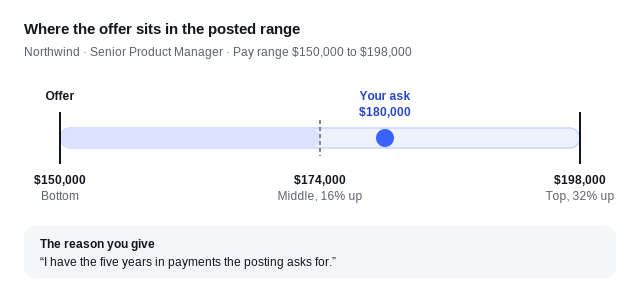
An illustration with a made-up range of the typical width in our count. The numbers are made up. Ask once, on a call or by email
You can negotiate either way, and career guides disagree on which is better. A call feels warmer, and an email gives you time to choose your words and leaves a record. Our advice: if they called you with the offer, ask for time on the call, then send your counter by email, replying on the offer thread. Start with why you want the job, give your number and your reason, and end with a simple question, then wait.
Handle the reply: yes, part of it, or best and final
If they say yes, thank them and ask for the new offer in writing. If they meet you partway, decide whether it works for you, and we'd stop negotiating after one counter. If they say the offer is final, or it's at the top of the range, ask about the rest of the package. An early pay review is another ask, which CareerOneStop suggests too. A few employers say in the posting that they don't negotiate pay, so ask about the package instead.
Get the final offer in writing before you resign
Before you accept, read the updated offer: base pay, bonus, equity, start date and anything else you agreed. Only then accept it, and only then hand in your notice where you work now.

Salary negotiation email templates, and what to say on the call.
Use these to negotiate in writing or on the phone. Swap the [square brackets] for your details. Reply on the offer email, so it stays in one thread. Keep every reason true, and use only numbers you really have.
Counter with a number
The most common one. Use it when the offer is below the number you picked in step 3.
Hi [First name],

Thank you again for the offer for the [Job title] role. I'm excited about joining [Team] and working on [one thing from the job].

Before I sign, I'd like to ask about the base salary. Given [your reason, such as my five years in payments, which the posting asks for], I was hoping for [your number]. If you can get there, I'm ready to accept.

Is that something you could do?

Thanks,
[Your name]
Counter on the whole package
When they've said the base is fixed, or the offer is already at the top of the range.
Hi [First name],

Thanks for explaining where the base salary sits. I understand, and I'm still keen to join.

Could we look at the rest of the offer instead? A sign-on bonus of [amount] would close most of the gap for me. I'd also like to ask about [one more item, such as a start date of June 2, or a pay review after six months].

If we can agree on that, I'm happy to go ahead.

Best,
[Your name]
When they say “let me check”
If it's been a few business days since they said they'd check with the team.
Hi [First name],

I hope your week is going well. I wanted to check in on the offer for the [Job title] role, after we spoke on [day].

I'm still very excited about it. Is there anything else you need from me, or a date I should expect to hear back?

Thanks,
[Your name]
What to say on the call
If you'd rather ask by phone, or HR calls you to talk it through.
Thank you, I'm really glad you called, and I want to make this work.

I've looked at the offer, and I'd like to ask about the base salary. Given [your reason], I was hoping for [your number]. Is there a way to get there?

[Then stop, and let them answer.]

If the base can't move, could we talk about [a sign-on bonus, the start date or a pay review]?
Job offer negotiation beyond base pay, when the salary won't move.
Base pay isn't the whole offer. For US private employers in June 2026, wages and salaries were 70% of what they spent on pay and benefits, says the Bureau of Labor Statistics. Benefits were the other 30%.
So if the base is fixed, ask about the rest. You can negotiate a sign-on bonus, equity or stock, and your start date. Remote days, the job title, paid time off, relocation costs, a training budget and a pay review after six months are all fair to ask about too.
Pick one or two, not all of them. Our advice: ask for the one or two that matter most to you, in one message. A long list makes it harder for them to say yes to anything.
Read the offer for what's missing. If it doesn't mention a bonus, equity or benefits, ask what's included. Asking a question isn't a counter.
Asked for a number before the offer? That's a different question.
If an application form or a recruiter asks for your salary expectations, you're not negotiating yet. You're giving a number that keeps you in the running. Our guide on what to put for desired salary covers that step, with answers to copy.
Whatever you said then, you can still negotiate once the offer is in writing. A new reason, such as what you've learned about the job in the interviews, is a fair one to give.
What not to say when negotiating salary, and what to say instead.
Say this
- “I'm excited about this role.” Start with it, and mean it.
- One number, with one true reason from the posting.
- “Is that something you could do?” A question, not a demand.
- “Could I have until Thursday?” Time to think is normal.
- “Could we look at the rest of the offer?” when the base is fixed.
- “Could you send that in writing?” before you accept.
Not this
- An invented offer from another company. Bad-faith asks are one of the usual reasons an offer is pulled.
- “Take it or leave it.” Our advice is that an ultimatum turns a question into a test.
- “Is this negotiable?” It invites a no. Ask for your number instead.
- “I need more because my rent went up.” Give reasons about the job, not your bills.
- A number far above the posted range, with no reason.
- “Yes” on the call, before you've seen the offer in writing.
Questions about negotiating salary, answered.
Is it okay to negotiate your salary?
Yes. Once you have an offer, one polite ask with a reason is normal, and most people who ask get more: about 2 in 3 in Pew's 2023 survey. It's also okay not to, if the offer already meets your number. Some jobs have more room than others, but a polite ask rarely costs the offer. Younger workers were the least comfortable asking in Pew's survey: 46% of those aged 18 to 29 who didn't ask said so.
How do you negotiate a salary without endangering a job offer?
Wait until the offer is in writing, say you want the job, and ask once for one number with a reason. Don't give an ultimatum or mention an offer you don't have. Pulled offers are rare: in Hart, Bear and Ren's 2024 study, hiring managers reported 1.73 offers withdrawn after a candidate negotiated, out of 26.9 they'd made. A decent employer that can't pay more says the offer is firm.
What is the 70/30 rule in negotiation?
It's a rule of thumb, with no research behind it. Umbrex, a consulting firm's site, gives it for first client meetings, where you let the other side talk about 70% of the time and spend most of your 30% asking questions. Using it for negotiation is our reading. On an offer call, that means asking what's flexible and when they need an answer, then making your one ask.
How do you increase your salary?
Two ways: negotiate when you get a new offer, or ask for a raise where you are. Changing jobs has tended to pay more. In the Atlanta Fed's Wage Growth Tracker for September 2026, median pay growth was 4.7% for people who changed jobs and 3.4% for those who stayed. To ask for a raise, use the same evidence as here: what the market pays for your role, and what you've delivered.
What is the #1 rule of salary negotiation?
There's no official one. The rule nearly every guide shares, and our pick, is to wait for the offer and get it in writing before you negotiate. Before then there's nothing to negotiate. After that, ask once, with one number and a reason.
What is a common mistake in salary negotiation?
Not asking at all. In Pew's survey, most workers didn't ask for more at their last hiring, and 38% of those who didn't said they weren't comfortable asking. Other common mistakes are saying yes on the call, asking before there's an offer, and giving a number with no reason. The list above has what to say instead.
How much money can you make negotiating a job offer?
It depends on the job and the range. In Pew's survey, 28% of those who asked got what they asked for, and 38% got more than the first offer but less than they asked. In one study of well-paid tech job seekers, those who countered got about 12% more on average. You'll often see “ask for 10% to 20% more”, but that's a rule of thumb. Our advice is to anchor on the posted range: its middle was typically about 16% above its bottom in our count.
What are 5 tips for negotiating salary?
Wait for the written offer and ask for a day or two. Find your evidence, starting with the posted range, and pick one number with one true reason. Negotiate once, warmly, by call or email. Get the final terms in writing before you accept. The six steps above add one more: how to handle their reply.
Is it OK to negotiate salary by email?
Yes. Negotiating by email lets you choose your words, and it leaves a record of what was agreed. Some guides prefer a call because it feels warmer. Our advice: thank them on the call, then send your counter by email on the offer thread. The first template above is a good place to start.
What do I say if they ask for my current salary?
You don't have to share it. Some states bar employers from asking about your pay history, including California, New York, Washington and Massachusetts. You can say, “I'd rather focus on what this role pays. Based on the range, I'm looking for [your number].” In New York, the law lets you share it if you choose to, to negotiate.
Where the facts come from.
Checked on November 12, 2026. The advice is ours, and where a line is our reading we say so. Survey and study figures come from each publisher's own page, linked below. Blynk's count: 1,477 job postings from Blynk's searches, mostly senior product roles, first seen October 31 to November 11, 2026, counted on November 12. 618 listed a yearly range. We took the first dollar range in each, with a bottom of $30,000 or more and a top above the bottom, and divided the top by the bottom. Some postings list several cities' ranges, a few give total pay rather than base, and long postings can be cut off, so ranges near the end may be missed. A posted range shows the band for the job, not where offers land in it.
- What to put for desired salary
- Pay transparency laws by state
- Follow-up email after an interview
- What DOE salary means
- An executive job search, step by step
- How to decline a job offer
- What a salary range means
- How to get a job in another state
- What OTE means in a job posting
- When a job offer is rescinded
- George Mason University: Hart, Bear and Ren on negotiating job offers (July 2024)
- Harvard Business Review: negotiating is unlikely to jeopardize your job offer (May 2024)
- Hart, Bear and Ren (2024), Organizational Behavior and Human Decision Processes 181
- Pew Research Center: most US women and men don't ask for higher pay (April 2023)
- Fidelity: 2022 Career Assessment Study
- NBER Working Paper 33903: Pushing the Envelope, the effects of salary negotiations (2025)
- UCLA Anderson Review: most job seekers skip negotiation (October 2025)
- NBER Digest: Hall and Krueger on wage bargaining
- Bureau of Labor Statistics: compensation costs, June 2026
- Ask a Manager: job offer rescinded after I tried to negotiate (February 2025)
- CareerOneStop (US Department of Labor): negotiate your salary
- Atlanta Fed Wage Growth Tracker on FRED: job switchers
- Atlanta Fed Wage Growth Tracker on FRED: job stayers
- Umbrex: the 70:30 squared rule for first client meetings
- California Labor Code 432.3 (salary history)
- New York Labor Law 194-a (salary history)
- Washington RCW 49.58.100 (salary history)
- Massachusetts General Laws c.149 §105A (salary history)
