
How to decline a job offer. Kindly, in writing, even after you said yes.
Turning down an offer after a long search can feel reckless, and doing it after a yes feels worse. Both are more common than you'd think. Here's how to decide, what to say in each case, and what the surveys show about backing out.

The short answer
- Decline soon, kindly, and in writing. Thank them, say no plainly, and give one short reason or none. If you've met several people, call first, then confirm by email.
- Already said yes? You can still back out. In a 2019 Robert Half survey, 28% of the US office workers it asked said they had. Call first, apologize once, and check what you signed.
- Not sure yet? Ask once before you say no. Ask for more time, with a date, or ask about pay. Taking another job? Get that offer in writing before you turn this one down.
On this page
Why saying no to a job offer feels hard, and what's really true.
Four worries people have about turning down an offer, and what the sources say about each one.
“Is it rude to decline by email?”
No. Handshake's guide says email is fine, and it gives the recruiter a written record. It suggests a call first if you mostly spoke by phone. Several top guides say the same when you've met a lot of people.
What to do: Email is fine. If you built a real rapport, call first, then confirm in writing.
“Do I have to give a reason?”
No. The top guides we read, from Handshake to Indeed, agree that one short reason is enough, or none at all. Saying you've accepted another offer is plenty.
What to do: One line, or none. If it's the pay, you can say so plainly.
“Will I burn the bridge?”
We found no source for a shared blacklist. But the company keeps its own record. Greenhouse, a hiring system, files your answer under "They rejected us", with reasons like "Accepted offer at another company - Compensation". If you apply again later, it flags you and shows the recruiter that reason.
What to do: Leave a good last note. It may be what they read next time.
“I signed the offer letter. Am I locked in?”
Usually not, in the US. Most jobs are at will, which means either side can end them. Montana is the only state that doesn't presume it, says the National Conference of State Legislatures. Job-Hunt adds that a signed offer letter is generally not a binding contract. A signed employment contract is different.
What to do: Read what you signed. Look for repayment terms, and ask a lawyer about a contract. This isn't legal advice.
Before you decline a job offer, ask for what would change your answer.
Is it the pay, or the job? Our advice: if it's the work, the manager or the commute, decline. More money won't change those.
If it's the pay, ask once before you say no. Handshake's guide gives a salary decline email only for after you've negotiated. Our guide to negotiating salary after an offer has the words to use.
Waiting on another offer? Ask for more time. In NACE's 2023 survey of employers, students took about 11 days on average to accept an offer, down from 14 days before the pandemic. These are entry-level hires, so treat it as a benchmark, not a rule. UW's career center also suggests asking for more time rather than rushing.
How to ask. Ask once, name the date you'll answer by, and give a short reason. There's an email for it below.
Is the other offer real yet? A good interview isn't an offer, and a phone call isn't a written one. Our advice: don't turn down a written offer for one you're still hoping for. To nudge the other company, send a short follow-up email after the interview.
How to decline a job offer, in six steps.
This works for any offer, by email or by phone.
Be sure, and get the other offer in writing
If you're declining for another job, wait until that offer is in writing, and accept it first. That way you're never left with none. That's our advice.
Tell them soon
Handshake says to reply "ideally within a day or two" of deciding, and not to wait for the deadline. Career Sherpa says within 24 hours if you can. The sooner you tell them, the sooner they can call their next choice.
Call or email the person who made the offer
That's usually the recruiter or the hiring manager. Email is fine. If you've met several people, or you mostly spoke by phone, call first and then send the email.
Came through an agency? Tell the agency recruiter too, so they hear it from you. That's our advice.Thank them, and say no in the first lines
Start with thanks for the offer and their time. Then say you're declining, plainly, in the first two or three lines. Don't make them read to the end to find out.
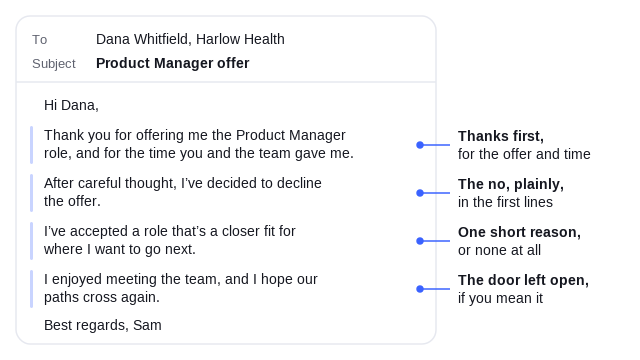
An illustration with made-up names. Four short parts, and nothing else. Give one short reason, or none
"I've accepted another offer" is enough. Guides split on pay. Indeed's says to leave it out, and others say to name it. Our advice: if pay is the reason, say so in one plain line. You don't need to give a number.
Leave the door open, if you mean it
Say you'd like to stay in touch, and offer to connect on LinkedIn. Keep it true. There's more on keeping the door open below.

How to decline a job offer by email, with four templates to copy.
Each one is short on purpose. Swap the [square brackets] for your details, and send it to the person who made the offer.
Decline a job offer, simple
You've accepted another job, or the role isn't right. Subject line, [Job title] offer
Hi [Name],

Thank you for offering me the [Job title] role, and for the time you and the team gave me.

After careful thought, I've decided to decline the offer. I've accepted a role that's a closer fit for where I want to go next.

I enjoyed meeting the team, and I hope our paths cross again.

Best regards,
[Your name]
Decline a job offer over salary
Only after you've asked about pay once and they couldn't move. Subject line, [Job title] offer
Hi [Name],

Thank you for taking another look at the salary for the [Job title] role. I know you went back to the team for me, and I appreciate it.

I've decided to decline the offer. The pay is the reason, and I understand the number is where it needs to be for you.

I really liked [one thing about the team or the work]. If the budget changes, I'd be glad to hear from you.

Best regards,
[Your name]
Decline, but keep the door open
To a hiring manager you'd like to work with one day. Subject line, Thank you, [Name]
Hi [Name],

Thank you for the offer for the [Job title] role. Saying no was harder than I expected.

I've decided to [stay in my current job / take another offer] for now. [One line on why, if you want to give one.]

I'd like to stay in touch. May I connect with you on LinkedIn? If a role like [the kind of role] opens up later, I'd love to be considered.

Best,
[Your name]
Ask for more time
Once, before the deadline. Subject line, [Job title] offer, timing
Hi [Name],

Thank you for the offer for the [Job title] role. I'm excited about it, and I want to give it the thought it deserves.

Could I have until [day and date] to give you my answer? [I'm finishing another interview process and want to make one clear decision. / I'd like to talk it over with my family.]

If that date doesn't work for you, please let me know what would.

Best,
[Your name]
Can you decline a job offer after accepting it? Yes. Here's what the surveys show.
In a Robert Half survey released in May 2019, 28% of professionals said they had backed out of a job offer after accepting it. It asked more than 2,800 US workers in office jobs, in 28 cities.
HR Dive's report on the survey lists the top reasons. A better offer came in (44%). Their current employer made a counteroffer they could accept (27%). Or they heard bad things about the company (19%).
New graduates do it too. In NACE's 2023 survey, employers said students reneged on 8% of the entry-level offers they had accepted, down from 8.7% the year before.
Robert Half's Michael Steinitz told NerdWallet that declining an offer you've accepted is "completely acceptable". How you do it is what people remember. The four steps below are the careful way.
How to back out of a job offer you accepted, in four steps.
Do them in this order, on the same day if you can.
Check what you signed
Job-Hunt says a verbal yes can be undone with a phone call, and a signed offer letter is generally not a binding contract. Most US jobs are at will. A signed employment contract is different. Job-Hunt and NerdWallet both suggest talking to an attorney then. This isn't legal advice.
Got a signing bonus or relocation money? Read the repayment terms. They vary, from paying it all back to a share based on time, and California, for one, limits them.Tell them as soon as you're sure
Every day you wait, they may turn away other candidates and start getting ready for you. That's our reading. If you're a student, check your career center's rules. UW's says reneging can cost you future chances with that employer, and employers may stop recruiting at the school.
Call the person who made the offer
Steinitz told NerdWallet that emailing instead of calling can be "a little bit of a cop-out". Say it plainly, apologize once, and give a short reason. If your current employer made you a counteroffer, you can say that.
Can't reach them? Leave a short voicemail asking them to call you back. Then send the email, so they hear it from you that day.Confirm it by email, the same day
NerdWallet suggests an email after the call, for the record. Keep it short, and offer to sort out anything you need to return or sign. Two examples follow.
How to decline a job offer after accepting, two example emails.
Send one after your call, not instead of it. Swap the [square brackets] for your details.
After accepting, for a better offer (example)
Call first, then send this the same day. Subject line, [Job title] offer, an update
Hi [Name],

Thank you for taking my call today. As I said, I've decided not to join [Company] as [Job title], even though I accepted your offer on [date].

I've accepted another role that fits my goals more closely. I know this makes real work for you and the team, and I'm sorry. I wanted to tell you as soon as I knew.

[If anything needs to be returned or repaid under my offer letter, tell me and I'll take care of it.]

Thank you again for your time and trust.

Best regards,
[Your name]
After accepting, because of a counteroffer (example)
Your current employer asked you to stay. Call first, then send this. Subject line, [Job title] offer, an update
Hi [Name],

Thank you for speaking with me today. I'm writing to confirm that I won't be joining [Company] as [Job title], though I accepted your offer on [date].

When I gave notice, my current employer asked me to stay, and I've decided to accept. I'm sorry for the trouble this causes, and I wanted you to know right away.

[If anything needs to be returned or repaid under my offer letter, tell me and I'll take care of it.]

Thank you for your time and understanding.

Best regards,
[Your name]
How to turn down a job offer and still be considered later.
The company keeps a note. Hiring systems record why a candidate said no. Greenhouse lists reasons such as "Accepted offer at another company - Compensation", and shows the recruiter that reason if you apply again. Ashby's guide lists "Accepted other offer" and "Offer Reneged". It also suggests teams look up past candidates by that reason to reach out again.
We found no shared blacklist. But people remember. UW's career center notes that recruiters may remember you, more so in small industries.
Our advice, in three moves. Give a true, simple reason they can record. Ask the hiring manager if you can stay in touch, and connect on LinkedIn. Then check in once in a while with something real, like a note on a launch, not only when you need a job.
If they come back with more money, say plainly whether it changes your answer. If it doesn't, thank them and let it rest. That's our advice too.
How to accept a job offer by email, once the terms are in writing.
If you're taking another offer, accept that one first, in writing. Then decline the rest. That's our advice.
Get the offer in writing, and check it. Look at the title, base pay, any bonus or equity, start date, where you'll work, and when benefits begin. Also check whether the offer depends on anything, like a background check. That's our advice.
Know what the letter isn't. Most US jobs are at will, so an offer letter usually isn't a promise of a job for a set time. Job-Hunt adds that a signed offer letter is generally not a binding contract. This isn't legal advice.
Settle the terms first, then say yes. Mailmeteor says the acceptance email is for saying yes to the offer as it is, so negotiate first. Restate the title, pay and start date instead, as Huntr and the Business Writing Blog also suggest. A common subject line is Job Offer Acceptance, then your name.
Then close the rest. UW's career center says to stop applying once you accept. Decline any other offers, and withdraw your other applications with a short note.
Job offer acceptance email templates, two to copy.
Short on purpose. Swap the [square brackets] for your details.
Accept, and confirm the terms
Once the offer is in writing. Subject line, Job Offer Acceptance, [Your name]
Hi [Name],

Thank you for the offer. I'm happy to accept the [Job title] role at [Company].

To confirm what we agreed, the base salary is [amount] a year, [plus the bonus or equity, if any], and my start date is [date]. I'll be working [on site in city / remotely / hybrid].

Please let me know what you need from me before then, such as [paperwork or a background check form]. I'm looking forward to joining the team.

Best regards,
[Your name]
Accept after saying yes on the phone
The same day as the call. Subject line, Accepting the [Job title] offer
Hi [Name],

Thank you for the call today. I'm writing to confirm that I accept the [Job title] offer.

As we discussed, my start date is [date] and the salary is [amount]. Could you send the offer letter, if it isn't on its way already, so I can sign it?

I'm excited to get started.

Best,
[Your name]
Declining a job offer, do this, not that.
Do
- Reply soon, once you're sure.
- Thank them, by name.
- Say no in the first few lines.
- Ask once about pay or timing before you decline.
- Call first if you've already accepted.
- Accept your new offer in writing before declining this one.
Don't
- Go silent, or let the deadline pass.
- Give a long reason, or criticize the company.
- Hint you'd take more money if you wouldn't.
- Back out of an accepted offer by email alone.
- Keep applying after you've accepted.
Questions about declining a job offer, answered.
How do I politely decline a job offer?
Reply soon, once you're sure, and keep it short. Thank them for the offer and their time. Say you're declining in the first few lines, and give one short reason or none. Close by saying you'd like to stay in touch, if you mean it. Handshake suggests replying ideally within a day or two of deciding.
How to politely reject a job offer example?
Here's a short one. "Thank you for offering me the [Job title] role. After careful thought, I've decided to decline. I've accepted a role that's a closer fit for my goals. I enjoyed meeting the team, and I hope our paths cross again." There are more emails to copy above, for pay, more time and keeping the door open.
How do I decline an offer of employment?
The same way as any job offer. Write to the person who sent it, usually the recruiter or the hiring manager. Thank them, say you're declining, and keep the reason to a line. If you've met several people, call first, then confirm by email.
Can I reject an offer after accepting it?
Yes. In a 2019 Robert Half survey, 28% of the US office workers it asked said they had backed out of a job offer after accepting it. Robert Half's Michael Steinitz told NerdWallet it's "completely acceptable". Call first, then confirm by email. If you signed a contract, NerdWallet suggests talking to an attorney.
I accepted a job offer but changed my mind. What should I do?
Tell them as soon as you're sure. First check what you signed, especially any repayment terms for a signing bonus or relocation money. Then call the person who made the offer, apologize once, and follow up by email the same day. There are two example emails above.
How do you say no thank you to a job interview?
The same way, only shorter. Thank them for the invitation, say you're withdrawing, and give a reason only if you want to. Do it as soon as you know, so they can offer the time to someone else. Our guide on how to withdraw a job application has short emails for each stage.
Is it rude to decline a job offer by email?
No. Handshake says email is fine, and it leaves a record. If you've met several people, or mostly spoke by phone, call first and then confirm by email. After you've accepted, the call matters more. Robert Half's Michael Steinitz calls email alone "a little bit of a cop-out" then.
How long do I have to respond to a job offer?
Until the deadline in the offer, if it has one. If there's no deadline, ask for one. As a benchmark, NACE's 2023 survey found students took about 11 days on average to accept an entry-level offer. Once you've decided, Handshake says to reply ideally within a day or two.
What if they offer more money after I decline?
Decide whether it changes your answer, and say so plainly. If pay was the only reason, it may. If it wasn't, thank them and say your answer stands. Don't reopen talks you don't mean to finish. That's our advice.
Should I call or email to accept a job offer?
Either works, but get it in writing. If you say yes on the phone, send a short email the same day that restates the title, pay and start date. Huntr and Mailmeteor both suggest putting those terms in the email.
Where the facts come from.
Checked on November 12, 2026. The advice is ours, and we say so where it matters. Survey numbers come from the survey named, with its year and who it asked. Nothing here is legal advice.
- How to withdraw a job application
- How to negotiate salary after an offer
- Follow-up email after an interview
- Free job application tracker template
- Job search burnout
- How to ask someone to be a reference
- When a job offer is rescinded
- How to give two weeks notice
- Robert Half: Cold Feet survey shows 28% of professionals renege on job offer after accepting (May 15, 2019)
- HR Dive: nearly one-third of candidates back out after they've accepted a job offer (2019)
- NACE: 2023 Recruiting Benchmarks Report, executive summary
- NerdWallet: how to decline a job offer after you already accepted (updated October 7, 2025)
- Job-Hunt: how to decline a job offer
- National Conference of State Legislatures: at-will employment overview
- University of Washington Career Center: how to handle multiple job offers
- Handshake: how to decline a job offer
- Career Sherpa: how to decline a job offer (April 24, 2023)
- Indeed career guide: how to decline a job offer, with email examples (updated June 15, 2026)
- Greenhouse: strategic use of rejection reasons (updated March 2, 2026)
- Ashby: managing and analyzing archive reasons (July 10, 2025)
- Huntr: how to accept a job offer (January 20, 2026)
- Mailmeteor: how to accept a job offer by email (February 5, 2024)
- Business Writing Blog: how to accept a job offer via email or letter (August 12, 2026)
- Terms.law: signing bonuses, clawbacks and training costs
