
Job offer rescinded? What to do now, and how to protect the next one.
Losing an offer after the hard part is over is a gut punch, and worse if you already gave notice. Here's what to do in the first few days, the rights you have if a background check was the reason, and how the offer stage works.

The short answer
- In most of the US, a company can rescind a job offer, even after you accept. Most jobs are at will. But it can't be for an illegal reason, such as discrimination, and a signed contract changes things.
- Ask why, in writing. If a background check played a part, the FTC says you get a copy of the report and a summary of your rights before they turn you down. You can dispute errors.
- Already quit or moved for it? Contact your state's unemployment office and an employment lawyer. Next time, don't resign until every condition in the offer letter is cleared.
On this page
Why a rescinded job offer hurts so much, and what's really true.
Four worries people have when an offer is pulled, and what the official pages and career offices say.
“Can they even do that?”
Usually, yes. Most US jobs are at will, which means an employer can end them at any time for any reason that isn't illegal. Montana is the only state that has done away with the at-will rule, says the National Conference of State Legislatures.
What to do: Assume it's legal at first. Then check the two big exceptions below, an illegal reason and a contract.
“Was it something I did?”
Often not. Michigan State's career network lists the common reasons. Budget cuts and hiring freezes, a reorganization that removes the role, a problem in a background check, and missteps by the candidate.
What to do: Ask, once, in writing. iHire notes employers don't have to give a reason, but you're free to ask.
“I already quit my job.”
This is where the cost is real. Unemployment rules differ by state, says the US Department of Labor. The law also has a rule called promissory estoppel, which can let people recover losses when they reasonably relied on a promise.
What to do: Write down what it cost you. Then call your state's unemployment office and an employment lawyer. This isn't legal advice.
“The background check got it wrong.”
You have rights here. The FTC says an employer must give you a copy of the report and a summary of your rights before rejecting you because of it. You can dispute anything wrong with the company that made the report.
What to do: Ask for the report. Then dispute errors with the background company, in writing.
Can a company rescind a job offer? Usually, yes. Here are the limits.
MIT's career office puts it plainly. “Short answer? Yes. A job offer can absolutely be pulled”. It adds that most reasons are legal, even when they feel unfair.
The rule underneath it is at-will work. An employer “can terminate an employee at any time for any reason,” says the National Conference of State Legislatures, as long as the reason isn't illegal. Michigan State's career network says most offers are at will too.
Limit 1, an illegal reason. An offer can't be pulled because of race, national origin, age, disability, gender or religion, among other protected traits. The EEOC says an employer must treat you the same as anyone else in a background check.
Limit 2, the background check rules. If a report from a background company is the reason, federal law sets steps the employer must follow first. They're in step 3 below.
Limit 3, medical questions. Under the ADA, an employer can't ask about disabilities or require a medical exam before an offer. After a conditional offer it can, if everyone hired into that job gets the same, says the EEOC.
Limit 4, a contract or a promise. A signed employment contract is different from an offer letter. The NCSL says 41 states and DC recognize implied contracts, and promissory estoppel can cover losses after relying on a promise. A lawyer can tell you if either fits your case.
How often does it happen? Michigan State's career network says rescinded offers “are not the norm,” and that reliable data is limited. We found no current survey we'd trust, so we don't give a rate.
Pulled after you negotiated? It's rare, and our guide to negotiating salary after an offer has the research. Want to back out of an offer yourself? That's a different case, covered in how to decline a job offer.
What to do if your job offer is rescinded, in six steps.
Do the first four in the first few days. They cost nothing, and they keep your options open.
Pause before you reply
Michigan State's career network says to take time to process it and avoid reacting on impulse. Our advice: a calm reply keeps the door open for a later role.
Ask why, in writing
Send a short email asking for the reason. iHire says employers “are not required to provide a reason,” but you're free to ask. Also ask if the start could be pushed back, or if another team has a role. Michigan State suggests both.
Keep it to the facts. A written answer, even a vague one, helps if you later talk to a lawyer or the unemployment office.If a background check played a part, ask for the report
This is a rule under the Fair Credit Reporting Act. The FTC says the employer must give you a copy of the report and a “Summary of Rights” before turning you down because of it. Once it decides, it must give you the background company's name, address and phone number.
Found a mistake? Dispute it with the background company, with papers that prove it, and ask it to send the corrected report to the employer. You can get one more free copy, but you must ask “within 60 days of the employer's decision,” the FTC says.Write down what you signed and what it cost you
Two questions matter most. Did you sign a written contract or a relocation agreement? Did you spend money because of the offer, like quitting a job or moving? If yes, or if you think the reason was discrimination, talk to an employment lawyer.
Two official routes. The EEOC takes discrimination complaints (800-669-4000). The FTC takes reports at ReportFraud.ftc.gov about a check run without your permission, without the notices, or with errors. This isn't legal advice.Already left your job? Call the unemployment office
“Each state sets its own unemployment insurance benefits eligibility guidelines,” says the US Department of Labor. It also says to contact your state's program as soon as possible.
Left on good terms? Our advice: send your old manager a short, honest note. Your old role may not be filled yet.Restart the search this week
Our advice: don't wait for the company to change its mind. Write to anyone you paused talks with, and say you're available again. Then pick a few roles you fit well, rather than many you don't.
Job offer rescinded? Three replies to copy and send.
Short and calm on purpose. Swap the [square brackets] for your details. Reply to the person who told you.
Ask why, and keep the door open
The day after you hear. Subject line, [Job title] offer
Hi [Name],

Thank you for letting me know about the [Job title] offer. I was looking forward to joining the team, so this is hard news.

Could you tell me the reason for the decision? It would help me understand what happened and plan my next steps.

If the role opens again, or another team needs someone with my background, I'd be glad to hear from you.

Best regards,
[Your name]
Ask for the background check report
If the call or email mentioned a background check. Subject line, Background check for the [Job title] offer
Hi [Name],

Thank you for your call today about the [Job title] offer.

You mentioned the background check. Could you send me a copy of the report the decision was based on, along with the name and contact details of the company that prepared it? I'd like to check it for errors.

If anything in it is wrong, I'll correct it with the company and send you the updated report.

Thank you,
[Your name]
Ask about a later start or another role
If the reason was budget, a freeze or a reorganization. Subject line, [Job title] offer, a question
Hi [Name],

I understand the [Job title] role is on hold because of [the budget / the reorganization]. Thank you for telling me directly.

Would a later start date be possible if the budget comes back? And if another team has a role that fits [my experience in your area], I'd welcome an introduction.

I enjoyed meeting [names], and I'd still like to work with them.

Best regards,
[Your name]
How a job offer works, from verbal offer to your first day.
iHire notes an employer can rescind an offer at any point in hiring, even after you accept. Here's each stage, and what to do at it.
The verbal offer, good news but not yet a promise
A call that says “we'd like to offer you the job” is good news, but get it in writing. iHire says employers “may be less likely to rescind your job offer” when you have it in writing. Our advice: thank them, ask when the written offer will come, and don't resign or turn down other offers yet.
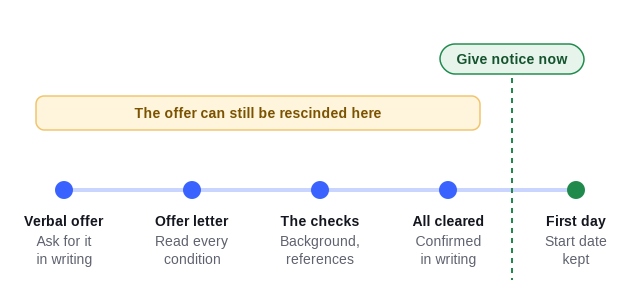
An illustration of the offer stage. The safe time to resign is after every condition is cleared, in writing. The offer letter, what's in it and what to check
Indeed says a conditional offer letter often lists the job and its duties, the salary and benefits, any conditions, and a time limit to meet them. Our advice: check the title, base pay, any bonus or equity, start date, where you'll work, and every condition. Ask about anything vague before you sign.
Ready to say yes? There are acceptance emails to copy in our guide on declining or accepting a job offer.The conditional job offer, what the conditions mean
A conditional job offer depends on you meeting set requirements, Indeed explains. Common ones are a background check, a drug test, reference checks, a certification, a medical exam and proof you can work in the US. What does it mean to accept a conditional offer? Indeed says it can be legally binding once you formally accept, and the employer can still withdraw it if you don't meet the conditions in time. To respond to a conditional job offer, Indeed suggests a call or email saying you understand the conditions and plan to meet them.
The posting rarely warns you. Of 1,535 job postings in Blynk's searches, 31, or about 1 in 50, mention a background check or a drug test. So the conditions usually show up first in the offer letter. Read it for them.The checks, and what they can ask after an offer
Some questions are only allowed after an offer. Under the ADA, medical questions and exams wait until a conditional offer, says the EEOC. In California, the Fair Chance Act generally bars employers with five or more employees from asking about conviction history before a job offer. References come here too, covered in our guide to job references.
Cleared, in writing, then give notice
Our advice: resign only once the employer confirms in writing that every condition is cleared, and you have a start date. An email from the recruiter is enough. Then give notice the usual way, as in our guide to two weeks notice.
Until day one, answer fast and stay in touch
Return forms and paperwork quickly. Michigan State's career network suggests you keep talking with the employer between accepting and starting. A quick check-in every week or two is plenty, by our reckoning.

How long does a background check take for a job? Usually 2 to 5 business days.
The typical range. Indeed's career guide says a check should take “between two and five business days”. HireRight, a screening company, says its average check takes two to four business days.
By type, from Indeed. A criminal check in one state or country takes 1 to 2 business days, and international records can take 20 days or more. Checking past jobs takes 2 to 4 days, or 1 to 2 weeks for work abroad. A credit check takes about 2 to 4 days.
What slows it down. HireRight names past employers or schools it can't reach, courts that are closed or behind, a call about a drug test result, and checks outside the US. Indeed adds wrong details, many past addresses and names you've used before, and says signing the release forms keeps it moving.
What you can do. Sign the release forms the day they arrive, and list every name you've used. Keep a W-2 or pay stub handy, since HireRight may ask for one to prove a past job.
When to ask. Our advice: if a week has passed beyond the time you were given, send the recruiter a short note asking if they need anything from you. Most of the delays HireRight lists come from slow sources, not from anything you did.
What can fail a background check, and how you'd know before a job offer is rescinded.
What disqualifies you from a job in a background check? There's no single list. The EEOC says employers may look at work history, education, criminal records, finances and social media. Each employer decides what matters for the job.
What is a red flag in a background check, and what does a bad one look like? Michigan State's career network names the usual problems. Differences in your employment history, criminal records and credit issues. By our reading, a mismatch between your resume and the record is the one you can prevent.
The limits on how they judge it. The EEOC says a policy that screens out people with certain records can be illegal if it hurts a protected group and isn't “job related and consistent with business necessity”. Some jobs have their own rules by law. Seven JPMorganChase postings in Blynk's searches say the offer is contingent on a review of criminal conviction history, citing Section 19 of the Federal Deposit Insurance Act.
How you'd know there's a problem. Before an employer rejects you because of the report, it must send you a copy and a summary of your rights, the FTC says. That notice is the sign. It gives you a chance to explain or fix things first.
Can you still get hired if you fail a background check? Sometimes. The EEOC says to be ready to explain anything negative and why it doesn't affect the job. If the report is wrong, dispute it with the background company and tell the employer you've done so.
Protecting a job offer before day one, do this, not that.
Do
- Ask for the offer in writing.
- Read the offer letter for every condition.
- Make your resume match your record, dates and titles included.
- Sign background check forms the day they arrive.
- Resign only after the conditions are cleared, in writing.
- Keep the reply calm and in writing if it's rescinded.
Don't
- Quit your job on a verbal offer.
- Guess at dates or titles on the background form.
- Go silent between accepting and starting.
- Post about the new job before your start date is set.
- Argue on the phone if the offer is pulled.
Questions about a rescinded job offer, answered.
Can a company rescind a job offer after you accept it?
Usually, yes, in the US. Most jobs are at will, so an employer can end them for any reason that isn't illegal. It can't be for discrimination, and a signed employment contract may change things. If you quit or moved for the job, talk to an employment lawyer. This isn't legal advice.
Can an employee rescind a job offer?
You can back out of an offer you accepted, yes. It's usually called reneging or declining after accepting. Call first, then confirm by email, and check what you signed. Our guide on how to decline a job offer has the steps and emails.
How do you say rescind an offer?
To rescind an offer means to take it back. Employers also say they withdrew, revoked or pulled it. NACE's surveys of employers, for example, say “revoke”. In an email, “we have decided to withdraw our offer” means the same thing.
Can I decline a job offer after I already accepted it?
Yes. In a 2019 Robert Half survey, 28% of the US office workers it asked said they had backed out of an offer after accepting it. Tell them as soon as you're sure, by phone first. Our guide to backing out has two example emails.
What happens if you back out after accepting a job offer?
Most US jobs are at will, so in most cases the company simply moves on. Our advice: check your offer letter for repayment terms on a signing bonus or moving money, and read our four steps for backing out.
Is it bad to accept an offer and then reject it later?
It isn't ideal, but it happens. Robert Half's Michael Steinitz told NerdWallet that declining an offer you've accepted is “completely acceptable”. Our advice: tell them quickly, call first, apologize once and keep it short.
Does a conditional job offer mean you got the job?
Yes, as long as you meet the conditions. A conditional offer depends on things like a background check or drug test, Indeed explains, and the employer can withdraw it if they aren't met in time. Treat it as a yes that still has steps to clear.
Should you hand in your notice on a conditional offer?
Our advice is to wait. Resign once the employer confirms in writing that every condition is cleared and you have a start date. Until then, the offer can still be withdrawn. If the timing is tight, ask the recruiter when the checks will finish.
Can I back out of a conditional job offer?
Yes. Indeed says you don't have to accept a conditional offer, and you can turn it down before you start on the conditions. Backing out after you accept is covered in our guide on how to decline a job offer.
How do you tell if you passed your background check?
Usually, the employer tells you the conditions are cleared and confirms your start date. If the report is the reason they might turn you down, the FTC says they must first send you a copy and a summary of your rights. If you've heard nothing, ask the recruiter.
Where the facts come from.
Checked on November 13, 2026. Nothing here is legal advice; the rules come from the agencies' own pages, and the advice is ours where we say so. Blynk's count covers all 1,535 job postings in Blynk's searches, mostly senior product roles, first seen October 31 to November 12, 2026, counted on November 13. 31 postings name a background check, background investigation, drug test or drug screen; we read a sample by eye. Postings that only say “pre-employment checks” aren't counted, and a posting that says nothing may still lead to a check.
- How to decline a job offer
- How to negotiate salary after an offer
- Job references
- Two weeks notice
- Hiring freeze
- National Conference of State Legislatures: at-will employment overview
- FTC: employer background checks and your rights (August 2025)
- FTC: background checks, what employers need to know
- EEOC: background checks, what job applicants and employees should know
- EEOC: guidance on disability-related questions and medical exams before and after an offer
- California Civil Rights Department: Fair Chance Act
- US Department of Labor: unemployment insurance
- Cornell Law School, Legal Information Institute: promissory estoppel
- Michigan State University Career Services Network: what to do if your job offer is rescinded (January 25, 2025)
- MIT CAPD: what to do if your job offer is rescinded
- iHire: what to do if your job offer was rescinded (September 14, 2022)
- Indeed career guide: what is a conditional employment offer (updated June 15, 2026)
- Indeed career guide: how long pre-employment background checks take (updated June 15, 2026)
- HireRight candidate support: how long does a background check take
- NerdWallet: how to decline a job offer after you already accepted (updated October 7, 2025)
- Robert Half: Cold Feet survey, 28% of professionals renege after accepting (May 2019)
- NACE: COVID-19 quick poll series report (2020), on revoking offers
