
How to get a job in another state. Before you've even moved.
If your applications to jobs in another state keep going quiet, there's usually a question nobody asks out loud. Will you really come, and when? Here's how to answer it on paper, search a city you don't live in yet, interview from afar, and ask about help with the move.

The short answer
- Say where and when you're moving. Put “Relocating to Denver, CO, March 2027” where your address goes, and put the move and its reason in your cover letter's first lines.
- Search the new city, and remote jobs open to people there. Set the location filter and alerts, and read each posting's location and relocation lines before you apply.
- Interview by video first. Ask about help with the move at the offer. Many employers accept video interviews early on. Help with the costs is worth asking about once they want you, and worth getting in writing.
On this page
Why out-of-state applications go quiet, and what helps.
Five things people say about job hunting from another state, what's really going on, and the change that helps.
“I never hear back from out-of-state jobs.”
Indeed's career guide says some hiring managers prefer local candidates. A resume from far away raises two questions. Will you really move, and when could you start?
What helps: Answer both before they ask. A relocation line with a month and year, and one sentence on why.
“Do I need a local address?”
Advice is split. In our view, an address you don't live at causes more trouble than it saves.
What helps: Be clear, not local. “Relocating to [City], [State], [Month Year]” tells them what they need to know.
“The software throws out my address.”
We found no source showing that hiring systems reject people by address on their own. But some forms ask if you'll relocate, and some postings say who they want, such as “Must be based in (or willing to relocate to) NYC.”
What helps: Answer the question they ask. If you'll move, say yes, and give the month.
“Will they pay for me to move?”
Sometimes. In 1,535 postings from Blynk's searches, 7 clearly offered help with a move, and 10 said plainly there was none.
What helps: Plan to pay, and ask anyway. Ask once they want you, and get the answer in writing.
“Do I move first, or get the job first?”
Both work for some people. Moving first makes you local but uses savings. Searching first keeps your income.
What helps: Decide by your savings and your field. The section on relocating below walks through it.
How to get a job in another state, in seven steps.
The order matters. Decide the move, search where the jobs are, then make every application answer “will you really come, and when?”
Pick the place, the date and the reason
Employers want to know you'll really come, and when. So before you apply, decide the city or area, the month you'll be there, and one honest sentence on why. To size up a state's job market, the Bureau of Labor Statistics publishes unemployment rates by state every month. The Bureau of Economic Analysis compares prices by state.
For example, “Moving to Denver in March 2027 to be near family.” Not “I'm thinking about Colorado.”Find a job in the new city, and remote roles that hire there
Set the job board's location to the new city and turn on alerts for it. On LinkedIn, add the city under Locations in your Open to work preferences; LinkedIn says a preferred location helps recruiters find you. Look at companies with offices both where you live and where you're going, including your own employer, and ask about a transfer. Remote jobs open to people where you're headed count too. Our guide to finding remote jobs shows how to check where one can be done from.
Read the location and relocation lines first
Before the title or the pay, read where the job is and what the posting says about the move. Some offer help. Some say plainly there's none. Many ask you to be local or willing to relocate, and don't say who pays. If a posting doesn't say, ask before you spend an evening on it.
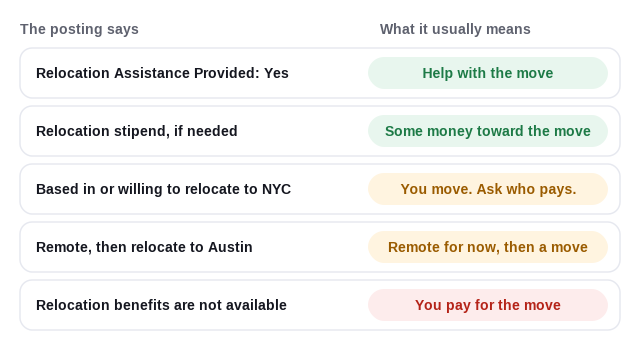
An illustration of five relocation lines and what each usually means. The wording is typical of postings Blynk counted; the meanings are our reading, so ask when it matters. Put the move on your resume and LinkedIn
Where your address goes, write the city you're going to and the month. Indeed's guide suggests a “Relocating to” line with the month and year, or leaving your address off if it isn't local. Don't borrow an address you won't live at. In our view, it comes apart at the first interview, the offer letter or the background check. Change your LinkedIn location once the move is certain.
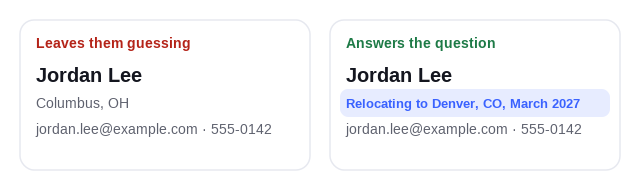
Two headers for the same made-up person. The second answers the question before anyone has to ask it. Say where, when and why in the cover letter
Open with the move, then get to the job. Use firm words. Cultivated Culture's guide warns that words like “considering” or “like to” make employers doubt you'll come. Then say when you can interview, and when you could start. There are opening lines to copy below.
Network with people who live there
Tell people you know that you're moving, and where. Search LinkedIn for people in your field in the new city, including alumni of your school, and ask for a short call, not a job. Local recruiters who fill roles there can help too. When a role comes up, write to the person hiring for it. Our guide to finding the hiring manager shows how.
Interview by video first, then travel
Ask for first rounds by video. The Muse notes that many employers accept virtual interviews, especially early on. If they invite you in person, ask who books and pays for the trip before you buy a ticket. That's our advice, not a rule, and it saves an awkward receipt later. Be flexible about their time zone.


How to apply for jobs out of state, with lines to copy.
Swap in your own city, month and job. Use only the lines that are true for you.
Resume header, three ways
Under your name, where your address would go. Pick one.
Relocating to Denver, CO, March 2027
Denver, CO (relocating March 2027)
Columbus, OH, relocating to Denver, CO in March 2027
Cover letter opening lines
The first lines of the letter, before anything else.
I'm moving to Denver in March 2027 to be closer to family, and I'd like to bring [your strongest result] to [Company] as your next [job title].

I'll be living in Denver from March 2027. I'm available for video interviews now and in person from [date].
When a recruiter asks if you're local
On a first call. Say it plainly, then move on.
Not yet. I'm moving to Denver in March 2027, and the move is planned either way. I can do video interviews any time and come in person for later rounds.
When a form asks if you'll relocate
If the form has a box for comments. Our guide to job application questions covers the rest of the form.
Yes. I'm moving to Denver, CO in March 2027 and can start from [date].
Asking about help with the move, after an offer
By email, once you have the offer and before you sign.
Hi [Name],

Thank you again for the offer. I'm excited about the role.

Before I sign, could you tell me whether the company offers any relocation help for this move? If it does, I'd love to know what it covers, whether it's paid up front or as a reimbursement, and whether any of it would need to be paid back if I left early.

Thank you,
[Your name]
What job postings say about relocation, 1,535 postings, read one by one.
Most postings never mention relocation. We read the job postings Blynk's searches found between October 31 and November 12, 2026, 1,535 of them, mostly senior product roles. Only 37 mention it at all.
Few offer help with the move. 7 clearly do, with lines like “Relocation Assistance Provided: Yes” or a stipend to help you move. 2 more say help may be included or can be discussed. So fewer than 1 in 200 of these postings made a clear offer.
About as many say there's none. 10 say it plainly, such as “Relocation benefits are not available for this posting.”
The rest want you there, and don't say who pays. 18 ask you to live in the area or be willing to move. “Must be based in (or willing to relocate to) NYC” is typical. One remote role asked for a move to Austin within 6 to 8 months. One company wrote 9 of these 18, and some jobs appear twice, posted on two sites.
Our advice: plan as if you'll pay for the move yourself, and ask anyway once they want you. A posting that says nothing hasn't said no.
These counts describe what Blynk's searches found in 13 days, not the whole job market. 205 of the postings had little or no description to read, so the real numbers may be a little higher.
What's in a relocation package, and how to ask for one.
A relocation package is an employer's help with the cost of a move for a job. What's in it depends on the company, how far you move and whether you cross a border, Deel's glossary says. The usual parts are help with the move itself (movers, shipping or storage), temporary housing, travel for the move, sometimes a house-hunting trip, and help breaking a lease.
It comes in a few shapes. A lump sum is a fixed amount of cash, so you choose the movers, keep what's left and cover any shortfall. In a managed move, the employer or a relocation company pays the movers directly. A reimbursement pays you back for what you spent. In Atlas Van Lines' 2026 survey of companies, 47% of relocations in 2025 were fully reimbursed, 23% partly reimbursed and 19% paid as a lump sum.
How much is normal? The most common lump sum was $10,000 to $12,499, unchanged from 2023 and 2024, Atlas says. Its survey asked 549 people who manage employee moves at companies that moved employees in the past two years or planned to in 2026.
Read the payback clause. Many employers ask you to repay some or all of it if you leave within a set time, often six to 24 months after the move, according to Deel. Ask to see that clause before you sign.
Ask how it will be taxed. For most employees, the IRS no longer lets moving reimbursements be left out of taxable income. Active-duty military members moving under orders are the exception, according to IRS Publication 15-B for 2026. We don't give tax advice, so check with the IRS or a tax professional.
When and how to ask. In our view, ask once they've made an offer, not in the first interview. Be specific about what it covers, how it's paid, and whether any of it is paid back. There's an email to copy above, and our guide to negotiating salary covers the rest of the offer.
Relocating for a job, or moving first? How to choose.
Getting the job first keeps your income while you search, and it's the only way help with the move is on the table. It can be slower, since some hiring managers prefer local candidates, as Indeed's guide notes.
Moving first makes you a local candidate from day one. In our view, it takes savings to cover rent and bills until the first paycheck, and the search may take longer than you plan.
There's a middle way. Indeed suggests asking your current employer about working remotely, and temp work or a recruiter can be a bridge in the new city. A remote job open to people in your new state can move with you.
Check what the pay is worth there. Prices differ a lot between states. The Bureau of Economic Analysis put 2024 prices at 110.7% of the national level in California and 86.9% in Arkansas. Compare the offer, the rent and the cost of the move before you say yes.
Ask the people moving with you. In Atlas Van Lines' 2026 survey, more companies said employees turned down relocations, and family ties and housing were the leading reasons.
Questions about getting a job in another state, answered.
How to get a job moving out of state?
Treat the move as a fact, not a hope. Pick the city and the month, and put “Relocating to [City], [State], [Month Year]” at the top of your resume. Then say where, when and why in your cover letter's first lines. Then search that city and remote jobs open to people there, reach people who live there, and ask for first interviews by video. The seven steps above have the details.
Which state is the easiest to find a job?
No state is easy for every job, but unemployment rates are a rough guide. In September 2026, the lowest were South Dakota (2.0%), North Dakota (2.2%), and New Hampshire and Vermont (2.6% each). Those are preliminary figures from the Bureau of Labor Statistics. California and Connecticut had the highest, at 5.1%. A low rate doesn't mean openings in your field, so search your own job title in the places you'd live.
Is it worth it to relocate for a job?
It can be, if the job moves your career forward and the pay goes further there. Compare the offer with local prices. The Bureau of Economic Analysis put 2024 prices at 110.7% of the national level in California and 86.9% in Arkansas. Then add the cost of the move, minus any help the employer gives, and weigh family ties and housing too. They were the leading reasons employees turned down moves in Atlas Van Lines' 2026 survey.
What's included in a relocation package?
It varies by company and by how far you move. Deel's glossary lists the usual parts, which are help with the move itself (movers, shipping or storage), temporary housing, travel for the move, sometimes a house-hunting trip, and help breaking a lease. Some packages are a lump sum of cash instead. The section above explains the shapes and what to ask.
How much is a normal relocation package?
For lump sums, the most common range was $10,000 to $12,499, unchanged from 2023 and 2024. That's from Atlas Van Lines' 2026 Corporate Relocation Survey of 549 people who manage employee moves at companies. Many packages aren't a lump sum at all. In the same survey, 47% of relocations in 2025 were fully reimbursed and 23% partly reimbursed.
Is 5000 a good relocation package?
It depends on the move. A $5,000 package is below the most common lump sum in Atlas Van Lines' survey ($10,000 to $12,499). But a renter moving one state over may need less than a family crossing the country. Get a mover's quote and price a month of temporary housing first, then ask how it's paid and whether you'd repay it if you left early. And ask how it will be taxed, because for most employees the IRS no longer lets moving reimbursements be left out of taxable income.
What state is offering $10,000 to move there?
The offers we found come from cities and regions, and the two below are for remote workers. Tulsa Remote, in Oklahoma, offers a $10,000 grant to remote workers who move to Tulsa. Ascend WV says it will pay $12,000 over two years to remote workers who move to one of its West Virginia communities. Each has its own rules, so read the program's terms on its own site before you plan a move around it.
What city will pay you $15000 to move and work there?
Topeka, Kansas, advertises it. Its Choose Topeka page says you “could get up to $15,000,” but the two incentives it lists are $5,000 each. One is for people who lived in Shawnee County before and are moving back, and the other is for people leaving the military. Both ask for a salary of at least $50,000 from an employer in Shawnee County, a home bought there, and an application before you move. Programs like this change, so check the current terms on the program's own site.
Should I use a local address on my resume?
Only if you really live there, or will by your start date. Otherwise, write “Relocating to [City], [State], [Month Year]” where your address goes, or leave your address off, as Indeed's guide suggests. In our view, a borrowed address backfires. The offer letter, the background check and your start date all depend on where you really are. And it comes up at the first interview anyway.
How far ahead should I apply for jobs in another state?
Indeed's guide suggests applying before you move and giving yourself a month or two for applications and interviews. In our view, start as soon as you know the city and the month, because hiring often takes longer than people plan for.
Sources, and where to go next.
Checked on November 12, 2026. The advice is ours unless a source is named. Unemployment rates come from the US Bureau of Labor Statistics (September 2026, preliminary), price levels from the US Bureau of Economic Analysis (2024), relocation package figures from Atlas Van Lines' 2026 Corporate Relocation Survey, the parts of a package and payback clauses from Deel's glossary, and the tax point from IRS Publication 15-B. Relocation programs are described from their own sites. Blynk's counts are its own, from 1,535 job postings from Blynk's searches, mostly senior product roles, first seen between October 31 and November 12, 2026. We found the 37 that mention relocation with a text search and read each one by hand to sort it; 205 postings had little or no description, so the counts are floors.
- How to find remote jobs
- How to negotiate salary
- How to find the hiring manager
- Tailor your resume to a job
- A job search strategy that works
- Cold email for a job
- What a hybrid job means
- Indeed career guide, how to get a job in another state (updated June 15, 2026)
- The Muse, how to find a job in another state, before moving there (republished by UC San Diego Rady)
- Cultivated Culture, expert tips on how to get a job in another state
- LinkedIn Help, let recruiters know you're open to work (job preferences)
- Atlas Van Lines Corporate Relocation Survey 2026, policy and administration
- Atlas Van Lines Corporate Relocation Survey 2026, who was surveyed, and why employees declined
- Deel glossary, relocation package
- IRS Publication 15-B (2026), moving expense reimbursement
- US Bureau of Labor Statistics, unemployment rates for states, September 2026
- US Bureau of Economic Analysis, regional price parities by state, 2024
- Tulsa Remote
- Ascend WV
- Choose Topeka, apply
- Blynk Find Jobs
- Blynk pricing
