
What a salary range means. And where in it you'll really land.
The posting says $120,000 to $160,000, or a recruiter asks for your range. You want to know what those numbers really mean, and what to say back without selling yourself short. Here's how employers set a salary range, where most people land in it, and the words to give your own.

The short answer
- A salary range is the lowest and highest pay an employer plans to pay for a job. It's the band for the role, usually base pay before any bonus. It isn't a quote for you.
- Most new hires land in the lower half. Employers' own pay policies start people who meet the minimum near the bottom. Glassdoor found that over 60% of reported salaries sit below the middle of the posted range.
- When you give your own range, start it at a number you'd happily accept. Ask for the top only when you bring more than the posting asks, and say why.
On this page
Why a salary range is hard to read, and what's really going on.
A pay range should make things clearer. Often it raises new worries instead. Here are the four that come up most, and what's true about each one.
“Will they just offer me the bottom?”
Not always, but most people are paid below the middle. Glassdoor matched 147,568 job listings from January to July 2024 with the pay people in those jobs reported from January 2023 to July 2024. About two-thirds of the time (67%), that pay fell inside the posted range. Over 60% of salaries sat below the middle of it.
What to do: Expect the lower half to the middle. Plan your numbers around that, not the top.
“Why is this range so wide?”
Some are. In Blynk's own count of 532 posted ranges, about 1 in 3 had a top at least 1.5 times the bottom. A range that wide often covers more than one level, or pay for several places. That's our reading.
What to do: Ask which level the job is hired at. It tells you which part of the range is really yours.
“Should I just ask for the top?”
Advice online splits. Some career sites say aim toward the top; the pay data says most people are paid below the middle. Both can be true. The top is there for people who bring more than the job asks.
What to do: Ask for the top with a reason. Without one, aim around the middle.
“If I give a range, won't they pick the low end?”
Many people worry they will, and nothing stops an employer from offering your bottom number. So the bottom of your range is the part that matters most. That's our reading.
What to do: Make your bottom a number you'd take. Never one you'd regret.
Salary range meaning, and pay range meaning, in a job posting.
What is a salary range? It's the lowest and highest pay an employer has set for a job. A pay range means the same thing; some employers use one phrase, some the other. HR teams describe it by three points, called the minimum, the midpoint and the maximum.
An example. Say a posting shows $120,000 to $160,000 a year. The minimum is $120,000, the maximum is $160,000, and the midpoint is $140,000, halfway between.
The midpoint matters most. In many pay plans it's the market rate for someone fully able to do the job. The University of Colorado Boulder, for one, describes it as “the market average or median for similar work”.
It's an estimate, not a promise. Pay transparency laws in states such as New York and California treat it as the employer's good-faith estimate of what it expects to pay. Our pay transparency guide lists those states and their rules.
It's usually base pay. A bonus, equity and benefits often sit below the range, outside it. In Blynk's count of 532 posted ranges, at least 99 (about 1 in 5) also mentioned a bonus. So read past the numbers before you compare two jobs.
Some postings show more than one range. 35 of those 532 postings listed two or more different ranges. Of 12 we read closely, 9 split the pay by place, such as city, state, country or pay zone. Find the one for where you'd work. Hourly jobs work the same way, with an hourly range.
Salary bands and pay grades, explained for job seekers.
What is a salary band? It's a salary range tied to a level or grade, not to one job. A company with salary bands puts each job in a level, and each level gets its own range. People also call them pay bands or pay scales.
How are pay grades determined? Employers put each job in a level or grade, then look at what the market pays for it. Pave, which sells pay software to employers, says to set the midpoint from market data. Then the range is built around it. It also advises that higher levels get higher ranges, and that neighbouring levels overlap, or nearly.
How wide a band is. “Most salary ranges span roughly 20% to 40% from minimum to maximum,” Pave says. The maximum, it says, is “for top performers or rare skills.”
How to read a salary scale with steps. Some employers, mostly in government, use a table of grades and steps. The US federal General Schedule is the best known. It has 15 grades, from GS-1 to GS-15, and “each grade has 10 step rates”, according to the US Office of Personnel Management (OPM).
Steps and place. On a scale like this, you find your grade, then read across the steps. A new hire usually starts on a low step. OPM adds locality pay, a percentage that depends on where you work.
What this means for you. If two jobs at one company post overlapping ranges, they're likely next to each other in the company's levels. That's our reading. If you're not sure where a job sits, ask the recruiter what level it's hired at.
How wide real salary ranges are, in 532 job postings.
What we counted. We looked at 1,535 job postings from Blynk's searches, mostly senior product roles, first seen from October 31 to November 12, 2026. 532 of them gave yearly pay as a range. We compared the top of each range with its bottom.
The typical top was 32% above the bottom. Half the ranges had a top between 20% and 60% above the bottom. The typical gap was about $62,000. These are senior jobs, so the dollars run high; the percentages travel better.
Most were narrow, but many weren't. 209 ranges (39%) had a top no more than 25% above the bottom. 143 (27%) were 25% to 50% wide. 160 (30%) had a top 50% to 100% above the bottom, and 20 (4%) doubled or more.
The width barely changed with seniority. For senior, staff, director and VP titles alike, the typical top was 31% to 34% above the bottom. A separate count published by nailedit.ai, of 9,550 US postings read in October 2026, also found a typical top 34% above the bottom.
What it means for you. A typical range sits close to the 20% to 40% that pay planners describe. When one is far wider, it probably covers more than one level or several places. That's our reading. It's a good reason to ask which part of the range fits the job you'd do.
Where in the salary range you'll land, and what moves you up.
Most people start in the lower half. Employers' own pay rules say so plainly. Duke University's pay policy says new hires who meet the job's minimum requirements “should generally” start in the first quarter of the range. A fully competent, experienced hire “should generally” start in the second quarter.
The midpoint is often a ceiling for new hires. The University of Colorado Boulder says the salary midpoint “is not designed to be a new hire starting rate”. Texas State University says a new hire's starting salary “should not exceed the midpoint” without an executive's approval.
The pay data agrees. In Glassdoor's study of 147,568 listings, people reported pay below the posted range in 22% of listings, and above it in 11%. Over 60% of salaries sat below the middle of the range. Glassdoor's salaries are reported by users, so read them as a guide, not an exact count.
Hiring range vs salary range. The full salary range is what the job can pay over time, as you grow in it. The hiring range is the part an employer plans to offer someone new, usually the lower part.
Which one is in the posting? CU Boulder says the range it posts for a job is “often the first quartile or the first two quartiles”. So a posted range may already be the hiring range, or it may be the whole band. You can ask which.
What moves you up. Bringing more than the posting asks for, such as more years doing the same work, a skill that's hard to find, or results you can show. Where you'd work matters too.
Market pay works the same way. The US Bureau of Labor Statistics (BLS) says people new to a field “may expect wages near the 10th or 25th percentile”. Those with more experience and education may expect pay near the 75th or 90th.
Should you ask for the top of the salary range? Only with a reason.
The advice splits. Career.io tells readers to aim toward the top of the range, based on their skills and experience. It also says to be ready to meet in the middle. The pay data above says most people end up below the middle.
Our advice: ask for the top when you can say why. If you bring more than the posting asks, name it, whether it's the years, the skill or the result. If you meet the requirements but don't go beyond them, aim around the middle. Asking for the top with no reason tells them nothing new.
Above the range is rare, but it happens. In Glassdoor's study, people reported pay above the posted range in 11% of listings. If the top of the range sits below the least you'd accept, say so early and ask if there's room. One of the answers below does that.
After the offer, it's a negotiation. Once you have a written offer, our guide on how to negotiate salary covers what to say and how much room a range usually leaves.
How to give a salary range when asked, in five steps.
Recruiters often ask for your range on the first call. Here's our advice, in order.
Find their range first
Read the job posting to the end, on the company's own careers page if you can. Many states now require a range in the posting. If there's no number, our guide to DOE salary meaning has the words to ask for it. Knowing their range first means you never have to guess.
Check the market for the role and the place
The BLS publishes pay for about 830 jobs, in about 530 areas of the US, free. Look up your job where you'd work, and note the 25th percentile, the median and the 75th percentile. Then ask yourself where your experience puts you.
Set your bottom at a number you'd happily accept
An employer can offer you the bottom of your range, so treat it as your price. Make it a number you'd say yes to without regret, based on the market and what you need. Don't start lower to look flexible. That's our advice.
Line your range up with theirs
Our advice: keep your own range narrow, with a top about 10% to 15% above your bottom. If you meet the posting's requirements, put it around the middle of theirs. If you bring more, put it higher and be ready to say why. If your bottom sits above their top, say so early.
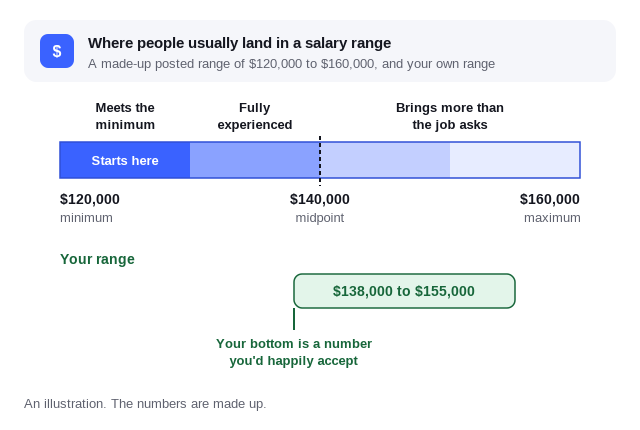
An illustration with made-up numbers. The first two labels follow Duke University's pay policy, and the top half is our reading. Other employers' rules differ. Say what your range covers
Say whether it's base salary or total pay, and yearly or hourly. Then say you're open to the whole package. If the application form has a desired salary box instead, our guide on what to put for desired salary covers that box.

Salary range answers to copy, for the call and the email.
Fill in the square brackets. Say the numbers as base salary unless you mean total pay, and keep your range the same on every call.
When you fit their posted range
On the first call, after the recruiter asks what you're looking for.
Thanks for asking. From what I know of the role, I'm looking for [$X] to [$Y] in base salary. That sits inside the range in the posting, and I'm open to talking about the whole package.
When you bring more than the posting asks
When you're asking for the top of the salary range. Give one reason with a number in it.
I'm looking for [$X] to [$Y] in base salary, toward the top of the posted range. The role asks for [requirement], and I've [what you've done beyond it, with a number]. I'm happy to talk it through.
When they ask before you've seen a range
When there's no number in the posting. Ask first, once. If they'd still like you to go first, give your range.
Happy to share. Before I do, could you tell me the range you have in mind for this role? That way I can tell you how my number fits.

If you'd rather I go first, I'm looking for [$X] to [$Y] in base salary, based on what similar roles pay in [city or remote].
By email
When a recruiter asks for your range in writing.
Hi [Name],

Thanks for your note. For this role I'm looking for a base salary of [$X] to [$Y], which fits the range in the posting. I'm flexible on how the full package comes together, including [bonus, equity or start date].

Best,
[Your name]
When their range sits below your bottom
Early, before more interviews. It saves both of you time.
Thanks for sharing the range. To be open with you, the least I could accept is [$X] in base salary, a little above the top of the posted range. Is there any room there, or a higher level this role could be hired at?
Salary range do's and don'ts, from the posting to the offer.
The habits that help you read a range and give one.
Do
- Read the whole pay section, the range and then any bonus or equity below it.
- Pick the range for where you'd work, when a posting lists several.
- Plan around the lower half to the middle of a posted range.
- Start your own range at a number you'd happily accept.
- Give one reason when you ask for the top.
Don't
- Assume the top of a posted range is your offer.
- Give a range so wide it says nothing, like $90,000 to $150,000.
- Start your range low just to look flexible.
- Compare base pay at one job with total pay at another.
Your questions, answered.
What does “salary range” mean?
It's the lowest and highest pay an employer has set for a job, often with a midpoint halfway between. A pay range means the same. In job postings it's usually base pay, with any bonus or equity listed apart. Most new hires start in the lower half.
What to answer when asked for salary range?
Give a narrow range in base salary, starting at a number you'd happily accept. If the posting shows a range, put yours around its middle, or higher if you bring more than it asks. If there's no number, ask for theirs first. The answers above are ready to copy.
How much should my salary range be?
Our advice: keep it narrow, with a top about 10% to 15% above your bottom. Base the bottom on what the job pays where you'd work, from the posting or BLS data, and on what you need. A very wide range tells the employer little, and they may hear only the bottom.
What is the difference between hiring range and salary range?
The salary range is everything the job can pay, as people grow in it. The hiring range is the part an employer plans to offer someone new, usually the lower part. CU Boulder, for example, often posts the first quarter or first half of a range. Ask which one a posting shows.
How to read salary scale?
Find your grade or level, then read across. Each grade has a minimum and a maximum, and some scales add steps in between. On the US federal General Schedule, for example, there are 15 grades with 10 steps each, and locality pay adds a percentage by place. A new hire usually starts on a low step.
What is a salary band?
A salary band is a pay range for a level or grade, with a minimum, a midpoint and a maximum. Jobs of similar worth share a band. Pave, which sells pay software to employers, says most ranges span roughly 20% to 40% from minimum to maximum.
What are the salary bands in the US?
There's no single national set. Each employer sets its own bands. The federal government uses the General Schedule, from GS-1 to GS-15, the highest grade. Many states and universities publish their own pay tables too, so search for the employer's name and “pay bands”.
How to find the average salary for a job?
Start with the BLS's free wage data, which covers about 830 jobs across the US, by state and area. It shows the median and the percentiles, so you can see a range, not only an average. Then check posted ranges for the same job where you'd work. Together, they tell you your own salary range.
How much is $20 hourly in salary?
$41,600 a year, at 40 hours a week for 52 weeks. That's the 2,080-hour year the BLS uses. $15 an hour is $31,200. Our guide on desired salary has more conversions.
Do salary ranges include bonus and equity?
Usually not. The range in a posting is most often base pay, and a bonus or equity is listed apart. In Blynk's count of 532 posted ranges, at least 1 in 5 also mentioned a bonus. If it's unclear, ask whether the range is base or total pay.
Where the facts come from.
Checked in November 2026. The advice is ours, and so is anything marked as our reading. Where new hires land comes from employers' own pay policies (Duke, CU Boulder, Texas State) and Glassdoor's 2024 study, which matched job listings with salaries its users reported. Range widths come from Pave and nailedit.ai, pay data from the BLS, and the federal scale from OPM. The count is Blynk's own, from 1,535 job postings from Blynk's searches, mostly senior product roles (513 of the 532 ranges had “product” in the title), first seen October 31 to November 12, 2026, counted on November 12. We used the first yearly pay range Blynk read from each posting; all 532 were yearly. Several ranges in one posting were found by matching dollar ranges in the text, and bonuses by pay words such as “annual bonus”; both are floors, and we read samples by eye.
- Glassdoor: navigating pay transparency, a closer look at employer pay ranges (September 30, 2024)
- Duke University: university pay structure and processes policy
- University of Colorado Boulder HR: compensation roles and oversight
- Texas State University: compensation guidelines
- Pave: what is a salary range, a guide for employers (updated August 20, 2026)
- nailedit.ai: what is a salary range, data from 9,550 US job postings (October 2026)
- BLS: how much could I be earning? Using OEWS data (May 2025 estimates)
- BLS: Occupational Employment and Wage Statistics technical note (2,080-hour year)
- US Office of Personnel Management: the General Schedule
- New York Labor Law 194-b
- California Labor Commissioner: Equal Pay Act and pay scale FAQ
- Career.io: negotiating salary when a salary range is posted
