
Pay transparency laws, by state. And what to do when a job hides the pay.
If you keep finding jobs with no salary listed, it isn't always against the rules. It depends on where the job is. Here's which states make employers post a pay range, checked on each state's own pages, how often postings really show one, and what to do when a posting doesn't.

The short answer
- There's no federal law, so where the job is decides. As of November 12, 2026, 14 states and Washington, DC require a pay range in the job posting: CA, CO, CT, HI, IL, ME, MD, MA, MN, NJ, NY, VT, VA and WA.
- Two more only make employers share it on request or after an interview: Nevada and Rhode Island. Delaware's posting rule starts in 2027, and some cities have their own.
- The range is the employer's good-faith estimate, not a promise. If a posting has none, check the employer's own careers page, then ask early.
On this page
Why you still see job postings with no pay range.
Five reasons a posting can leave out pay, and what each one means for you.
“There's a law now, so why doesn't this job list a salary?”
There's no federal law that makes private employers put pay in a job posting. States and some cities set their own rules, and most states have none.
What to check: Where the job is based. Compare it with the list of states below.
“It's a New York job, and still nothing.”
The range can drop out on the way. In New York City, the City Council found the required range missing from 11% of postings on Indeed and 44% on Google for Jobs. It traced the gap largely to scraping and reposting.
What to check: The employer's own posting. Find the same job on the company's careers page.
“It's a small company.”
Most laws only cover employers above a size. New York counts 4 or more employees, New Jersey 10, California, Washington and Illinois 15, Massachusetts 25, Minnesota 30 and Hawaii 50. Connecticut covers employers with even one.
What to check: How big the employer is. Under the limit, it doesn't have to post a range.
“It says remote.”
Each state decides for itself. New York's labor department says its law “includes remote positions.” California's covers any job that “may ever be filled in California.” Some states' pages don't mention remote work.
What to check: Which states the job is open to. A remote job open across the US can be covered by several states at once.
“It's a big employer in a state with a law, and still no range.”
Some covered postings still leave it out. The New York Fed estimated that about 24% of ads covered by the Colorado, New York City, California and Washington laws had no salary information, as of January 2025. Some laws let you claim damages. In Washington, a job applicant can be owed $100 to $5,000 per violation.
What to check: What the state's own page says. New York's labor department, for example, takes complaints online or at 1-888-52-LABOR.
What pay transparency means for you as a job seeker.
Pay transparency means employers share pay openly. For you, it mostly means one thing: the job posting shows a pay range, and in some states the benefits too.
There are three kinds of rule. Some states make employers put the range in the posting. Some only make them share it when you ask, or after an interview. Some also cover people already working there who apply for a promotion or a transfer. The first kind is the one that can save you an application.
It has changed what you see. Across the US, about 15% of job postings showed pay before 2018, and about 53% have since January 2024, the New York Fed found. In Colorado, postings with pay rose by 30 percentage points after its law, and wages rose 1.3% to 3.6%, with no effect on jobs. That's from a 2025 study for the National Bureau of Economic Research.
Which states have pay transparency laws, as of November 12, 2026.
These 14 states and Washington, DC require a pay range in the posting.
New York, since September 17, 2023: a minimum and maximum, for 4 or more employees. Remote jobs count, and so do jobs elsewhere that report to New York.
California, since January 1, 2023: a pay scale in the posting itself, for 15 or more employees. Remote jobs count if they may ever be filled in California.
Colorado, since January 1, 2021: the pay or a range, and a description of benefits. Since 2024, also when applications close.
Washington, since January 1, 2023: a wage scale or salary range, plus benefits and other pay, for 15 or more employees. Remote jobs a Washington-based worker could do count.
Illinois, since January 1, 2025: the pay scale and benefits, for 15 or more employees, for work at least partly in Illinois or reporting to a boss there.
Massachusetts, since October 29, 2025: a pay range, for 25 or more employees in the state.
New Jersey, since June 1, 2025: the pay or a range, plus general benefits, for 10 or more employees.
Maryland, since October 1, 2024: a wage range and general benefits, for work at least partly in Maryland.
Minnesota, since January 1, 2025: a starting salary range or a fixed rate, plus benefits, for 30 or more employees in the state.
Hawaii, since January 1, 2024: an hourly rate or salary range, for 50 or more employees.
Vermont, since July 1, 2025: the pay or a pay range, for 5 or more employees, including remote jobs mainly for a Vermont office.
Connecticut, since October 1, 2026: the wage or a wage range and general benefits, for any employer. Before that, only on request.
Maine, since July 29, 2026: a pay range, for 10 or more employees.
Virginia, since July 1, 2026: the pay or a pay range, in public and internal postings.
Washington, DC, since June 30, 2024: the minimum and maximum projected pay, for all employers, and healthcare benefits before the first interview.
Pay ranges on request, coming later, and in cities.
On request or after an interview. Nevada's law has employers give the pay range to an applicant after an interview. Rhode Island's has them give it to an applicant who asks, and before pay is discussed. Neither makes employers put it in the posting.
Passed, not yet in effect. Delaware's law will require a pay range and benefits in postings, for employers with 26 or more employees. It starts two years after it was enacted, in 2027.
Not on the list. Oregon's SB 906, which some lists count, is about pay stubs, not job postings. States such as Texas, Florida and Georgia have no statewide law requiring pay in postings, as of November 2026. That's our reading, not legal advice.
City rules. New York City has required a good-faith salary range in job ads since November 1, 2022, for employers with 4 or more employees. Ithaca and Westchester County in New York, and Jersey City in New Jersey, also require pay in postings. Cleveland's law, for 15 or more employees, took effect 180 days after it passed in April 2025. Columbus, Ohio, passed one in November 2025 that won't be enforced until January 1, 2027.
How often postings show pay where pay transparency laws apply.
What we counted. We looked at 1,477 job postings from Blynk's searches, mostly product roles, first seen from October 31 to November 11, 2026. Of those, 701 (47%) showed pay.
Where there's a posting law, most did. We matched postings to seven of those states, all with posting laws in effect before October 31. They are New York, California, Massachusetts, New Jersey, Illinois, Washington and Colorado. For jobs there, 70% showed pay, 422 of 602. New York was 68%, California 70%, Massachusetts 91% and New Jersey 60%.
Where there isn't, few did. In Texas, Florida and Georgia, 16% showed pay: 9 of 55. Texas alone was 3 of 33.
Remote jobs sat in between. Of US postings that named no state, mostly “Remote, United States,” 42% showed pay (157 of 375). Some state laws cover remote jobs, which may be part of why. That's our reading.
Read it as a floor. Some postings reached us short or cut off, so a range near the end could be missed. The numbers show where pay appears, not why. In our reading, where the job is says a lot about whether you'll see the pay before you apply.
What to do when a job posting has no pay range.
Six steps, in order. Most take a minute.
Check where the job is, and where you'd work from
Find the job's city or state, and the line on where it can be done from. Then compare it with the list above. A job in Texas may have no rule to follow. A remote job open to people in New York, Washington or California may have one. That's our reading, not legal advice.
Open the employer's own posting, and read to the end
Job boards copy postings, and the pay range can get lost on the way. So find the job on the company's own careers page. The pay line often sits near the end of the posting.
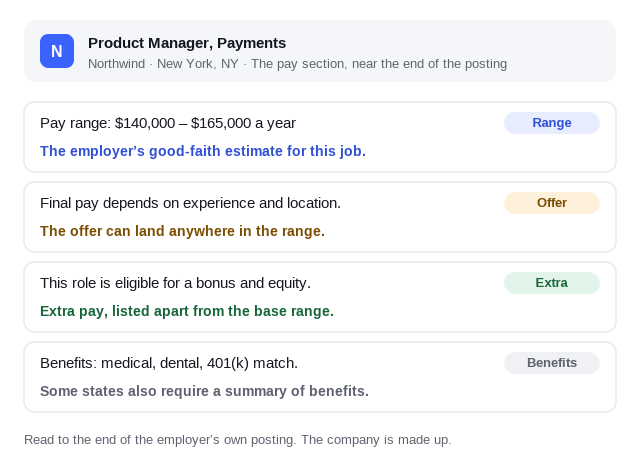
An illustration of a posting's pay section. The wording is the kind seen in real postings; the company is made up. Look for the same job title in a state that requires a range
Big employers often post one role in several places. If the same title is posted in New York or California, that posting may show the range. Our advice: use it as a guide to the level, since pay can differ by place.
Decide your number before the first call
Know the lowest pay you'd take, and the pay you'd like. Then a range, or the lack of one, is easy to judge. If a posted range tops out below your lowest number, you've saved an application.
Ask for the pay range early, in one line
Ask the recruiter before an interview takes your time. One short, plain question is enough, and our guide has the words to use with a recruiter. In New York, the state's labor department says employers can't retaliate against you for asking about pay.
Decide if it's worth the application
If there's still no range, you choose. Some people skip those jobs. Others apply when everything else fits, and ask at the first call. Our advice: spend your evenings on jobs that fit you, pay included.

How to read a pay range in a job posting.
It's a good-faith estimate. New York's law asks for the range the employer “in good faith believes to be accurate.” California's Labor Commissioner calls it “a good faith estimate of the salary or hourly wage range” the employer reasonably expects to pay on hire. Massachusetts asks for the range it “reasonably and in good faith expects to pay.”
It isn't a promise of the top. None of these laws says you'll be offered the top of the range. Our advice: plan around the middle, and treat the top as something to ask about, not to expect.
Base pay isn't all of it. New York wants commission stated. Colorado, Washington, Illinois, New Jersey, Maryland, Minnesota and Connecticut also ask for benefits, and Washington, DC wants healthcare benefits shared before the first interview. So read what sits below the range: a bonus, equity and benefits are often listed apart.
Most ranges aren't huge. Very wide ranges get shared online, but they're the exception. In New York City postings with a range, the City Council found 85% on Indeed had a top under 1.5 times the bottom, and 97% under twice.
Wide ranges put people off. In three experiments reported by Washington State University, ranges of about $50,000 or more made employers seem less trustworthy than narrow ones. If a range is very wide, ask which level the job is hired at. That's our advice.
This page reports what each state's own law or labor department page says, as checked on November 12, 2026. It isn't legal advice. For your own case, ask your state's labor department.
Questions about pay transparency laws, answered.
Does the US have pay transparency laws?
Not a federal one for job postings. States and cities set their own. As of November 12, 2026, 14 states and Washington, DC require a pay range in the job posting. Nevada and Rhode Island require it only after an interview or on request, and Delaware's posting rule starts in 2027. Separately, federal labor law protects most private-sector employees who talk about pay, the National Labor Relations Board says.
Which states have pay transparency laws in 2026?
As of November 12, 2026, 14 states and Washington, DC require a pay range in the job posting. The states are California, Colorado, Connecticut, Hawaii, Illinois, Maine, Maryland, Massachusetts, Minnesota, New Jersey, New York, Vermont, Virginia and Washington. Connecticut, Maine and Virginia started in 2026. Nevada and Rhode Island require it only after an interview or on request. Lists that say 18 states usually count those too, and laws not yet in effect.
What does pay transparency mean?
Employers sharing pay openly. For a job seeker, it mostly means the job posting shows a pay range, sometimes with benefits. In a few states it means the employer must give you the range when you ask, or after an interview. Equal pay is a separate rule, and paying a woman less than a man for equal work is illegal under federal law. “The Equal Pay Act requires that men and women in the same workplace be given equal pay for equal work,” the EEOC says.
Is pay transparency good or bad?
Here's what the US studies we found say. The share of US postings with pay rose from about 15% before 2018 to about 53% since January 2024 (New York Fed). In Colorado, wages rose 1.3% to 3.6% after its law, with no effect on jobs (a 2025 study for the National Bureau of Economic Research). Why it matters to you: you can see whether a job pays enough before you spend an evening applying.
What are the downsides of pay transparency?
For job seekers, the main one is a range too wide to tell you much. In three experiments reported by Washington State University, ranges of about $50,000 or more made employers seem less trustworthy. Most ranges are narrower: in New York City, the City Council found 85% on Indeed had a top under 1.5 times the bottom. Employers name other downsides, such as raise requests from current staff. Those are their concerns, not findings.
Why do employers not disclose salary?
Often because no law makes them: the job is in a state without one, or the employer is under the size limit. Sometimes the range was there and a job board dropped it, so check the employer's own posting. Reasons employers give include room to negotiate, and keeping pay private from staff and rivals. Is it illegal not to post salary? Only where a law covers that job and that employer.
Do pay transparency laws apply to remote jobs?
Often, yes. New York's labor department says its law “includes remote positions.” California's covers any job that “may ever be filled in California, either in-person or remotely.” Washington's covers remote jobs a Washington-based worker could do. So a remote job open across the US may have to show a range. That's our reading, not legal advice.
Does California have a pay transparency law?
Yes. Employers with 15 or more employees must put a pay scale in the job posting itself; a link isn't enough, the Labor Commissioner says. That rule dates from January 1, 2023. New for 2026, since January 1 under SB 642, the pay scale is “a good faith estimate of the salary or hourly wage range” the employer reasonably expects to pay on hire.
Can employers legally tell you not to discuss pay?
For most private-sector employees, no. The National Labor Relations Board says you have the right to discuss pay “whether or not you are represented by a union.” Supervisors are generally not covered. And if you talk about pay with a coworker, the NLRB says it's unlawful for your employer to punish or retaliate against you in any way for it.
In what states is it illegal to ask for salary history?
It differs by state and city, so check your state's labor department. Some pay transparency laws include it. Virginia's new law, for example, bars employers from seeking your wage history or relying on it to set your pay. Our advice, wherever you are: answer with the pay you're looking for, not what you make now.
Sources, and where to go next.
Checked on November 12, 2026. Each state's rule comes from its own law or labor department page, linked below. Where a statute page doesn't show its start date, we link the official law or session record that does. The advice is ours, and none of it is legal advice. Blynk's count: 1,477 job postings from Blynk's searches, mostly product roles, first seen October 31 to November 11, 2026. A posting “shows pay” if Blynk's parsed pay field is set or its text has a dollar range such as “$180,000 - $210,000”. Where the job is comes from its location text, matched to a state by name, two-letter code or city. Other Blynk guides count pay with a different rule, so their numbers differ.
- How to reach out to a recruiter
- How to find remote jobs
- How to spot ghost jobs
- What DOE salary means
- Job application questions, answered
- How to negotiate salary
- What to put for desired salary
- What a salary range means
- What OTE means in a job posting
- New York State DOL: pay transparency
- New York State DOL: Pay Transparency Act FAQ
- New York Labor Law 194-b
- California Labor Commissioner: Equal Pay Act and pay scale FAQ
- California Civil Rights Department, 2022 Legislative Summary (SB 1162, Statutes of 2022 ch. 559)
- California Labor Commissioner, new laws for 2026 (SB 642)
- Senator Monique Limón, SB 642 signed by the Governor (Oct 2025)
- Colorado General Assembly: SB19-085, Equal Pay for Equal Work Act
- Colorado General Assembly, SB23-105 (application close date, from January 1, 2024)
- Washington: RCW 49.58.110
- Washington L&I: pay transparency fact sheet
- Illinois Department of Labor: salary transparency FAQ
- Massachusetts General Laws c.149 §105F
- New Jersey DOL: pay transparency
- Maryland Labor and Employment §3-304.2
- Maryland General Assembly, SB 525 (2024), Chapter 272
- Minnesota Statutes 181.173
- Minnesota Session Laws 2024, ch. 110, art. 7, §2
- Hawaii Civil Rights Commission: Act 203 pay transparency FAQ
- Vermont: 21 V.S.A. §495p
- Connecticut Public Act 26-12
- Maine: 26 M.R.S. §622-A
- Maine Legislature, Legislative Digest, 132nd Legislature, Second Regular Session (LD 54, Public Law 2025 ch. 771)
- Code of Virginia §40.1-28.7:12 (2026, cc. 996, 1063)
- Constitution of Virginia, Art. IV, §13 (laws take effect July 1)
- DC Code §32-1453.01
- D.C. Law 25-138, Wage Transparency Omnibus Amendment Act of 2023
- DC Attorney General: business advisory on pay transparency
- Nevada: NRS 613.133
- Rhode Island: R.I. Gen. Laws 28-6-22
- Delaware: Laws of Delaware vol. 85 ch. 228
- Oregon Legislature, SB 906 (2025)
- NYC Commission on Human Rights: pay transparency
- Jersey City: pay transparency
- City of Ithaca: salary transparency FAQ
- Westchester County: salary transparency amendment
- Cleveland City Council: pay transparency law (2025)
- Columbus City Council: Ordinance 2898-2025
- New York City Council: salary transparency data
- New York Fed, Liberty Street Economics: do employers comply with pay transparency requirements? (Oct 2, 2025)
- NBER Working Paper 34480: Colorado's pay transparency law (Nov 2025)
- Washington State University: job ads with wide pay ranges can deter applicants (Jan 3, 2024)
- NLRB: your rights to discuss wages
- NLRB, employee rights (who the NLRA covers)
- US EEOC, equal pay and compensation discrimination
- Blynk Find Jobs
- Blynk pricing
