
The meaning of a DOE salary on a job posting. And how to get the real number.
You found a job you'd like, and the pay line says “DOE” or “competitive”, with no number. You don't want to spend an application on a job that pays far less than you need. Here's what those words mean, how often real postings use them, and what to say to get the range.

The short answer
- On a job posting, DOE means “depending on experience”. The employer will set your pay inside a range, based on your experience and skills. Here it doesn't mean the Department of Education or Energy.
- “Commensurate with experience” means the same thing, and “competitive salary” isn't a number either. Competitive is the employer's claim that it pays close to the market.
- Ask for the salary range early, in one line. A short, plain question before the first interview is fair. In 14 states and Washington, DC, many employers must post the range anyway.
On this page
Why a DOE salary feels like a warning sign, and what it really tells you.
When a posting hides the pay, it's natural to assume the worst. Four worries come up again and again. Here's what's true about each one.
“Is DOE code for a lowball?”
Lots of people say so online, but that's an opinion, not a finding. In Blynk's own sample, the words “depending on experience” usually came with a pay range printed right next to them: 18 times out of 22. Payscale, which writes for employers, does admit DOE has downsides. It can put applicants off, and it “may promote unequal pay”.
What to do: Read DOE as a range that exists. Then ask what it is.
“Competitive means low, right?”
Sources disagree. Datapeople, a hiring software company, argues the phrase “actually works against the job ad”. But one large analysis, reported by HR Executive and Recruiting News Network in August 2026, found that postings saying “competitive salary” had higher median pay than other postings. Our reading: the phrase alone tells you nothing you can compare.
What to do: Treat it as no number. Not as a good sign or a bad one.
“I don't want to waste an application.”
You're far from alone. In a ResumeLab survey reported by SHRM, 4 in 5 workers said they were unlikely to apply to a job without a pay range. A job can fit you on paper and still pay well below what you need.
What to do: Check the employer's own posting first. Then ask, before the first interview.
“Will asking make me look like I only care about money?”
We found no study showing that asking about pay costs people the job. Advice columns differ on when to ask. In New York, the state's labor department says employers can't retaliate against you for asking about pay. Our advice: one short, plain question is fine.
What to do: Ask once, briefly, early. The words to use are below.
What DOE salary means on a job posting, and what it doesn't tell you.
DOE stands for “depends on experience”, or “depending on experience”. Payscale puts it this way: “many employers have opted to replace a listed salary range in favor of the acronym DOE: depends on experience”. Indeed's guide for employers and Salary.com's HR glossary define it the same way. You may also see “dependent on experience”.
So there's a salary range, and you can't see it yet. The employer will place you in it based on your years of relevant experience, your skills and your level. A more experienced candidate usually lands higher in the range, and a less experienced one lower. Our reading: DOE tells you the position has a budget. It doesn't tell you where the range sits, how wide it is, or which experience level the job is hired at.
Why employers write it. Guides written for employers, such as Payscale's, Indeed's and Zippia's, list the advantages: flexibility to hire candidates at different experience levels, and room for negotiation. Payscale also lists the downsides, such as putting some candidates off applying.
DOQ is a close cousin. It means “depends on qualifications”. Payscale says that adds things like certifications and education to the experience you bring.
The other DOE. Outside job postings, DOE often means the US Department of Energy, or a Department of Education. If you're a New York City teacher looking for pay steps, that's the Department of Education's salary schedule. It's answered in the questions below.
How often job postings say DOE, in 1,477 real postings.
What we counted. We looked at 1,477 job postings from Blynk's searches, mostly senior product roles, first seen from October 31 to November 11, 2026. Of those, 701 (47%) showed pay. That's the same count our guide to pay transparency laws uses.
Not one used the abbreviation DOE. Zero of 1,477. DOQ didn't appear either. Our sample is mostly senior product roles, so the short form may be more common on other jobs, such as small-business or hourly postings. We found no count for those.
22 spelled it out, and 18 of those showed a pay figure. The words usually followed the range, as in “$240K - $300K base, depending on experience” or “$124,600 – $220,000 depending on experience and location”. A few of the 22 are the same job posted twice. One was hourly: “$35–$65 USD/hour, depending on experience”.
What that means for you. In our sample, “depending on experience” mostly explained where you'd land inside a range that was printed. A posting that says DOE and nothing else is the one to ask about. That's our reading.
What “competitive salary” means on a job posting, and why it isn't a number.
It's a claim to pay near the market. Mercer, a pay consulting firm, defines competitive pay as “comparable to what other employers competing for the same talent are offering”. It adds: “Typically, you would consider a compensation offering that's within ±10% of the market as competitive”. Many employers aim for the median, the 50th percentile, and may pay more for key roles. Reed, a UK recruiter, says it means “equal to (or more than) the industry average”.
So it isn't the top of the market. Our reading: “competitive” promises roughly the middle, give or take. It doesn't say which market, which level, or what number.
Low or high? Sources disagree. Many job seekers read it as a lowball, and Datapeople argues the phrase works against the job ad. One large analysis, reported by HR Executive and Recruiting News Network, found the opposite: postings with “competitive salary” had higher median pay. We couldn't read its method, so our advice is to read it as no number at all.
Often there's no number behind it. In Blynk's 1,477 postings, 128 called pay “competitive”, about 1 in 11. 58 of those 128 (45%) gave no pay figure anywhere. In the 12 we read by eye, the word sat in a benefits list, such as “Competitive salary and equity”. Where a posting law applied, most gave a figure anyway: 41 of 56 in the seven states we matched (New York, California, Washington, Colorado, Illinois, Massachusetts and New Jersey).
Competitive compensation means the whole package. Salary is your base pay, and compensation adds bonus, equity and benefits. Mercer's definition of competitive pay speaks of a “salary or compensation package”. Our reading: employers use the word to attract candidates without naming a number. So ask which number they mean.
Commensurate with experience meaning, plus DOQ and other ways to say DOE.
It means the same as DOE. Payscale and Salary.com both say “salary commensurate with experience” means the same as DOE. In plain words, commensurate means in proportion to, so pay is matched to the experience you bring. That's our wording, not a dictionary's.
Other ways employers say it. Zippia's guide for employers lists “Commensurate with Experience”, “Depends on Qualifications (DOQ)” and “Salary based on experience”. You'll also see “depending on experience and location”. Our reading: there, where you'd work from moves the number too.
Hourly jobs work the same way. If a posting says the hourly rate depends on experience, your experience sets where your rate lands. To compare an hourly job with a salaried one, multiply the hourly rate by 2,080, the typical work year the BLS uses. So $35 an hour is $72,800 a year.
What to do when the salary says DOE, in five steps.
Our advice, in order. Most steps take a minute or two.
Read the employer's own posting to the end
Job boards copy postings, and the pay line can get lost on the way. In New York City, the City Council found the required range missing from 11% of postings on Indeed and 44% on Google for Jobs. So find the position on the company's own careers page and read the whole job description. Then look at the exact words, because they tell you more than you'd think.
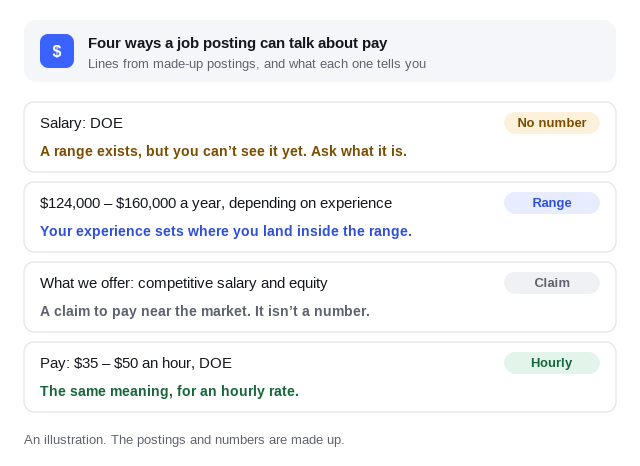
An illustration of the pay lines you might see. The postings and numbers are made up. Check whether a pay law covers the job
In 14 states and Washington, DC, many employers must put a pay range in the posting, with rules on company size. Our pay transparency guide lists each one. In Blynk's count, 70% of postings in seven of those states showed pay, against 16% in Texas, Florida and Georgia. If a covered job still says only DOE, it should show the range. That's our reading, not legal advice.
Look up the market salary range for the role, level and place
Salary sites give you a starting point for similar positions. Payscale prices a job title from what people report, and asks you to share your job and salary before it shows your report. Salary.com's free estimate has “no personal customization”, and its personal report is paid. Levels.fyi shows pay by company, level and location. Our advice: check two, and use the overlap for your experience level and city.
Decide your lowest number before the first call
Know the lowest pay you'd take, and the pay you'd like. Then any range they share is quick to judge. If it tops out below your lowest number, you've saved yourself an interview.
Ask for the salary range early, in one line
Ask the recruiter, or whoever wrote to you, early in the hiring process, before an interview takes your time. Keep it to one plain question, and don't apologize. The words below are ready to copy.

How to ask about the salary range, in words you can copy.
Our advice: ask once, keep it short, and give a reason that helps both sides. If you're not sure who to write to, our guide on how to reach out to a recruiter covers finding the right person.
Ask before you apply, by email or LinkedIn
When the posting says DOE or competitive and gives no number. Send it to the recruiter for the role, or to the person who posted it.
Hi [Name],

I'm interested in the [Job title] role and would like to apply. Before I do, could you share the salary range for it? I want to make sure we're aligned before taking up anyone's time.

Thanks,
[Your name]
Ask the recruiter about salary on the first call
Say it near the start, after the introductions, rather than in the last minute of the call.
Before we go further, could you share the salary range for this role? I'd like to be sure it works for both of us before we get into the details.
When they say “let's discuss it later”
One polite follow-up, by email or on the call. If they still won't say, you decide whether to go on.
Of course. Could you share even a rough range, or the level the role is hired at? It would help me see how my experience fits what you have in mind.
Ask in the form's free-text box
Only where the application has an open question, such as “Anything else you'd like us to know?” Keep it to one or two lines.
I'd be glad to talk about pay once I know the range for this role. Could you share it when you get in touch?
When the form asks your desired salary, before you know the range.
Asked for your salary expectations first? You can ask for their range in return, using the words above. That's our advice.
Answer from the range you researched. If a required box asks for a number and the posting shows none, type one you'd happily accept for this role, level and place. Don't type 0 or 999999. Our guide to what to put for desired salary covers every kind of box.
Got an offer? That's the time to talk numbers in full. Our guide on how to negotiate salary has the emails, and what to say on the call.
Do's and don'ts when a job hides the pay range, from the posting to the first call.
The habits that get you the number without wasting anyone's time.
Do
- Ask for the range early, in one plain line.
- Read DOE as a range that exists, set by experience.
- Use the market range for the role, level and place.
- Compare like for like: base with base, and an hourly rate times 2,080 for a year.
Don't
- Type 0 or 999999 into a desired salary box.
- Assume “competitive” means low, or high.
- Write “negotiable” where the form asks for a figure.
- Name your number before you've seen theirs, unless a required box forces it.
- Spend an evening on an application before you know the job can pay enough.
Questions about DOE and other salary basics, answered.
How much is level 7 salary?
There's no single answer. “Level 7” is a grade on one employer's own pay table, and each employer numbers its levels its own way. That's our reading. If a posting names a level, look for that employer's published pay table, or for tech companies, Levels.fyi, which shows pay by company, level and location. A DOE range then sits inside that level.
Is $75,000 a year a good salary?
It's above what a typical full-time worker earns. The BLS put median weekly earnings of full-time wage and salary workers at $1,232 in the third quarter of 2026. That's about $64,000 a year, by our arithmetic. Whether $75,000 is good for a given job depends on the role, level and place, so compare it with that job's market range.
What are the salary steps for NYC DOE teachers?
That's a different DOE: New York City's Department of Education. Teacher pay there follows a salary schedule that the UFT, the teachers' union, explains on its site. The UFT says “A salary step is an incremental increase in salary based on previous qualifying professional experience”. Teachers with uninterrupted service move up two steps a year, such as 1A to 1B, with a satisfactory rating, up to 8B. Extra pay for credits beyond a bachelor's degree, called differentials, must be applied for.
What is the difference between salary and compensation?
Salary is your base pay. Compensation is the whole package: base pay plus things like a bonus, equity and benefits. So “competitive compensation” on a posting is a claim about the package, not the base.
How does PTO work if you're salaried?
It's set by the employer's own policy. The US Department of Labor says “The Fair Labor Standards Act (FLSA) does not require payment for time not worked, such as vacations, sick leave or federal or other holidays”. So read the benefits in the posting, and ask about paid time off in the same message as the range.
Is it better to have a salary or wage?
Neither is better on its own, in our reading. A salaried worker “regularly receives a predetermined amount of compensation each pay period”, in the Labor Department's words, whatever the hours. A wage is paid by the hour, so more hours mean more pay. To compare, multiply the hourly rate by 2,080 hours, the typical year the BLS uses. DOE can appear on both.
Is DOE a red flag?
Not on its own. In Blynk's sample of 1,477 postings, 18 of the 22 that said “depending on experience” also printed a pay figure. Our reading: it becomes a worry when a posting gives no range, and the recruiter won't share one when you ask.
What does DOE mean in hourly jobs?
The same thing: the hourly rate depends on your experience. One posting in our sample put it as “$35–$65 USD/hour, depending on experience”. Ask where in that range someone with your experience would start.
Is it rude to ask about salary before an interview?
No, if you ask once and keep it short. Advice columns differ on timing, and we found no study showing that asking costs people the job. Some postings even invite the question. Of the 1,204 postings in Blynk's searches, 19 said your recruiter can share the salary range. The words to use are in the templates above.
Do employers have to post the salary?
Only in some places. As of November 12, 2026, 14 states and Washington, DC require a pay range in the job posting, mostly above a company-size floor. Our guide to pay transparency by state lists each one. Where no such law applies, a posting can leave pay out.
Where the facts come from.
Checked in November 2026. The advice is ours, and so is anything marked as our reading. Definitions come from Payscale, Indeed, Salary.com and Zippia, and the meaning of competitive pay from Mercer and Reed. The study of “competitive” postings is reported by HR Executive and Recruiting News Network; we couldn't read its own report. Pay laws come from our pay transparency guide, which cites each state's own pages, and the missing ranges on job boards from the New York City Council. The count is Blynk's own: 1,477 job postings from Blynk's searches, mostly senior product roles, first seen October 31 to November 11, 2026, counted on November 12. A posting shows pay if Blynk's parsed pay field is set or its text has a dollar range, the same rule as our pay transparency guide. Phrases were matched in each posting's text, and all 22 “depending on experience” postings were read by eye. Some texts are cut off, so “no figure” is a slight overcount. The recruiter line comes from 1,204 postings counted earlier for our recruiter guide.
- What to put for desired salary
- Pay transparency laws by state
- How to negotiate salary
- How to reach out to a recruiter
- How to spot ghost jobs
- What a salary range means
- What OTE means in a job posting
- Payscale: what DOE means in a salary (Sept 19, 2023)
- Indeed for employers: what does DOE mean (updated June 29, 2026)
- Salary.com HR glossary: DOE compensation
- Zippia for employers: DOE salary
- Mercer: market pricing 101, competitive pay (Oct 20, 2026)
- Reed: what does competitive salary actually mean
- Datapeople: competitive salary signals low pay
- Recruiting News Network: competitive salary isn't the red flag jobseekers think it is (Aug 25, 2026)
- HR Executive: competitive salary isn't the red flag jobseekers think it is (Aug 23, 2026)
- SHRM: workers unlikely to apply to a job without a pay range (Mar 6, 2023)
- New York City Council: salary transparency data
- New York State DOL: pay transparency
- UFT: salary steps
- UFT: salary steps and differentials
- BLS: usual weekly earnings, third quarter 2026 (Oct 21, 2026)
- BLS: Occupational Employment and Wage Statistics technical note (2,080-hour year)
- US Department of Labor: Fact Sheet 17G, salary basis
- US Department of Labor: vacation leave
- Payscale for individuals
- Salary.com Personal Salary Report FAQ
- Levels.fyi: Google Product Manager salaries
- Blynk Find Jobs
- Blynk pricing
