
The OTE meaning on a job posting, in plain numbers. And how much of it you'll really be paid.
A job posting says “$200K OTE”, and you want to know how much of that is real money. Here's what OTE, base salary and total compensation mean, what the numbers work out to, and what to ask before you apply.

The short answer
- OTE means on-target earnings: your base salary plus the commission or bonus you'd earn at 100% of your target. A $200K OTE at a 60/40 split is a $120K base and $80K at target.
- Only the base salary is guaranteed. Miss the target and you earn less than the OTE. Beat it, and you may earn more.
- Total compensation is wider still. It adds equity, and some employers count benefits too. So compare base with base, and OTE with OTE.
On this page
Why OTE on a job posting is confusing, and what's true.
The same four worries come up whenever a posting shows an OTE. Here's what's true about each one.
“Is the OTE what I'll be paid?”
Not all of it. Paychex, a payroll company, calls the base “Guaranteed; paid regardless of performance” and says OTE is “not guaranteed”. And many people miss. QuotaPath reports that in RepVue's index of about 47,000 quota-carrying sales professionals, “57.31% of sales reps missed their quota” in the second quarter of 2025.
What to do: Count on the base. Treat the rest as a target.
“Do I add the base on top?”
No. The base is already inside the OTE. Paychex writes it as “Base Salary + Target Variable Pay = OTE”. So a $100,000 OTE with a $65,000 base means $35,000 depends on hitting your target.
What to do: Find the base inside the OTE. If the posting doesn't give it, ask.
“The recruiter's number is lower than the posting.”
It happens. On Blind, an anonymous forum for workers, an account manager described a posting with an OTE of 160-180k. After four interview rounds, the recruiter quoted 145k OTE with an 85K base. One reply said to ask for the breakdown before going further. Our reading: a posted range is a band, and the offer depends on where they place you, as our salary range guide explains.
What to do: Ask for the base and the split early. Before the interviews take your time.
“I'm not in sales. Why does my posting say OTE?”
Some senior roles use it for a bonus. In Blynk's searches, a VP posting gave a pay range and then a separate OTE range, “(including bonus or commission)”. The OTE ran about $35,000 to $60,000 above the pay range.
What to do: Ask what the variable part is. A bonus, a commission, or both.
What OTE means on a job posting, and how on-target earnings work.
OTE stands for on-target earnings. Some people say on-track earnings. Wikipedia calls on-target earnings (OTE) “a term often seen in job advertisements, especially for sales personnel”. It is “the expected total pay, if performance matches the expected targets”.
How on-target earnings work. OTE has two parts: a fixed base salary, and a variable part. The variable part, usually commission or a bonus, is what you earn when you hit 100% of your target. The target is usually a sales quota, such as the revenue or number of deals you close in a period. So the OTE formula is base salary plus target variable pay.
Only the base is guaranteed. Sell less than the target and you earn less than the OTE. Sell more and you can earn more. Paychex says accelerators, higher commission rates above 100%, can push pay past the stated OTE.
The split is called the pay mix. It's written base first, so 70/30 means 70% base and 30% variable. Paychex gives 70/30 for junior sales reps and 50/50 for senior enterprise reps, and calls 50/50 to 70/30 a common range. Everstage says the ratio depends on the position, the length of the sales cycle and how complex the product is. Our reading: the bigger the variable share, the more risk you carry.
A sales OTE is the usual case. The BLS says of wholesale and manufacturing sales reps: “Most employers use a combination of salary and commissions or salary plus bonuses”. It adds that “Commissions usually are based on a percentage of sales”.
Other meanings of OTE. Outside a job posting, OTE can mean Overtime Elite, a basketball league for 16 to 20 year olds in Atlanta. In Australia, ordinary time earnings are the basis for superannuation payments. OTE is also Greece's national telecom company. On a job posting, it's about pay.
What a $50K or $200K OTE means, worked out in dollars.
A $50K OTE. At a 70/30 mix, the base is $35,000 and the target commission is $15,000. At 50/50, the base is $25,000. Same OTE, very different guaranteed pay. These two examples are ours.
A $200K OTE. At 60/40, that's a $120,000 base and $80,000 at target. It's the example Everstage, a commission software company, uses. At 50/50, the base is $100,000.
A real one. A sales development manager posting in Blynk's searches gave “an OTE of $190,000-$234,000 and a base of $133,000-$164,000 annually”. Divide the base by the OTE, and both ends come out at 70%. So it's a 70/30 mix, with $57,000 to $70,000 at target.
Below target. Say you reach 80% of quota on that $200K OTE at 60/40. If your plan pays commission in step with sales, you'd earn about 80% of the $80,000. That's $64,000 on top of the $120,000 base. Plans differ, so ask how yours pays below and above 100%.
Base salary meaning, and why it's the number to plan on.
Base salary is your fixed pay. Paychex defines base pay as “a fixed amount that an employer agrees to pay an employee in exchange for time and services”. It adds: “It doesn't include benefits or additional earnings, such as commission, tips, overtime pay, or bonuses”.
It's a before-tax number. Gross pay is your base plus any extras, before deductions. Net pay, what lands in your account, is gross pay minus taxes and other deductions. So the base salary on a posting is before taxes.
A base salary example. Paychex gives this one: a $4,000 paycheck every two weeks, times 26 paychecks, is a $104,000 base salary a year.
Monthly or yearly? Read the words after the number, such as “annually”, “/year” or “an hour”. If there are none, ask. For hourly pay, the BLS turns an hourly rate into a year by multiplying by 2,080 hours.
How often postings say base. Of the 565 postings in Blynk's searches that showed pay, 197 (about 1 in 3) used the words base salary, base pay or base compensation. Our advice: when a posting only says “salary range”, ask whether a bonus or commission is inside the number.
Total compensation meaning, and how it differs from OTE.
Total compensation is everything you're paid in a year. Levels.fyi, a pay data site, says “Total compensation is the full yearly value of everything an employer pays you”. It counts base salary, annual bonus and annual stock. People often shorten it to TC.
Stock is spread over the years it vests. In Levels.fyi's example, a $320,000 stock grant that vests over four years counts as $80,000 a year.
Benefits, in or out? It depends who's counting. Levels.fyi says it “does not include benefits in total compensation”. Some employers do count them. One posting in Blynk's searches spelled out “Total Compensation = Base Salary + Incentive(s) + Benefits”.
Benefits are worth a lot. The BLS found they made up 30.0% of private employers' compensation costs in June 2026. So when two offers have the same base, the benefits can still set them apart. That's our reading.
OTE vs total compensation. OTE is cash: your base plus target commission or bonus. Total compensation adds equity, and sometimes benefits. So “220k ote plus stock”, as one Blind poster put it, is more than $220K in total compensation.
How often postings mention pay on top. About half the postings in Blynk's searches that showed pay, 280 of 565, also mentioned a bonus, equity, commission or other incentive pay. Our reading: the range on a posting is often only part of the package.
How real job postings write OTE and base salary, from 1,535 postings.
What we counted. We read 1,535 job postings from Blynk's searches, first seen from October 31 to November 12, 2026. Most are product roles, and only 27 have a sales title. So OTE is rare here: 8 postings say it, and one of those is the same job posted twice.
Base and OTE side by side. The clearest postings give both. A business development rep posting in New York said “a base salary of ~ 70,000 with an OTE of ~80,000”. That's a mix of about 88/12, mostly base.
OTE with no base. A VP posting said “$200-$290k OTE + Equity”, and gave no base. You can't tell how much of it is guaranteed, so ask.
One line, two meanings. A senior product manager posting read “Salary Range or On Target Earnings: $124,000.00 - $271,200.00”. The line doesn't say which one this job has. Ask.
Boilerplate. Three postings, none of them for sales, said in general terms that sales roles get an OTE. For a job outside sales, that line doesn't describe your pay. That's our reading.
How to read OTE and base salary on a job posting, in five steps.
Our advice, in order. Most steps take a minute, or one question.
Name the number in front of you
Is it a base salary, an OTE, total compensation, or a range of one of those? Look at the words around it, such as “base”, “OTE”, “on-target”, “total” or “including bonus or commission”. If it doesn't say, don't assume. If the line says DOE or “competitive”, our guide to DOE salary meaning explains those.
Find the base salary and the split inside the OTE
If the posting gives an OTE, find the base inside it, or ask for it. Then divide the base by the OTE to get the mix. A $133,000 base on a $190,000 OTE is 70%, so the mix is 70/30.
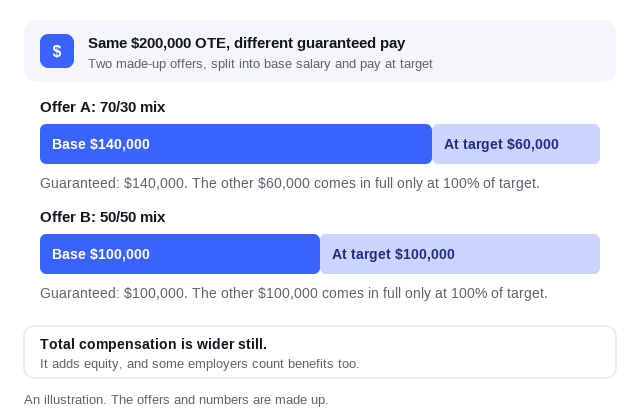
An illustration of two offers with the same OTE. The offers and numbers are made up. Ask what 100% of target means, and how many people reach it
Your earning potential is only as real as the quota. Ask what the quota is, and what share of the sales team hit it last year. That share is called quota attainment. QuotaPath reports that in RepVue's index for the second quarter of 2025, more than half of software sales reps missed quota, so it's a fair question. Ask what the average rep earned, too.
Ask about a cap, accelerators, a draw and the ramp
Commission structures vary, so read the compensation plan. A cap is the most commission you can earn, however much you sell, and accelerators pay a higher rate above 100%. A draw, in FreshBooks' words, “provides a guaranteed amount of pay in advance”, and a recoverable one is paid back from later commission. The ramp period is your first months, while you build up deals. Everstage puts it at 3 to 9 months, and says new hires may get a draw or a lower quota during it.
Compare like with like
Compare base with base, and OTE with OTE. Look at the gap between the base and the OTE, too. A $150,000 base salary and a $200,000 OTE at 50/50 aren't close, because the second guarantees $100,000. Add equity only when you compare total compensation. Some states' posting laws also cover commission and benefits, and our pay transparency guide lists each state's rule.

How to ask about OTE and base salary, in words you can copy.
Our advice: ask early, and ask for numbers, not adjectives. Send it to the recruiter or the hiring manager. Square brackets are blanks to fill in. When an offer arrives, our guide on how to negotiate salary covers the next step.
Before you apply, by email or LinkedIn
When the posting gives an OTE but no base, or one number with no label.
Hi [Name],

I'm interested in the [Job title] role. Before I apply, could you share how the pay is split? I'd like to know the base salary, the target commission or bonus, and the quota it's based on.

Thanks,
[Your name]
On the first recruiter call
Near the start, after the introductions.
Could you walk me through the pay for this role? What's the base salary, what's the variable part at target, and roughly what share of the team hit their target last year?
When the offer comes
Before you accept. Ask for it in writing.
Thank you for the offer. Could you send the compensation plan in writing? I'd like to see the base salary, the target variable pay, the quota, how commission is paid above and below target, and whether there is a cap or a draw.
Do's and don'ts for OTE and base salary, from the posting to the offer.
The habits that keep a target from being mistaken for your pay.
Do
- Count on the base salary, not the full OTE.
- Ask for the base, the split and the quota before the interviews take your time.
- Ask what share of the team hit target last year.
- Get the compensation plan in writing before you accept.
- Compare base with base, and OTE with OTE.
Don't
- Add the base on top of the OTE.
- Count commission you haven't earned yet as guaranteed.
- Compare one job's OTE with another job's base salary.
- Assume “total compensation” means the same thing at every company.
- Assume an OTE line on a posting outside sales describes your pay.
Questions about OTE and base salary, answered.
Is OTE the base salary?
No. OTE is the base salary plus the commission or bonus you'd earn at 100% of your target. The base is the guaranteed part inside it. In Paychex's example, a $100,000 OTE is a $65,000 base and $35,000 at target.
Does OTE include bonuses?
Yes, when a bonus is the variable part of the plan. Paychex describes OTE as base salary plus target variable pay, which can be commission or a bonus. One VP posting in Blynk's searches said its OTE was “including bonus or commission”. In our reading, equity and benefits sit outside the OTE, in total compensation.
Does OTE pay you?
Not as one fixed amount. Your base salary comes in your regular paycheck. The variable part is paid only as you earn it, on the schedule your commission or bonus plan sets. So ask how often it's paid, and when a sale counts as earned.
What is a realistic OTE?
One that the team actually reaches. An OTE built on a quota almost no one hits is unrealistic, however big the number. OTE assumes you hit 100% of your target, and many sellers don't. QuotaPath reports that in RepVue's index of about 47,000 software sellers at 246 companies, 57.31% missed quota in the second quarter of 2025. So ask what share of the team hit target last year, and what you can expect to earn in your first year.
What is a good OTE?
It varies by industry, role, level and market, so compare like with like. For a rough US check, the BLS put the median annual wage of wholesale and manufacturing sales reps at $104,920 for technical and scientific products, and $72,080 for other products, in May 2025. BLS wage figures include commissions. Our advice: a good OTE also has a base you can live on, and a target people reach.
What do I put for base salary?
If a form asks your current or last base salary, give your fixed yearly pay before taxes. Leave out bonus, commission and overtime. Several states stop employers seeking your salary history, and our guide to what to put for desired salary covers that box and the desired pay box.
How do I calculate my base salary?
Multiply your fixed pay per paycheck by the number of paychecks in a year. Paid every two weeks, that's 26, so $4,000 a paycheck is $104,000. For an hourly rate, multiply by the hours you work in a year. The BLS uses 2,080 for full time. Leave out bonus, commission, tips and overtime.
Is $70,000 considered a good salary?
It's above what a typical full-time US worker earns. The BLS put median weekly earnings of full-time workers at $1,232 in the third quarter of 2026. That's about $64,000 a year, by our arithmetic. Whether $70,000 is good for a given job depends on the role, level and place.
What is my salary if I make $3,500 a month?
$42,000 a year, before taxes. That's $3,500 times 12 months. If you're paid every two weeks rather than monthly, multiply each paycheck by 26 instead.
How much is $20 hourly in salary?
About $41,600 a year before taxes, if you work full time. That's $20 times 2,080 hours, the full-time year the BLS uses for its annual wage figures. Fewer hours, or unpaid time off, means less.
Where the facts come from.
Checked in November 2026. The advice is ours, and so is anything marked as our reading. Definitions come from Wikipedia, Paychex and Levels.fyi, and pay data from the BLS. The quota figure is from RepVue's index, as reported by QuotaPath; we couldn't open RepVue's own page. The forum examples come from Blind. Blynk's counts: 1,535 job postings from Blynk's searches, first seen October 31 to November 12, 2026, mostly product roles. “OTE” was matched as a whole word (8 postings, all read by eye). 565 showed pay; of those, 197 used “base salary”, “base pay” or “base compensation”, and 280 mentioned a bonus, equity, commission or incentive pay, after removing phrases such as “diversity, equity and inclusion” (of 15 matches read by eye, 1 was still a false match).
- What a salary range means
- DOE salary meaning
- Pay transparency laws by state
- What to put for desired salary
- How to negotiate salary
- Blynk vs Levels.fyi
- Wikipedia: On-target earnings
- Paychex: what is OTE (updated April 14, 2026)
- Paychex: what is base pay
- Levels.fyi: what is total compensation (updated October 26, 2026)
- BLS: Employer Costs for Employee Compensation, June 2026 (Sept 9, 2026)
- BLS Occupational Outlook Handbook: wholesale and manufacturing sales representatives (May 2025 wages)
- BLS: OEWS technical notes (what wages include)
- BLS: Occupational Employment and Wage Statistics technical note (2,080-hour year)
- BLS: usual weekly earnings, third quarter 2026 (Oct 21, 2026)
- QuotaPath: SaaS sales reps missed quota, on RepVue's Q2 2025 Cloud Sales Index (April 2026)
- Everstage: what is OTE, with examples and ramp time
- FreshBooks: draw against commission (updated Nov 7, 2024)
- QuotaPath glossary: capped commissions
- Blind: a posted OTE and a lower offer (Dec 2023)
- Blind: OTE plus stock, and TC (Aug 2023)
- Wikipedia: Overtime Elite
- Wikipedia: OTE (other meanings)
