
How to list freelance work on a resume. So it reads like the real work it was.
If your experience includes client projects, agency contracts or a business you ran, it belongs on your resume like any other job. Here’s how to list freelance work, contract work and self-employment side by side, what hiring software does with each entry, and examples to copy.

The short answer
- List freelance work in your work history like any job, with a title that names your field, such as “Freelance UX Designer”. Not “Freelancer” alone.
- Put “Self-Employed” or your business name in the employer line, with one date range for the whole stretch and a few results under it.
- Group many short clients under one entry, and give a long contract its own. If an agency placed you, name the agency and the client.
On this page
Freelance, contract or self-employed, three cases, side by side.
Most guides treat these as one thing, or give each its own page. They need slightly different resume entries. LinkedIn’s help center defines all three, and its definitions are a good way to tell which case you’re in.
Freelance. LinkedIn calls freelancers “self-employed service providers who aren’t committed to a single employer” for the long term. You worked for several clients, often on short projects. Give the whole stretch one entry, with your field in the title, “Self-Employed” or your trading name as the employer, and your clients in the bullets.
Contract. LinkedIn calls a contract “a temporary employment with a fixed length”. You may have been an independent contractor working directly for the company, or an employee of a third-party agency. Give each long contract its own entry. If an agency employed you, name the agency and the client you were placed at.
Your own business. LinkedIn’s “self-employed” means working for oneself, including sole proprietors, entrepreneurs and small business owners. If you ran a business with a name and customers, the business is the employer. Your title is what you did there, such as Owner or Founder, with your field next to it.
A mix of these? Our advice: pick the case that describes most of your time. If you freelanced for clients under your own business name, that’s one entry, not two.
How hiring software reads a freelance entry, from Greenhouse’s and Lever’s own help pages.
Most guides say “add keywords” and stop there. The hiring systems’ own help pages say more. They’re specific about three parts of an entry, the title, the employer and the dates.
Job titles. Greenhouse’s own search example has the recruiter type each word, trainer OR instructor OR teacher, and its help describes no synonym matching. Greenhouse also lists “incomplete job titles” among the causes of a failed resume parse. Both help pages were updated on March 2, 2026.
Employer names. On the same page, Greenhouse lists company names without identifying words such as Inc., Co., LTD or LLC among the causes. Lever, another applicant tracking system (ATS), lets recruiters filter candidates by the company and job title parsed from the resume. We checked Lever’s page in November 2026.
Dates. Lever also filters by years of experience, which it says is “calculated based on parsed dates”. So the dates on a freelance entry do real work.
What it means (our reading). No help page we found says a system rejects the word “Self-Employed”. But a recruiter looking for a UX designer won’t search for “self-employed”. So put your field in the job title, and put “Self-Employed” or your full business name in the employer line. Then give the entry real dates.
Will freelance work hurt your resume? Three worries, and what’s really true.
Three things people often worry about when they list freelance or self-employed work, and what the sources say.
“It’ll look like I couldn’t get a real job.”
We found no study either way, only opinions. On Hacker News, a self-described hiring manager wrote that several successful years of freelancing, with results to show, always catch their attention. Another commenter warned that a few months of it before job hunting can look weak. MIT’s career office lists freelance projects among what an experience section can include.
Check: Does your entry read like a job, with a title, dates and results? That part is in your hands.
“The ATS will throw out ‘Self-Employed’.”
Some guides say “Self-Employed” rarely matches what hiring systems look for, without a source. None of the hiring-system help pages we read says a system rejects it. What they document is a search that matches the words a recruiter types (Greenhouse) and filters by job title (Lever). In our reading, the risk isn’t the word. It’s a title with no field in it.
Check: Does your title name your field, the way a job posting would? That’s the word a recruiter types.
“Who would know if I called a gap freelance?”
A background check can ask. HireRight, a background check company, verifies self-employment with documents. It asks for a document such as an IRS Form 1099 for the start and end years. A DBA record, a business license, or a Schedule C completed by a third party also work. Not every employer runs a check, but list only real work.
Check: Could you show one of those documents for each year you list? Then list it with confidence.
How to list freelance work on a resume, in six steps.
The same six steps work for freelance work, contract work and your own business. Where they differ, the step says so.
Write a title a recruiter would search for
Start with your field, then the kind of work. “Freelance Graphic Designer” or “Contract Data Analyst” says what you did. “Freelancer” or “Self-Employed” alone doesn’t. The Muse, in an article Boston University’s career center reprints, recommends a descriptive title such as “Freelance Graphic Designer” over “Self-Employed”. Use the words the job postings you want use, when they’re true for you.
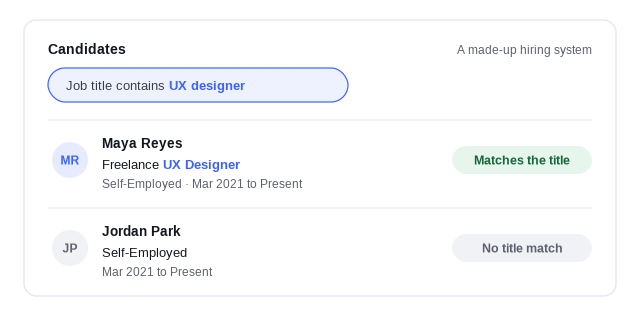
An illustration based on Lever’s help page, where recruiters can filter by job title. The screen, people and entries are made up. List self-employment in the employer line, not the title
The employer line says who you worked for. For freelance work, write “Self-Employed”, or your business or trading name if you used one. If your business is registered, use its full name, with LLC or Inc., since Greenhouse lists names without those words among causes of a failed parse. For contract work through an agency, write the agency and the client. Our advice: never leave this line blank.
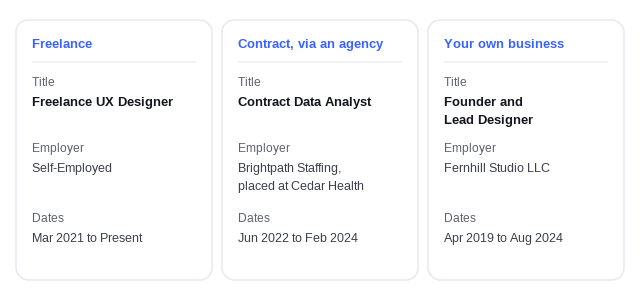
An illustration of the three cases. The people, businesses and clients are made up. Use one date range for the whole stretch
Give the entry the month and year you started, and the month and year you stopped, or “Present”. MIT’s career office asks for month and year, or “present”, on every entry. For several clients, the dates cover the whole time you freelanced, not each project. Our advice: short pauses between projects don’t need their own lines. Lever counts years of experience from parsed dates, so use your real ones.
Group short clients, and give a long contract its own entry
Many small projects go under one entry, with your main clients in the bullets. The Muse suggests grouping similar gigs under one header, with representative clients in the bullets. A client you worked with for years, or a long contract with one company, can have its own entry, like any job. Freesumes, a resume template site, describes a middle way, with the big clients named and the rest grouped. You don’t have to list every client, and a master resume is a good place to keep them all.
Write results, and name clients only if you can
Under the entry, write a few bullets, each saying what changed because of your work, with numbers you can explain. Name a client only if your contract allows it. 4 Corner Resources, a staffing firm, also says to check your contract for confidentiality first. If you can’t name a client, describe it, such as “a regional bank”. The resume bullet points guide covers the wording.
Keep it in date order with your other jobs
Put the entry in your work history where its dates fall, newest first. Several of the top guides suggest a functional resume for freelancers, which groups skills instead of jobs. Ask a Manager, a hiring manager’s advice column, says functional resumes are generally taken as a red flag and hide how recent your work is. A separate section only makes sense for side work next to a full-time job, covered below. If freelancing was your way into a new field, the career change resume guide covers the rest.


Freelance, contract and own-business resume examples, ready to copy.
Plain text, ready to copy. The people, businesses and clients are made up, and the [square brackets] are for your own facts and numbers.
Freelance work for several clients
One entry for the whole stretch. Your field is in the title, “Self-Employed” is in the employer line, and the clients are in the bullets.
Freelance UX Designer · Self-Employed · Remote · Mar 2021 to Present
- Designed [product or feature] for [number] clients, including a regional bank and [type of client]
- Redesigned the [flow or page] for [client], [the result, with your number]
- Ran [number] usability tests that led to [what changed]
Portfolio  [your portfolio link]
Freelance, with one main client named
When one client was most of your work and you’re allowed to name it. The smaller clients stay grouped in one bullet.
Freelance Copywriter · Self-Employed · Jan 2020 to Dec 2023
- Wrote [what you wrote] for Harlow Outdoor, the main client, for [number] years
- [One result for Harlow Outdoor, with your number]
- Also wrote for [number] smaller clients in [industry], including [type of client]
How to put contract work on a resume, through an agency
The agency employed you and placed you at a client, so the line names both, with a title and dates. For a contract directly with a company, that company is the employer and “Contract” goes in the title. Several titles with one employer is a different layout, covered in how to list promotions on a resume.
One long placement
Contract Data Analyst · Brightpath Staffing, placed at Cedar Health · Jun 2022 to Feb 2024
- Built [number] dashboards the [team] used to [decision]
- Cut the monthly report from [number] days to [number]

Several short placements through one agency
Contract Accountant · Brightpath Staffing · Mar 2019 to May 2022
- Placed at [number] companies, including a hospital group and [type of client]
- [One result, with your number]

A contract directly with the company
Contract Software Engineer · Cedar Health · Mar 2024 to Present
- [One result, with your number]
How to put your own business on a resume
The business is the employer, and your title says what you did there. The first bullet says what the business did.
Founder and Lead Designer · Fernhill Studio LLC · Portland, OR · Apr 2019 to Aug 2024
- Ran a [number]-person design studio for [type of clients]
- Grew to [number] clients and [amount] in yearly revenue
- Hired and managed [number] designers and contractors
- [One more result, with your number]
Freelance work next to a full-time job, when the dates overlap.
Of the top-ranking guides we read, only one gives a rule for this. 4 Corner Resources says to list the position with the more recent start date first. Our advice: choose between two layouts by how much the side work matters for the job you want.
Side work in your work history, newest start date first
When the freelance work is relevant to the job you want. Both entries keep their real dates, and “Part-time” on the side work shows why they overlap.
Freelance Product Designer (Part-time) · Self-Employed · Remote · Sep 2023 to Present
- Designed [what you designed] for [number] early-stage clients
- [One result, with your number]

Product Designer · Northfield Insurance · Hartford, CT · Feb 2020 to Present
- [Result, with your number]
- [Result, with your number]
Side work in its own section, still dated
When the side work is in another field, or small next to your main job. A section called “Freelance work” goes after your work history. Our advice: if it has nothing to do with the job and your page is full, leave it off.
EXPERIENCE
Product Designer · Northfield Insurance · Hartford, CT · Feb 2020 to Present
- [Result, with your number]
- [Result, with your number]

FREELANCE WORK
Wedding Photographer · Self-Employed · Jun 2021 to Present
- Photographed [number] weddings a year for [type of clients]
One freelance entry, rewritten, with the same facts and nothing added.
Many examples online are full of numbers that come from nowhere. This one only renames the title, fills the employer line and rewords the bullets. Every fact in the “after” is in the “before”.
Before, a vague title and no employer
A reader can’t tell the field, and a title filter has nothing to match.
Freelancer · 2021 to 2024
- Worked on websites for various clients
- Did design and front-end work
- Clients included a bakery chain and two law firms
- Managed projects from start to finish
After, the field in the title and the clients in a bullet
The same years and the same facts. If you know the months, add them.
Freelance Web Designer · Self-Employed · 2021 to 2024
- Designed and built websites for clients, including a bakery chain and two law firms
- Handled the design and front-end work, and managed each project from start to finish
Freelance and contract work mistakes on a resume, and what to do instead.
The common mistakes when people list freelance, contract or self-employed work, from the sources on this page and the guides that rank for this search.
Do
- Write a job title that names your field.
- Put “Self-Employed” or your business name in the employer line.
- Give every entry a month-and-year start and end.
- Group short clients under one entry.
- Name clients only when your contract allows it.
- Keep freelance work in date order with your other jobs.
- Keep the paperwork that shows it, such as 1099s.
Don't
- Write “Freelancer” with no field.
- Leave the employer line blank.
- Turn a short gig into a title you didn’t hold.
- List every small project as its own job.
- Hide the work in a functional resume.
- Call a gap freelance work when it wasn’t.
- Link a profile that only logged-in members can see.
Questions about freelance work on a resume, answered.
How do I say I am a freelancer?
Say it in the job title, next to your field, such as “Freelance Graphic Designer” or “Freelance Copywriter”. Then write “Self-Employed”, or your business name, in the employer line. The Muse, reprinted by Boston University’s career center, says “freelance” is more familiar to recruiters. It says “self-employed” may fit better if you’ve run your own business for a long time.
What is the 7 second rule in resume?
It comes from a 2018 eye-tracking study by Ladders, as HR Dive reported it. Recruiters spent about 7.4 seconds on a first skim of a resume, and simple layouts with clear headings and bold titles did well. Ladders didn’t give a sample size. In our reading, it’s one more reason to put your field in the title of a freelance entry.
What is a red flag on a resume?
For freelance work, a vague “Freelancer” title or a stretch with no dates is worth fixing, and the resume mistakes guide covers the rest.
What are the 10 worst mistakes to avoid on a resume?
Our guide to resume mistakes lists the common ones, with what to do instead.
Can employers tell if your resume was written by AI?
Usually they can’t prove it, and our guide on whether employers can tell covers what they do notice.
Does freelance work count as work experience?
Yes, if it was real work. MIT’s career office lists freelance projects among what an experience section can include. LinkedIn offers Freelance, Self-employed and Contract as employment types for a position. List it like any job, with a title, dates and results.
Should I put Self-Employed on my resume?
Yes, in the employer line, not as your job title. HireRight, a background check company, uses “Self-Employed” as the employment type when it verifies this kind of work. As a title, it says nothing about your field. In our reading, a recruiter searching for your kind of role won’t find it there.
How do I list Upwork or Fiverr work on a resume?
Like any freelance entry. The title names your field, and the employer line says “Self-Employed”, or “Self-Employed, via Upwork”. Upwork’s own guide suggests saying whether you worked through a platform or directly with the client. Link your profile only if it’s set to Public. Upwork’s help center says the other settings need a login to see it.
How do I prove freelance work if an employer checks?
Keep the paperwork. For self-employment, HireRight asks for a document such as an IRS Form 1099 for the start and end years. A DBA record, a business license, or a Schedule C completed by a third party also work. 4 Corner Resources suggests asking satisfied clients to be references. Our advice: keep your portfolio and contracts too.
How do I add freelance work to LinkedIn?
Add it as a position in your Experience section, and pick Freelance, Self-employed or Contract as the employment type. LinkedIn’s help center gives the steps as Add profile section, then Core, then Add position. It also says experience must reflect real professional work with the organization you name. Use the same title and dates as your resume.
Sources, and where to read more.
Checked in November 2026. The advice is ours where we say so. We read the help pages of two applicant tracking systems (Greenhouse and Lever), a background check company (HireRight), LinkedIn and Upwork, two career offices and the guides that rank for this search. The people, businesses and clients in the examples are made up.
- Career change resume, how to write one
- How to list promotions on a resume
- Master resume, keep every role on file
- Resume sections, what goes where
- ATS-friendly resume, what it means
- Contract-to-hire jobs explained
- Functional vs chronological resume
- What fractional jobs are
- LinkedIn Help, employment types on your profile
- LinkedIn Help, add a position to your profile
- Greenhouse help, unsuccessful resume parse
- Greenhouse help, search candidates using Boolean queries
- Lever help, advanced search and rediscovery
- HireRight, self-employment verification
- Upwork Help, how to control who sees your profile
- Upwork (a freelance marketplace), how to list freelance work on a resume
- MIT CAPD, crafting an effective resume
- The Muse, reprinted by Boston University Career Center, formatting a resume with freelance work
- 4 Corner Resources, how to put freelance work on a resume
- Freesumes, how to list freelance work on a resume
- Ask a Manager, resume tricks that will backfire on you
- HR Dive, the Ladders eye-tracking study
- Hacker News, Ask HN, will self-employment sink my resume?
- Blynk Resume Builder
