
Product manager resume. Proof you shipped outcomes, at the level you want.
If you’ve rewritten your resume again and still hear little back, it may read like a list of duties. A product manager resume is evidence: the problem, what you decided, what changed. Here’s each section, with sample bullets by level and what 601 job postings for product roles ask for.

The short answer
- Show outcomes, not duties. Each bullet says the problem, what you decided and what changed, with a real number when you have one.
- Use the posting’s words for what you’ve really done. In the postings we counted, those words are about leading the work: strategy, roadmap, stakeholders. Tools like SQL are rare.
- One page early in your career; a senior resume can run to two if every line earns its place. Then fit it to each job you apply for.
On this page
Why your product manager resume gets few callbacks, and what’s really going on.
Five ways a product manager resume goes wrong, and what reviewers and hiring managers told the people who posted them.
“It reads like I ran meetings.”
A Technical Product Manager on Blind had sent more than 300 applications and got 2 first interviews. Replies said the resume read like a program manager’s, not a product manager’s. They also said it lacked the features he had launched.
Check: Does each bullet say what you decided and what shipped? Coordination alone reads as project work.
“My numbers sound made up.”
In the same thread, a reviewer called the resume’s user and retention numbers “very very unbelievable.” A figure that looks too neat makes a reader doubt the rest.
Check: Could you explain every number in an interview? If not, say the change another way. There’s a section on that below.
“I’m senior, so I call myself a Product Leader.”
Another Blind poster had 16 years of experience and no callbacks for Senior PM roles. The top reply, from someone who said they hire, was to drop “Product Leader” from the summary.
Check: Does your headline use the title the posting uses? Let the work show the seniority.
“I send the same resume to every job.”
Paweł Huryn reviews product manager resumes for free. He says about 70% of the ones he sees fail basic expectations, and one reason he gives is a resume not aligned with a specific job description. That’s his own count, not a study.
Check: Are the posting’s title and top three asks on your resume? In its words, next to a result.
“The ATS must be rejecting me.”
Greenhouse says its Talent Matching “does not automatically advance or reject candidates.” Its automatic rejections run on answers to the employer’s own questions. Recruiters search and filter, so the posting’s words help you come up. The resume keywords guide covers how that search works.
Check: Did you answer every screening question fully? That’s where automatic rejections are set up.
What product management job postings ask for, level by level.
Most product manager resume tips give one generic list of skills, whatever the industry or level. So we counted. Blynk looked at 601 job postings for product roles from its own searches. They come from 449 companies and were first seen between October 31 and November 11, 2026.
The sample, exactly: 284 VP and Chief Product Officer titles, 165 Head of Product titles, 125 Product Manager titles and 27 Director or “Product Leader” titles. About half say remote, and they aren’t only US jobs. So this is a picture of senior product roles, not of every PM job.
At every level, the words are about leading the work. Strategy comes up in 79% of the 601 postings, roadmap in 69%, vision in 58%, stakeholders in 49%, cross-functional in 48% and outcomes in 47%.
Tools are rare. SQL is in 7%, Jira in 5% and Figma in 3%. Only 6 of the 601 name a certification such as CSPO, PSPO or PMP. AI comes up in about half the requirements sections: 227 of the 463 postings that have one.
A mention isn’t always a requirement. We counted a word anywhere in the posting, because company blurbs can use these words too. That’s why the AI figure uses the requirements part only.
Product manager to VP: the numbers for each level.
VP and Chief Product (284 postings): strategy 81%, cross-functional 53%, executives or the board 51%, and an MBA 15%. At least 26% ask you to lead or hire product managers. That count uses a strict pattern, so the real share is likely higher. Where a posting names a number of years, the median is 10.
Head of Product (165 postings): roadmap 61%, revenue 32%, experimentation 25%, SaaS 24%, and leading or hiring product managers at least 24%. Only 13% mention a degree and 2% an MBA. Our reading: more of these postings come from startups, which may explain it. The median years asked is also 10.
Product Manager titles (125 postings, a smaller and lumpier sample): stakeholders 72%, cross-functional 63%, metrics or KPIs 50%, a degree 50% and SQL 17%. Only 6% ask you to lead or hire product managers.
Read that last group with care. 61 of the 125 are bank-style titles such as “Product Manager, Vice President”, from just 20 companies. At a bank, Vice President is a rank, not a VP of Product job. The other 64 are Senior, Staff, Principal, Group, Lead and plain PM titles from 53 companies. The median years asked: 8 for those, 5 for the bank titles.
What it means for your resume (our reading): the evidence changes with the level. The higher it is, the more your bullets should show the team, the strategy and the people you answered to. The words that repeat belong inside your results, not in a skills list.
How to write a product manager resume, section by section.
From the top of the page down. Each step is one section, in the order a reader meets it. This structure works whether you’re junior or senior.
Start from a plain, one-column template
In Ladders’ 2018 eye-tracking study, recruiters’ first skim of a resume averaged about 7.4 seconds. Simple layouts with clear section and job headings did well. Several columns, clutter and long sentences did poorly. So use one column, standard headings and bold job titles: easy for both a person to skim and hiring software to read. Put your best result first in each role.
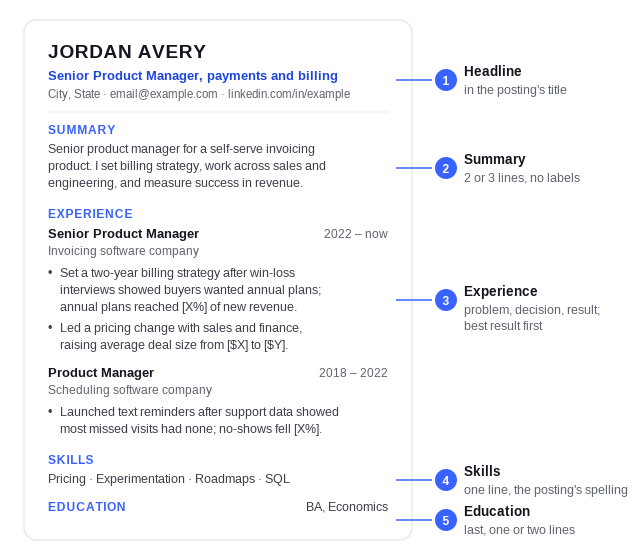
An illustration of a one-column product manager resume. The name and products are made up. Headline: the posting’s own title
Under your name and contact information, write the title you’re applying for, in the posting’s form. Titles vary a lot: the 796 product-role postings in Blynk’s searches, before we dropped cut-short texts, used 509 different titles; 247 said “Vice President” and 190 said “VP”. Lever reads job titles from your resume into a filter recruiters search. Never rename a past job to match; your past titles stay as they were.
Example (made up): the posting says “Senior Product Manager, Payments” → your headline: “Senior Product Manager, payments and billing”.Write a two- or three-line product manager resume summary
Some call it a professional summary, and a strong one is short. Say what type of product you build, for whom, and your strongest real result. In Huntr’s data, 91% of its users’ interview-stage product manager resumes open with one (vendor data, its own users). Skip labels such as “Product Leader” or “visionary”. Let the summary carry the posting’s top two or three asks that really describe you.
Experience: the problem, your decision, the result
Your accomplishments go here. Laszlo Bock, then head of people at Google, gave a formula: “Accomplished [X] as measured by [Y], by doing [Z].” A product manager’s version adds the problem you saw. A hiring manager writing on Stay SaaSy reads for proof you owned a roadmap, built and sold software, and made strategic decisions. This is where your impact shows. Start each bullet with a verb, keep each to one or two lines, and put the bullet points most related to the job first.
Before (made up): “Responsible for the onboarding roadmap. Research showed most new users quit at setup. Worked with design and engineering on a new flow. Activation went from 31% to 38%.”
After: “Worked with design and engineering on a new onboarding flow after research showed most new users quit at setup; activation rose from 31% to 38%.”Skills and tools: short and true
Keep it to one or two lines, in the posting’s spelling. In the postings we counted, SQL, Jira and Figma each came up in fewer than 1 in 10. So list the tools you actually use, such as SQL, Tableau or Jira, and leave off one you’re still learning. Name product skills, such as user research, prioritization, pricing or experimentation, inside your bullets where they have proof. Soft skills such as communication and collaboration are better shown in a result than listed.
Education, MBA and certifications: last and brief
37% of the 601 postings mention a degree, and 70 of those also accept equivalent experience. An MBA comes up in 10%, and 43 of those 59 call it preferred or a plus. Computer science is named in 12%, and only 6 postings name a certification. The Stay SaaSy hiring manager doesn’t mark people down for missing higher education. Once you have a few years of work, education goes at the bottom, in one or two lines.

Action verbs for product manager bullets: led, launched, shipped, decided, prioritized, cut, grew, reduced, improved, redesigned, tested, partnered, hired. Start each bullet with one. Avoid “responsible for”, “helped with” and “worked on”: they hide what you did.
Product manager resume examples: summaries and bullets by level.
Samples with made-up products. The [square brackets] are for your real numbers, so nobody ends up copying an invented figure. Keep only what you’ve really done.
A plain product manager resume template
One column, in this order. Paste it into any editor and fill in the brackets.
[YOUR NAME]
[Target job title, in the posting’s words]
[City, State] · [email] · [LinkedIn profile link]

SUMMARY
[The kind of product you build, for whom.] [How you work: research, decisions, shipping.] [Your strongest real result.]

WORK EXPERIENCE
[Job title] · [Company] · [Start year] – [End year or Now]
- [Most relevant result: problem, decision, result]
- [Second result]
- [Third result]

[Job title] · [Company] · [Start year] – [End year]
- [Result]
- [Result]

SKILLS
[Product skills you can prove] · [Tools you really use]

EDUCATION
[Degree, such as Bachelor of Arts], [Subject, such as Economics] · [University] · [Year]
[Certification, only if the posting asks for it]
The bullet formula
Use it for every experience bullet.
[Verb] [what you built or changed] for [who], after [the problem you found]. Result: [real number, or the change you can show].

Example:
Rebuilt checkout for small business buyers after interviews showed they left at shipping costs. Result: conversion from [X%] to [Y%].
Product Manager (sample)
A few years in, owning one product area.
Summary
Product manager for a scheduling app used by clinics. I find where users get stuck, decide what to fix first, and ship it with design and engineering. Most recent result: [X%] fewer missed appointments.

Experience
- Launched text reminders after support data showed most missed visits had no reminder; missed appointments fell [X%].
- Identified fields nobody used in [N] customer calls and designed a shorter setup, cutting steps for new clinics from [X] to [Y].
- Ran the booking product roadmap with [N] engineers and [N] designers; moved from quarterly to [N]-week releases, so new features clinics asked for shipped in weeks, not months.
Senior Product Manager (sample)
Owning a product line, its strategy and its numbers.
Summary
Senior product manager for a self-serve invoicing SaaS product. I set the strategy and roadmap for billing, work across sales, support and engineering, and measure success in revenue and retention. Most recent result: annual plans at [X%] of new revenue.

Experience
- Set a two-year billing strategy after win-loss interviews showed buyers wanted annual plans; annual plans reached [X%] of new revenue.
- Collaborated with sales and finance on a cross-functional pricing change, raising average deal size from [$X] to [$Y].
- Chose to retire a feature used by under [X%] of accounts, freeing a team of [N] engineers for the payments roadmap.
- Ran [N] experiments on the upgrade page; kept the [N] that lifted paid conversion.
Technical or AI product manager (sample)
A platform, data or AI-powered product, working closely with engineers.
Summary
Technical product manager for a developer platform. I turn what customers need into APIs and payment integrations, decide what the engineering team builds first, and track what’s driving adoption and reliability. Most recent result: support tickets down [X%] after an API rebuild.

Experience
- Launched an AI-powered search feature for a cloud payments product after testing showed users couldn’t find past transactions; [X%] of active users tried it within [N] months.
- Decided to rebuild the public API instead of patching it, after [N] partner integrations broke in one quarter; support tickets fell [X%].
- Wrote the data product requirements with the analytics team, so sales could see usage by account for the first time.
Head of Product or VP of Product (sample)
Leading product managers and answering to executives.
Summary
Product executive for B2B software. I build and lead product teams, set the product vision with the executive team, and tie the roadmap to revenue. Current team: [N] product managers and [N] designers. Most recent result: [X%] growth in net revenue retention.

Experience
- Hired and led a team of [N] product managers across three product lines; [N] were promoted.
- Set the product strategy with the CEO and the board, moving the company from one product to a platform of [N].
- Owned the pricing and packaging change behind [X%] growth in net revenue retention.
- Started quarterly reviews of customer research with sales and support, which shaped [N] of the year’s [N] launches.
Senior product manager, Head of Product or VP resume: what changes as a product leader.
The Stay SaaSy hiring manager reads every product resume for relevance and quality. Relevance is strict for senior hires and loose for an associate product manager. Quality includes trajectory: the path your roles have taken. So a senior resume has to show closer, more direct proof.
Team leadership. In our count, at least 26% of VP and Chief Product postings ask you to lead or hire product managers. For Product Manager titles it’s 6%. If you’ve hired, coached or led product managers, say how many team members and what they shipped.
Answering to executives. Executives or the board come up in 51% of VP and Chief postings, against 39% of PM titles. Name the decisions you took to the executive team, and the cross-functional team you led to deliver them.
Money. Revenue comes up in 32% of VP and Chief postings and P&L in 9%. If you owned a budget, revenue goals or pricing, say so with the result.
Years. Where VP, Chief and Head of Product postings name a number of years, the median is 10; for non-bank PM titles, it’s 8. Clear start and end dates let a reader see it quickly.
What to lead with, by level (our reading): a product manager leads with features launched and what changed. A senior product manager leads with a product area’s strategy and results across teams. A Head of Product or VP leads with the team built, the strategy set with executives, and revenue.
Product, not program. If your bullets are about running the process (schedules, standups, status), they read as program management, the trap the Blind replies named. Keep one line on process at most, and spend the rest on decisions and outcomes.
Titles. Use the posting’s form of the title in your headline. If you’re moving from a bank to tech, a “Vice President” rank isn’t a VP of Product role, so describe the product work, not the rank.
No metric for a bullet? What a product manager can write instead.
Most guides say to quantify, and few say what to do when the number doesn’t exist. It may be new, confidential or never measured. Made-up numbers are worse than none: the Blind reviewer’s “unbelievable” is what a reader may think. Here’s our advice.
Use a real number when you have one. The ones product teams track include adoption, active users, engagement, retention or churn, conversion, revenue, cost, efficiency or time saved, and customer satisfaction scores. A reader can trust a number you can explain. If you can’t explain how it was measured, leave it out.
Otherwise say the scope: how many users, customers, markets or teams the work touched. “Rolled out to all 12 regional sales teams” (made up) is a fact you can stand behind.
Or the decision: what you chose, what you said no to, and why. Seniority shows in the trade-offs.
Or the change you can show: a before and after state, such as “from a weekly manual export to a live dashboard”, or customer feedback that changed after a release.
If the number is confidential, use a share or a direction you’re allowed to give, such as “roughly doubled” or “the top request from enterprise customers”.
Product manager skills, and where each kind goes.
Many guides give a long list of hard and soft skills. The postings we counted point to a shorter one, and most of each skill’s proof belongs in your bullets, even at senior levels.
Product skills, shown in results: product strategy and the product roadmap, prioritization, user research and customer interviews, market research, competitive analysis, the user experience, pricing, go-to-market strategy and experimentation (A/B testing), across the product lifecycle. Strategy, the roadmap, pricing, go-to-market and experimentation are among the words the postings repeat, so each one needs a bullet behind it.
Analytical skills: data analysis, metrics and KPIs, and data-driven decision making. Show them through insights that changed a decision, not through the word “data-driven”.
Technical skills, listed if you use them: SQL, APIs, Tableau, Jira, Agile or Scrum with sprint planning and user stories. In our sample these come up less often, apart from APIs and SQL in the PM-title postings.
Soft skills, shown, never listed: communication, leadership, cross-functional collaboration and stakeholder management. “Presented the roadmap to the executive team every quarter” (made up) proves more than “excellent communicator”.
No product manager title yet? How to write the resume anyway.
Maybe your background is in software development, data or product analyst work, design, marketing, operations, consulting, project management, support or sales. The Stay SaaSy hiring manager holds relevance loosely for associate product manager hires. So what you need to show is product thinking, not the title.
Keep your real job titles. A software engineer stays a software engineer. Show the product work inside the bullets: a customer problem you found, a feature you proposed, a trade-off you made, launching something with a team. If you were a product owner in a Scrum team, say what you decided, not just the backlog you kept.
Use the bullet formula above. For example (made up): “Proposed and built a bulk-upload tool after support tickets showed it was the top request; onboarding for new accounts dropped from [X] days to [Y].”
Add a project if your job didn’t give you one. Side projects, personal projects, an internship or a product you built at school all count. A portfolio link can help if it shows real product work (our advice). Describe it like a job: the problem, what you decided, what happened and what you learned. Relevant coursework goes in education, in one line.
Point the summary at the move. Say the role you want and the product work you’ve already done, in two lines.
Product manager resume keywords, and how to use them truthfully.
The keywords that matter are in the postings you’re applying to. The resume keywords guide shows how to count them across 10 to 15 postings; here’s what that looks like for product roles.
The core words, at every level: strategy, roadmap, vision, stakeholders, cross-functional, outcomes, metrics or KPIs, data-driven or analytics.
More common at VP and Chief level: executives or the board (51%, against 39% of PM titles), leading or hiring product managers (26%, against 6%) and revenue (32%, against 18%).
More common in our smaller PM-title sample: stakeholders (72%, against 51% at VP level), metrics or KPIs (50%, against 36%), APIs (30%, against 14%) and SQL (17%, against 4%).
How to use them: employers’ recruiters search applicants by words like these. Put each one inside a real result, in the posting’s spelling, and only for work you can talk about. A skills section full of terms with nothing behind them doesn’t hold up once a person reads it. Before you apply, you can see how hiring software reads your resume against the job, including the keywords you’re missing.
How long a product manager resume should be, and when two pages are fine.
We found no employer rule that sets a page count, and the guides don’t agree. Aha, which makes product management software, says to stick to one page early in your career, and that a senior candidate can extend to two. Enhancv says two pages only with more than 10 years of experience. Huntr found a median of 1.9 pages in 150 interview-stage product manager resumes from 77 of its users (vendor data).
Our advice: one page is enough while you’re early in your career. A senior resume can run to two pages if every line earns its place. The test for each line: would this posting’s hiring manager miss it?
Page one does most of the work. The first skim in the Ladders study averaged about 7.4 seconds. Put your headline, summary and the most important results on the first page. Previous roles from years back can shrink to a single line each, without the details.
Long isn’t the same as senior, and a line is only worth keeping if it adds value. On Blind, reviewers told the TPM with 300 applications that his two pages were too long. Cut repeats before you consider a second page.
Product manager resume mistakes, and what to do instead.
The common ones, from reviewers’ replies and what the postings ask for.
Do
- Write each bullet as the problem, your decision and the result.
- Use the posting’s title and top asks, for work you’ve really done.
- Show the team, the strategy and the executives you worked with as you get more senior.
- Make sure every date, title and number is right.
- Use real numbers you can explain, or the scope and the change.
- Create a version for each job: highlight the most relevant result at the top of each role.
- Ask a product manager you trust to read it and say what they’d cut or improve.
Don't
- List features without what they changed.
- Invent or round up a metric you can’t defend.
- Fill bullets with jargon, framework names or generic soft skills instead of decisions.
- Describe running meetings and schedules as product work.
- List a skill you can’t talk about in an interview.
- Write “managed” or “owned” without saying what changed.
- Send one resume to every job.
Questions about product manager resumes, answered.
Is the ATS rejecting my product manager resume?
Probably not on its own. Greenhouse, an applicant tracking system, says its Talent Matching doesn’t automatically advance or reject candidates, and its automatic rejections act on answers to the employer’s questions. So answer every screening question fully, use the posting’s words for your real work, and keep the layout plain. The ATS-friendly resume guide has the formatting.
How long should a product manager resume be?
One page early in your career. A senior product manager, Head of Product or VP resume can run to two pages if every line earns its place. Aha says the same, Enhancv puts the line at 10 years, and Huntr’s interview-stage samples had a median of 1.9 pages. Put the most relevant work on page one.
Do I need an MBA, a degree or a certification to be a product manager?
Usually not. In the 601 postings for product roles we counted, 10% mention an MBA, and most of those call it preferred or a plus. 37% mention a degree, often with “or equivalent experience”. Only 6 name a certification. VP and Chief postings mention an MBA most, at 15%.
How do I write a product manager resume with no product manager experience?
Lead with product-like work you’ve really done: a problem you found, a decision you made, something you shipped or changed, and what happened. The Stay SaaSy hiring manager says relevance is judged loosely for associate product managers. Use your real title, and let the bullets show the product thinking.
What should a product manager put in a resume summary?
Two or three lines: the kind of product you build and for whom, how you work, and your strongest real result. Use the posting’s top asks that truly describe you. Skip self-labels such as “Product Leader”; one Blind reviewer who said they hire told a candidate to drop it.
What keywords should I put on a product manager resume?
The ones your target postings repeat. In the postings we counted, those were strategy, roadmap, vision, stakeholders and cross-functional, far more often than any tool. Put each inside a real result. The resume keywords guide shows how to count your own.
Does a product manager resume need to be technical, and how do I show AI work?
It depends on the posting. In our smaller PM-title sample, SQL came up in 17% and Python in 10%; at VP level SQL was 4%. AI was in about half the requirements sections. Show AI work the same way as any other, with the focus on the problem, what you shipped with it, and what changed.
What’s the difference between a product manager and a program manager resume?
A product manager resume shows what you decided to build and why, and what it changed. A program manager resume shows how work got delivered: plans, timelines, coordination. On Blind, reviewers said one PM resume with few interviews read like a program manager’s.
Senior PM or VP of Product: what changes on the resume?
Scope and people. In our count, at least 26% of VP and Chief postings ask you to lead or hire product managers, against 6% of PM titles, and executives or the board come up more (51% against 39%). A VP resume leads with the team, the strategy and the revenue.
What font, colors and template should I use for a product manager resume?
Plain and readable: one column, standard headings, one common font, bold job titles, little or no color. In the Ladders study, simple layouts did well and multiple columns did poorly. Blynk’s Resume Builder has four one-column looks with the headings hiring software expects.
Sources, and where to read more.
Checked in November 2026. The advice is ours, and is marked where it’s our reading. The posting counts are Blynk’s own: 601 job postings for product roles from Blynk’s searches, from 449 companies, first seen between October 31 and November 11, 2026, one per company and job title, after dropping postings whose text was cut short. Mostly VP and Head of Product, about half remote, not US-only. We counted postings that mention each word anywhere; the AI figure uses the requirements part only, and “leads or hires product managers” uses a strict pattern, so it’s a floor. The years figure is the highest number written next to “years of experience”, so it’s rough. Samples on this page are made up.
- Resume keywords: how to find the right ones
- How to tailor your resume to a job description
- ATS-friendly resume: what it means
- The best AI resume builders, compared
- Blynk vs Enhancv
- Blynk vs Huntr
- How to write an executive resume
- Aha: product manager resume templates (length)
- Enhancv: product manager resume examples (length)
- Huntr: product manager resume examples and data
- HR Dive: eye-tracking study shows recruiters look at resumes for 7 seconds
- Business Insider: Laszlo Bock’s resume formula
- Stay SaaSy: how I read product manager resumes
- Greenhouse help: Talent Matching
- Greenhouse help: application rules overview
- Lever help: using advanced search and rediscovery
- Blind: Technical Product Manager, 300 applications, 2 interviews
- Blind: 16 years of experience, what’s wrong with my resume
- Product Compass (Paweł Huryn): free product manager resume review
- Blynk Resume Builder
- Blynk ATS Check
- Blynk pricing
