
What is a hiring manager? The person who decides, and how to get ready for them.
A job posting, a recruiter or a rejection email mentioned “the hiring manager”, and you're not sure who that is. Here's who they are, what they do at each step, how they differ from a recruiter and HR, and how to prepare for their interview.

The short answer
- A hiring manager is the person who'd manage you if you got the job. Usually that's the head of the team with the opening, not someone in HR.
- They usually make the final call. Recruiters and HR find and screen applicants. The hiring manager picks who gets the offer.
- Their interview is about the work itself. Expect questions on what you've done. Bring 3 to 5 short stories, and ask about the team's priorities.
On this page
What is a hiring manager? The meaning, in plain words.
A hiring manager is your possible future boss. Greenhouse, which makes hiring software, puts it simply. The hiring manager is “the person who will manage whoever fills that role,” it says. That's “the person you would report to if you got the job.”
So yes, a hiring manager is a manager. It's usually a team lead, a director or a VP, often one level above the job. “Hiring manager” is the part they play for this one job, on top of their real work. That part is our reading.
They don't work in HR. St. John's University's career office says the hiring manager “is an industry professional in the field you are applying to.” The HR recruiter, it says, is not. So the hiring manager can judge your actual skills.
At a small company, it may be the founder. Blynk read 1,127 job postings from its searches between October 31 and November 12, 2026, almost all for product roles. 215 of them said who the role reports to. In 43 of those, it was the CEO, a founder or the president.
What does a hiring manager do? Their part at each step of hiring.
Greenhouse says hiring managers “tend to be involved in every step of the hiring process.” Here's their part, in order, and what it means for you.
They ask for the hire and shape the job
The hiring manager knows what the team needs. Greenhouse lists creating job descriptions and requirements among their key duties, and says they work closely with the recruiter.
What it means for you. In our reading, the must-haves in a job posting are often the hiring manager's own words. Use the same words for the same skills on your resume, if they're true.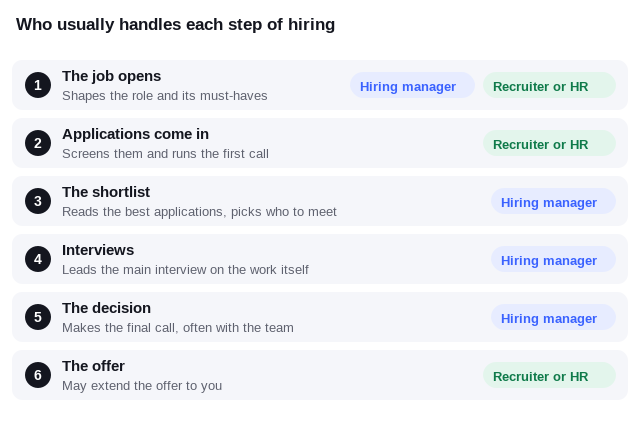
Who usually handles each step. It varies by company, and at a small one, one person may do several. They read the shortlist the recruiter sends
Recruiters “find, screen, and interview applicants,” says the US Bureau of Labor Statistics (BLS). The best ones go to the hiring manager. Federal jobs can work this way too. At the EPA, HR checks each application, then sends a list called a “Certificate of Eligibility” to the manager who is hiring.
What it means for you. A status like “hiring manager review” usually means you passed the first screen. That's our reading, since each employer names its own steps. Our guide to what “under review” means covers the common statuses.They lead the main interviews
“Hiring managers usually take the lead in conducting interviews,” Greenhouse says. Often a recruiter calls you first, and the hiring manager comes next. Others on the team may meet you too.
What it means for you. The interview with the hiring manager is the one about the work. There's more on it below.They make the final call
The hiring manager is “ultimately the person who makes the decision about which candidate to extend an offer to,” Greenhouse says. The recruiter “often serves as an advisor,” it adds. At the EPA, the manager interviews, checks references and “makes a final selection.”
What it means for you. In our reading, winning over the hiring manager matters most. But the decision is often shared with the team, so be good to everyone you meet.They become your manager
If you're hired, this is the person you'll report to. The recruiter may make the offer call. BLS says recruiters may “contact references, and extend job offers.” After that, the hiring manager is your boss.
What it means for you. You're picking them too. The Forage, a careers site, says you'll want to know “what they're like as a manager.”

How a hiring manager differs from a recruiter, and where HR fits.
The recruiter runs the process. BLS says recruiters find, screen and interview applicants. They may also contact references and make job offers. St. John's career office says they focus on “initial screening to identify shortlisted candidates.”
The hiring manager judges the fit. Greenhouse calls the hiring manager “the subject matter expert for the role.” St. John's says they're “responsible for making the final hiring decision.”
HR sets the rules. Human resources managers “oversee an organization's recruitment, interview, selection, and hiring processes,” BLS says. In many companies, the recruiters sit in HR. At a small one, the founder may do all three jobs. That last part is our reading.
Writing to one of them? Our guide on which one to contact first covers it. And what is a recruiter explains the three kinds you'll meet.
Who is the hiring manager for your job? Start with the job posting.
Look for the reporting line. Many postings say it in a line like “You'll report to the VP of Product” or “reporting directly to the CEO”. In our reading, that title is usually the hiring manager.
Most postings don't name the hiring manager. Of the 1,127 postings in Blynk's searches, 215 (about 1 in 5) said who the role reports to. Only 16 used the words “hiring manager” at all. Just 3 gave the person's name.
No reporting line? Look one level above the role, in the same team. On LinkedIn, some job posts also show a “Meet the hiring team” section. LinkedIn says you can connect with or message the people listed there.
To find the person and their email, follow our step-by-step guide on how to find the hiring manager. It covers LinkedIn searches, team pages and checking an email address.
The hiring manager interview, and how it differs from the recruiter screen.
The Forage calls it “one of the most important interviews of the process.” If you've been asked to one, you've passed the first screen. That's our reading, not a promise of an offer. Here's how to get ready.
Know where it falls
In our reading, it usually comes after a first call with a recruiter. A few postings in Blynk's searches spell out their steps. One lists a recruiter screen, then the hiring manager interview, then team rounds, a take-home task with a presentation, and a final interview with a senior leader.
Expect questions about the work itself
BetterUp, a coaching company, says a talk with a hiring manager “will be a formal job interview.” They'll ask about your skills, education and experience. St. John's says the hiring manager is focused on “evaluating industry skills and knowledge.” In our reading, the recruiter screen is lighter, and checks the basics.
Example. A recruiter may ask, “Why are you looking?” A hiring manager is more likely to ask, “Tell me about a project like this one, and what you did.” That contrast is our own illustration.Prepare 3 to 5 short stories
MIT's career office says to “prepare 3-5 stories” for interviews that ask about your past work. It suggests the STAR method. Say the situation, your task, the action you took and the result. Pick stories that match the must-haves in the posting.
Ask about the job, not the logistics
Save the timeline and pay for the recruiter. With the hiring manager, ask about the work. St. John's suggests asking, “How do you measure success in this role?”
More questions to ask. What would you want done in the first 90 days? What is the team's biggest problem right now? What do the best people on your team do differently? How do you like to work with the people on your team?Size them up as a boss
“Because hiring managers are hiring for roles on their team, they're usually your potential boss,” says The Forage. Notice how they talk about their team, and whether you'd like to work for them.
Thank them within a day or two
The Forage says to send a thank-you note “usually within 24-48 hours.” Mention one thing you talked about. Our guide to the follow-up email after an interview has notes to copy.
Writing a hiring manager email, and answering one.
If a hiring manager emails you, it's usually to set up a call or ask a question. Reply within a business day, in a few lines, and offer two times. That's our advice.
If you write to one first, keep it short. Name the role, give one result that fits it, and ask one easy question. Our guide to a cold email for a job has examples. If you've already applied, see the follow-up email after applying.
Don't guess the address. A wrong one bounces, or goes to someone else. Blynk's hiring manager finder checks each person's work email before it shows them to you.
Writing “Dear Hiring Manager” on a cover letter? Use their name if you can find it. Our guide on how to address a cover letter has the options.
Working with a hiring manager, do this, not that.
The advice is ours, unless a source is named.
Do
- Read the posting's reporting line to see who the hiring manager is.
- Match your resume to the must-haves, in the posting's words, if they're true.
- Bring 3 to 5 stories about real work to their interview.
- Ask the hiring manager about the work, and the recruiter about pay and dates.
- Send a thank-you note within 24 to 48 hours, as The Forage suggests.
- Be kind to everyone you meet. The decision is often shared.
Don't
- Assume the hiring manager works in HR.
- Treat an interview with the hiring manager as an offer.
- Ask the hiring manager about pay in the first minutes.
- Write to five people at one company about the same job.
- Pay anyone to get a job. Honest employers never ask you to, the FTC says.
Questions about the hiring manager, answered.
Is a hiring manager a manager?
Usually, yes. The hiring manager is the person you'd report to if you got the job, Greenhouse says. That's most often the manager of the team with the opening. At a small company, it can be the founder or CEO.
Do hiring managers make the final decision?
Usually. Greenhouse says the hiring manager is ultimately the one who decides who gets the offer, with the recruiter advising. BetterUp says the decision “rests with them and the rest of the team.” In federal hiring, the EPA says the manager “makes a final selection.”
Who is responsible for recruiting employees?
Recruiters and HR run it. BLS says recruiters find, screen and interview applicants, and HR managers oversee hiring. The hiring manager says what the team needs and chooses who to hire. At a small company, one person may do all of it.
Does the hiring manager or recruiter make the offer?
The hiring manager usually decides, and the recruiter may make the call. BLS says recruiters may extend job offers. It varies by company, so ask the recruiter who you'll hear from. That's our advice.
What does it mean when you have an interview with the hiring manager?
It means you passed the first screen, and the person who decides wants to meet you. That's our reading. It's a good sign, but not an offer. Prepare for questions about the work, and ask about the team.
What are signs you will get a job offer?
No sign is certain until you have an offer in writing. In our reading, the clearest signs are practical. They ask for your references, ask when you could start, or the recruiter asks about your pay needs. Our guide on how long it takes to hear back has the usual timing.
What are red flags in the hiring process?
Being asked to pay is the biggest one. Honest employers “will never ask you to pay to get a job,” the FTC says. At least two employers in Blynk's searches warn in their postings that scammers pose as their recruiters or hiring managers. Our guide to job scams has more signs.
Is a hiring manager the same as HR?
No. HR and its recruiters run the process and screen applicants. The hiring manager runs the team you'd join. St. John's career office says the hiring manager is an industry professional in your field, and the HR recruiter isn't.
Should I contact the hiring manager directly?
Often, yes, in one short note about the role. That's our advice. Write to one or two people, not everyone on the team. Our guide on finding the hiring manager covers who to write to and how.
Where the facts come from.
Checked on November 12, 2026. The advice is ours, and where a line is our reading we say so. Facts about hiring roles come from each publisher's own page, linked below. Blynk's counts cover 1,127 distinct job postings from Blynk's searches, almost all for product roles and most of them senior, first seen October 31 to November 12, 2026, each with more than 300 characters of text. We searched them for a reporting line (“reports to”, “reporting to”) and for the words “hiring manager”, read samples by eye, and dropped matches that weren't about the role's manager.
- How to find the hiring manager
- What is a recruiter?
- How to reach out to a recruiter
- Cold email for a job
- Follow-up email after an interview
- What “under review” means
- How to write a 30-60-90 day plan
- Greenhouse glossary, what is a hiring manager
- US Bureau of Labor Statistics, human resources specialists
- US Bureau of Labor Statistics, human resources managers
- US EPA careers, what to expect after you submit your application
- St. John's University Career Services, human resources vs hiring manager
- The Forage, what is a hiring manager and how to talk to one
- BetterUp, hiring manager vs recruiter
- MIT Career Advising and Professional Development, the STAR method
- LinkedIn Help, Meet the hiring team on job posts
- US Federal Trade Commission, job scams
- Blynk Find the Hiring Manager
