
How to write a 30 60 90 day plan. For the interview, and your first three months.
They asked you to bring a 30 60 90 day plan to the next round, or you just started and want one. You don't work there yet, so it feels like guessing. Here's how to build it from the job posting, what goes in each phase, a template to copy, and how to present it.

The short answer
- A 30 60 90 day plan is a short outline of what you'd learn, do and own in your first three months. Indeed calls the three phases learn, apply and lead.
- For an interview, build it from the job posting. Three to five goals per phase, each with a way to measure it, on one or two pages, with your guesses marked as guesses.
- Once you start, rewrite it with your manager in your first week. Their priorities beat your guesses, and the plan becomes the real one.
On this page
Why a 30 60 90 day plan feels hard to write, and what's really going on.
Four worries that stop people starting, and what to do about each.
“I don't know their problems yet.”
Nobody expects you to. Coursera's guide says that if you lack information, you can make the details hypothetical. Darden's career blog says the plan isn't about getting everything right. It's about asking good questions and forming a view.
What to do: Build it from what the posting says. Then mark each guess as a guess.
“How long should it be?”
Sources disagree. Wonsulting says "ideally 1-2 pages". Amy Segelin of the search firm Chaloner wrote in Fortune in 2017 that a typical plan runs 3-4 pages.
What to do: Our advice is one or two pages. Short enough to read during the interview.
“Will they hold me to it?”
It's a draft, not a contract. Indeed's guide tells new hires to stay flexible and revise goals as they learn. Wonsulting's advice for the interview: "Use your plan as a guide, not a script."
What to do: Call it a draft out loud. Ask them what you got wrong.
“They didn't ask for one. Should I bring it?”
Segelin suggests offering it anyway. Her line is "I've put together a plan of what I'd like to do in this position." Wonsulting says to work it into your talk about the role if it isn't asked for.
What to do: Bring it, and offer it once. If they don't take it up, leave it.
What is a 30 60 90 day plan, and why do interviewers ask for one?
What it is. In Indeed's words, it's "a strategic roadmap that outlines clear, measurable goals to help you succeed in a new role."
It's structured as three phases across your first three months. Indeed calls them learn (days 1 to 30), apply (31 to 60) and lead (61 to 90). Asana's names are similar: learning, active contribution, and leadership or ownership.
What goes in it. Indeed lists three parts of a plan. Goals are what you want to reach. Tactics are the actions that get you there. Metrics are how you'll know you did, such as dates, milestones or feedback.
Why interviewers ask. "Employers often ask this interview question to gauge how you might transition to a new position," says Indeed. Asana's FAQ adds that presenting one signals initiative and strategic thinking.
In Fortune, Segelin cites three questions from Michael Kissinger that interviewers want answered. Do they understand the job? Can they do the job? Will they do the job? Our reading: a good plan answers all three on one page.
Who gets asked. Darden's career blog said in 2016 that employers increasingly ask candidates for senior management roles. But Indeed's advice covers entry-level candidates too, who can point to school or internships. So it isn't only for managers.
The manager's version. Many pages for this search are written for managers planning the onboarding process for new employees. Rippling says the manager usually drafts that plan and shares it with the new hire. This page is for the person in the job.
How to write a 30 60 90 day plan for an interview, in six steps.
Give yourself an evening. Most of the work is reading the job closely.
Pull the job's priorities from the posting
Start with the job description, similar postings and the company's own materials, as Indeed suggests, and list the responsibilities, skills and results the role must deliver. Of 1,535 job postings Blynk's searches found from October 31 to November 12, 2026, almost all for senior product roles, 33 spell out what the person should achieve in their first months or first year. Of those, 20 set goals for the first three months. One even asks applicants what they'd prioritize in their first 90 days. If your posting has a section like that, it's your outline.
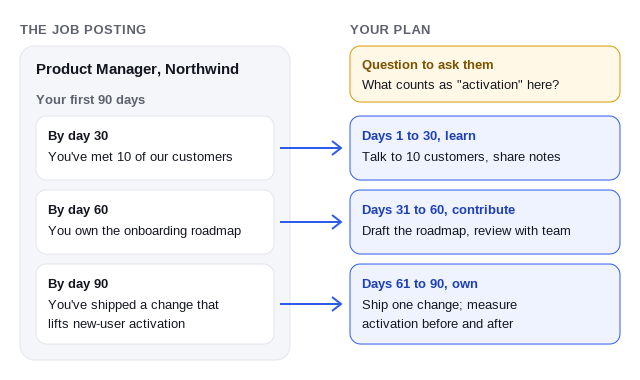
An illustration of a posting's "first 90 days" section turned into a plan. The company and the goals are made up. Ask what success looks like, in an earlier round
Segelin suggests asking how success is defined during the phone screen. Coursera suggests asking what the team's immediate priorities are. Darden's blog adds two more sources: people who work there now or did before, and what the company says in public. Each answer turns a guess into a goal.
Days 1 to 30: learn the people, the product and the process
This phase is about listening. Plan the team members, key stakeholders and cross-functional partners you'll meet, and the processes, tools and company culture you'll learn. Give each goal a number or a date. Asana's example is to build relationships with at least 10 colleagues. Our advice is to end the month with something written, such as a short summary of what you heard.
Days 31 to 60: contribute something real
Now you start doing the work. Pick one or two pieces you can deliver, and one process improvement. The Institute of Project Management's example plan finds at least one quick win per project in the first month, then closes at least two by day 60. Asana's example is to document at least three areas where a process could improve.
Days 61 to 90: own something you can measure
By now you should own an outcome, not just tasks. Wonsulting suggests three to five goals per phase, each with a measurable result. Indeed and Coursera both suggest SMART goals: specific, measurable, achievable, relevant and time-based. Coursera's example is "Increase the number of website page views by 10 percent by the end of the month." Coursera also suggests using this stage to set long-term goals.
Mark your guesses, cut it to two pages, and add your questions
Label anything you assumed, such as "I'm assuming the team uses Jira". Add a short section of questions you'd ask them, as Wonsulting suggests, and frame ideas as proposals, not demands. Indeed's advice is to keep goals realistic for the time and resources you'll have. Then cut. If a goal doesn't connect to the posting or something they told you, it can go.

A 30 60 90 day plan template you can copy.
Paste one into a doc and fill in the brackets. The first is for the interview. The second is for your first week in the job.
30 60 90 day plan for an interview
One page, or two at most. Print a few copies.
[Your name]
30 60 90 day plan for [Job title], [Company]
A draft, built from the job posting and our conversations so far

DAYS 1 TO 30, LEARN
Goal 1  [Who you'll meet or what you'll learn], by day [number]
How I'll know  [A number, a date or a written summary]
Goal 2  [Tool, process or customer you'll get to know]
How I'll know  [Measure]

DAYS 31 TO 60, CONTRIBUTE
Goal 1  [First piece of real work from the posting]
How I'll know  [Measure]
Goal 2  [One small improvement you'd propose]
How I'll know  [Measure]

DAYS 61 TO 90, OWN
Goal 1  [An outcome you'd own]
How I'll know  [Measure]
Goal 2  [Something you'd set up for the next quarter]
How I'll know  [Measure]

WHAT I ASSUMED
- [Guess 1, such as the tools the team uses]
- [Guess 2]

QUESTIONS FOR YOU
- What would make the first 90 days a success for you?
- [A question about a priority in the posting]
- [A question about the team]
30 60 90 day plan for a new job
Bring it to your first one-on-one, then update it with your manager.
30 60 90 day plan, [Your name], [Job title]
Start date [date]   Check-ins with [Manager's name] on [day 30 date], [day 60 date], [day 90 date]

PEOPLE TO MEET IN MONTH ONE
- [Name or team], [why]
- [Name or team], [why]

DAYS 1 TO 30, LEARN
- [Goal], [measure], [date]
- [Goal], [measure], [date]

DAYS 31 TO 60, CONTRIBUTE
- [Goal], [measure], [date]
- [Goal], [measure], [date]

DAYS 61 TO 90, OWN
- [Goal], [measure], [date]
- [Goal], [measure], [date]

WHAT CHANGED AFTER OUR FIRST TALK
- [Goal you dropped or added, and why]
Offering it in the interview
Say it when they ask about your first months, or near the end if they don't.
I put together a short draft of what my first 90 days could look like, based on the posting and what you've told me. Would it help if I walked you through it? Some of it is guesswork, so I'd like to hear what I got wrong.
How to present a 30 60 90 day plan in an interview.
If they asked for it. Bring a few printed copies, as Wonsulting suggests. Our advice for a video call is a file you can share on screen. Start with one line on what you built it from: the posting and what they've told you.
If they didn't. Wonsulting says to bring it up when they ask about your first 30, 60 or 90 days, your priorities, or getting up to speed, or when they ask for your questions. Our advice is to offer it once. If they don't take it up, send it with your thank-you instead. Our follow-up email after an interview guide has a template for that.
Keep it short. Wonsulting suggests talking through only the most important one or two points per phase and letting the page carry the rest. Our advice: a few minutes in all, unless they set the time.
Make it a conversation. After each phase, ask whether it matches what they expect. Indeed suggests a similar follow-up question at the end. In our view, what they correct is the most useful thing you'll hear. For what the hiring manager is weighing in that round, see what a hiring manager does.
30 60 90 day plan examples, by role.
These are short summaries of examples other sites publish, so you can see the shape. Yours should come from your own posting.
Sales. Rippling's sales example builds a list of 60 leads in the first 30 days. By day 60 it qualifies at least 20 leads and completes a first sale, with a goal of 20% of the quarterly target. By day 90 it reaches 50% of the quarterly goal.
Project manager. The Institute of Project Management's example starts with a stakeholder map and a written health summary of the programme for the sponsor. Days 31 to 60 bring a one-page dashboard and agreed meeting rhythms with clients. Days 61 to 90 end with a written 90-day review for the sponsor.
New people manager. Asana's manager version is observe and learn, then identify opportunities, then take strategic action. That means one-on-ones first, quick wins next, and a team vision and goals by day 90.
Individual contributor. Indeed's example goal is to "complete training on the reporting system and assist with at least one report by day 60." Small, dated and easy to check.
Once you're hired, turn your 30 60 90 day plan into the real one.
The interview plan did its job. Now it needs your manager's view. Indeed suggests sharing your plan with your manager early, because it can clear up expectations. Rippling says managers often draft a plan for a new hire. If yours did, put the two side by side.
In week one, our advice is to bring your plan to your first one-on-one and ask what they'd change. Drop the goals that don't matter to them. Add the ones you couldn't have known.
At day 30 and day 60, check it together. Indeed recommends regular check-ins and tracking your progress, tasks and feedback. A short note of what you did against each goal makes those talks easy.
By day 90, the plan should show what you own and what's next. That note is also useful later, when you update your resume.
Common mistakes in a 30 60 90 day plan, and what to do instead.
Do
- Build each goal from a line in the posting or something they told you.
- Give every goal a number, a date or something written you can show.
- Mark your guesses, and invite corrections.
- Keep it to one or two pages.
- Spend the first 30 days mostly listening and learning.
Don't
- Don't reuse the same plan for every company.
- Don't promise big changes in month one. You don't know enough yet.
- Don't read the whole page out loud in the interview.
- Don't include anything confidential from a past employer.
- Don't treat it as fixed once you start.
Questions about the 30 60 90 day plan, answered.
Should I bring a 30-60-90 day plan to an interview?
If they asked for one, yes, with printed copies. If they didn't, you still can. Segelin, writing in Fortune, suggests offering it anyway, and Wonsulting says to work it into the conversation. Our advice is to offer it once and not push it.
What is a 30-60-90 plan for an interview?
It's a one- or two-page draft of what you'd learn, do and own in your first three months in the job you're interviewing for. Indeed says employers ask "to gauge how you might transition to a new position." It shows you read the job closely.
How to prepare a 90 day plan?
Read the posting and list what the role must deliver. Ask what success looks like in an earlier round. Then set goals for each 30-day phase, each with a measure, and mark your guesses. The six steps above walk through it.
How to structure a 30-60-90 day plan?
Three phases: days 1 to 30 to learn, 31 to 60 to contribute, 61 to 90 to own an outcome. Indeed builds the plan from goals, tactics and metrics. Wonsulting suggests three to five goals per phase. The template above follows that shape.
What is a good example of a 30-60-90 day plan?
One where every goal is specific and dated. Indeed's example is finishing training on the reporting system and helping with at least one report by day 60. The examples by role above show sales, project manager, people manager and individual contributor plans.
Where can I find a template for a 30-60-90 day plan?
There are two on this page you can copy, one for the interview and one for a new job. Reclaim.ai offers a free download in Google Docs, Word or PDF, with priorities, learning, performance and relationship goals for each month.
What is a 30-60-90 day management plan for project managers?
The same three phases, aimed at projects and stakeholders. The Institute of Project Management's example starts with a stakeholder map and a written health summary of the programme. It moves to a dashboard and quick wins, then ends with a 90-day review for the sponsor.
Why is a 90 day plan important?
In an interview, it shows how you'd move into the role, which Indeed says is why employers ask. In a new job, Indeed says many professionals find it gives them confidence and clarity, and it opens clear conversations with your manager. Our reading: either way, it saves you three months of guessing.
What are some good 90-day goals for a new job?
Goals you can check. Asana's examples include building relationships with at least 10 colleagues and documenting at least three areas where a process could improve. Indeed's example is helping with at least one report by day 60. Base yours on what your manager says matters.
What is the biggest red flag to hear when being interviewed?
Our advice: if no one can tell you what success looks like in the first 90 days, ask again before you accept. The red flags candidates mention most are in our follow-up email after an interview guide.
Where the facts come from.
Checked in November 2026. Where something is advice rather than a finding, the page says so, and the advice is ours. Blynk's count comes from 1,535 job postings first seen in its searches between October 31 and November 12, 2026, almost all for senior product roles (1,486 have "product" in the title). We counted postings that describe what to achieve in a first period (the first 30 or 90 days, three or six months, or the first year) and read every match by eye, leaving out 7 that only mentioned benefits such as first-year paid time off. A few postings appear twice, and some may say it in words we didn't search for, so 33 is a floor.
- Indeed: how to create a 30-60-90-day plan for a new job (July 2026)
- Indeed: what are your 30, 60 and 90 day goals, the interview question (June 2026)
- Asana: 30 60 90 day plan, new-hire guide and examples (October 2026)
- Wonsulting: how to prepare and present your plan in a final interview (November 2025)
- Fortune: Amy Segelin of Chaloner on the 30/60/90 question (March 2017)
- Darden Career Corner, University of Virginia: land the job with a 90-day plan (2016)
- Coursera: how to write a 30-60-90 day plan (November 2026)
- Institute of Project Management: 30-60-90 day plan, the PM guide (July 2026)
- Rippling: 30-60-90 day plan template and examples (July 2026)
- Reclaim.ai: 30-60-90 day plan and free template (September 2025)
- Blynk Find Jobs
