
Job scams. How to check the message in front of you.
If a recruiter just offered you a remote job by text, with an interview on Telegram and a check for equipment, you're right to pause. Here's how to check it in five minutes, what real employers say in their own postings, and what to do if you've already replied.

The short answer
- Three signs settle most job scams. They want money, a check deposit or your bank details before you start. The whole hiring process happens by text or chat. And you can't find the job on the company's own careers site.
- Real employers say so in their own postings. Many warn that they never ask candidates to pay, and some name the only email domain their recruiters write from.
- If it looks wrong, stop replying. Find the job on the company's site yourself, and report the message at ReportFraud.ftc.gov.
On this page
How real employers warn you about job scams, in their own job postings.
Many real job postings carry a scam warning. Of 1,405 job postings with text from Blynk's searches (mostly product roles, first seen October 31 to November 11, 2026), 36 postings from 31 employers warned candidates about recruitment scams in the posting itself. 18 of those employers named the email domain real messages come from. 26 said they never ask candidates for payment, or for bank or similar details, during hiring.
What they say, in their own words. “Real Duolingo employees always use an email that ends in @duolingo.com or @recruiting.duolingo.com,” Duolingo says. “We will never ask for payment, gift cards, cryptocurrency, or banking information during the recruiting process,” says Twilio. “Clever does not conduct interviews via text or Telegram,” says Clever. And CookUnity holds its interviews on Google Meet or Zoom, “never WhatsApp, Telegram, or SMS,” its postings say.
How to use this today. Open the real posting on the company's own careers site and search the page for words like scam, fraud or recruit. If it names a domain, a message from any other address fails the check, by the company's own account. The FBI tells employers to warn applicants on their careers page if they've been impersonated, so look there too. A missing warning proves nothing, though, since most postings in the sample had none.
Is it a job scam? Check the message in five minutes, before you reply.
Do these in order, and don't reply while you check. Every step uses details you find yourself, never the links, names or numbers the message gives you.
Find the job on the company's own careers site
Type the company's web address yourself, or search for its name, and skip any link in the message. Then look for the job on its careers page. The FBI says scammers copy real postings and change the contact details, so a real job somewhere else isn't enough. It has to be listed by the company itself.
Not there? Treat the message as a scam until the company tells you otherwise, through a contact you found yourself.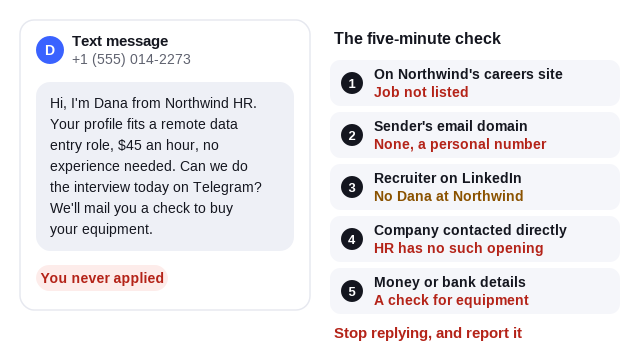
An illustration of one message run through the check. The company, the person and the number are made up. Check the sender's email domain against the company's site
Recruiters usually write from a company account, the FTC says, not Gmail or Yahoo. Compare the part after the @ with the company's own web address, letter by letter. LinkedIn's help pages list mismatched domains as a sign of a job scam. If the real posting names a domain, as 18 employers in Blynk's sample do, only that domain counts.
A text or chat app has no domain to check. Task scams usually start with an unexpected text or WhatsApp message, the FTC says, so a job offer that arrives that way is already a warning sign.Look the recruiter up, then search their name with “scam”
Find the person on the company's website or on LinkedIn, and check that their profile shows them working there. Then search their name and the company's with words like scam, review or complaint, as the FTC suggests. No complaints isn't a guarantee, the FTC adds. The FBI says scammers use real employees' names, so this step backs up the others but can't replace them.
Contact the company yourself, using details you found
Still not sure? Reach the company through a website or phone number you know is real, the FTC advises, and ask whether the job and the person are real. Don't use any number, link or address from the message, since those lead back to the sender.
Never pay, deposit a check or share bank details to get hired
Honest employers never ask you to pay to get a job, the FTC says. Walk away from any offer to deposit a check and use some of the money. Real employers don't ask for financial details for direct deposit until they've interviewed and hired you, the FTC adds.
One employer puts it plainly. Charlie Health says in its postings that it won't ask for bank details “until you have signed an offer of employment and completed onboarding paperwork.”

Job scam numbers from the FBI and FTC, and why the figures disagree.
The FBI, for 2025. In its 2025 Internet Crime Report, the FBI's Internet Crime Complaint Center (IC3) logged 24,688 employment complaints, with $362.9 million in reported losses. That's up from 20,044 complaints and $264.2 million in 2024. The FBI counts a complaint here when someone believes they're really employed and loses money, or launders money or items for the job.
The FTC, for 2024. Reports of job and employment agency scams to the Federal Trade Commission (FTC) tripled from 2020 to 2024, it says. Reported losses rose from $90 million to $501 million. As of November 12, 2026, we found no all-ages 2025 figure for this group in the FTC's news releases.
Why the numbers you'll see disagree. The FBI and the FTC each count the reports sent to them, under their own definitions. Many pages also quote the FTC's wider group, business and job opportunities, which reached $750.6 million in 2024. For 2023, the FTC's Consumer Sentinel Network Data Book counts 107,134 reports and $491 million lost in that wider group, not job scams alone. And all of these are reports people chose to file, so in our reading the real totals are higher.
Where the money goes now. In the FBI's 2025 report, 10,338 employment complaints involved cryptocurrency, with $288.2 million lost. The FTC found that task scams grew from about 5,000 reports in 2023 to about 20,000 in just the first half of 2024. In the FBI's data, losses were highest for people aged 50 to 59, at $100.9 million.
What people get wrong about job scams, and what's really true.
Five things people believe about job scams, and what the FBI, the FTC and real employers say instead.
“The message was polished, so it's real.”
Good writing is easy to fake now. The FBI's 2025 report counted almost $13 million lost to employment scams that involved AI. LinkedIn still lists spelling mistakes as one sign, but a clean message proves nothing on its own.
What helps: Check the money, the channel and the domain. None of the three depends on how well the message is written.
“The money is in my account, so the check cleared.”
Not yet. The FTC says seeing the funds in your account doesn't mean the check is good. It can take weeks for a bank to find out a check is fake. By then the money you sent on is gone, and you owe the bank.
What helps: Never send on money from a new employer's check. Connecticut's attorney general says real recruiters don't charge for jobs, training or equipment.
“I had a video interview, so it's real.”
A video call doesn't show that the person works for the company they name. In our reading, no interview, on video or anywhere else, replaces the other checks.
What helps: Find the job on the company's site anyway. And make sure their email address is on the company's own domain.
“Only older or naive people fall for this.”
The FBI's 2025 data shows employment complaints from every age group. People aged 30 to 39 filed the most, 5,025, while losses were highest for people aged 50 to 59. Connecticut's attorney general warns that scammers look for people who've posted about a layoff or being open to work.
What helps: Assume you could be a target. Most of all right after you post that you're looking.
“Real recruiters never message you on LinkedIn.”
Some do. One posting in Blynk's sample says its recruiters write from the company's email or from LinkedIn accounts marked as verified recruiters. The FTC's warning is narrower. Be wary of unexpected job texts or WhatsApp messages, especially from a personal number.
What helps: Judge what they ask for, not where they wrote. A real recruiter can wait while you check, and won't ask you to pay.
Recruiter scams, and how fake recruiters work.
They borrow a real company's name. The FTC says scammers pose as recruiters for well-known employers, by email or text, often from a personal number or email address. Connecticut's attorney general says they work on Indeed, LinkedIn and social media. They target people who've posted about a job search, a layoff or being open to work.
They move you off the platform fast. LinkedIn lists urgent pushes to WhatsApp, Telegram or outside forms as signs of a job scam, along with recruiters who write from Gmail or Yahoo. Several employers in Blynk's sample say they never interview by text or chat app.
The offer comes before the interview. You may get a job offer and paperwork before anyone interviews you, the FTC says. The paperwork may ask for financial details “for direct deposit,” which real employers don't ask for until they've interviewed and hired you.
Some ask you to buy equipment. LinkedIn lists being asked to buy equipment and mail it to “IT” as a sign of a job scam. Our advice is also to never install software, or open a coding test, sent by a recruiter you haven't checked with the steps above. If the recruiter does check out, here's how to write back to a real recruiter.
Remote job scams, and how to spot a fake remote job.
Task scams. They usually start with an unexpected text or WhatsApp message, the FTC says. You're paid small amounts for simple online tasks, like rating products, then asked to deposit your own money to unlock more work. The FTC found task scams made up 38.8% of job scam reports in the first half of 2024, up from 5.6% in 2023. “Never pay anyone to get paid,” the FTC advises.
Equipment checks and reshipping. A new “employer” sends a check for your equipment and asks you to send part of it on, or asks you to receive packages and ship them somewhere else. The FTC warns about both. California's attorney general lists being asked to receive or send money or packages as a sign of a scam.
How to spot a fake remote job. In our reading of the sources above, three things give most of them away. The pay is high for little work or experience, a sign North Carolina's attorney general lists. The job came to you, which California's attorney general says is most likely a scam if you never applied, and it isn't on the company's own careers site. For finding real remote work, see our guide to finding remote jobs.
Job scam or ghost job? How to tell them apart.
A scam asks you for something, while a ghost job just never answers. In our reading, a scam soon wants money, a deposit, your bank details or your ID. A ghost job asks for nothing beyond the usual application, and the Congressional Research Service notes it usually comes from a real employer. If a posting goes quiet, it may be a ghost job, and our guide to spotting ghost jobs has a quick check. If anyone asks for money or bank details, treat it as a scam.
If a job scam got you, what to do today.
Start with the money, then your identity, then the reports. These are the FTC's and the FBI's own steps, in short.
Stop replying, and keep the evidence
Our advice is to stop replying, without arguing or telling them you know. Save the messages, the names, numbers and addresses they used, and any receipts. The FBI asks for transaction details when you report.
Call your bank or card company right away
For a credit card, call the company that issued it. For a debit card or a bank transfer such as Zelle, call your bank and ask to reverse it. For a gift card, call the company that issued it, using the number on the card, and keep the card and receipt. For crypto, contact the exchange or ATM operator, the FTC says.
Protect your identity if you shared your Social Security number
Go to IdentityTheft.gov to report it and get a recovery plan, the FTC says. If you're not sure what was exposed, start at IdentityTheft.gov/databreach. If they had remote access to your computer, scan it, change your passwords and turn on two-factor login.
Report it to the FTC, the FBI and the site where it started
Report it at ReportFraud.ftc.gov and at ic3.gov, and to your state attorney general if you like, as the FTC suggests. Forward scam texts to 7726 (SPAM). LinkedIn says to report a fake profile or job through the three-dot menu, and other job sites have their own report buttons.
Ignore anyone who offers to get your money back
The FBI warns people not to pay services that promise to recover lost cryptocurrency. Go through your bank and the official reports above instead.
Questions about job scams, answered.
How do I know if I am chatting with a scammer?
Watch for requests for money, a check deposit or bank details before you start. They keep everything in text or a chat app like Telegram or WhatsApp. And the job isn't on the company's own careers site. LinkedIn adds urgent pushes off the platform and recruiters writing from Gmail or Yahoo. If any of these show up, stop replying and run the five-minute check above.
How to verify if a person is real?
Check them without asking them. Find the person on the company's website or on LinkedIn, and find the job on the company's careers site. Search their name with words like scam or complaint, as the FTC suggests. Then contact the company through a website or number you found yourself, and ask. Details in the message itself can lead straight back to the sender.
What should you never say to a scammer?
Never give your Social Security number, bank or card details, passwords or a photo of your ID. LinkedIn and California's attorney general list these among what job scammers ask for. Never agree to pay, buy gift cards or deposit a check, the FTC warns. Our advice is to say nothing at all. Stop replying, keep the messages, and report them at ReportFraud.ftc.gov.
Which site is legit for job search?
The safest place to apply is the company's own careers site, because that's where the employer lists the job itself. Federal jobs are on USAJobs.gov and Postal Service jobs on usps.com/employment, and both are free to apply for, the FTC says. Big job boards are real, but North Carolina's attorney general warns that scammers post fake jobs on well-known sites too. So find a job anywhere, then apply where the company lists it. Blynk can apply on the employer's own site for you, and you approve every application before it's sent.
What jobs pay $3,000 a day?
Treat the question itself as a warning. An offer of big money, fast, for little work is “almost certainly a scam,” the FTC says. Its 2024 alert was about texts promising up to $600 a day for remote work, which then asked for Social Security numbers. If a job message promises $3,000 a day, stop there.
What is ghost tapping?
It's a different scam, not a job scam. BBB warnings, reported by local news such as FOX 7 Austin, describe someone sneaking a charge onto your contactless card or phone, or rushing you through a tap-to-pay payment. If you meant ghost jobs, postings no one plans to fill soon, see our ghost jobs guide.
Do real recruiters ask you to pay?
No. Honest employers, including the federal government, never ask you to pay to get a job, the FTC says. Connecticut's attorney general says recruiters don't charge for jobs, training or equipment. “Any request for payment should be considered a red flag,” the office warns. North Carolina's attorney general lists fees for training, equipment or background checks as signs of a scam.
Why would a company send me a check before I start?
A scammer sends it to get money from you. In a fake check scam, you deposit the check, send part of it on, and the check bounces later. The FTC says seeing the funds in your account doesn't mean the check is good, and a bank can take weeks to find a fake. Its advice is to walk away from any offer to deposit a check and use some of the money.
How do I know a recruiter is real?
Check that their email is on the company's own domain, and that their LinkedIn profile shows them working there. Search their name with words like scam or review, as the FTC suggests. Several employers' postings name the only domains their recruiters use. And a real recruiter never asks you to pay. Our guide to reaching out to a recruiter covers what to write once you know they're real.
Is it safe to give my Social Security number on a job application?
Not early on. The FTC says real employers don't ask for financial details until they've interviewed and hired you. Connecticut's attorney general says employers don't ask for sensitive details before hiring. And if a text about a job asks for your Social Security number, the FTC's advice is simple. Don't share it.
Where the facts come from.
Checked on November 12, 2026. The advice and our reading of each source are ours. Figures come from the FBI and the FTC, each for the year named. Employers' quotes come from their own live job postings. Blynk's count is its own, a keyword search of the 1,405 job postings with text from Blynk's searches (mostly product roles, first seen October 31 to November 11, 2026), with every match read by hand. It finds warnings in the posting itself, so warnings worded another way, or only on a careers page, are missed.
- Ghost jobs, and how to spot them
- How to reach out to a recruiter
- How to find remote jobs
- LinkedIn Easy Apply vs the company site
- How to find the hiring manager
- FTC, Job scams
- FTC consumer alert, Job scammers are looking to hire you (July 2025)
- FTC Data Spotlight, Paying to get paid, gamified job scams drive record losses (December 2024)
- FTC, new data on reported fraud losses in 2024 (March 2025)
- FTC, Consumer Sentinel Network Data Book 2023 (February 2024)
- FTC consumer alert on texts offering up to $600 a day (August 2024)
- FTC, What to do if you were scammed
- FTC, How to spot, avoid and report fake check scams
- FBI Internet Crime Complaint Center, 2025 Internet Crime Report
- FBI IC3 public service announcement on fake work-from-home task jobs (June 2024)
- FBI IC3 public service announcement on fake job postings (February 2022)
- Connecticut Attorney General, warning on job recruiter scams (May 2026)
- North Carolina Attorney General, job scam warning (May 2026)
- California Attorney General, alert on job recruitment scams (April 2025)
- LinkedIn Help, Recognize and report scams
- LinkedIn, Job Search Safety Pulse (May 2026)
- Congressional Research Service, “Ghost” job postings (April 2025)
- FOX 7 Austin, BBB warns of ghost tapping
- Duolingo careers (scam warning in its postings)
- Twilio jobs (scam warning in its postings)
- Clever careers (scam warning in its postings)
- CookUnity careers (scam warning in its postings)
- Charlie Health careers (scam warning in its postings)
- Blynk Find the Hiring Manager
- Blynk Auto-Apply
