
How to cold email for a job. One person, one role, five sentences.
If you've applied through portal after portal and heard nothing, writing to a real person is the obvious next step, and it can feel awkward. Here's who to write to, how to find their address, what to say, and five emails to copy.

The short answer
- Write to one person: the manager of the team you'd join, or the recruiter for that role. Not a careers inbox, and never ten people at once.
- Keep it to about five sentences: a subject line that names the role, why you're writing to them, one true result that fits, and one small ask.
- Check the address before you send, then follow up twice, about a week apart. After that, stop.
On this page
Does cold emailing for jobs work? What's known, and when not to send one.
Nobody has published a measured reply rate for job seekers' cold emails. The figures you'll see on other pages come from sales emails or the sites' own products. Here's what is known.
“I apply and never hear back.”
You're not imagining it. In a US experiment that sent more than 83,000 test applications to entry-level jobs at 108 Fortune 500 companies, 24% heard from the employer within 30 days.
What to do: Reach a person as well. A short email to the person who'd manage you gives your job application a second way in.
“Is it a good idea, or just annoying?”
In our reading, what annoys people is a long email, a vague ask, or the same message sent to the whole team. A short note about a role they're hiring for is part of a hiring manager's work.
What to do: Make it worth their minute. One role, one true result, one small ask.
“Is it even allowed?”
In Blynk's sample, postings almost never say no. None of 1,204 job postings from Blynk's searches, mostly senior product roles, asked candidates not to contact the hiring team. The "no unsolicited resumes" notices we found were addressed to recruitment agencies.
What to do: Respect the rare no. If a posting asks for no calls or emails, apply through the portal only. What US law says is in the questions below.
“I don't know who to write to, or what to say.”
Most postings don't name anyone, and a blank email to a stranger is hard to start. Both have a method.
What to do: Follow the steps below. Who to pick, how to find them, then the five parts of the email.
Who to send a cold email to, and how to find their address.
Most of the work is here. A good email to the wrong person, or to an address that doesn't exist, goes nowhere.
Pick one person: the manager of the team you'd join
The hiring manager usually makes the decision, so write to them first. That's usually the person who leads the team the job sits in, often one level above the role. The recruiter for the role is a good second, and at large companies often the easier one to reach. Skip the CEO, the careers inbox and HR's general address. If no role is posted, pick the person who leads the team whose work you could help with.
Senior Product Manager, Growth? Write to the Director or Head of Product for Growth, not the Chief Product Officer. Our guide to finding the hiring manager has seven ways to work out who that is.Read the job posting for clues, because it rarely names anyone
Of 1,204 job postings from Blynk's searches, mostly senior product roles, just 1 labelled the hiring manager or recruiter by name. About 1 in 5 said who the role reports to, by title. That title is often enough: search LinkedIn for it at the company, in the same team.
"Reports to the Head of Growth Marketing" tells you exactly who to look for.Find their work email, then check it
Many companies use one pattern for every work email address, such as first.last@company.com. Find an address with a person's name that the company has published, on its website or in a press release, and follow the same pattern. Then run it through an email checker before you send. Some company servers accept mail for any address (a "catch-all"), so a checker can't confirm the person exists; treat that as unchecked, and use LinkedIn rather than guess. Or paste the job link below, and Blynk finds the address and checks it for you.
Published: jordan.lee@northwind.com. So try: dana.ruiz@northwind.com. Can't check it? Send a LinkedIn connection request with a short note instead. Notes are up to 200 characters, and free accounts can add one to up to three requests a month.
How to write a cold email for a job, in five parts.
The guides that rank for this search suggest anywhere from 80 to 200 words, and none cites a study. Our advice: about five sentences, short enough to read on a phone without scrolling.
Write a subject line that names the role
Our advice: a plain subject line, not a clever one. Put the job title in it, and the team if you know it, so they know what it's about before they open it. If no role is posted, name their team and your reason for writing.
Try "Senior Product Manager, Growth: Sam Okafor" or "Question about Northwind's onboarding". Not "Quick question" or "Exciting opportunity".Open with why them, not your life story
Your first line says why you're writing to this person: the role on their team, or something real they've done. A few minutes of research helps: their team page, a recent launch or a post. If you have a mutual connection, mention them here. Skip "I hope this finds you well" and the paragraph about yourself.
Give one true result that fits
Pick the one thing the posting or the team needs most, and the one result from your experience that matches it. A number helps, if it's true. One result they remember beats a list they skim.
Instead of "I'm a results-driven product leader" try "At Brightline, I grew trial-to-paid conversion from 9% to 14%."Ask for one small thing
A short call (some call it an informational interview), a pointer to the right person, or a yes or no to sending more. One ask, easy to say yes to. A line that makes no easy too, such as "If now's not the time, no problem", takes the pressure off. "Do you have any openings?" is the hard ask: it hands them the work.
Sign off with links, then read it on your phone
End with your name, a link to your LinkedIn profile and, if you have one, a portfolio link. Then read it on your phone and proofread it: in five sentences, mistakes stand out. If it needs scrolling, cut it. Here's a finished one, with its parts labelled.
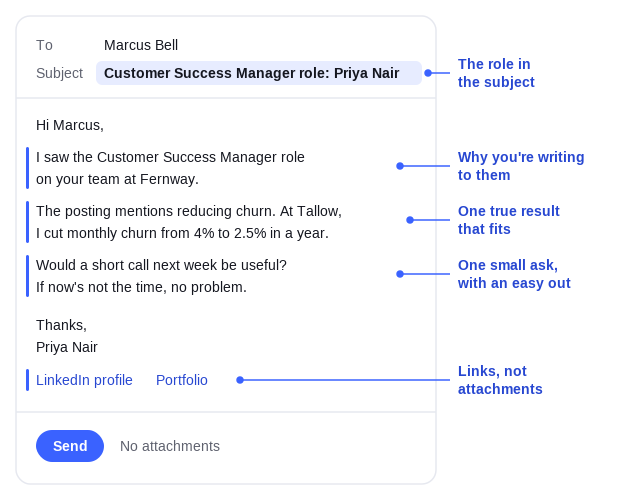
An illustration of a finished cold email. The names are made up.

When to send it, and how to follow up.
Link, don't attach, in the first email. The guides disagree: GMass and Snov.io say attach your resume, LoopCV says offer it instead, and no survey settles it. Our advice: a stranger may be wary of opening a file from someone they don't know, and a link lets them look in one tap. Send the PDF when they reply.
Send it on a weekday morning, their time. If they're in another time zone, Gmail and Outlook both let you schedule an email to go out later. We found no study that settles the best day, so don't wait for a perfect one.
Follow up twice, about a week apart, then stop. The ranking guides suggest anything from one follow-up to three, and one email-software guide says keep going until they reply. Our advice: two, in the same thread, each adding something. The second one closes the loop politely. For notes after you've applied through the portal, see our follow-up email guide.
One person at a time, never a mail merge. Some email-software guides suggest sending the same email to a list, with automatic follow-ups. Google's rules for anyone sending to Gmail ask senders to keep spam reports below 0.3%, and recommend below 0.1%. Our reading: the same email sent to dozens of strangers is how a personal address ends up in spam folders.
Cold email templates for a job, ready to copy.
Swap the [square brackets] for your details, keep your result true, and keep each one about this short. Writing to a recruiter on LinkedIn instead? Our guide on how to reach out to a recruiter has those messages.
To the hiring manager, about a role that's posted
Before or just after you apply. Subject line: [Job title] role on your team: [Your name]
Hi [First name],

I saw the [Job title] role on your team and wanted to write to you directly. The posting mentions [the one thing the role needs most]. At [Company], I [one true result that matches it, with a number if you have one].

Would a short call next week be useful? If now's not the right time, no problem.

Thanks,
[Your name]
[Link to your LinkedIn profile]
About a job opportunity that isn't posted
To the person who leads the team you could help. Subject line: [Their team]'s [project or goal]: [Your name]
Hi [First name],

I read [their post, talk or launch] about [project or goal], and it's close to the work I do. At [Company], I [one true result on the same kind of problem].

If your team expects to hire for [kind of role] this year, I'd love to be considered. Would a short call be useful, or is there someone else I should talk to?

Thanks,
[Your name]
[Link to your LinkedIn profile or portfolio]
To the recruiter for the role
After you've applied, when the recruiter is the person you can reach. Subject line: [Job title], [job ID if there is one]: [Your name]
Hi [First name],

I've applied for the [Job title] role ([job ID]) and wanted to introduce myself. I [one true result that matches the posting], and I'm [one line on location, work authorization or start date, if it matters].

Is there anything else I can send that would help?

Thanks,
[Your name]
[Link to your LinkedIn profile]
The first follow-up, about a week later
Reply in the same thread, so they see your first email. Add something new.
Hi [First name],

Following up on my note about the [Job title] role. Since I wrote, I [one new, true thing: a project, a result, or an idea for their team].

Would a short call be useful?

Thanks,
[Your name]
The last follow-up, a week after that
Same thread. Short, friendly, and the last one you send.
Hi [First name],

I know you're busy, so this is my last note about the [Job title] role. If the timing's wrong, no problem at all, and I'd be glad to stay in touch.

Thanks for reading,
[Your name]
A cold email that gets ignored, and the same one, fixed.
Sam is writing to Dana Ruiz, who leads Growth at Northwind, about the Senior Product Manager role on her team. Here's his first draft.
Subject: Quick question
Hi,
I hope this email finds you well. I'm Sam Okafor, a passionate product manager, and I saw Northwind is hiring a Senior Product Manager for Growth. At Brightline I grew trial-to-paid conversion from 9% to 14%. I've attached my resume, and I'd love to be considered for any openings.
Thanks, Sam
"Quick question." The subject says nothing about the role, so it's easy to skip.
"Hi," with no name. It reads like a mass email, even though it isn't.
The role comes after the pleasantries. Dana has to read two sentences to learn why Sam is writing to her.
"Any openings." A vague ask hands Dana the work. And some people won't open an attachment from a stranger.
Here's the same email, fixed. The facts about Sam haven't changed; the order, the ask and the link have.
Subject: Senior Product Manager, Growth: Sam Okafor
Hi Dana,
I saw the Senior Product Manager role on your Growth team. At Brightline I grew trial-to-paid conversion from 9% to 14%. Would a short call be useful? If now's not the time, no problem.
Thanks, Sam Okafor
[Link to Sam's LinkedIn profile]
Cold email do's and don'ts.
Do
- Write to one named person who'd manage the role.
- Name the role, or the team's goal, in the subject line.
- Check the address before you send.
- Give one true result that fits what they need.
- Ask for one small thing.
- Follow up twice, about a week apart, then stop.
Don't
- Send the same email to a list, or use a mail merge.
- Send to a guessed address you couldn't check.
- Attach files to a first email to a stranger.
- Open with your life story or a list of your skills.
- Write to the CEO, or to everyone on the team.
- Get in touch at all if the posting asks you not to.
Questions about cold emailing for a job.
Is it a good idea to cold email for a job?
Yes, when it's one specific person, about one real role or problem, in a few sentences with one true result. Nobody has published a measured reply rate for job seekers' cold emails, so be wary of any number you see. What has been measured is how often portal applications go unheard: in one large US experiment, about 1 in 4 test applications heard from the employer within 30 days. A short email gives yours a second way in. Skip it only if the posting asks for no contact.
Is cold emailing illegal?
Not for a one-to-one note about a job, in our reading; this isn't legal advice. In the US, the email law (CAN-SPAM) covers messages whose primary purpose is "the commercial advertisement or promotion of a commercial product or service", according to the FTC's own guide. The FTC adds that it "doesn't apply just to bulk email", so the test is the purpose, not how many you send. A personal note asking about a job isn't advertising a product. Other countries have their own rules, so check them if you're writing abroad.
What to say in a cold email for a job?
Five things, in about five sentences: a subject line that names the role, a first line on why you're writing to them, one true result that fits what they need, one small ask such as a short call, and your name with a link to your LinkedIn profile. Keep the tone professional and friendly, and leave out your life story and attachments. The first template above is a good starting point.
What is the 30/30/50 rule for cold emails?
It's a sales rule of thumb, and it has no shared definition. Spotler, an email marketing company, describes it as 30% of success from targeting, 30% from the message and 50% from follow-up, and notes that the numbers add up to 110%. Close, a sales software company, uses the same numbers as targets for opens, replies and conversions, such as booking a demo. For a job seeker, the useful part is Spotler's point: who you pick and how you follow up matter as much as the words.
Should I email the recruiter or the hiring manager?
The hiring manager first, since they usually make the decision. The recruiter for the role is a good second, and at large companies often the easier one to reach. Write to one or both, never the whole team. For messages to recruiters, see our guide on how to reach out to a recruiter.
Should I attach my resume to a cold email?
Not in the first email, in our advice. Guides disagree and no survey settles it, but a stranger may be wary of opening a file from someone they don't know. Put a link to your LinkedIn profile or portfolio instead, and send your resume as a PDF when they reply.
How many times should I follow up on a cold email?
Twice, about a week apart, in the same thread, then stop. Make the first follow-up add something new, and let the second close the loop politely. If there's still no response, stop there. The guides that rank suggest anything from one to three. Our advice is two because a third starts to feel like pressure.
How long should a cold email for a job be?
About five sentences. The guides that rank suggest anywhere from 80 to 200 words, and none cites a study for it. Short enough to read on a phone without scrolling is a good test.
Can a tool write my cold email for me?
An AI writing tool can draft the words, but you still need to find the right person, check the address and keep every claim true. Blynk starts from the job link: it finds the people hiring for the role, checks their work email and writes a short email from your resume, with two polite follow-ups. You read every note before it goes, and nothing is sent until you say so.
Where the facts come from.
Checked in November 2026. The advice is ours. The law comes from the FTC's own guide, the sending rules from Google, and facts about LinkedIn, Gmail, Outlook and Blynk from each company's own pages. What other guides recommend comes from those guides. The posting counts are Blynk's own: 1,204 job postings from Blynk's searches, mostly senior product roles, from company career sites and job boards, first seen between October 31 and November 11, 2026, each read for named contacts, email addresses and requests not to be contacted.
- How to find the hiring manager
- Follow-up email after applying
- How to reach out to a recruiter
- Blynk vs Hunter
- Blynk vs Snov.io
- Blynk vs Apollo
- How to ask for a coffee chat
- How to write a letter of interest
- How to email your resume
- How to find someone's email address
- FTC: CAN-SPAM Act, a compliance guide for business
- Google: email sender guidelines
- Truelist: what a catch-all email domain is
- LinkedIn Help: personalize invitations to connect
- Kline, Rose and Walters: Systemic Discrimination Among Large US Employers (NBER)
- Spotler: what is the 30/30/50 rule for cold emails
- Close: sales benchmarks
- Gmail Help: schedule emails to send later
- Microsoft Support: delay or schedule sending email in Outlook
- Next Play: the guide to getting a job with cold emails
- LoopCV: cold email for a job
- Artisan Talent: cold emailing in your job search
- Hunter: cold emailing for a job
- GMass: how to write a cold email for a job
- Snov.io: cold email for a job
- Blynk Find the Hiring Manager
- Blynk pricing
